The 2017 Chevrolet Bolt EV was a watershed moment for affordable long-range electric vehicles. With an EPA-estimated 238 miles of range from its 60 kWh lithium-ion battery pack, it remains a compelling used EV in 2026. But that sticker range is only half the story — how you charge at home directly affects daily usability, battery longevity, and whether you actually see 238 miles on a full charge.
This guide walks through the exact charging setup that makes sense for a 2017 Bolt EV owner, covering Level 1 limitations, Level 2 home installation, DC fast-charging realities, connector compatibility, and what you'll actually spend per mile.
Understanding the 2017 Chevy Bolt's Battery and Real-World Range
Before sizing a charger, you need to know what you're filling. The 2017 Bolt EV uses a 60 kWh usable LG Chem NMC (nickel-manganese-cobalt) battery pack. The EPA rates it at 238 miles combined, with 119 MPGe. But real-world range depends heavily on conditions:
EPA Combined: 238 miles
Highway (70 mph, mild weather): ~210–220 miles
City / stop-and-go with regen: ~240–255 miles
Cold weather (below 32°F): ~165–190 miles (30–35% reduction)
Hot weather with A/C (above 95°F): ~215–225 miles
The Bolt's battery management system includes a buffer above and below the displayed 0–100% State of Charge (SoC), so you're never truly draining cells to zero. However, NMC chemistry degrades faster when habitually charged to 100% or left at extreme SoC levels for days. For daily driving, setting a charge limit to 80% (if your charger supports scheduling or the Bolt's "Hill Top Reserve" mode) extends battery life — though the 2017 Bolt's native charge-limiting options are more limited than newer GM EVs. Source: fueleconomy.gov.
Charging Levels Explained: How Fast Will Each Add Range?
EV charging comes in three tiers. Here's what each means for a 60 kWh Bolt battery:
| Level | Voltage / Amperage | Power (kW) | Miles of Range Per Hour | 0–100% Time (60 kWh) |
|---|---|---|---|---|
| Level 1 (120V) | 120V / 12A | ~1.4 kW | ~4 mi/hr | ~43 hours |
| Level 2 (240V) | 240V / 32A | 7.7 kW | ~25 mi/hr | ~8 hours |
| Level 2 (240V, max) | 240V / 48A | 11.5 kW (Bolt onboard max) | ~37 mi/hr | ~5.5 hours |
| DC Fast (CCS1) | 400V+ DC | Up to 55 kW peak | ~160 mi in 30 min | 10–80% in ~45 min |
Key distinction — kW vs kWh: kW (kilowatts) measures power — how fast energy flows into your car. kWh (kilowatt-hours) measures energy — how much your battery holds. Think of kW as the width of a hose and kWh as the size of the bucket. The 2017 Bolt's onboard AC charger accepts up to 7.7 kW on a standard 32A Level 2 circuit, but can accept up to 11.5 kW on a 48A circuit (available on Premier trim or with the optional DC fast-charge package that upgraded the onboard charger).
DC fast-charging curve reality: The 2017 Bolt peaks at roughly 55 kW on a CCS1 DC fast charger, but only between ~10–50% SoC. Above 60%, the charge rate tapers significantly — dropping below 25 kW past 80%. This means that 10–80% session takes approximately 45 minutes, but pushing from 80–100% adds another 30+ minutes. Plan road-trip stops around the 10–80% window.
Home Level 2 Installation: Electrical Requirements and Costs
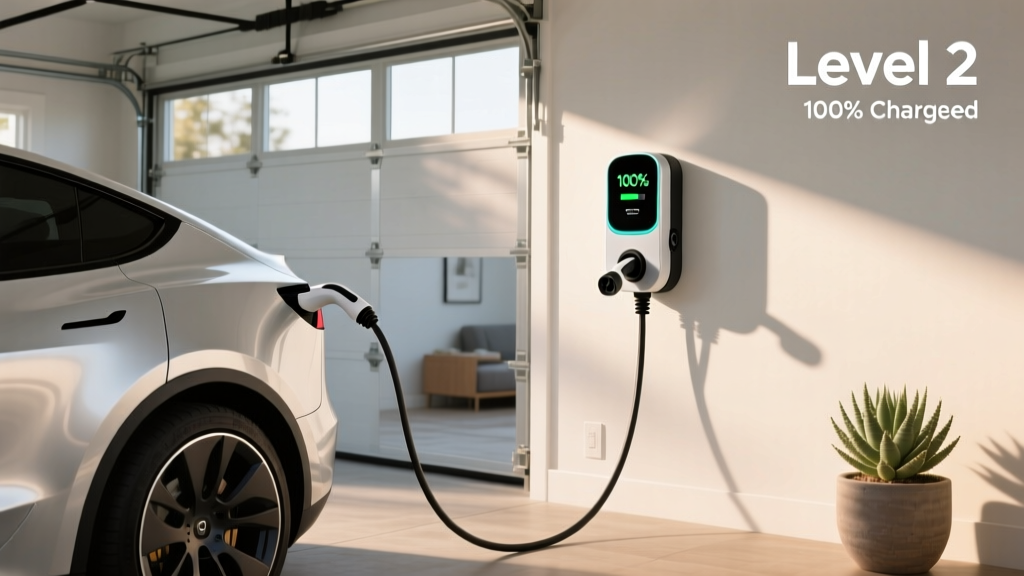
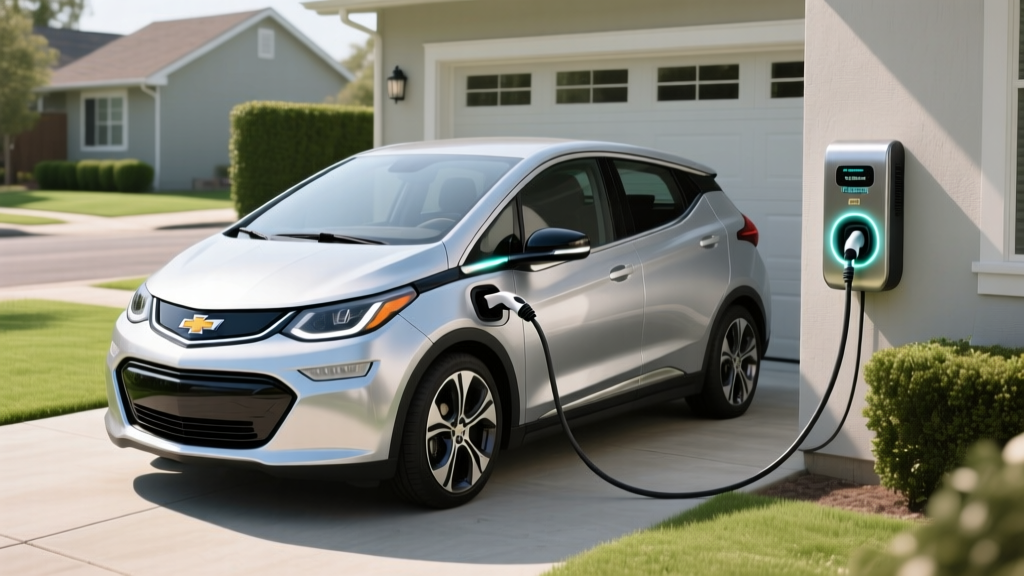
Level 1 charging (the included 120V cord) technically works, but at 4 miles of range per hour, fully replenishing a depleted 60 kWh Bolt battery takes over 40 hours. For any owner driving more than 30 miles daily, a Level 2 home station is essential.
Electrical Requirements for a 2017 Bolt Level 2 Charger
A 32A Level 2 charger — the sweet spot for the Bolt's 7.7 kW onboard charger — requires:
- Circuit: Dedicated 40A breaker (NEC code requires continuous loads to be 80% of breaker rating, so 32A draw needs a 40A circuit)
- Wiring: 8 AWG copper (or 6 AWG aluminum) in conduit
- Outlet: NEMA 14-50 (if using a plug-in charger) or hardwired junction box
- Panel capacity: Your main electrical panel must have at least 40A of spare capacity beyond existing loads
If you opt for a 48A charger to max out the Bolt's 11.5 kW onboard capability (Premier trim), you'll need a 60A breaker and 6 AWG copper wiring.
What Electrical Upgrades Might You Need?
Homes built before 2000 often have 100A or 150A main panels that may lack spare capacity for a dedicated 40A EV circuit. Signs you need a panel upgrade:
- Main panel is 100A and already near capacity (electric range, dryer, HVAC)
- No available double-pole breaker slots
- Panel is a recalled or obsolete brand (Federal Pacific, Zinsco, certain Challenger models)
- Service entrance wiring is undersized for modern loads
A panel upgrade from 100A to 200A typically costs $1,500–$3,500 including permits and utility coordination. This is the single biggest variable in home charger installation — and it's a cost many online guides gloss over.
How Much Does It Cost to Install a Home EV Charger?
| Component | Simple Install (panel nearby) | Complex Install (long run / panel upgrade) |
|---|---|---|
| Level 2 charger (32–48A) | $350–$700 | $350–$700 |
| Electrician labor (2–8 hrs @ $85–$150/hr) | $300–$600 | $800–$2,000 |
| Wiring, conduit, breaker, NEMA 14-50 | $100–$300 | $400–$900 |
| Electrical permit | $50–$200 | $50–$200 |
| Panel upgrade (if needed) | — | $1,500–$3,500 |
| Total | $800–$1,800 | $3,100–$7,300 |
Federal incentive note: The §30D Alternative Fuel Vehicle Refueling Property Credit covers 30% of home charger equipment and installation costs, up to $1,000. Eligibility depends on your census tract meeting certain income or rural criteria per current IRS rules. Check irs.gov for your eligibility before purchasing. This credit is separate from the vehicle purchase credit.
Connector Compatibility: CCS1, NACS, and the 2017 Bolt
The 2017 Chevy Bolt EV uses the CCS1 (Combined Charging System) connector for both Level 2 AC and DC fast charging. This is the J1772 AC inlet with two additional DC pins below it.
| Connector | Native Support? | Adapter Needed? | Notes |
|---|---|---|---|
| J1772 (Level 2 AC) | ✅ Yes (top portion of CCS1) | None | All public Level 2 stations |
| CCS1 (DC Fast) | ✅ Yes | None | Electrify America, EVgo, most networks |
| NACS / Tesla | ❌ No | CCS1-to-NACS adapter (~$200–$250) | Required for Tesla Supercharger access |
| CHAdeMO | ❌ No | Not practical (adapters $400+, rare) | Legacy Nissan Leaf standard; network shrinking |
Tesla Supercharger access: As of 2026, Tesla has opened its Supercharger network to non-Tesla CCS1 vehicles at many locations, but you need a CCS1-to-NACS adapter (available from Tesla, Lectron, or A2Z). Not every Supercharger stall supports non-Tesla vehicles — check the Tesla app for station compatibility before relying on it for a road trip. The 2017 Bolt's 55 kW DC fast-charge ceiling means you won't see the 250 kW speeds Tesla vehicles enjoy, but you will get reliable 10–80% charges in about 45 minutes.
Level 2 Charger Recommendations for the Bolt EV
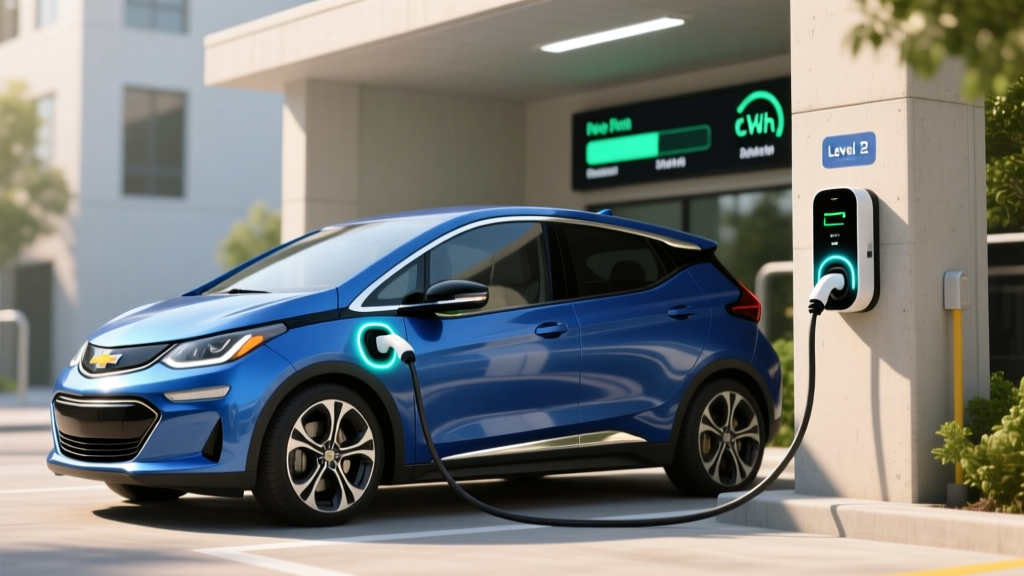
Since the 2017 Bolt's onboard charger maxes out at 7.7 kW (32A) on base trims and 11.5 kW (48A) on Premier/DCFC-equipped trims, here are chargers matched to each scenario:
Best for 7.7 kW Onboard Charger
ChargePoint Home Flex (NEMA 14-50)
- Power output: Up to 12 kW (50A), adjustable via dip switch
- Set to: 32A / 7.7 kW for base Bolt
- Connector: J1772 (CCS1 compatible)
- Cable length: 23 ft
- Smart features: Wi-Fi, app scheduling, Alexa, charge tracking
- Price: ~$550
- UL listed: Yes
Best for 11.5 kW Onboard Charger
Emporia Vue Level 2 Charger
- Power output: Up to 11.5 kW (48A)
- Connector: J1772 (CCS1 compatible)
- Cable length: 24 ft
- Smart features: Wi-Fi, app, energy monitoring, solar integration
- Price: ~$400
- UL listed: Yes
Best Budget Pick
Lectron V-BOX Pro (32A)
- Power output: 7.7 kW (32A)
- Connector: J1772 (CCS1 compatible)
- Cable length: 21 ft
- Smart features: Basic app, no Wi-Fi scheduling
- Price: ~$280
- UL listed: Yes (ETL certified)
Best for Outdoor Install
Grizzl-E Smart (40A)
- Power output: Up to 9.6 kW (40A)
- Connector: J1772 (CCS1 compatible)
- Cable length: 24 ft
- Smart features: Wi-Fi, OCPP, app scheduling
- Price: ~$500
- NEMA 4 rated: Yes — built for outdoor/wet locations
Installation tip: Hardwired chargers eliminate the NEMA 14-50 receptacle (a potential failure point under sustained high-amperage loads) and allow 48A+ circuits. Plug-in units offer portability if you move. For a garage install, either works. For outdoor mounts, hardwired with a NEMA 4-rated unit is the safer long-term choice.
Charging Cost Per Mile: Bolt EV vs Gas Equivalent
The 2017 Bolt averages roughly 3.5 miles per kWh in mixed driving (28 kWh/100 mi per EPA). Here's what that costs in different scenarios compared to a 30 MPG gas car at $3.40/gallon:
| Scenario | Rate | Bolt Cost/Mile | Gas Car Cost/Mile |
|---|---|---|---|
| Home (off-peak utility rate) | $0.09/kWh | $0.026 | $0.113 |
| Home (national avg rate) | $0.17/kWh | $0.049 | $0.113 |
| Public Level 2 (ChargePoint, etc.) | $0.25/kWh | $0.071 | $0.113 |
| DC Fast Charging (Electrify America) | $0.43/kWh | $0.123 | $0.113 |
The takeaway: home charging on off-peak rates makes the Bolt extraordinarily cheap to fuel — roughly one-quarter the per-mile cost of a 30 MPG gas car. But frequent DC fast charging at public rates can actually exceed gas costs per mile. For Bolt owners without home charging access, the economics narrow considerably. This is why home Level 2 installation isn't just a convenience — it's central to the Bolt's value proposition.
Over 15,000 miles of annual driving, home charging at the national average saves approximately $960/year versus a 30 MPG gas vehicle. Over five years, that's $4,800 in fuel savings alone — more than enough to justify the charger installation cost. Source: fueleconomy.gov Bolt EV comparison.
Safety, Code, and Permit Considerations
EV charging is a continuous high-amperage load — the most demanding circuit in most homes. Here's what the National Electrical Code (NEC) and best practices require:
- Dedicated circuit: Your EV charger must be on its own dedicated breaker — it cannot share a circuit with other outlets or appliances.
- 80% rule (NEC 210.20): Continuous loads (defined as 3+ hours) must not exceed 80% of the breaker rating. A 32A charger requires a 40A breaker; a 48A charger requires a 60A breaker.
- GFCI protection: NEC 2020 and later requires GFCI protection for 14-50 receptacles in garages. Hardwired chargers are exempt from this requirement and avoid nuisance GFCI trips that some owners experience with receptacle-based setups.
- Outdoor rating: Any charger mounted outside must carry a NEMA 3R (rain-resistant) or NEMA 4 (watertight) rating. Look for UL or ETL listing — uncertified chargers from overseas marketplaces may not meet insurance requirements.
- Permit and inspection: Most jurisdictions require an electrical permit for new 240V circuits. The inspection verifies wire gauge, breaker sizing, grounding, and proper torque on connections. Skipping the permit can void homeowner's insurance coverage for electrical fires.
- Wire gauge: 8 AWG copper for 40A circuits; 6 AWG copper for 50–60A circuits. Aluminum wire must be one size larger and requires proper anti-oxidant compound at terminations.
Hire a licensed electrician familiar with EV charger installations. Ask whether they've installed Level 2 stations before — the continuous-load requirements differ from typical appliance circuits, and improper torque on a 14-50 receptacle is a documented fire risk.
Frequently Asked Questions
Can I charge my 2017 Chevy Bolt on a regular 120V outlet?
Yes, using the included Level 1 charging cord. At ~1.4 kW, it adds roughly 4 miles of range per hour — sufficient only if you drive under 30 miles daily and can leave the car plugged in for 10+ hours overnight. For a full charge from empty, expect 43 hours. Most Bolt owners find Level 1 inadequate as a primary charging method.
How long does the 2017 Bolt's battery last before needing replacement?
GM warranted the Bolt's battery for 8 years/100,000 miles with a capacity retention threshold of 60%. Real-world data from high-mileage Bolt owners shows typical degradation of 8–12% over 100,000 miles with NMC chemistry. A full battery replacement in 2026 runs approximately $14,000–$17,000 including labor, though individual module replacement is sometimes possible for isolated cell failures. Many 2017 Bolts are now outside the original warranty window — a used battery health check (via OBD2 tools like OBDLink + Torque Pro to read cell voltages) is advisable before purchasing.
Is a 48A charger worth it for the Bolt EV?
Only if your 2017 Bolt has the upgraded 11.5 kW onboard charger (standard on Premier trim with DC fast-charge package; not available on LT trim). If your Bolt's onboard charger is the standard 7.2/7.7 kW unit, a 48A charger will still work but the car will only draw 32A. You'd be paying for circuit capacity you can't use. Check your window sticker or RPO codes (look for "DC1" — DC fast charge package) to confirm.
Does cold weather affect charging speed?
Yes, significantly. The 2017 Bolt lacks a battery thermal management system with active heating for charging preconditioning (unlike newer EVs with heat pumps). In sub-freezing temperatures, DC fast charging can be limited to 20–30 kW until the battery warms through use — sometimes doubling your 10–80% time in winter. Level 2 home charging is less affected since the slower rate generates less heat stress. Bolt owners in cold climates should plan for longer DC fast-charge stops in winter.
Can I use a Tesla wall connector to charge my 2017 Bolt?
The Tesla Wall Connector uses a NACS (Tesla) plug natively. To charge a CCS1 Bolt, you'd need a NACS-to-J1772 adapter for AC Level 2 charging (~$150–$200). This works but adds a connection point and cable bulk. If you don't own a Tesla, a native J1772 charger like the ChargePoint Home Flex is simpler and equally capable.