Why the 2016 Ford Focus Electric Still Matters in 2026
If you're researching the range of 2016 Ford Focus Electric, you're likely evaluating one on the used market or already own this early mainstream EV and want to optimize your charging setup. The 2016 Focus Electric was Ford's second model year with the upgraded 33.5 kWh (usable) liquid-cooled lithium-ion battery — a meaningful step up from the 23 kWh pack in the 2012–2014 models. It remains one of the most affordable entry points into EV ownership on the used market, often selling between $6,000 and $10,000 depending on condition and mileage.
But owning a short-range, older EV requires a smart charging strategy. With just 76 miles of EPA-rated range, daily charging at home isn't optional — it's essential. This guide covers exactly what you can expect from the Focus Electric's range in real-world conditions, how to set up home charging, what it costs, and which equipment makes sense for a 33.5 kWh battery.
Real-World Range: What the EPA Sticker Doesn't Tell You
EPA Range: 76 miles | Real-World Expectation: 60–72 miles
The 2016 Focus Electric's 33.5 kWh usable battery and 107 MPGe combined rating deliver 76 miles on the EPA cycle. However, expect 60–72 miles in typical mixed driving. Highway-heavy commutes at 70+ mph can drop range to ~58 miles. In cold weather (below 35°F), range loss of 20–30% is common, meaning winter range may fall to 50–60 miles. The Focus Electric lacks a heat pump, relying on a resistive cabin heater that draws significant power from the traction battery.
The 2016 model year's 107 kW (143 hp) electric motor provides peppy acceleration — 0–60 mph in approximately 8.4 seconds — but aggressive driving erodes range quickly. Regenerative braking on this model is moderate; Ford did not offer true one-pedal driving, so you'll use the friction brakes more than on modern EVs.
| Spec | Value |
|---|---|
| EPA Range | 76 miles |
| Battery (Usable) | 33.5 kWh (liquid-cooled, LG Chem NMC) |
| EPA Efficiency | 107 MPGe (31 kWh/100 mi) |
| Motor Output | 107 kW (143 hp) / 184 lb-ft torque |
| 0–60 mph | ~8.4 seconds |
| Level 2 Charge Rate | 6.6 kW (onboard charger) |
| DC Fast Charging | Not available |
| Connector | J1772 (Level 2) / SAE Combo CCS1 (not used — no DCFC) |
| Original MSRP | $29,170 (before incentives) |
| Battery Warranty (Original) | 8 years / 100,000 miles |
Source: fueleconomy.gov — EPA ratings for the 2016 Ford Focus Electric.
Charging the Focus Electric: Levels, Speeds, and Times
The 2016 Focus Electric is a Level 2-only vehicle. It has no DC fast charging capability — a significant limitation that shapes how you use this car. You cannot pull into a 150 kW Electrify America station and add range in 15 minutes. Every charge will happen on Level 1 (120V household outlet) or Level 2 (240V dedicated circuit).
Before we break down the specifics, here's the essential distinction: kW (kilowatts) measures power — the rate at which energy flows into the battery. kWh (kilowatt-hours) measures energy — the total capacity of the battery, like gallons in a gas tank. The Focus Electric's battery holds 33.5 kWh of usable energy, and its onboard charger can accept power at up to 6.6 kW.
| Level | Voltage / Amperage | Power (kW) | Miles of Range Per Hour | 0–100% Time (33.5 kWh) |
|---|---|---|---|---|
| Level 1 (120V) | 120V / 12A | ~1.4 kW | ~4–5 mi/hr | ~24 hours |
| Level 2 (240V, 32A) | 240V / 32A | ~6.6 kW (max onboard) | ~22–24 mi/hr | ~5.5 hours |
| DC Fast | N/A | N/A | N/A | Not supported |
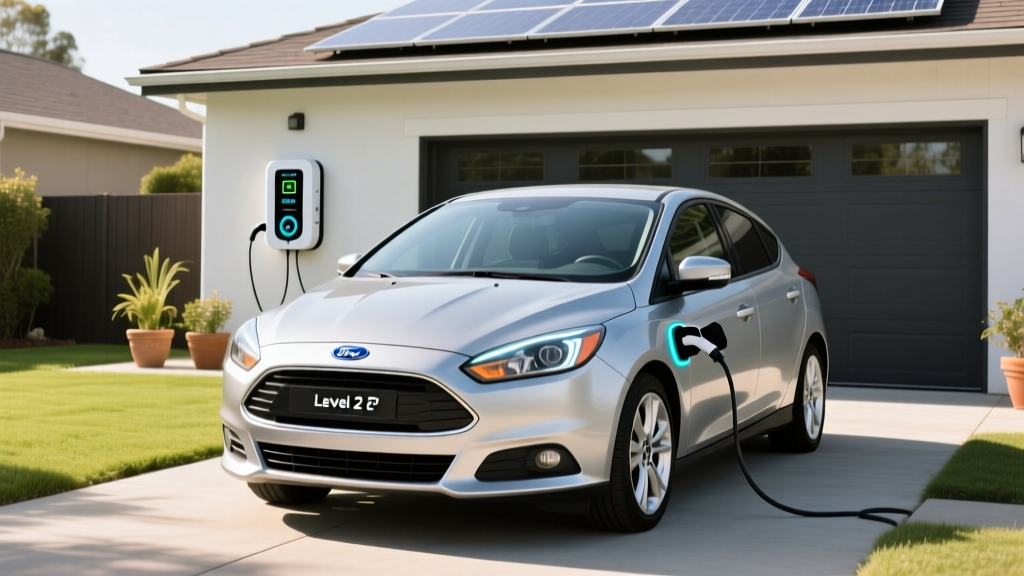
With the 6.6 kW onboard charger, a Level 2 station delivers a full charge in roughly 5–5.5 hours. For a daily commuter driving 30–40 miles round trip, plugging in overnight on Level 2 means you wake up to a full battery every morning — no problem. Level 1 charging (a standard 120V outlet) adds only about 4–5 miles per hour, which means recovering a full day's 40-mile commute takes roughly 8–10 hours. Level 1 works as a supplement but is not practical as a primary charging strategy.
Home Charger Installation: Electrical Requirements and Costs
Because the Focus Electric relies entirely on Level 2 for practical daily charging, installing a home Level 2 charger is the single most important ownership investment. Here's what's involved.
Electrical Requirements
The Focus Electric's 6.6 kW onboard charger means you need a 240V circuit rated at 40 amps to deliver a continuous 32 amps (the National Electrical Code requires circuits to be rated at 125% of continuous load). A NEMA 14-50 outlet or a hardwired connection on a dedicated 40A breaker is the standard setup.
You do not need a 48A or 80A circuit — the car physically cannot accept more than 6.6 kW regardless of what the charger or circuit provides. However, installing a 40A or 50A circuit gives you flexibility to charge future EVs with larger onboard chargers.
Panel Upgrade Possibility
Many older homes (especially those built before 1990) have 100-amp electrical panels. Adding a 40A dedicated circuit to an already-loaded 100A panel may require a panel upgrade to 200 amps, which is a significant cost factor. Homes with 200A panels typically have sufficient headroom. Ask your electrician to perform a load calculation before proceeding.
Installation Cost Breakdown
| Item | Low End | High End | Notes |
|---|---|---|---|
| Level 2 Charger (Equipment) | $250 | $650 | 32A–40A, J1772 connector, 18–25 ft cable |
| Electrician Labor | $400 | $1,500 | Varies by run length, conduit, wall material |
| Permit & Inspection | $50 | $300 | Required in most jurisdictions |
| Electrical Materials (conduit, wire, breaker) | $100 | $400 | Longer runs cost more |
| Total (No Panel Upgrade) | $800 | $2,850 | Most installs: $1,200–$2,000 |
| Panel Upgrade (if needed) | $1,500 | $3,500 | 100A → 200A upgrade, additional cost |
For the 2016 Focus Electric, the sweet spot is a 32A or 40A Level 2 charger on a 240V circuit. Spending extra on a 48A or 80A charger provides no benefit to this vehicle, though it's reasonable future-proofing if you plan to upgrade to a newer EV later.
Charging Cost: Home vs. Public vs. Gas
One of the biggest ownership advantages of the Focus Electric is the low fuel cost. The car consumes approximately 31 kWh per 100 miles (its EPA-rated efficiency). Here's how charging costs break down across scenarios:
| Scenario | Rate | Cost per 100 Miles | Cost per Mile |
|---|---|---|---|
| Home (off-peak utility rate) | $0.10/kWh | $3.10 | $0.031 |
| Home (national avg. residential) | $0.17/kWh | $5.27 | $0.053 |
| Public Level 2 (ChargePoint/EVgo) | $0.25–$0.39/kWh | $7.75–$12.09 | $0.078–$0.121 |
| Gas Car (28 MPG avg, $3.40/gal) | $3.40/gallon | $12.14 | $0.121 |
At home off-peak rates, the Focus Electric costs roughly 3 cents per mile to fuel — about one-quarter the cost of a 28 MPG gas car at $3.40/gallon. Even at national average residential rates, you're paying ~5 cents per mile. Public Level 2 charging narrows the gap but still typically undercuts gasoline.
Since the Focus Electric has no DC fast charging, you won't encounter the $0.40–$0.55/kWh DC fast charging rates that can make some public charging more expensive than gas. Every charge you do will be Level 1 or Level 2.
Connector Compatibility: J1772 and What to Know
The 2016 Ford Focus Electric uses the J1772 connector for all AC charging (Level 1 and Level 2). This was the North American standard for AC charging before Tesla's NACS connector gained adoption starting in 2023–2024.
| Connector Type | Compatible? | Notes |
|---|---|---|
| J1772 (AC Level 1 & 2) | ✅ Native | Standard connector on all Focus Electric models. Use for all home and public AC charging. |
| NACS (Tesla) | ❌ No (adapter available) | Tesla J1772-to-NACS adapters exist (~$150–$250), but only useful for AC Tesla Destination Chargers — not Superchargers, since Focus Electric has no DCFC. |
| CCS1 (DC Fast) | ❌ Not applicable | The Focus Electric has no DC fast charging port or hardware. CCS1 stations cannot charge this vehicle. |
| CHAdeMO (DC Fast) | ❌ Not applicable | Not equipped. CHAdeMO was never offered on the Focus Electric. |
Key takeaway: Buy a J1772 Level 2 home charger. You do not need a NACS charger, and you cannot use DC fast chargers of any type. When shopping for public charging, look for Level 2 J1772 stations on networks like ChargePoint, EVgo (Level 2 locations), and Blink.
Recommended Level 2 Chargers for the Focus Electric
Since the Focus Electric caps at 6.6 kW, you need a charger that can deliver at least 32 amps (7.7 kW) to fully utilize the onboard charger. Here are three proven options well-suited to this vehicle:
Emporia Level 2 EV Charger
- Power Output: Up to 48A (11.5 kW) — Focus Electric will draw max 32A (6.6 kW)
- Connector: J1772
- Cable Length: 24 feet
- Smart Features: Wi-Fi, app scheduling, energy monitoring, solar integration
- Price: ~$350–$400
- Best For: Budget-conscious buyers who want smart scheduling for off-peak rates
ChargePoint Home Flex
- Power Output: Up to 50A (12 kW) — adjustable via DIP switches
- Connector: J1772
- Cable Length: 23 feet
- Smart Features: Wi-Fi, app-based scheduling, Alexa integration, energy reports
- Price: ~$550–$650
- Best For: Reliable brand with excellent app and broad network compatibility
Grizzl-E Smart (United Chargers)
- Power Output: Up to 40A (9.6 kW)
- Connector: J1772
- Cable Length: 24 feet
- Smart Features: OCPP-compatible, app scheduling, adjustable amperage
- Price: ~$400–$500
- Best For: Cold-climate durability (rated to -40°F), rugged build, NEMA 4 outdoor rating
Any of these chargers will fully charge the Focus Electric's 33.5 kWh battery in approximately 5–5.5 hours. The Grizzl-E is our pick for outdoor installations in cold climates, while the ChargePoint Home Flex offers the most polished software experience. The Emporia provides the best value with energy-monitoring features that help track your electricity costs.
Safety, Code, and Installation Best Practices
Level 2 charger installation involves high-voltage electrical work and must comply with the National Electrical Code (NEC Article 625) and local building codes. Key requirements:
- Dedicated circuit: Your Level 2 charger must be on its own dedicated breaker — not shared with other appliances. For the Focus Electric, a 40A breaker (supporting 32A continuous draw) is the minimum.
- GFCI protection: NEC 2020 and later requires GFCI (Ground Fault Circuit Interrupter) protection for EV charging outlets. Hardwired chargers may have built-in GFCI; outlet-based setups require a GFCI breaker.
- Outdoor rating: If installing outdoors, use a NEMA 4-rated charger enclosure and ensure all outdoor wiring is in weatherproof conduit.
- Permit and inspection: Most jurisdictions require an electrical permit for a new 240V circuit. The inspection ensures the work meets code and protects your home insurance coverage.
- Wire gauge: 8 AWG copper wire is typical for a 40A circuit; 6 AWG for a 50A circuit. Your electrician will size wire based on run length and local code.
Always hire a licensed electrician for this work. DIY 240V installations carry serious fire and shock risk and may void your home insurance if unpermitted.
Frequently Asked Questions
How much does it cost to install a home EV charger for the 2016 Focus Electric?
A typical Level 2 home installation (40A circuit, 240V, J1772 charger) costs $1,200–$2,000 for most homes with an adequate electrical panel. This includes the charger ($250–$650), electrician labor ($400–$1,500), materials ($100–$400), and permit ($50–$300). If your home needs a panel upgrade from 100A to 200A, add $1,500–$3,500.
How fast will each charging level add range to the Focus Electric?
Level 1 (120V, 12A) adds approximately 4–5 miles per hour. Level 2 (240V, 32A) adds approximately 22–24 miles per hour, fully charging the 33.5 kWh battery in about 5.5 hours. DC fast charging is not supported on this vehicle.
Which connector and charger is compatible with my 2016 Focus Electric?
The Focus Electric uses the J1772 connector for all AC charging. Purchase any J1772 Level 2 charger rated at 32A or higher. You cannot use CCS1, CHAdeMO, or Tesla NACS (for DC fast charging) — the car has no DC fast charging hardware.
How much does charging cost per mile vs. gas?
At the national average residential electricity rate of ~$0.17/kWh, the Focus Electric costs approximately $0.05 per mile to fuel. A comparable 28 MPG gas car at $3.40/gallon costs ~$0.12 per mile. Home off-peak charging at $0.10/kWh drops the cost to ~$0.03 per mile — roughly 75% cheaper than gasoline.
What electrical upgrades might I need for a Level 2 charger?
You need a dedicated 240V, 40-amp circuit with a NEMA 14-50 outlet or hardwired connection. If your home has a 100-amp electrical panel that's already near capacity, you may need a panel upgrade to 200 amps ($1,500–$3,500). Your electrician will perform a load calculation to determine if an upgrade is necessary. Homes built after 2000 typically have 200A panels and sufficient capacity.
Can I use a Tesla Supercharger with the 2016 Focus Electric?
No. The Focus Electric has no DC fast charging capability of any kind. Even with a J1772 adapter, Tesla Superchargers deliver DC power that the Focus Electric cannot accept. You can only use AC Level 2 Tesla Destination Chargers with an appropriate adapter, but this is rarely practical compared to standard J1772 public stations.
How long will the 2016 Focus Electric battery last?
The original battery warranty was 8 years/100,000 miles (covering defects and capacity loss below ~60–70% of original). In 2026, most Focus Electric vehicles are 10 years old and out of factory battery warranty. Real-world degradation on Ford's liquid-cooled LG Chem NMC packs has generally been moderate — expect 10–20% capacity loss at 80,000–100,000 miles, depending on climate and charging habits. A replacement battery, if available, typically costs $5,000–$8,000 installed through a Ford dealer or independent EV shop.