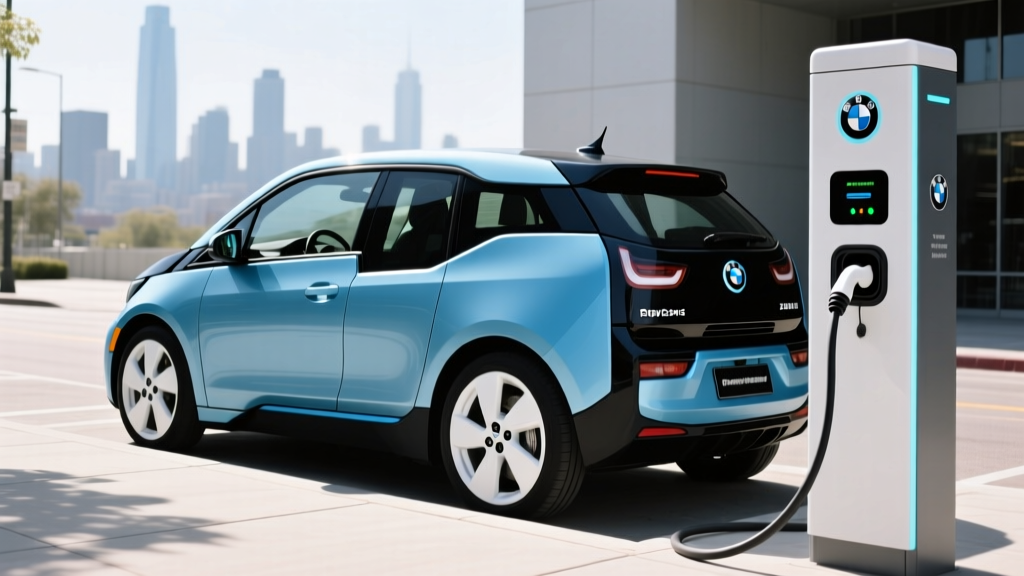
The 2016 BMW i3 Range Extender (REx) occupies a unique space in the used EV market. With its 60 Ah lithium-ion battery pack delivering roughly 72 miles of EPA-rated electric range, plus a 647cc two-cylinder gasoline engine that extends total range to around 180 miles, it was BMW's answer to early range anxiety. In 2026, this compact hatchback remains a compelling urban commuter — especially for buyers who want electric driving for daily errands but need the gas backup for occasional longer trips. Getting the most from the i3 REx, however, depends entirely on how you charge it.
This guide breaks down every charging scenario for the 2016 BMW i3 Range Extender: Level 1 trickle charging from a standard outlet, Level 2 home charging on a 240V circuit, and DC fast charging via its CCS1 connector. We'll cover real-world costs, home installation requirements, and which equipment actually makes sense for a battery this size.
Understanding the 2016 BMW i3 REx Battery and Charging Architecture
Before plugging in, it's worth understanding what you're working with. The 2016 i3 REx carries a 21.6 kWh gross / 18.8 kWh usable battery pack using Samsung SDI NMC (nickel-manganese-cobalt) cells. The usable capacity is what matters for charging calculations — that's the energy the battery management system (BMS) allows you to access, with top and bottom buffers protecting long-term health.
The onboard charger handles up to 7.4 kW on Level 2 AC power, meaning even if you connect a 48-amp home charger capable of delivering 11.5 kW, the i3 will only accept 7.4 kW. On DC fast charge, the i3 REx uses the CCS1 (Combo 1) connector and peaks at approximately 47 kW — modest by 2026 standards but adequate for a sub-20 kWh battery.
- EPA rated: 72 miles electric-only
- Real-world highway (70 mph): ~58–64 miles
- Real-world city/mixed: ~65–72 miles
- Cold weather (below 32°F): ~48–55 miles
- REx gas engine total range: ~180 miles combined
Source: fueleconomy.gov
Charging Levels Explained: Speeds and Range Added Per Hour
Every EV owner needs clarity on the three charging tiers. The critical distinction: kW (kilowatts) measures power — how fast energy flows into the car. kWh (kilowatt-hours) measures energy — how much the battery stores. Think of kW as the flow rate of a hose and kWh as the bucket size. For the 2016 i3 REx, the bucket is 18.8 kWh usable.
| Level | Voltage | Max Power (kW) | Miles of Range Added/Hour | Full Charge Time (0–100%) |
|---|---|---|---|---|
| Level 1 (120V household) | 120V / 12A | ~1.4 kW | ~4–5 miles | ~14–16 hours |
| Level 2 (240V home/public) | 240V / 32A | 7.4 kW (car-limited) | ~25–28 miles | ~2.5–3 hours |
| DC Fast Charge (CCS1) | 400V DC | 47 kW peak | ~100+ miles equivalent | 10–80% in ~25 min |
Because the i3 REx battery is small by 2026 standards, Level 2 charging fills it quickly — a full 0–100% session takes under three hours. That's practical for overnight charging and means you rarely need DC fast charging unless you're on a longer trip and need to top up the electric portion quickly.
Home Charging Installation: Requirements, Costs, and Panel Considerations
Installing a Level 2 charger at home is the single biggest upgrade an i3 REx owner can make. Here's what the project actually entails.
Electrical Requirements
A Level 2 home charger for the i3 REx requires a 240-volt dedicated circuit. Since the i3's onboard charger maxes out at 7.4 kW (32 amps), a 40-amp circuit with a 32-amp charger is ideal. You could install a 48-amp or higher charger for future-proofing if you plan to own a higher-capacity EV later, but the i3 won't use the extra amperage.
Key electrical specifications:
- Circuit: 40A double-pole breaker (dedicated, no shared loads)
- Wire gauge: 6 AWG copper (or 4 AWG aluminum) for a 40A circuit
- Outlet: NEMA 14-50 (if using a plug-in charger) or hardwired connection
- GFCI protection: Required by NEC 2020+ for outdoor receptacles and many jurisdictions for indoor EV circuits
Panel Upgrade Reality Check
Many older homes (pre-1990s) have 100-amp electrical panels that may not have capacity for a dedicated 40A EV circuit. If your panel is already near capacity — running electric range, dryer, and central AC — adding 40A could push total calculated load beyond the panel's rating. A licensed electrician will perform a NEC Article 220 load calculation to determine if an upgrade is needed. Upgrading from 100A to 200A typically costs $1,500–$3,500 depending on your utility and local requirements.
Installation Cost Breakdown
| Component | Low Estimate | High Estimate | Notes |
|---|---|---|---|
| Level 2 charger (hardware) | $300 | $700 | 32A–48A smart chargers |
| Electrician labor | $400 | $1,500 | Depends on panel-to-garage distance, wall type |
| Permit and inspection | $50 | $250 | Varies by municipality |
| Electrical materials (wire, conduit, breaker) | $100 | $400 | Longer runs cost more |
| Panel upgrade (if needed) | $1,500 | $3,500 | 100A to 200A service upgrade |
| Total (no panel upgrade) | $850 | $2,850 | Most homes with 200A panels |
| Total (with panel upgrade) | $2,350 | $6,350 | Older homes with 100A service |
Some utilities and states offer rebates for home charger installation — check with your local provider. The federal Residential Clean Energy Credit (as outlined by the IRS) may cover up to 30% of charger hardware and installation costs up to $1,000, subject to current-year eligibility rules.
Connector Compatibility: CCS1, Adapters, and the NACS Transition
The 2016 BMW i3 REx uses the CCS1 (Combined Charging System) connector for both Level 2 AC charging (the J1772 portion) and DC fast charging (the two additional DC pins below). In 2026, the North American charging landscape is mid-transition: Tesla's NACS connector has been adopted by most major automakers for new vehicles starting in 2025, but the i3 and other CCS1-equipped EVs remain fully supported.
| Connector Type | 2016 i3 REx Compatibility | Adapter Required? | Notes |
|---|---|---|---|
| J1772 (Level 2 AC) | Native — direct plug | No | Standard for all public Level 2 stations |
| CCS1 (DC Fast) | Native — direct plug | No | Electrify America, EVgo, ChargePoint DC stations |
| CHAdeMO (DC Fast) | Not compatible | No adapter available | Nissan Leaf standard; being phased out |
| NACS / Tesla Supercharger | Not compatible natively | CCS1-to-NACS adapter (Magic Dock or third-party) | Tesla has opened some Superchargers to CCS1 vehicles via adapter |
For daily home charging, you'll use the J1772 connector (the upper portion of CCS1). For road trips requiring DC fast charging, CCS1 stations from Electrify America and EVgo are your primary network. Tesla's Magic Dock adapter at select Supercharger stalls also works with CCS1 vehicles, though availability varies by region.
Cost to Charge: Home vs. Public vs. Gas Comparison
One of the strongest arguments for the i3 REx is the cost differential between electric and gasoline driving. Here's how the numbers break down using the i3's EPA-rated efficiency of 124 MPGe combined (approximately 27 kWh per 100 miles).
| Scenario | Rate | Cost per Full Charge (18.8 kWh) | Cost per Mile (EV mode) |
|---|---|---|---|
| Home off-peak (utility time-of-use) | $0.09/kWh | $1.69 | $0.024 |
| Home standard rate (national avg) | $0.16/kWh | $3.01 | $0.042 |
| Public Level 2 (network average) | $0.30/kWh | $5.64 | $0.078 |
| DC Fast Charge (network average) | $0.42/kWh | $7.90 | $0.110 |
| Gasoline (REx mode, 39 MPG combined) | $3.40/gallon | — | $0.087 |
At home off-peak rates, driving the i3 REx in electric mode costs roughly 2.4 cents per mile — about one-quarter the cost of gasoline even with the efficient REx engine. At national average residential rates, you're still at roughly half the per-mile cost of gas. Public DC fast charging narrows the gap, and in some high-cost networks, it can actually exceed the per-mile cost of the REx's gasoline engine. This is why home charging is so critical to the i3 REx ownership economics.
For context, the 2016 i3 REx achieves 39 MPG combined when running on its gasoline range extender, which is excellent for a gas vehicle but still costs roughly 3.5× more per mile than home off-peak electric charging.
Equipment Recommendations: Best Level 2 Chargers for the i3 REx
Since the i3 REx is limited to 7.4 kW (32 amps) on Level 2, you don't need the most powerful charger on the market. However, installing a 48-amp unit provides headroom for future EVs. Here are three solid options for 2026:
Emporia Level 2 EV Charger
- Power output: 48A / 11.5 kW max (i3 will draw 32A / 7.4 kW)
- Connector: J1772 (CCS1 compatible for AC)
- Cable length: 24 feet
- Smart features: Wi-Fi, app scheduling, energy monitoring, solar integration
- Price: ~$350–$400
- Why it works for i3 REx: Excellent value, detailed energy tracking helps you monitor charging costs and battery health over time
ChargePoint Home Flex
- Power output: Configurable 16A–50A / up to 12 kW (i3 will draw 32A / 7.4 kW)
- Connector: J1772
- Cable length: 23 feet
- Smart features: Wi-Fi, app-based scheduling, Alexa integration, flexible amperage dial
- Price: ~$550–$650
- Why it works for i3 REx: Adjustable amperage means you can set it to 40A to match your circuit exactly — no wasted capacity
Grizzl-E Smart
- Power output: 40A / 9.6 kW max (i3 will draw 32A / 7.4 kW)
- Connector: J1772
- Cable length: 24 feet
- Smart features: OCPP-compatible, app control, firmware updates
- Price: ~$450–$500
- Why it works for i3 REx: Built for extreme temperatures (-40°F rated), ideal for unheated garages or outdoor installation in cold climates where the i3's range already drops
For a dedicated i3 REx charger on a budget, the Emporia provides the best value and the energy-monitoring data that helps track your battery's state of health over time — important for a 2016 model-year pack.
Safety, Electrical Code, and Maintenance Considerations
EV charging involves sustained high-current draw for hours at a time. This is fundamentally different from most household circuits, which see short bursts of load. Proper installation and ongoing safety practices protect both your home and your i3's battery.
Code Requirements
- Dedicated circuit: NEC requires EV charging circuits to be dedicated — no shared outlets or appliances on the same breaker
- GFCI protection: Required for outdoor installations in most jurisdictions since NEC 2020; some local codes now require it indoors as well
- Outdoor rating: If your charger is mounted outside, it must carry a NEMA 4 (weatherproof) rating — all three chargers above meet this standard
- Permit and inspection: Virtually all jurisdictions require an electrical permit for a new 240V circuit; skipping this can void homeowner's insurance coverage for related incidents
Ongoing Best Practices
- Inspect the J1772 connector and cable monthly for signs of heat damage, discoloration, or fraying
- Use a charger with built-in thermal monitoring — it will reduce power or shut down if the plug or cable overheats
- For the i3 REx battery specifically, BMW recommends keeping state of charge between 20% and 80% for daily use to maximize NMC cell longevity; use your charger's scheduling feature to stop at 80%
- Precondition the battery (via the i3's connected app) before DC fast charging in cold weather — the i3's thermal management system warms the pack to accept higher charge rates
Frequently Asked Questions
How much does it cost to install a home EV charger for a 2016 BMW i3?
Expect $850–$2,850 for a standard installation (charger + electrician + permit + materials) if your electrical panel has sufficient capacity. If a panel upgrade from 100A to 200A is needed, add $1,500–$3,500. The i3 REx only needs a 40A circuit, which is a relatively modest requirement compared to higher-power EVs.
How fast will each charging level add range to the i3 REx?
Level 1 (120V) adds roughly 4–5 miles of electric range per hour. Level 2 (240V at 32A) adds approximately 25–28 miles per hour, filling the 72-mile battery in under 3 hours. DC fast charging at 47 kW peak can take the battery from 10–80% in about 25 minutes.
Which connector does the 2016 BMW i3 Range Extender use?
The 2016 i3 REx uses the CCS1 connector. For Level 2 AC charging (home and public), it uses the J1772 portion of the CCS1 plug. For DC fast charging, it uses the full CCS1 connector. It is not natively compatible with Tesla NACS or CHAdeMO, though CCS1-to-NACS adapters are available for access to some Tesla Superchargers.
How much does charging the i3 REx cost per mile versus gas?
At home off-peak rates ($0.09/kWh), electric driving costs about $0.024/mile. At national average rates ($0.16/kWh), it's roughly $0.042/mile. The gasoline range extender at 39 MPG and $3.40/gallon costs about $0.087/mile. Home charging saves 50–75% per mile compared to gasoline.
What electrical upgrades might I need for a Level 2 charger?
You'll need a dedicated 40A, 240V circuit with a double-pole breaker. If your home has a 100A electrical panel that's already heavily loaded, you may need a panel upgrade to 200A service ($1,500–$3,500). A licensed electrician will perform a load calculation per NEC Article 220 to determine if your existing panel can support the additional circuit.
Can I charge the 2016 i3 REx at Tesla Superchargers?
Not natively. The i3 uses CCS1, while Tesla Superchargers use NACS. However, Tesla has opened select Supercharger stations to non-Tesla EVs via the Magic Dock adapter (CCS1-to-NACS). Availability is limited and varies by region. Apps like PlugShare show which Supercharger stalls support CCS1 vehicles.
Does DC fast charging degrade the i3's battery faster?
Frequent DC fast charging can accelerate degradation in NMC cells, particularly if the battery is charged to 100% or charged while hot. For the i3 REx's relatively small 18.8 kWh usable pack, DC fast charging sessions are inherently short (~25 minutes to 80%), which limits heat buildup. Reserve DC fast charging for road trips and rely on Level 2 for daily use to maximize battery longevity.