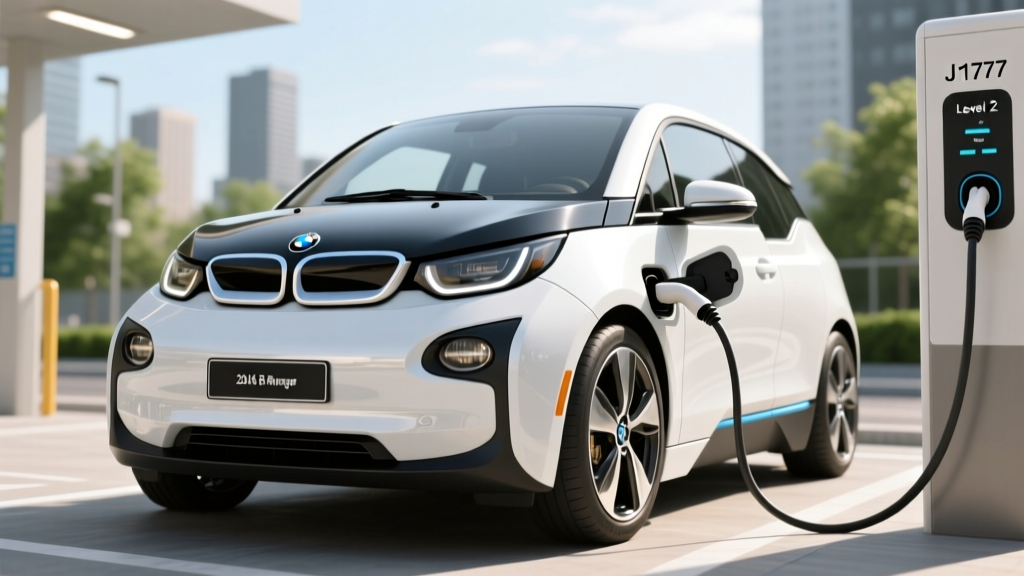
The 2016 BMW i3 with Range Extender (REx) remains one of the most distinctive plug-in vehicles on the used market. Its 18.8 kWh usable battery paired with a 0.65-liter two-cylinder gasoline generator means you're managing two energy sources — and that makes charging knowledge essential. Whether you just picked up a used i3 REx or are evaluating one, this guide breaks down exactly how fast it charges, what home equipment you need, what it costs, and which connectors to look for.
Before we get into the numbers, a critical distinction: kW (kilowatts) measures power — how fast energy flows into your car. kWh (kilowatt-hours) measures energy — the total capacity of the battery, like gallons in a tank. The 2016 i3 REx has an 18.8 kWh usable battery (21.6 kWh gross). Charging speed is always measured in kW.
2016 BMW i3 REx: Battery, Range, and Charging Specs at a Glance
The 2016 i3 REx combines a relatively small battery with a gas generator, giving it a unique profile. Here are the hard numbers from fueleconomy.gov and BMW's original specifications:
| Specification | Value |
|---|---|
| Battery (usable / gross) | 18.8 kWh / 21.6 kWh (NMC lithium-ion) |
| EPA electric-only range | 72 miles |
| EPA total range (electric + gas) | 180 miles |
| Range Extender engine | 0.65L 2-cyl gasoline generator (34 hp) |
| Electric motor output | 170 hp / 184 lb-ft torque |
| EPA MPGe (electric mode) | 117 MPGe combined |
| EPA MPG (gas generator mode) | 39 MPG combined |
| 0–60 mph | 6.9 seconds |
| Onboard charger (AC) | 7.4 kW (single-phase) |
| Max DC fast charge rate | 50 kW (CCS1 combo) |
| Charge port | J1772 (AC) / CCS1 (DC) |
Real-world range note: The EPA's 72-mile electric figure assumes moderate temperatures and mixed driving. In highway-heavy driving at 70+ mph, expect closer to 55–65 electric miles. In cold weather (below 30°F), that can drop to 45–55 miles due to battery chemistry limitations and cabin heating load. The Range Extender kicks in once the battery reaches its minimum state of charge (~6%), adding roughly 100–110 miles of gas-powered range.
Charging Levels Explained: How Fast Each Level Adds Range to the i3 REx
The i3 REx can accept three charging levels, but each behaves differently given its small 18.8 kWh battery. Here's what you'll see in practice:
| Level | Power (kW) | Miles of Range per Hour | Full Charge Time (0–100%) | Typical Use |
|---|---|---|---|---|
| Level 1 (120V) | ~1.4 kW | ~5–6 miles/hr | ~13–14 hours | Overnight trickle; emergency top-up |
| Level 2 (240V, 32A) | 7.4 kW (car-limited) | ~25–30 miles/hr | ~2.5–3 hours | Home daily charging; destination charging |
| DC Fast (CCS1) | Up to 50 kW | ~120–150 miles/hr | ~25 min (0–80%) | Road trips; rapid top-up |
Because the i3 REx battery is small, even Level 1 charging can fully replenish the battery overnight — something owners of larger-battery EVs can't count on. However, Level 2 at 240V is the practical daily choice, delivering a full charge in under three hours. The i3's 7.4 kW onboard charger is the bottleneck on AC power: even if you plug into a 48A Level 2 station delivering 11.5 kW, the car will only accept 7.4 kW.
DC fast charging reality: The i3 REx's 50 kW CCS1 peak is modest by 2026 standards, but with only 18.8 kWh to fill, it's more than adequate. Expect a 0–80% charge in roughly 25 minutes. Above 80% state of charge, the charge curve tapers significantly — the final 20% can take an additional 15–20 minutes. If you're road-tripping, plan to charge to 80% and let the Range Extender handle the rest.
Home Charger Installation: Electrical Requirements and Costs for the i3 REx
Since the i3 REx's onboard charger maxes out at 7.4 kW, you don't need the most powerful home charger on the market. A 32-amp, 240V circuit delivers the full 7.4 kW the car can accept. Here's what your installation will involve:
Electrical Requirements
- Circuit: Dedicated 40-amp breaker (NEC requires circuits rated at 125% of continuous load, so a 32A charger needs a 40A breaker)
- Wire: 8 AWG copper (THHN/THWN in conduit or NM-B/Romex depending on local code)
- Outlet or hardwire: NEMA 14-50 receptacle or direct hardwire connection
- Panel capacity: Your main service panel needs at least 40 amps of available capacity. Many older homes with 100A service may need a panel upgrade to 200A — a significant added cost
Panel upgrade reality: If your home has a 100-amp main panel that's already near capacity (common in homes built before 1990), an upgrade to 200A service may be required. This typically adds $1,500–$3,500 to your project. Always have a licensed electrician perform a load calculation before committing to equipment.
| Component | Cost Range |
|---|---|
| Level 2 charger unit (32A, 240V) | $300–$650 |
| Electrical permit | $50–$200 |
| Electrician labor (standard install, panel to garage ~30 ft) | $500–$1,500 |
| Additional wiring, conduit, materials | $150–$500 |
| Panel upgrade to 200A (if needed) | $1,500–$3,500 |
| Total (no panel upgrade) | $1,000–$2,850 |
| Total (with panel upgrade) | $2,500–$6,350 |
Many utility companies and some states offer rebates of $250–$1,000 for home charger installation. Check your local utility's EV program page and the Alternative Fuels Data Center state incentive database for current programs. Note: the federal §30D credit applies to vehicle purchases, not home charging equipment. However, a separate §30C Alternative Fuel Vehicle Refueling Property Credit may cover up to $1,000 of home charger installation costs for eligible taxpayers — consult a tax professional and review current IRS guidelines.
Safety and Code Considerations
- Dedicated circuit: Your Level 2 charger must be on its own dedicated breaker — never shared with other appliances
- GFCI protection: NEC 2020 and later requires GFCI protection for EV receptacles. Hardwired units often have built-in GFCI, but receptacle installations may need a GFCI breaker ($50–$100 extra)
- Outdoor rating: If your charger is installed outside or in an exposed carport, ensure the unit is rated NEMA 4 or NEMA 4X for weather resistance
- Cable management: Choose a cable length (18–25 ft is typical) that reaches your charge port comfortably without stretching across walkways — a tripping hazard and code violation in some jurisdictions
Connector Compatibility: What Plugs Into the 2016 BMW i3 REx
The 2016 i3 REx was built during the CCS1/J1772 era, before Tesla's NACS connector became the industry standard. Here's what fits and what requires an adapter:
| Connector Type | Native Compatibility? | Notes |
|---|---|---|
| J1772 (Level 1 & 2 AC) | Yes — native | All public Level 2 stations and home chargers with J1772 plugs connect directly |
| CCS1 (DC fast charge) | Yes — native | Uses the CCS1 Combo connector (J1772 + two DC pins below). Found at Electrify America, EVgo, and most non-Tesla DC stations |
| CHAdeMO (DC fast charge) | No | Used by older Nissan Leaf and Mitsubishi models. No adapter exists for i3 → CHAdeMO |
| NACS / Tesla (AC & DC) | No — adapter needed | As of 2025, Tesla sells a J1772-to-NACS adapter (~$250) allowing access to Tesla Superchargers. Third-party adapters are also available. Verify your i3's firmware supports Supercharger handshake before relying on this |
Practical connector advice: For home charging, any J1772 Level 2 charger works natively — no adapter needed. For public DC fast charging, CCS1 stations remain widespread and are your native option. The growing NACS/Supercharger network is accessible with an adapter, which is worth the investment if Superchargers are more convenient in your area. As of 2026, most new EVs ship with NACS ports, but your 2016 i3 will always need a J1772 adapter to use NACS-native infrastructure.
How Much Does Charging the i3 REx Cost vs. Gasoline?
One of the strongest arguments for the i3 REx is low per-mile energy cost in electric mode. Let's run the numbers with the i3's real-world efficiency of approximately 28 kWh per 100 miles (derived from its 117 MPGe rating):
| Scenario | Rate | Cost per Mile |
|---|---|---|
| Home charging (off-peak, $0.12/kWh) | $0.12 × 28 kWh / 100 mi | $0.034/mile |
| Home charging (standard rate, $0.18/kWh) | $0.18 × 28 kWh / 100 mi | $0.050/mile |
| Public Level 2 ($0.35/kWh) | $0.35 × 28 kWh / 100 mi | $0.098/mile |
| DC fast charging ($0.48/kWh) | $0.48 × 28 kWh / 100 mi | $0.134/mile |
| i3 REx on gasoline (39 MPG, $3.40/gal) | $3.40 / 39 MPG | $0.087/mile |
| Comparable gas car (28 MPG, $3.40/gal) | $3.40 / 28 MPG | $0.121/mile |
The takeaway: Home off-peak charging makes the i3 REx extraordinarily cheap to drive — roughly 3.4 cents per mile, or about one-quarter the cost of the gasoline generator mode. Even public DC fast charging is comparable to running the gas engine. The economics strongly favor plugging in whenever possible.
For a driver covering 12,000 miles per year with 80% of driving in electric mode on home charging, annual fuel cost is approximately $400–$600 — compared to $1,200–$1,450 for a conventional 28 MPG gasoline car. Over five years, that's $4,000–$5,000 in fuel savings, partially offset by the cost of home charger installation.
Recommended Level 2 Chargers for the 2016 BMW i3 REx
Since the i3 REx's onboard charger caps at 7.4 kW (32 amps at 240V), you don't need a 48A charger — but buying one provides future-proofing if you add a second EV later. Here are three strong options across price tiers:
Budget Pick: Emporia Vue Level 2 Charger
- Power output: 40A / 9.6 kW (i3 will draw 32A / 7.4 kW)
- Connector: J1772 (native for i3)
- Cable length: 24 feet
- Smart features: Wi-Fi, app scheduling, energy monitoring, works with Emporia home energy panel
- Installation: Hardwire or NEMA 14-50 plug
- Price: ~$350–$400
- Why it works: Reliable, affordable, and the energy monitoring pairs well with the i3 REx's small battery for precise SoC tracking
Best Value: ChargePoint Home Flex
- Power output: Adjustable up to 50A / 12 kW (set to 32A for i3 REx)
- Connector: J1772 (native for i3)
- Cable length: 23 feet
- Smart features: Wi-Fi, Alexa/Google integration, ChargePoint app with scheduling and cost tracking, Alexa voice control
- Installation: NEMA 14-50 plug or hardwire
- Price: ~$550–$650
- Why it works: Adjustable amperage means you can dial it to match your panel capacity. The ChargePoint network integration helps track public and home charging in one app
Premium Pick: Tesla Universal Wall Connector
- Power output: Up to 48A / 11.5 kW (i3 will draw 32A / 7.4 kW)
- Connector: Integrated NACS + J1772 adapter included in box
- Cable length: 24 feet
- Smart features: Wi-Fi, over-the-air updates, power-sharing between two units, Tesla app integration
- Installation: Hardwire only (no plug option)
- Price: ~$600
- Why it works: If you plan to add a Tesla or NACS-equipped vehicle in the future, this single unit charges both your i3 (via the included J1772 adapter) and any NACS car natively. Excellent build quality and future-proofing
Installation tip: All three chargers above require a 240V dedicated circuit. The Emporia and ChargePoint offer plug-in (NEMA 14-50) options, which can save on installation cost and allow you to take the charger when you move. Hardwired installations (required for the Tesla) typically support higher amperage but are permanent fixtures.
Charging the i3 REx on Public Networks: What to Expect
The i3 REx's CCS1 DC fast charging port gives you access to Electrify America, EVgo, and most non-Tesla fast-charging networks. With a J1772-to-NACS adapter, you can also access Tesla Superchargers that have been opened to non-Tesla vehicles (via the Tesla app).
Practical DC fast charging expectations:
- At a 50 kW CCS1 station: 0–80% in ~25 minutes, adding approximately 55–60 electric miles
- At a 150 kW+ CCS1 station: The i3 still caps at 50 kW, so charging speed is identical to a 50 kW station — you won't benefit from ultra-fast chargers
- Charge curve taper: Above 80% SoC, power drops to ~20 kW, then ~7 kW above 90%. Don't wait for 100% at a DC station — it's not time-efficient
Level 2 public charging: Public J1772 Level 2 stations (common at shopping centers, workplaces, and parking garages) deliver 6.6–7.4 kW to the i3 REx. A typical 2-hour shopping trip can add 50–60 electric miles — nearly a full battery. Apps like PlugShare and ChargePoint show real-time station availability and connector types.
Frequently Asked Questions
How much does it cost to install a home EV charger for the 2016 BMW i3 REx?
For a standard installation with a 40-amp dedicated circuit and no panel upgrade, expect $1,000–$2,850 total (charger unit + electrician + permit + materials). If your home needs a panel upgrade from 100A to 200A service, add $1,500–$3,500, bringing the total to $2,500–$6,350. Get at least two quotes from licensed electricians and ask specifically about load calculations.
How fast will each charging level add range to the i3 REx?
Level 1 (120V) adds roughly 5–6 miles per hour. Level 2 (240V, 32A) adds approximately 25–30 miles per hour and fully charges the 18.8 kWh battery in 2.5–3 hours. DC fast charging (50 kW CCS1) adds roughly 120–150 miles per hour, reaching 80% in about 25 minutes. These figures assume moderate temperatures — cold weather slows all charging speeds by 15–30%.
Which connector and charger is compatible with my 2016 BMW i3 REx?
The i3 REx natively accepts J1772 (AC Level 1 and 2) and CCS1 (DC fast charge). For home charging, any J1772 Level 2 charger works without adapters. To access Tesla Superchargers, you need a J1772-to-NACS adapter (~$250). CHAdeMO connectors are not compatible and no adapter exists.
How much does charging cost per mile compared to gasoline?
On home off-peak electricity ($0.12/kWh), the i3 REx costs about $0.034 per mile in electric mode — roughly 72% cheaper than running the gasoline generator ($0.087/mile at 39 MPG and $3.40/gallon). Even on public DC fast charging at $0.48/kWh ($0.134/mile), the cost is comparable to the gas engine and still cheaper than a typical 28 MPG gas car ($0.121/mile).
What electrical upgrades might I need for a home Level 2 charger?
Most homes with a 200-amp electrical panel and available breaker space need only a new 40-amp dedicated circuit with 8 AWG wiring. Homes with older 100-amp panels, especially those already near capacity with electric HVAC, dryers, and ranges, may require a full panel upgrade to 200A. Some jurisdictions also require a GFCI breaker for EV receptacles. A licensed electrician's load calculation is the definitive answer — don't guess.
Does the Range Extender affect charging behavior?
The REx gasoline generator does not charge the battery while driving in normal operation — it maintains the battery at its minimum state of charge (~6% SoC) to power the electric motor. You cannot "charge" the battery via the gas engine from a depleted state. The only way to increase battery SoC is to plug in. Some owners report the REx maintaining a ~6% buffer, which BMW designed to protect battery longevity by avoiding deep discharge.
Should I precondition the i3 REx battery before charging?
The 2016 i3 does not have active battery preconditioning for DC fast charging (unlike newer EVs with thermal management preconditioning routines). In cold weather, the battery will charge more slowly until it warms up through use. If possible, start a DC fast charge session immediately after driving (when the battery is warm) rather than after the car has been sitting in cold temperatures for hours.
The 2016 BMW i3 with Range Extender is a uniquely practical used EV: small enough battery to charge quickly and cheaply at home, with a gas backup that eliminates range anxiety on longer trips. With a $1,000–$2,850 home charger installation and off-peak electricity rates, most owners will spend under $500 per year on energy for daily driving. Just remember the connector landscape — J1772 and CCS1 are your native ports, and a NACS adapter unlocks the Tesla network for road trips.