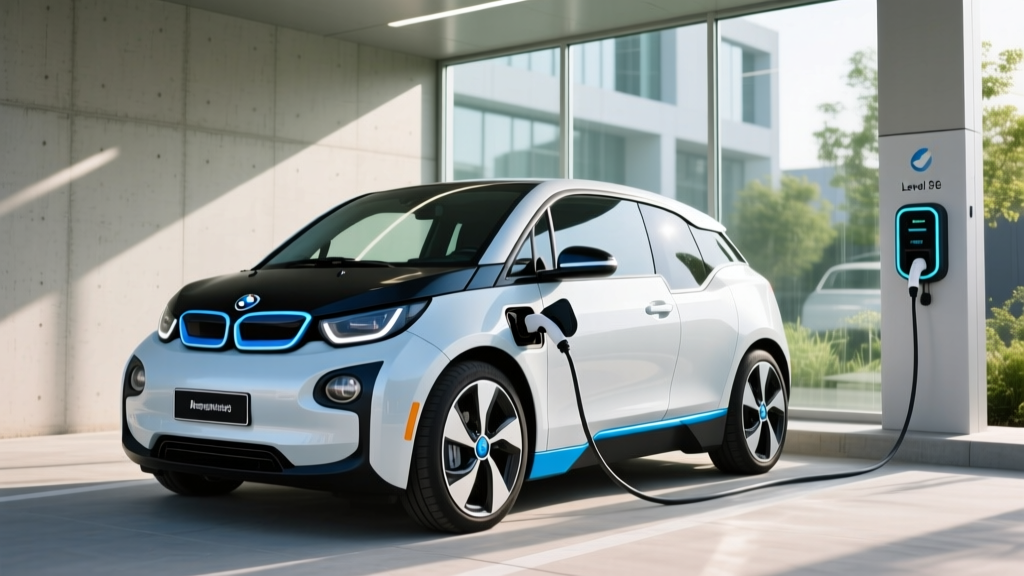
The 2015 BMW i3 with Range Extender (REx) occupies a unique space in the used EV market: a lightweight carbon-fiber city car with a small gasoline backup generator. If you're evaluating one today, understanding the 2015 BMW i3 base w/ range extender range — and how to charge its compact battery efficiently — is essential to getting the most out of this pioneering plug-in.
This guide covers the i3 REx's real-world electric and combined range, then walks through every charging scenario you'll encounter: Level 1 trickle, Level 2 home charging, and DC fast charging. We'll also break down home installation costs, connector compatibility, per-mile charging costs versus gasoline, and the specific equipment that works best with this model's CCS1 port.
2015 BMW i3 REx Range: EPA vs. Real World
The 2015 BMW i3 REx pairs a 22 kWh total battery (18.8 kWh usable) lithium-ion NMC pack with a 647cc two-cylinder gasoline engine that acts solely as a generator — it never drives the wheels directly. Here's how the EPA rated it:
| Metric | Value |
|---|---|
| Electric-only range | 72 miles |
| Gasoline-only range (REx) | 78 miles |
| Total combined range | 150 miles |
| MPGe (electric mode) | 117 MPGe combined |
| Fuel economy (gas mode) | 39 MPG combined |
| Battery capacity (usable) | 18.8 kWh |
| Fuel tank capacity | 2.4 gallons |
Charging Levels Explained: Speeds in kW and Miles per Hour
Before we dive into specifics for the i3 REx, let's clarify the distinction between kW (kilowatts — the rate of power delivery, like water pressure in a hose) and kWh (kilowatt-hours — the total energy stored, like gallons in a tank). A charger rated at 7.2 kW delivers 7.2 kWh of energy per hour. The i3's 18.8 kWh usable battery determines how long any charger takes to fill it.
| Level | Voltage | Max Power (kW) | Miles of Range Added per Hour | Typical Use |
|---|---|---|---|---|
| Level 1 | 120V AC | 1.0–1.4 kW | 3–5 mi/hr | Overnight trickle, emergency top-ups |
| Level 2 | 240V AC | 3.3–19.2 kW | 12–75 mi/hr | Home daily charging, workplace, public destinations |
| DC Fast Charge | 200–500V DC | 25–350 kW | 100–1,000+ mi/hr | Road trips, highway corridors |
2015 BMW i3 REx Charging Times by Level
The i3 REx accepts a maximum of 7.4 kW on Level 2 AC (single-phase onboard charger) and up to 50 kW on DC fast charge via its CCS1 Combo connector. Here's what that means in practice:
- Level 1 (120V, ~1.2 kW): Full charge from empty in approximately 16–17 hours. Adds about 4 miles of electric range per hour. Useful only for overnight top-ups if you drive fewer than 30 miles daily.
- Level 2 (240V, 32A / 7.4 kW): Full charge from empty in roughly 3 hours. This is the practical home-charging sweet spot for the i3 REx — plug in when you get home, wake up to a full battery every morning.
- DC Fast Charge (50 kW CCS1): 0–80% in approximately 25–30 minutes. The i3's charge curve holds near peak rate up to about 60% SoC, then tapers to protect the battery. Expect 80–100% to add another 15 minutes.
Home Charger Installation: Requirements, Costs, and Electrical Upgrades
Installing a dedicated Level 2 home charger is the single biggest quality-of-life upgrade for any i3 REx owner. Here's what's involved electrically and financially.
Electrical Requirements
A Level 2 charger delivering the i3's maximum 7.4 kW requires a 240V circuit rated at 40 amps (the charger itself draws 32A continuously; NEC code requires circuits be rated 125% above continuous load). Your electrician will install a NEMA 14-50 outlet or hardwire the charger directly — hardwiring is preferred for permanent installations as it avoids outlet wear and allows higher amperage without a plug rating bottleneck.
Panel Upgrade Considerations
Homes built before 1990 often have 100-amp electrical panels, which may lack capacity for a 40A EV circuit alongside existing loads (electric range, dryer, HVAC). A panel upgrade to 200A typically costs $1,500–$3,000 and may be required before your utility will approve the EV circuit. Your electrician will perform a load calculation per NEC Article 220 to determine whether your existing panel can handle the additional draw. Some homeowners can avoid a panel upgrade by using a smart load-management device (such as the Emporia Smart Load Center or Span drive panel) that throttles charger amperage when other heavy loads are active.
| Component | Cost Range |
|---|---|
| Level 2 charging equipment (32A–48A) | $350–$750 |
| Electrician labor (240V circuit run, 20–60 ft) | $500–$1,800 |
| Permit and inspection | $50–$250 |
| Panel upgrade to 200A (if needed) | $1,500–$3,000 |
| Total (no panel upgrade) | $900–$2,800 |
| Total (with panel upgrade) | $2,400–$5,800 |
The IRS residential clean energy credit covers 30% of home charger equipment and installation costs (up to $1,000) for installations placed in service through 2032, per §25E. This can offset several hundred dollars of your out-of-pocket expense.
Connector Compatibility: What Plugs Into the 2015 BMW i3 REx
The 2015 BMW i3 REx uses the CCS1 (Combo 1) connector for DC fast charging and a standard J1772 inlet for Level 1 and Level 2 AC charging. Here's how the i3 fits into today's connector landscape:
| Connector Type | Used For | i3 REx Compatibility |
|---|---|---|
| J1772 | Level 1 & Level 2 AC charging | ✅ Native — plugs in directly |
| CCS1 (Combo) | DC fast charging (most non-Tesla networks) | ✅ Native — plugs in directly |
| CHAdeMO | DC fast charging (Nissan Leaf, older stations) | ❌ Not compatible |
| NACS (Tesla) | Tesla Superchargers (now opening to other EVs) | ⚠️ Requires CCS-to-NACS adapter |
Charging Cost per Mile: Home Electricity vs. Gasoline
The i3 REx gives you two energy sources to compare. Let's run the numbers using realistic 2026 energy prices.
| Energy Source | Unit Cost | Efficiency | Cost per Mile |
|---|---|---|---|
| Home electricity (off-peak, avg) | $0.13/kWh | 3.5 mi/kWh (117 MPGe) | $0.037 |
| Home electricity (peak, avg) | $0.22/kWh | 3.5 mi/kWh | $0.063 |
| Public Level 2 (avg network) | $0.35/kWh | 3.5 mi/kWh | $0.100 |
| DC Fast Charge (avg network) | $0.48/kWh | 3.5 mi/kWh | $0.137 |
| Gasoline (REx mode, $3.40/gal) | $3.40/gal | 39 MPG | $0.087 |
| Gasoline (avg ICE sedan, 28 MPG) | $3.40/gal | 28 MPG | $0.121 |
The takeaway: charging at home off-peak costs roughly $0.04 per mile — less than half the cost of running the i3 on gasoline and a quarter of what a comparable gas sedan spends per mile. Even public DC fast charging at premium rates stays competitive with gasoline. The financial case for home Level 2 charging is overwhelming if you can install it.
For a driver covering 12,000 miles per year with 80% home charging and 20% gasoline (REx), annual fuel costs run approximately $560 — compared to roughly $1,450 for a 28 MPG gas car driven the same distance. That's nearly $900 in annual savings.
Best Level 2 Chargers for the 2015 BMW i3 REx
Since the i3 REx maxes out at 7.4 kW AC, you don't need a 48A charger — but buying one future-proofs your garage for your next EV. Here are three well-regarded options:
Emporia Vue Level 2 EV Charger
- Power output: 48A / 11.5 kW (240V hardwired) or 40A / 9.6 kW (NEMA 14-50)
- Connector: J1772 (CCS-compatible for AC)
- Cable length: 24 ft
- Smart features: Wi-Fi scheduling, energy monitoring, solar integration, load management
- Price: ~$399
- Why it fits the i3: Excellent energy monitoring lets you track exactly how many kWh you're putting into the i3's small battery, and the load-management feature can avoid a panel upgrade.
ChargePoint Home Flex
- Power output: Up to 50A / 12 kW (hardwired) or 40A / 9.6 kW (NEMA 14-50)
- Connector: J1772
- Cable length: 23 ft
- Smart features: App scheduling, Alexa integration, amperage configurable via dip switches
- Price: ~$549
- Why it fits the i3: Configurable amperage means you can set it to 32A on a 40A circuit today and reconfigure for a higher-power EV later.
Tesla Wall Connector (with J1772 adapter)
- Power output: 48A / 11.5 kW (hardwired, 60A circuit)
- Connector: NACS native — requires a J1772 adapter (~$30–$50) for the i3
- Cable length: 24 ft
- Smart features: Wi-Fi updates, Tesla app integration, Powerwall integration
- Price: ~$475 (plus adapter cost)
- Why it fits the i3: Overkill for the i3 alone, but ideal if you own (or plan to own) a Tesla alongside the BMW. Buy the J1772 adapter and charge both vehicles from one unit.
Safety and Code Considerations for Home EV Charging
EV charging draws sustained high current for hours — far longer than most household appliances. Code compliance isn't optional; it protects your home from fire risk.
- Dedicated circuit: Your Level 2 charger must be on its own dedicated circuit — no sharing with other outlets or appliances. A 40A breaker for a 32A charger is standard for the i3.
- GFCI protection: NEC 2020 and later require GFCI (Ground Fault Circuit Interrupter) protection for all EV charging outlets. Hardwired installations may not require a GFCI breaker depending on local code — your electrician will confirm. GFCI breakers for 240V circuits cost $50–$120 more than standard breakers.
- Outdoor rating: If your charger mounts outdoors, ensure it carries a NEMA 4 or IP65 rating for weather resistance. All three chargers recommended above meet this standard. The connector holster should shield the plug from rain and debris.
- Wire gauge: A 40A circuit requires minimum 8 AWG copper wire; a 50A circuit needs 6 AWG. Longer wire runs (over 60 ft) may require upsizing to prevent voltage drop. Your electrician will calculate this based on your specific run.
- Permit and inspection: Virtually all jurisdictions require an electrical permit for a new 240V circuit. The inspection ensures proper wire sizing, breaker rating, grounding, and GFCI compliance. Skipping the permit risks insurance denial in the event of an electrical fire.
Frequently Asked Questions
How much does it cost to install a home EV charger for the 2015 BMW i3?
Expect to spend $900–$2,800 for a straightforward Level 2 installation on an existing 200A panel, including the charger unit ($350–$750), electrician labor ($500–$1,800), and permit ($50–$250). If your home needs a panel upgrade from 100A to 200A, add $1,500–$3,000. The IRS §25E credit can refund 30% of equipment and installation costs up to $1,000.
How fast will each charging level add range to the i3 REx?
Level 1 (120V) adds roughly 4 miles per hour — adequate only for light daily driving. Level 2 (240V, 32A) adds approximately 25 miles per hour, fully recharging the 18.8 kWh battery in about 3 hours. DC fast charging at 50 kW can restore 0–80% (about 58 miles of electric range) in 25–30 minutes.
Which connector and charger are compatible with the 2015 BMW i3 REx?
The i3 REx uses J1772 for AC charging (Levels 1 and 2) and CCS1 Combo for DC fast charging. Any J1772 Level 2 charger works natively. For Tesla Superchargers that have opened to non-Tesla EVs, you'll need a CCS-to-NACS adapter (~$175–$250). The i3 is not compatible with CHAdeMO.
How much does charging the i3 REx cost per mile versus gasoline?
Home off-peak charging at $0.13/kWh costs roughly $0.04 per mile in electric mode. Running the gasoline range extender at $3.40/gallon and 39 MPG costs about $0.09 per mile. A comparable gas-only sedan at 28 MPG costs $0.12 per mile. Prioritizing home charging yields the lowest operating costs.
What electrical upgrades might my home need for Level 2 charging?
The most common upgrade is a panel capacity increase from 100A to 200A ($1,500–$3,000), necessary if your existing panel can't accommodate a new 40A circuit alongside current loads. Older homes may also need wiring updates (aluminum-to-copper replacement) or a new conduit run from panel to garage. A licensed electrician's load calculation will determine exactly what's required. Smart load-management devices can sometimes avoid a panel upgrade by dynamically limiting charger draw.
Does the range extender charge the battery or just drive the wheels?
The i3's 647cc two-cylinder engine acts purely as a generator — it charges the battery to maintain a minimum state of charge (typically around 6–7% SoC buffer) but never mechanically drives the wheels. This is known as a series-hybrid or EREV (Extended-Range Electric Vehicle) architecture. The electric motor always provides propulsion.
Can I use a Tesla Supercharger with my 2015 i3 REx?
Yes, but with caveats. Tesla has opened select Supercharger stalls to CCS-equipped non-Tesla EVs through the Magic Dock adapter or via a purchased CCS-to-NACS adapter. However, the i3's 50 kW DC fast-charge ceiling means you'll charge at a fraction of the Supercharger's capability, and per-kWh pricing may be higher than Electrify America or EVgo in some markets. It's a useful backup option, not a primary charging strategy.