Why a 2011 Mopar Charger EV Conversion Needs a Serious Charging Plan
The 2011 Dodge Charger — built during the Mopar performance era with its available 5.7L HEMI V8 and rear-wheel-drive architecture — has become an unexpected candidate for EV conversions. Enthusiasts are pulling the internal-combustion powertrain and dropping in electric motors paired with salvaged or new battery packs ranging from 30 kWh to 85 kWh. The result: a classic muscle sedan with instant torque and zero tailpipe emissions.
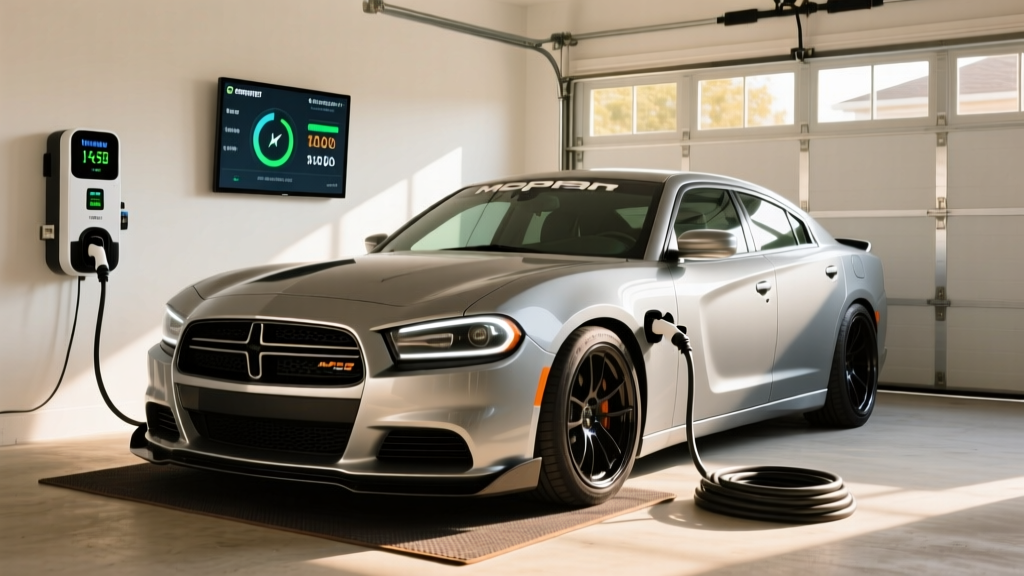
But here's the problem most converters hit after the drivetrain swap: how do you actually charge it at home? Unlike a factory EV with a validated onboard charger and software-managed thermal systems, an EV-swapped 2011 Mopar Charger relies on whatever charging hardware the builder integrates. That makes understanding charging levels, electrical requirements, and connector compatibility essential before you plug in for the first time.
This guide covers everything a conversion builder or buyer needs to set up safe, efficient home and public charging for a 2011 Mopar Charger EV project — with exact numbers, cost breakdowns, and equipment picks.
Charging Levels Explained: Speeds, kW, and Miles Per Hour
Before selecting equipment, you need to understand the three charging tiers available to any EV — including conversions. The critical distinction: kW (kilowatts) measures power — how fast energy flows into the battery. kWh (kilowatt-hours) measures energy capacity — how much the battery holds. Think of kW as the flow rate of a hose and kWh as the size of the tank.
| Level | Voltage | Power (kW) | Miles of Range Added Per Hour | Typical Use Case |
|---|---|---|---|---|
| Level 1 | 120V AC | 1.0–1.4 kW | 3–5 mi/hr | Overnight trickle, emergency top-up |
| Level 2 | 240V AC | 3.3–19.2 kW | 12–75 mi/hr | Primary home and workplace charging |
| DC Fast Charge | 400–800V DC | 50–350 kW | 150–1,000+ mi/hr (peak) | Road trips, rapid top-ups |
For a 2011 Mopar Charger EV conversion with, say, a 60 kWh battery pack (yielding roughly 180–220 miles of real-world range depending on weight and motor efficiency), here's what charging times look like:
- Level 1 (1.4 kW): A full 10–80% charge takes approximately 30 hours. Impractical as a primary method.
- Level 2 (7.7 kW, 32A): 10–80% in roughly 5.5 hours. The sweet spot for overnight home charging.
- Level 2 (11.5 kW, 48A): 10–80% in about 3.5 hours. Ideal if your conversion's onboard charger supports it.
- DC Fast Charge (50 kW): 10–80% in approximately 50 minutes — if your conversion includes a CCS or CHAdeMO inlet and a compatible BMS that can negotiate the handshake protocol.
Home Charger Installation: Electrical Requirements, Costs, and Panel Upgrades
Installing a Level 2 home charger for your EV-swapped Charger is not a plug-and-play affair. It requires a dedicated circuit, proper wiring, and — in many older homes — an electrical panel upgrade. The 2011 Charger era coincides with homes built or wired decades earlier, and a 200-amp panel may already be near capacity.
Electrical Requirements for Level 2 Charging
- Voltage: 240V (same as a dryer or oven outlet)
- Amperage: 32A circuit (for 7.7 kW charging) or 48A circuit (for 11.5 kW charging)
- Breaker sizing: NEC code requires the breaker be rated at 125% of continuous load — so a 32A charger needs a 40A breaker, and a 48A charger needs a 60A breaker
- Wire gauge: 8 AWG copper for 40A; 6 AWG copper for 60A (may vary by run length and local code)
- Dedicated circuit: The charger must have its own circuit — no sharing with other appliances
Panel Upgrade: The Cost Many Converters Overlook
If your home has a 100-amp or even a 150-amp service panel, adding a 40A or 60A EV circuit may exceed available capacity. A licensed electrician will perform a load calculation per NEC Article 220. If the panel is maxed out, you'll need a service upgrade to 200A — a significant expense.
| Component | Low Estimate | High Estimate | Notes |
|---|---|---|---|
| Level 2 EVSE equipment (charger unit) | $350 | $750 | Depends on brand, amperage, smart features |
| Electrician labor (wiring, breaker, outlet or hardwire) | $500 | $1,500 | Varies by run length, wall type, conduit needs |
| Electrical permit | $50 | $200 | Required in most jurisdictions |
| Panel upgrade (if needed: 100A → 200A) | $1,500 | $4,000 | Major variable — older homes often need this |
| Total (no panel upgrade) | $900 | $2,450 | Typical scenario for newer homes |
| Total (with panel upgrade) | $2,400 | $6,450 | Common in homes pre-2000 |
Always hire a licensed electrician and pull a permit. Unpermitted electrical work can void home insurance and create fire risk — especially critical with the sustained high-current draw of EV charging, which runs for hours at a time.
Safety and Code Considerations
- GFCI protection: NEC 2020 and later require GFCI protection for EV charging outlets in garages. Hardwired units may have GFCI built into the EVSE.
- Outdoor rating: If charging outside, use a NEMA 4-rated EVSE and an in-use weatherproof cover for the outlet.
- Cable management: Choose a charger with at least 18–25 feet of cable to reach from your garage wall to the Charger's charge port location (which varies by conversion build).
- Load management: Smart chargers like the Emporia Vue or EnelX JuiceBox can dynamically adjust amperage based on real-time household load, potentially avoiding a panel upgrade.
Connector Compatibility: NACS, CCS1, CHAdeMO, and Conversion Realities
Factory EVs come with a standardized charge port. An EV-swapped 2011 Mopar Charger does not — the builder chooses the inlet. This decision affects where you can charge publicly and what adapters you may need.
| Connector | Type | Used By | DC Fast Charge Support | Public Network Availability |
|---|---|---|---|---|
| NACS (J3400) | AC + DC combo | Tesla (all); Ford, GM, Rivian, Volvo (2025+) | Yes (up to 350 kW) | Tesla Supercharger network (20,000+ stalls in US) |
| CCS1 | AC + DC combo | Most non-Tesla EVs (2014–2024) | Yes (up to 350 kW) | Electrify America, EVgo, ChargePoint DC |
| CHAdeMO | DC only (separate AC inlet needed) | Nissan Leaf, Mitsubishi (legacy) | Yes (up to 100 kW typically) | Declining — being phased out in US |
| J1772 | AC only | All non-Tesla EVs (Level 1/2) | No | Universal for AC public charging |
For a conversion build, CCS1 is the most practical choice for DC fast charging in 2026. The Electrify America and EVgo networks support CCS1 natively, and CCS1-compatible onboard chargers and BMS systems are widely available from EV conversion suppliers. NACS is growing rapidly as Ford, GM, and others adopt it, but adapter availability for custom builds varies. CHAdeMO is effectively dead for new projects — avoid it.
If your conversion uses a J1772 inlet for AC charging only (with no DC fast-charge capability), you're limited to Level 2 public chargers. That's fine for a daily-driver garage build, but it means road trips require careful planning around Level 2 stops that add ~25 miles per hour.
Charging Cost Per Mile: EV Swap vs. the Original 5.7L HEMI
One of the strongest arguments for converting a 2011 Mopar Charger to electric is fuel cost. The stock 5.7L HEMI V8 returned roughly 16 mpg city / 25 mpg highway per EPA estimates on fueleconomy.gov. Let's compare that to EV charging costs.
| Scenario | Energy Cost | Efficiency | Cost Per Mile | Annual Cost (12,000 mi) |
|---|---|---|---|---|
| Gas HEMI (20 mpg combined avg) | $3.40/gallon | 20 mpg | $0.170 | $2,040 |
| EV swap — home Level 2 (off-peak) | $0.13/kWh | 3.0 mi/kWh (333 Wh/mi) | $0.043 | $520 |
| EV swap — home Level 2 (peak rate) | $0.28/kWh | 3.0 mi/kWh | $0.093 | $1,120 |
| EV swap — public DC fast charger | $0.45/kWh | 3.0 mi/kWh | $0.150 | $1,800 |
At off-peak home rates, the EV-swapped Charger costs roughly $1,500 less per year to fuel than the original HEMI. Even at public DC fast-charge prices, it's still slightly cheaper than gasoline. The conversion pays for a portion of itself through fuel savings alone — though the full conversion cost (typically $15,000–$35,000 for a quality build) takes several years to recoup.
Equipment Recommendations: Best Level 2 Chargers for an EV Conversion
Not every Level 2 charger is equal. For a conversion project, you need reliability, adjustable amperage (so you can match your onboard charger's acceptance rate), and a long cable. Here are proven picks for 2026:
Emporia Level 2 EV Charger
- Power output: Up to 11.5 kW (48A) — configurable down to 16A
- Connector: J1772 (NACS adapter available)
- Cable length: 24 feet
- Smart features: Real-time energy monitoring, scheduling, load management via Emporia Vue panel integration
- Price: ~$399
- Best for: Conversion builders who want granular amperage control and energy tracking
ChargePoint Home Flex
- Power output: Up to 12 kW (50A) — configurable via DIP switches
- Connector: J1772 (NACS version available)
- Cable length: 23 feet
- Smart features: Wi-Fi, app scheduling, Alexa integration, works with utility demand-response programs
- Price: ~$549
- Best for: Reliable daily charging with smart-home integration
Grizzl-E Smart
- Power output: Up to 10 kW (40A)
- Connector: J1772
- Cable length: 24 feet
- Smart features: OCPP-compatible, adjustable amperage, extreme cold rated (-40°F)
- Price: ~$449
- Best for: Cold-climate garages and unheated spaces — built in Canada for harsh winters
Tesla Wall Connector (Universal)
- Power output: Up to 11.5 kW (48A)
- Connector: NACS + J1772 adapter built-in (Magic Dock style)
- Cable length: 24 feet
- Smart features: Wi-Fi, over-the-air updates, power sharing between two units
- Price: ~$599
- Best for: Multi-EV garages or builders planning NACS adoption
Important for conversions: Confirm your onboard charger's maximum AC acceptance rate before buying. If your conversion uses a 6.6 kW onboard charger, a 48A/11.5 kW EVSE won't charge any faster — the car limits the draw. Match the EVSE to the onboard charger, or choose an adjustable unit like the Emporia or ChargePoint Home Flex.
Public Charging for a Conversion: What Works and What Doesn't
Public charging access depends entirely on the inlet your conversion builder installed. Here's the landscape in 2026:
- Tesla Superchargers (NACS): Now open to non-Tesla EVs via the Tesla app, but only vehicles with native NACS inlets or approved adapters. A custom conversion with a NACS inlet may work, but Tesla's software handshake can be finicky with non-OEM implementations.
- Electrify America / EVgo (CCS1): The most reliable option for CCS1-equipped conversions. Plug-and-charge authentication works with most standard CCS1 implementations. Per the Electrify America network, over 4,500 DC fast-charging stalls are available nationwide.
- ChargePoint / Blink (Level 2 public): Ubiquitous J1772 Level 2 stations at malls, workplaces, and parking garages. Perfectly compatible with any conversion that has a J1772 inlet. Speeds typically 6.6–7.2 kW.
Before relying on public DC fast charging, test your conversion's BMS communication at a low-power station first. Some aftermarket BMS systems don't properly negotiate the CCS handshake, causing the session to fail or default to very low power.
Tax Credits and Incentives for Home Charger Installation
The federal Alternative Fuel Vehicle Refueling Property Credit (IRS §30C) was revived under the Inflation Reduction Act and covers up to 30% of home EV charger equipment and installation costs, capped at $1,000. However, eligibility depends on your census tract meeting specific low-income or non-urban criteria per IRS guidelines.
- Equipment must be new and placed in service at your primary residence
- Home must be located in an eligible census tract (check IRS interactive tool)
- Credit is 30% of combined equipment + installation, up to $1,000 maximum
- Must file IRS Form 8911 with your tax return
- Consult a tax professional — eligibility rules are location-specific and subject to change
Some utilities and states offer additional rebates for Level 2 charger installation — often $200–$500 on top of the federal credit. Check your local utility's EV programs.
Frequently Asked Questions
How much does it cost to install a home EV charger for a 2011 Mopar Charger EV conversion?
Expect $900–$2,450 for a standard Level 2 installation (equipment, electrician, and permit) if your electrical panel has sufficient capacity. If a panel upgrade from 100A to 200A is needed, total costs rise to $2,400–$6,450. The charger unit itself costs $350–$750.
How fast will each charging level add range to my EV-swapped Charger?
Level 1 (120V) adds 3–5 miles per hour. Level 2 (240V, 32A) adds approximately 25 miles per hour. Level 2 at 48A adds roughly 37 miles per hour. DC fast charging at 50 kW can add 150+ miles per hour at peak, but sessions taper above 80% SoC. Actual rates depend on your conversion's battery size and motor efficiency (typically 2.5–3.5 mi/kWh for a Charger-weight vehicle).
Which connector should I install on my 2011 Mopar Charger EV conversion?
For maximum public charging compatibility in 2026, install a CCS1 inlet for DC fast charging and a J1772 inlet for AC Level 2 charging. Many conversion kits combine these into a single CCS1 port. NACS is viable if you primarily use Tesla Superchargers, but CCS1 offers broader network access for non-OEM builds.
How much does charging cost per mile vs. the original HEMI V8?
Home charging at off-peak rates (~$0.13/kWh) costs roughly $0.04 per mile — about 75% cheaper than the stock 5.7L HEMI at $0.17 per mile (assuming 20 mpg combined and $3.40/gallon gas). Even public DC fast charging at $0.45/kWh costs ~$0.15 per mile, still below gasoline.
What electrical upgrades might I need for a Level 2 home charger?
You need a dedicated 240V circuit with a 40A or 60A breaker. If your home's service panel is 100A or 150A and already near capacity, a 200A service upgrade ($1,500–$4,000) may be required. A licensed electrician will perform an NEC Article 220 load calculation to determine if your panel can handle the additional continuous draw. Smart chargers with load-management features can sometimes avoid a panel upgrade by dynamically reducing charge rate when household demand is high.
Can I use DC fast charging with an EV conversion?
Yes, but only if your conversion includes a DC-compatible inlet (CCS1 or NACS), a BMS that supports the CCS/CHAdeMO communication protocol, and proper high-voltage contactors and wiring rated for DC fast-charge current. Many budget conversion kits only support AC Level 2 charging. Confirm DC capability with your conversion supplier before relying on fast-charging networks.