From Supercharged V8 to Electrified: A Charging Reality Check
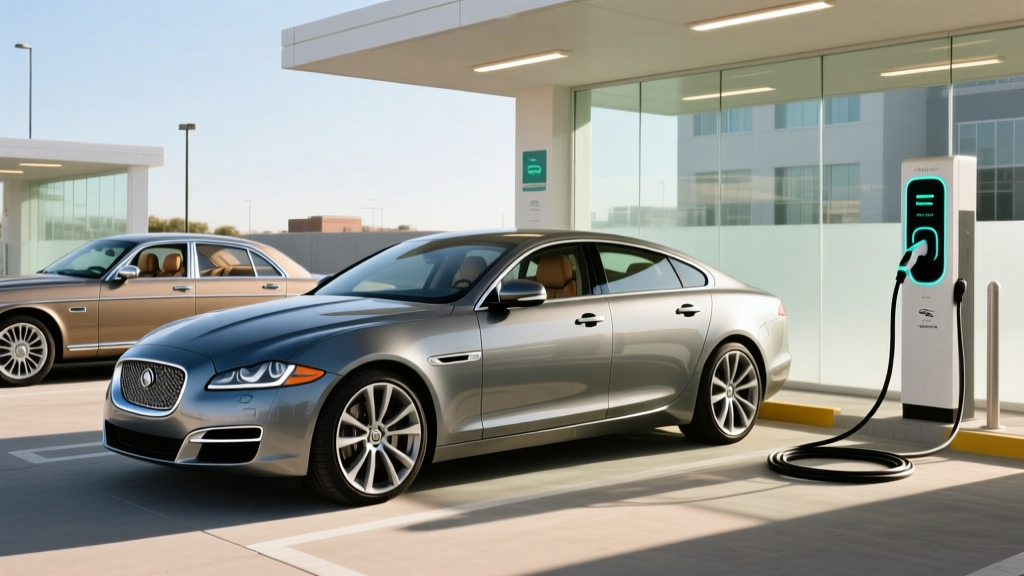
The 2011 Jaguar XJ L Supercharged is a landmark luxury sedan: a 5.0-liter supercharged V8 producing 470 horsepower, 0-60 mph in 4.9 seconds, and a long-wheelbase cabin that defined British executive transport. But with EPA fuel economy rated at roughly 15 mpg city / 21 mpg highway, owners face a painful cost-per-mile reality in 2026. That pain is driving many XJ L enthusiasts to consider a modern EV as a daily driver while keeping the Jaguar for weekend use.
This guide breaks down exactly what home and public EV charging looks like today — installation costs, electrical requirements, charging speeds in kW (power) versus kWh (energy capacity), connector compatibility, and how cost-per-mile stacks up against that thirsty 5.0L V8. Whether you're pairing an EV with your XJ L or replacing it entirely, these numbers will shape your decision.
Charging Levels Explained: How Fast Does Each Add Range?
Before evaluating equipment, understand the three charging tiers available to EV owners. The critical distinction: kW (kilowatts) measures the rate of power delivery — think of it as the width of the pipe. kWh (kilowatt-hours) measures total energy stored in the battery — the size of the tank. A 100 kWh battery charged at 10 kW takes roughly 10 hours from empty to full (minus losses).
| Level | Voltage / Amperage | Power (kW) | Miles of Range Added Per Hour | Best For |
|---|---|---|---|---|
| Level 1 (120V) | 120V / 12A | ~1.4 kW | 3–5 miles | Overnight top-ups, PHEVs, emergencies |
| Level 2 (240V) | 240V / 32A–48A | 7.7–11.5 kW | 25–44 miles | Daily home charging, most EVs |
| DC Fast Charging | 400V–800V DC | 50–350 kW | 150–1,200+ miles/hr equivalent | Road trips, rapid top-ups |
A typical 2026 EV with an 80 kWh battery charging on Level 2 at 11.5 kW will go from 10% to 80% in roughly 5 hours. That same session on a 250 kW DC fast charger takes approximately 18–22 minutes, though charge curves taper significantly above 80% State of Charge (SoC) to protect battery health. Peak kW ratings are never sustained across the full session — a 250 kW-capable vehicle may only hold that rate between 10–40% SoC before tapering to 100 kW or less.
Home Charger Installation: Electrical Requirements and Real Costs
Installing a Level 2 home charger is the single biggest ownership infrastructure decision. The 2011 Jaguar XJ L Supercharged needed only a gas station; an EV needs a dedicated 240V circuit. Here's what that involves.
Electrical requirements: A 48-amp Level 2 charger requires a dedicated 60-amp breaker on a 240V circuit (NEC code mandates circuits be rated at 125% of continuous load). The charger hardwires directly to the panel or plugs into a NEMA 14-50 outlet. Wire gauge is typically 6 AWG copper for runs under 50 feet, stepping to 4 AWG for longer distances.
Panel upgrade reality: Many homes built before 2000 have 100-amp or 150-amp main panels. If your panel is already near capacity (running electric range, dryer, HVAC, water heater), adding a 60-amp EV circuit may require upgrading to a 200-amp service. This is the single largest variable in installation cost and is especially common in older neighborhoods where XJ L owners often reside.
| Component | Low-End Cost | High-End Cost | Notes |
|---|---|---|---|
| Level 2 Charger (Equipment) | $350 | $750 | Smart Wi-Fi chargers, 32A–48A |
| Electrician Labor | $500 | $2,000 | Depends on panel proximity and wall material |
| Electrical Permit | $50 | $250 | Varies by municipality |
| Panel Upgrade (if needed) | $1,500 | $4,500 | 100A→200A service upgrade |
| Total (no panel upgrade) | $900 | $3,000 | Most straightforward installs |
| Total (with panel upgrade) | $2,400 | $7,500 | Older homes with limited capacity |
The federal Residential Clean Energy Credit (IRS §25C) covers 30% of charger equipment and installation costs, up to $1,000, for equipment placed in service through 2032. Some utilities also offer rebates of $250–$500 for smart charger installations — check your local provider. Always hire a licensed electrician and pull a permit; unpermitted work can void homeowner's insurance claims.
Connector Compatibility: NACS, CCS, and CHAdeMO
As of 2026, the North American Charging Standard (NACS), developed by Tesla, has become the dominant connector for new EVs. Most legacy CCS1 vehicles can access Tesla Superchargers via a manufacturer-approved adapter. Here's the compatibility landscape:
| Connector | Brands Using It (Native) | Adapter Available? | Notes |
|---|---|---|---|
| NACS (Tesla) | Tesla, Ford, GM, Rivian, Volvo, Polestar, Hyundai (2025+), Kia (2025+) | N/A — native standard | 25,000+ Supercharger stalls in North America |
| CCS1 | BMW, Mercedes, VW (pre-2025), Stellantis, older Hyundai/Kia | CCS-to-NACS adapters ($150–$250) | Electrify America, EVgo networks |
| CHAdeMO | Nissan Leaf (legacy) | Limited adapters | Network being phased out in North America |
For home Level 2 charging, most chargers ship with a J1772 connector (the Level 2 standard). Tesla owners use the included J1772-to-NACS adapter, or purchase a NACS-native wall connector. If you drive a CCS1 vehicle, no adapter is needed for home charging — J1772 is universal for AC Level 2.
Cost to Charge vs. Fueling the 2011 Jaguar XJ L Supercharged
This is where the math gets compelling. The 2011 XJ L Supercharged's 5.0L V8 drinks premium fuel at roughly 15 mpg city / 21 mpg highway per EPA estimates on fueleconomy.gov. With premium gasoline averaging $4.50/gallon in early 2026, that's roughly $0.26 per mile in combined driving.
| Scenario | Rate | Cost Per Mile | Annual Cost (12,000 mi) |
|---|---|---|---|
| Home charging (off-peak utility rate) | $0.12/kWh | $0.04 | $480 |
| Home charging (average US rate) | $0.17/kWh | $0.05 | $600 |
| Public Level 2 (network pricing) | $0.30/kWh | $0.09 | $1,080 |
| DC Fast Charging (road trips) | $0.45/kWh | $0.14 | $1,680 |
| 2011 XJ L Supercharged (premium gas) | $4.50/gal, 17 mpg combined | $0.26 | $3,120 |
Assumptions: EV efficiency of 3.0 miles per kWh (typical for a 2026 mid-size luxury EV sedan). Even using exclusively DC fast charging — the most expensive scenario — an EV costs less per mile than the supercharged Jaguar. Home charging at off-peak rates delivers fuel cost savings of roughly $2,600 annually over 12,000 miles. Over five years, that's $13,000 back in your pocket.
Equipment Recommendations: Top Level 2 Chargers for 2026
Not all Level 2 chargers are equal. Here are three proven options spanning budget, smart features, and maximum power output:
ChargePoint Home Flex
- Power Output: Up to 11.5 kW (48A) on a 60A circuit, configurable down to 16A
- Connector: J1772 (NACS adapter included for Tesla-compatible vehicles)
- Cable Length: 23 feet
- Smart Features: Wi-Fi, Alexa integration, scheduling, energy dashboard, utility demand-response
- Price: ~$550
Best for: Most EV owners wanting a flexible, future-proof charger with robust app control.
Tesla Wall Connector
- Power Output: Up to 11.5 kW (48A)
- Connector: NACS native (includes J1772 adapter for non-Tesla EVs)
- Cable Length: 24 feet
- Smart Features: Wi-Fi, over-the-air updates, power sharing between two units, access control
- Price: ~$450
Best for: Tesla owners or households with NACS-equipped vehicles seeking the cleanest native integration.
Emporia Vue EV Charger
- Power Output: Up to 11.5 kW (48A)
- Connector: J1772
- Cable Length: 24 feet
- Smart Features: Whole-home energy monitoring integration, solar-aware charging, scheduling
- Price: ~$400
Best for: Budget-conscious buyers or homes with solar panels wanting integrated energy management.
Safety, Code, and Installation Best Practices
EV charging is a continuous high-amperage load — unlike a dryer that cycles on and off, a charger may draw maximum current for 6–10 hours straight. This demands proper installation:
- Dedicated circuit: Your charger must have its own breaker — never share a circuit with other appliances.
- GFCI protection: NEC 2023 and later require GFCI (Ground Fault Circuit Interrupter) protection for outdoor receptacles. Many modern chargers include built-in GFCI; verify with your electrician to avoid nuisance tripping from double-GFCI configurations.
- Outdoor rating: If your charger mounts outside, ensure it carries a NEMA 4 (weatherproof) rating. Indoor-rated units in garages need no special weather protection.
- Wire gauge: 6 AWG copper minimum for 48A circuits. Aluminum wire is cheaper but requires larger gauge — your electrician will spec this based on run length and local code.
- Permit and inspection: Every jurisdiction requires a permit for new 240V circuits. Skipping this risks insurance denial in the event of an electrical fire. Inspection typically costs $50–$100 and takes 15 minutes.
Charging Time Examples for Common Battery Sizes
How long does a real charging session take? These examples assume starting from 10% SoC to 80% (the practical daily charging window — charging above 80% slows dramatically on both LFP and NMC batteries to protect cell longevity):
| Battery Size (usable kWh) | Level 2 at 7.7 kW (32A) | Level 2 at 11.5 kW (48A) | DC Fast at 150 kW (avg) | DC Fast at 250 kW (avg) |
|---|---|---|---|---|
| 60 kWh (compact EV) | ~5.5 hours | ~3.6 hours | ~32 minutes | ~22 minutes |
| 80 kWh (mid-size sedan/SUV) | ~7.3 hours | ~4.9 hours | ~42 minutes | ~28 minutes |
| 100 kWh (large SUV/truck) | ~9.1 hours | ~6.1 hours | ~52 minutes | ~35 minutes |
| 130 kWh (heavy-duty truck) | ~11.8 hours | ~7.9 hours | ~68 minutes | ~45 minutes |
Note that DC fast charging times reflect average sustained rates, not peak rates. A vehicle rated for 250 kW peak may sustain 180 kW average from 10–80% due to thermal management and charge-curve taper. Battery preconditioning — warming the pack before arriving at a charger via the vehicle's navigation system — is essential for achieving advertised charge speeds, especially in temperatures below 50°F.
Frequently Asked Questions
How much does it cost to install a home EV charger?
A straightforward Level 2 installation with an adequate electrical panel typically runs $900–$3,000 including equipment, electrician labor, and permit. If your home needs a panel upgrade from 100A to 200A service, add $1,500–$4,500. The federal §25C credit covers 30% of installation costs up to $1,000, and many utilities offer additional rebates.
How fast will each charging level add range?
Level 1 (120V) adds 3–5 miles per hour — adequate for plug-in hybrids with small batteries but impractical for full EVs. Level 2 (240V) adds 25–44 miles per hour depending on amperage, easily replenishing a day's driving overnight. DC fast charging adds 150–1,200+ miles per hour equivalent, enabling 10–80% sessions in 18–35 minutes for most modern EVs.
Which connector or charger is compatible with my EV?
For 2026 model-year vehicles, NACS is the dominant standard (Tesla, Ford, GM, Rivian, Hyundai, Kia, Volvo, and others). Older CCS1 vehicles work with CCS-to-NACS adapters at Superchargers. For home Level 2 charging, J1772 is universal — Tesla owners use an included adapter. Check your vehicle's charge port before purchasing a home charger.
How much does charging cost per mile compared to gas?
Home charging at average US electricity rates ($0.17/kWh) costs roughly $0.05 per mile for a typical EV. The 2011 Jaguar XJ L Supercharged, at 17 mpg combined on premium fuel at $4.50/gallon, costs approximately $0.26 per mile — over five times more. Even exclusive DC fast charging at $0.45/kWh undercuts the Jaguar at $0.14 per mile.
What electrical upgrades might I need?
The most common upgrade is a panel replacement from 100-amp to 200-amp service ($1,500–$4,500). Other potential needs include: running new conduit from the panel to the garage ($5–$15 per foot), upgrading the meter base if your utility requires it, or adding a sub-panel if your main panel lacks physical breaker slots. A licensed electrician can assess your specific situation during a free or low-cost consultation.