If you're retiring a rumbling 2006 Dodge Charger SRT8 — with its 6.1L Hemi V8, 425 hp, and 13 MPG combined — and stepping into your first electric vehicle, the single biggest ownership shift isn't the silence or the instant torque. It's the fueling paradigm. Instead of weekly stops at the gas pump, you'll be plugging in at home, at work, or at public DC fast-charging stations. This guide walks you through every layer of EV charging in 2026, from the wall outlet in your garage to the 350 kW chargers lining interstate corridors, with exact numbers so you can budget, plan, and buy the right equipment.
Charging Levels Explained: kW, Miles per Hour, and What Each Level Actually Does
Before buying any hardware, understand the three tiers of EV charging. The critical distinction: kW (kilowatts) measures power — how fast energy flows into the car. kWh (kilowatt-hours) measures energy capacity — the size of the battery "tank." Confusing them is the most common new-owner mistake.
| Level | Voltage / Amps | Power (kW) | Miles of Range Added per Hour | Typical Use Case |
|---|---|---|---|---|
| Level 1 | 120V / 12A | ~1.4 kW | 3–5 mi/hr | Overnight top-ups, PHEVs, emergency |
| Level 2 | 240V / 32–48A | 7.7–11.5 kW | 25–44 mi/hr | Home daily charging, workplaces, malls |
| DC Fast (Level 3) | 400–800V DC | 50–350 kW | 150–1,200+ mi/hr (peak) | Road trips, highway corridors, quick top-ups |
Real-world nuance: Those "miles per hour" figures assume moderate efficiency (~3–4 mi/kWh, typical of a midsize crossover like the Hyundai Ioniq 5 or Tesla Model Y). A heavy electric truck like the Rivian R1T will add fewer miles per kWh, while a sleek sedan like the Lucid Air adds more. DC fast-charging speeds also taper sharply above ~80% state of charge (SoC) to protect the battery — so a "350 kW" peak rarely sustains for the full session.
How Much Does It Cost to Install a Home EV Charger?
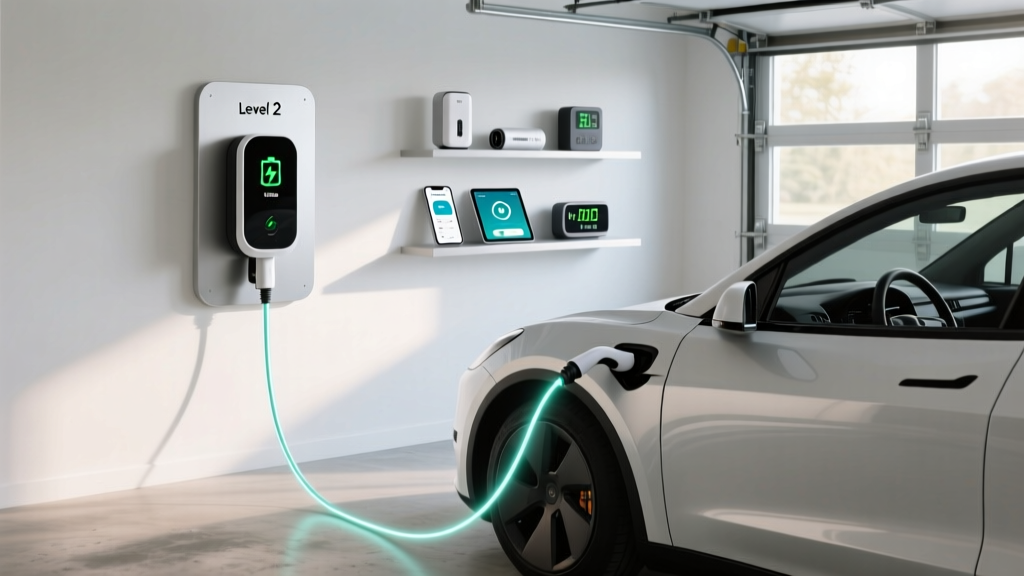
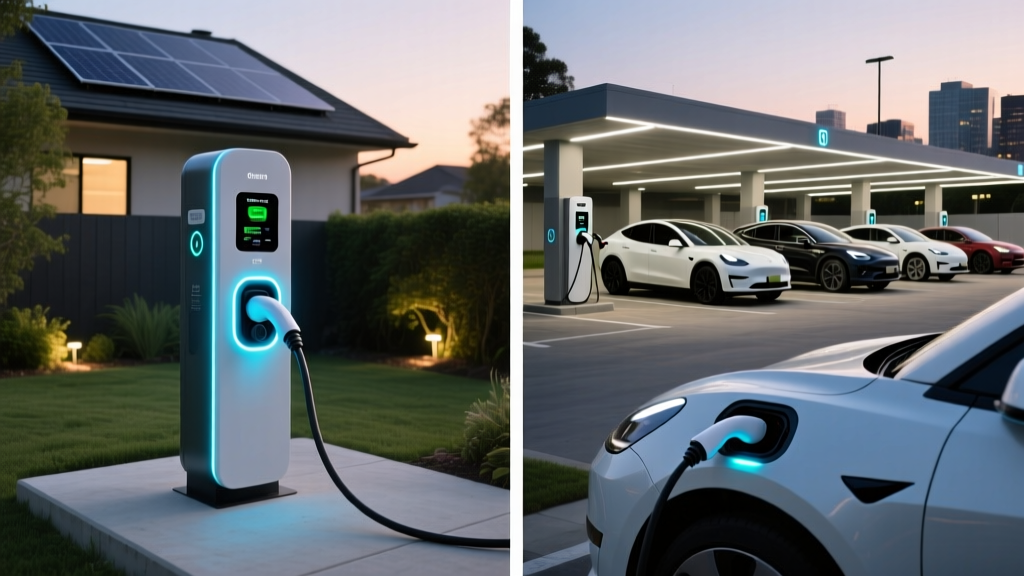
For most EV owners, a Level 2 home charger is the backbone of daily life. You'll plug in each evening and wake up to a full battery — no gas station detours. But installation costs vary wildly depending on your home's electrical infrastructure.
| Component | Cost Range | Notes |
|---|---|---|
| Level 2 EVSE hardware (charger unit) | $350–$750 | Smart WiFi-enabled 40A–48A units |
| Electrician labor (standard install) | $400–$1,200 | Run 240V/50A circuit from panel to garage |
| Permit & inspection | $50–$250 | Required by most local codes |
| Electrical panel upgrade (if needed) | $1,500–$3,500 | Older homes with 100A service may need 200A upgrade |
| Total (no panel upgrade) | $800–$2,200 | Most homes with 200A service |
| Total (with panel upgrade) | $2,300–$5,700 | Homes built pre-1990, or with heavy existing loads |
Electrical Requirements: What Your Home Needs
A standard Level 2 charger requires a dedicated 240V circuit — the same voltage as your electric dryer or oven. Most 48A chargers require a 60-amp breaker (the National Electrical Code requires circuits to be rated at 125% of the continuous load, so 48A × 1.25 = 60A). A 40A charger needs a 50-amp breaker.
Panel capacity check: If your home has a 200-amp main panel with moderate existing loads (HVAC, water heater, stove), adding a 60A EV circuit is usually straightforward. But if you have a 100-amp panel — common in homes built before the 1990s, or those that never had central A/C added — you'll likely need a panel upgrade or a smart load-management device that throttles charger amperage when other heavy loads kick on.
Safety and code requirements:
- Dedicated circuit — never share with other appliances
- GFCI (Ground Fault Circuit Interrupter) breaker — required by NEC 2020+ for EV circuits in garages
- NEMA 14-50 outlet (for plug-in chargers) or hardwired connection (often required for 48A+ units)
- Outdoor-rated (NEMA 4) enclosure if the charger is mounted outside
- Local permit and post-installation inspection — skip this and you risk voiding homeowner's insurance coverage for electrical fires
Note: Always hire a licensed electrician for the final install and spec confirmation. The figures above are national averages; your local rates and code requirements may differ.
Which Connector Is Compatible With Your EV?
The connector landscape has consolidated significantly by 2026. Here's where things stand:
| Connector | Brands Using It (2026 Models) | Notes |
|---|---|---|
| NACS (North American Charging Standard / Tesla) | Tesla (all), Ford, GM, Rivian, Volvo, Polestar, Hyundai, Kia, BMW, Mercedes-Benz, Subaru | Industry-wide adoption. Smaller, lighter plug. Native Supercharger access. |
| CCS1 (Combined Charging System) | Legacy models from VW, some Stellantis, Honda (older trims) | Being phased out on new models. Adapters available for NACS stations. |
| CHAdeMO | Nissan Leaf (discontinued), Mitsubishi Outlander PHEV | Essentially deprecated in North America. Avoid for new purchases. |
Adapter reality: If you buy a CCS1-equipped used EV (say, a 2023 VW ID.4), you can purchase a CCS-to-NACS adapter (~$150–$250) to access Tesla Superchargers. Ford and GM began shipping vehicles with native NACS ports for the 2025 model year. By 2026, nearly every new EV sold in North America uses NACS natively, and most public DC fast-charging networks (Electrify America, EVgo, ChargePoint) have added NACS cables alongside CCS.
How Fast Will Each Charging Level Add Range? Real Charging-Time Examples
Charging time depends on battery size (kWh), the charger's power output (kW), and the vehicle's onboard charger limit for Level 2. Here are practical scenarios:
Example 1: Tesla Model Y (75 kWh battery, ~310 mi EPA range)
- Level 1 (1.4 kW): 0–100% in ~54 hours — impractical except for trickle-top-ups
- Level 2, 48A (11.5 kW): 0–100% in ~7 hours — wake up fully charged every morning
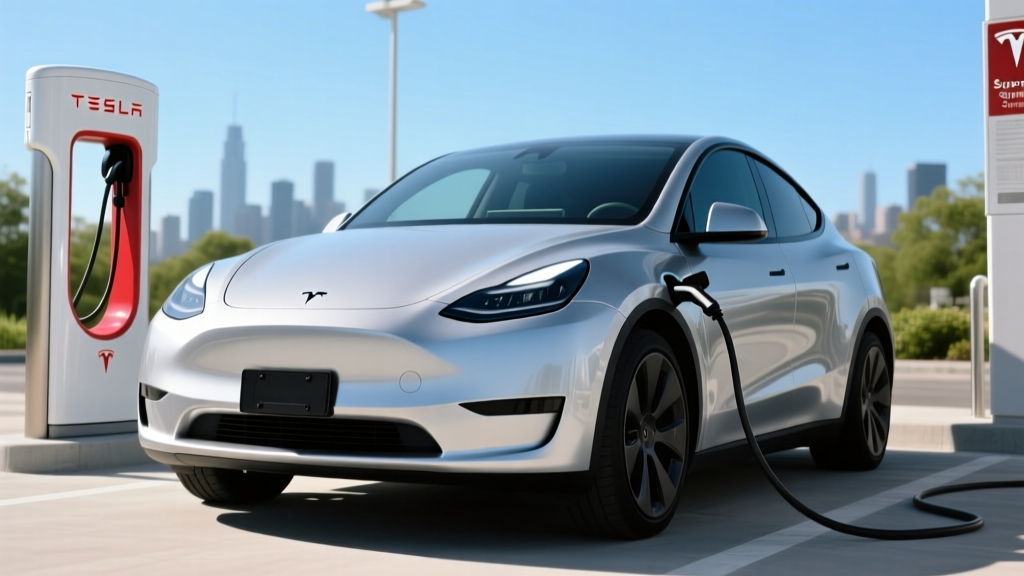
- DC Fast (250 kW peak): 10–80% in ~18 minutes at a V4 Supercharger, adding ~200 miles
Example 2: Hyundai Ioniq 5 (84 kWh battery, ~305 mi EPA range)
- Level 2, 40A (9.6 kW): 0–100% in ~9 hours
- DC Fast (350 kW peak, 800V architecture): 10–80% in ~18 minutes — among the fastest in production
Example 3: Ford F-150 Lightning Extended Range (131 kWh battery, ~320 mi EPA range)
- Level 2, 48A (11.5 kW): 0–100% in ~12 hours — plan on a full overnight session
- DC Fast (150 kW peak): 10–80% in ~41 minutes
Charging-curve reality check: Peak kW ratings are just that — peaks. Most EVs sustain peak charge rate only between ~10–40% SoC, then taper progressively. A "350 kW capable" vehicle might average 180–220 kW across a 10–80% session. This is why 10–80% time is a more honest metric than peak kW alone.
Cost to Charge: $/kWh Scenarios and Cost per Mile vs. Gas
This is where EV ownership economics really shine — especially compared to the 2006 Charger SRT8's appetite for premium fuel at 13 MPG combined.
| Scenario | Rate | Vehicle Efficiency | Cost per Mile |
|---|---|---|---|
| Home, off-peak utility rate | $0.11/kWh | 3.5 mi/kWh (e.g., Model Y) | $0.031/mi |
| Home, average U.S. rate | $0.17/kWh | 3.5 mi/kWh | $0.049/mi |
| Public Level 2 (ChargePoint, etc.) | $0.25–$0.40/kWh | 3.5 mi/kWh | $0.071–$0.114/mi |
| DC Fast (Electrify America, EVgo) | $0.35–$0.55/kWh | 3.5 mi/kWh | $0.10–$0.157/mi |
| Gas: 2006 Charger SRT8 (premium) | $3.80/gal | 13 MPG combined | $0.292/mi |
| Gas: 2026 Toyota Camry (regular) | $3.40/gal | 32 MPG combined | $0.106/mi |
The takeaway: Home charging at off-peak rates costs roughly 1/9th per mile what the old SRT8 cost in premium fuel. Even public DC fast charging undercuts the SRT8 by half. Compared to an efficient modern gas sedan, home-charged EVs still win by ~2:1, while road-trip DC fast charging is roughly cost-neutral with a 32 MPG gas car.
Sources: U.S. average electricity rates from EIA; fuel economy data from fueleconomy.gov.
Recommended Home Level 2 Chargers for 2026
Not all EVSEs (Electric Vehicle Supply Equipment) are equal. Here are three proven units spanning budget, mid-range, and premium tiers — all NACS-native for 2026.
Emporia Vue Level 2 Charger
- Power output: 48A (11.5 kW) on a 60A circuit
- Connector: NACS (native)
- Cable length: 24 ft
- Smart features: WiFi, app-based scheduling, energy monitoring, solar integration
- Price: ~$399
- Best for: Budget-conscious buyers who want full smart features
ChargePoint Home Flex
- Power output: Configurable 16A–50A (up to 12 kW)
- Connector: NACS (2026 model)
- Cable length: 23 ft
- Smart features: WiFi, app scheduling, Alexa integration, detailed energy reports
- Price: ~$599
- Best for: Flexible amperage to match your circuit capacity
Tesla Wall Connector
- Power output: 48A (11.5 kW)
- Connector: NACS (native — no adapter needed for Tesla or NACS-equipped vehicles)
- Cable length: 24 ft
- Smart features: WiFi, firmware updates, power-sharing with a second unit on one circuit
- Price: ~$475
- Best for: Tesla owners or multi-EV households (power-sharing is a standout feature)
All three units are NEMA 4-rated for outdoor use, UL-listed, and compatible with hardwired or NEMA 14-50 plug-in installation (the ChargePoint and Emporia ship with a 14-50 plug; the Tesla is hardwire-only at 48A). Hardwired is generally preferred for 48A+ circuits — many jurisdictions now require it by code.
Public Charging Networks: What to Expect on the Road
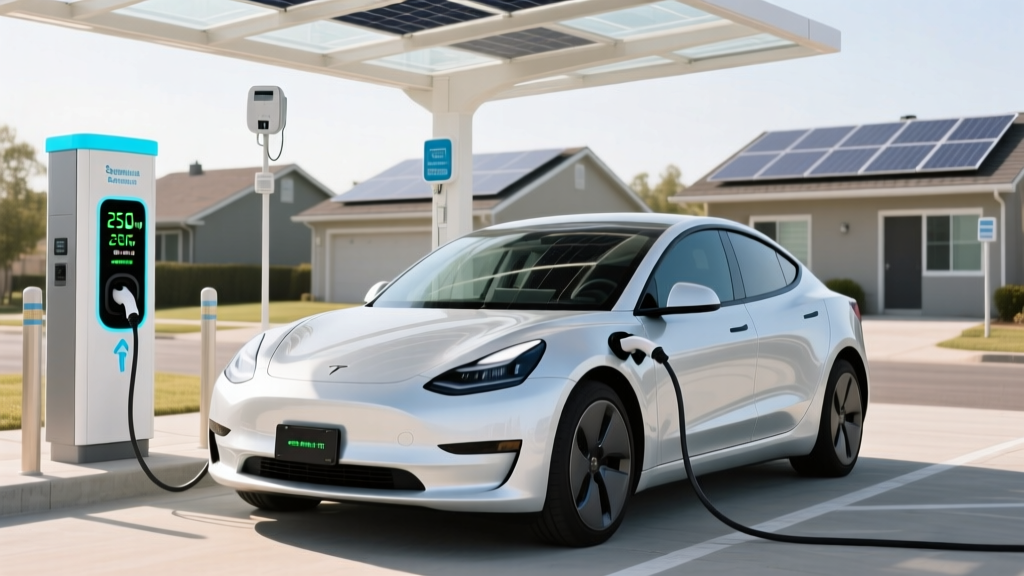
For road trips, you'll rely on DC fast-charging networks. In 2026, the major players are:
- Tesla Supercharger network: 7,000+ stalls in North America, now open to NACS-equipped Fords, GMs, Rivians, and others via the native plug. Reliability remains the industry benchmark — stalls are overwhelmingly operational.
- Electrify America: ~1,000 stations, up to 350 kW. CCS1 and NACS connectors available. Improving reliability after years of criticism.
- EVgo: ~1,100 stations, partnership with GM's Ultium Charge network. NACS and CCS available.
- ChargePoint: Largest network by station count, but a mix of Level 2 and DC fast; check the app for real-time stall status.
Cold-weather charging tip: Battery chemistry slows ion movement in cold temperatures. If you arrive at a DC fast charger with a cold-soaked battery (below ~50°F), expect significantly reduced charge speeds — sometimes 50% slower. Always use your vehicle's preconditioning feature (navigate to the charger in the nav system, or activate it manually) to warm the battery before arrival. This can shave 10+ minutes off a fast-charging session in winter.
Frequently Asked Questions
Can I just use a regular 120V outlet to charge my EV?
Yes, but slowly. Level 1 charging at 1.4 kW adds only 3–5 miles of range per hour — roughly 35–50 miles overnight. That's adequate for plug-in hybrids with small batteries (e.g., a Toyota RAV4 Prime with 42 mi of electric range) but impractical for a full-size BEV with a 75–130 kWh battery. For daily BEV use, Level 2 is essentially mandatory.
Do I qualify for a tax credit on home charger installation?
The federal Alternative Fuel Vehicle Refueling Property Credit (IRC §30C) covers up to 30% of home EVSE costs, capped at $1,000, but only if you live in an eligible census tract (typically rural or low-income areas as defined by the IRS). Many states and utilities offer additional rebates — check afdc.energy.gov for your ZIP code. Consult a tax professional for eligibility.
Will charging at home increase my electric bill significantly?
Absolutely, but the increase is far less than what you'd spend on gas. Driving 12,000 miles/year in an EV averaging 3.5 mi/kWh requires ~3,430 kWh annually. At $0.13/kWh (U.S. average), that's roughly $446/year — compared to $2,770/year in premium fuel for the 2006 Charger SRT8 at the same mileage. Time-of-use (TOU) utility plans can push home charging costs even lower by shifting charging to overnight off-peak hours.
How long do home EV chargers last?
Quality Level 2 EVSEs from reputable brands (ChargePoint, Tesla, Emporia, Grizzl-E) typically last 8–15 years with minimal maintenance. The cable and connector are the most wear-prone components. Most units carry 2–3 year warranties. Keep the connector holster covered outdoors to prevent moisture and debris ingress.
What if my home only has a 100-amp electrical panel?
You have three options: (1) Upgrade to a 200A panel ($1,500–$3,500), which also adds home resale value; (2) Install a lower-amperage 32A charger on a 40A circuit, which still adds ~25 mi/hr — sufficient for most daily needs; (3) Use a smart load-management device like the Emporia Smart Panel or Tesla Gateway that dynamically reduces charger amperage when other heavy loads (dryer, HVAC) are running, allowing you to keep the existing panel.
Swapping a 2006 Charger SRT8 for an EV is a seismic shift — from 425 hp of Hemi thunder to silent, instant electric torque, and from $0.29/mile in premium fuel to $0.03/mile on home electricity. The charging infrastructure is the foundation of that transition. Invest in a proper Level 2 home install, understand your connector type, and use DC fast charging strategically for road trips. The numbers — in both your wallet and your daily convenience — will speak for themselves.