Why a 2005 Chevy Cobalt SS Supercharged Owner Needs This Guide
If you've been holding onto a 2005 Chevy Cobalt SS Supercharged — that 2.0L supercharged Ecotec pushing 205 hp and roughly 22 MPG combined — you already know the era of affordable supercharged coupes is behind us. Parts are getting scarce, insurance is creeping up, and the 30D federal EV tax credit (up to $7,500 at point-of-sale for qualifying new EVs under IRS §30D rules) is pulling many enthusiasts toward electrification.
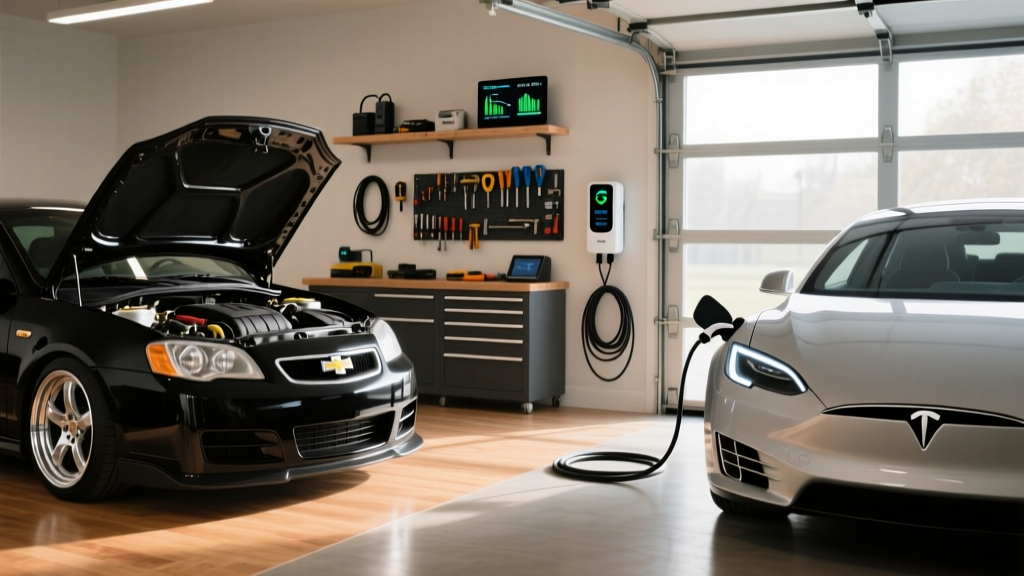
The problem? Most Cobalt SS owners have a standard 120V/15A garage outlet that was fine for a block heater but is wildly underpowered for daily EV charging. This guide walks through exactly what it takes to convert a garage built for a 2005 Cobalt SS Supercharged into a modern EV-ready charging station, with real numbers for cost, electrical requirements, and equipment.
Charging Levels Explained: kW, Miles Per Hour, and Real-World Times
The most common EV mistake is confusing kW (power — how fast energy flows) with kWh (energy — how much the battery holds). A 60 kWh battery charged at 6 kW takes roughly 10 hours from empty. Here's how the three charging levels stack up:
| Level | Voltage / Amps | Power (kW) | Miles of Range / Hour | Best For |
|---|---|---|---|---|
| Level 1 | 120V / 12A | 1.4 kW | 3–5 mi/hr | Overnight top-offs, PHEVs |
| Level 2 | 240V / 32–48A | 7.7–11.5 kW | 25–44 mi/hr | Daily home charging (BEV) |
| DC Fast | 400–800V DC | 50–350 kW | 150–1,000+ mi/hr | Road trips, quick stops |
For context, a 2026 Tesla Model 3 Long Range (82 kWh usable, ~342 mi EPA) charging on a 48A Level 2 station recovers roughly 35 miles of range per hour. A 10–80% session at home takes about 7–8 hours overnight. On a 250 kW DC fast charger, the same 10–80% takes around 25–30 minutes, though the charge curve tapers significantly above 80% to protect the battery — expect the final 20% to take as long as the first 60%.
How Much Does It Cost to Install a Home EV Charger?
If your garage was last wired around the time a 2005 Chevy Cobalt SS Supercharged rolled off the Lordstown assembly line, budget for more than just the charger itself. Here's a realistic breakdown based on 2026 electrician rates:
| Item | Typical Cost Range | Notes |
|---|---|---|
| Level 2 charger (hardware) | $400 – $750 | 40A–48A smart Wi-Fi units |
| Electrician labor (run + mount) | $600 – $1,800 | Depends on run length from panel |
| Permit and inspection | $75 – $250 | Required in most jurisdictions |
| 60A dedicated circuit (breaker + wire) | $150 – $400 | For 48A continuous charger |
| Electrical panel upgrade (if needed) | $1,500 – $4,000 | 100A → 200A service upgrade |
| Total (no panel upgrade) | $1,225 – $3,200 | Typical suburban garage |
| Total (with panel upgrade) | $2,725 – $7,200 | Older homes, common pre-2010 |
The Panel-Upgrade Gotcha Most Cobalt-Era Garages Hit
Homes built in the early-to-mid 2000s often have 100A or 150A main service. Adding a 60A dedicated EV circuit can push your panel past the NEC 80% continuous-load rule. Budget for a 200A service upgrade if your electrician flags this — it's one of the most commonly overlooked costs. Some utilities offer rebates of $200–$500 for panel upgrades paired with EV adoption; check your local provider.
Which Connector Does Your EV Need? NACS, CCS, and CHAdeMO
As of 2026, the North American market has largely consolidated around NACS (Tesla's connector, now adopted by Ford, GM, Rivian, Hyundai, and most major OEMs). CCS1 is still present on older-stock EVs and some commercial fleets, while CHAdeMO is effectively legacy (Nissan Leaf).
| Connector | Brands Using It | Adapter Needed? |
|---|---|---|
| NACS (native) | Tesla, Ford, GM, Rivian, Hyundai/Kia (2025+), Volvo, Polestar | No — plug directly at Superchargers |
| CCS1 (legacy) | VW ID.4 (pre-2025), older BMW iX, some commercial | NACS-to-CCS adapter (~$200) for Supercharger access |
| CHAdeMO | Nissan Leaf (legacy) | Limited public network; consider CCS adapter |
If you're buying a 2026 model-year EV, NACS is the safe bet. For home Level 2 charging, all EVs use the J1772 standard (or NACS, which includes J1772 signaling), so any quality Level 2 station will work regardless of DC connector.
Level 2 Charger Equipment Picks for 2026
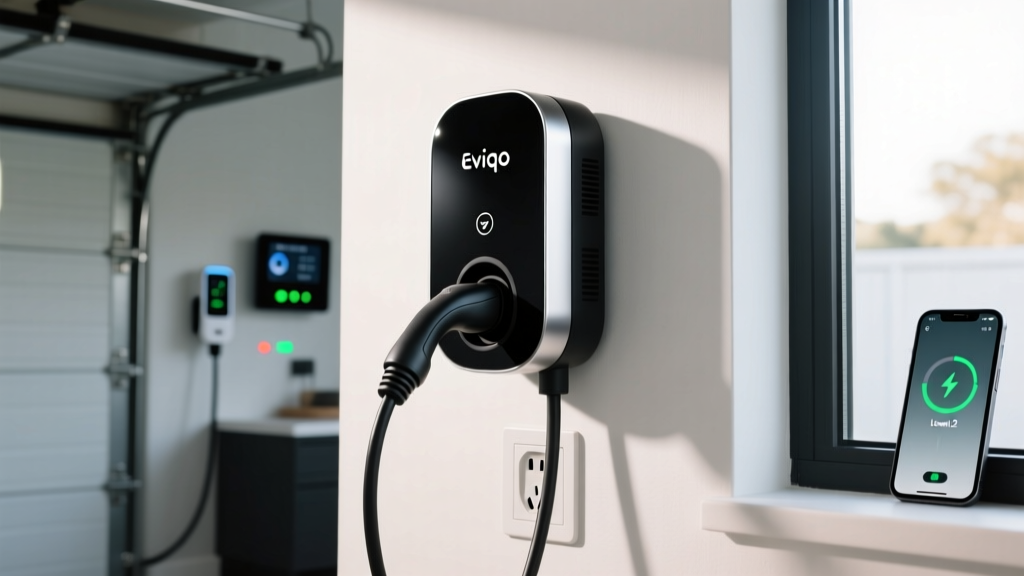
These are the chargers we recommend based on sustained power delivery, smart features, cable quality, and real-world durability. All are hardwired or NEMA 14-50 compatible.
Emporia Level 2 Smart Charger
- Power: 48A (11.5 kW on 60A circuit)
- Cable length: 24 ft
- Connector: J1772 (NACS adapter included in 2026 kit)
- Smart features: Wi-Fi, solar integration, load management, scheduling
- Price: ~$449
- Best for: Budget-conscious buyers with solar panels
ChargePoint Home Flex (2026 refresh)
- Power: Up to 50A (12 kW, adjustable via DIP switches)
- Cable length: 23 ft
- Connector: J1772 or NACS (order-specific)
- Smart features: Alexa/Google Home, detailed app analytics, utility demand-response
- Price: ~$599
- Best for: App-heavy users wanting granular cost tracking
Tesla Wall Connector (Gen 4)
- Power: 48A (11.5 kW)
- Cable length: 24 ft
- Connector: Native NACS
- Smart features: Wi-Fi updates, power sharing (up to 6 units on one circuit), load management
- Price: ~$475
- Best for: Tesla owners or households with multiple NACS EVs
Cost to Charge Per Mile: EV vs. the Cobalt SS Supercharged
The 2005 Chevy Cobalt SS Supercharged averages around 22 MPG combined on premium fuel. At $3.80/gallon (2026 national average premium), that's roughly $0.173 per mile in fuel alone. Here's how EV charging compares across scenarios, using a 2026 Hyundai Ioniq 6 SE Long Range (~3.5 mi/kWh efficiency):
| Scenario | Rate | Cost / Mile | Annual Savings (12k mi) |
|---|---|---|---|
| Home Level 2 (off-peak TOU) | $0.09/kWh | $0.026 | $1,764 vs. Cobalt SS |
| Home Level 2 (standard rate) | $0.16/kWh | $0.046 | $1,524 vs. Cobalt SS |
| Public Level 2 (ChargePoint, EVgo) | $0.35/kWh | $0.10 | $876 vs. Cobalt SS |
| DC Fast (Electrify America) | $0.48/kWh | $0.137 | $432 vs. Cobalt SS |
| 2005 Cobalt SS Supercharged (gas) | $3.80/gal @ 22 MPG | $0.173 | — |
Even exclusively using DC fast charging — the most expensive option — an EV still undercuts the Cobalt SS on per-mile energy cost. But the real savings come from home Level 2 on time-of-use rates, where a full "tank" (roughly 60–80 kWh) costs $5–$13 versus $50+ for premium gas.
Safety, Electrical Code, and What Your Inspector Will Check
EV charging is a continuous load under NEC Article 625, which triggers specific requirements your electrician must follow:
- Dedicated circuit: Your Level 2 charger needs its own breaker — no sharing with outlets or lighting. A 48A charger requires a 60A breaker (NEC 125% continuous-load rule).
- GFCI protection: 2026 NEC requires GFCI on all 240V EV receptacles (NEMA 14-50). Hardwired chargers may be exempt in some jurisdictions, but GFCI breakers are increasingly standard.
- Outdoor rating: If your charger is mounted outside or in an unsealed garage, it must carry a NEMA 4 or IP56 rating. All three chargers recommended above meet this standard.
- Wire gauge: 60A circuits require 6 AWG copper (THHN in conduit) or 4 AWG aluminum. Do not let an electrician undersize wire to cut costs.
- Permit and inspection: Nearly all jurisdictions require a permit for new 240V circuits. Unpermitted work can void homeowner's insurance claims related to electrical fire.
Frequently Asked Questions
Can I just use the mobile charger that came with my EV?
Yes, but most OEM mobile connectors max out at 12A on 120V (Level 1, ~1.4 kW) or 32A on 240V with the right adapter. For a BEV with a 75+ kWh battery, Level 1 adds only ~4 miles per hour — impractical for daily use. A dedicated Level 2 station is strongly recommended for battery-electric vehicles.
Do I qualify for a tax credit on the charger installation?
The federal 30C Alternative Fuel Vehicle Refueling Property Credit covers up to 30% of charger hardware and installation costs (max $1,000 for residential), but only if you live in a qualifying census tract (typically rural or low-income areas per IRS 30C guidelines). Many states and utilities stack additional rebates on top — check your local program.
Will charging degrade my EV battery faster than the Cobalt's engine wore out?
Modern EV batteries (NMC and LFP chemistries) are warranted for 8 years/100,000 miles at minimum 70% capacity retention. Level 2 home charging at moderate SoC (20–80%) is actually the gentlest charging method. DC fast charging does accelerate degradation slightly, but data from fueleconomy.gov and long-term fleet studies show less than 5% additional loss over 150,000 miles compared to exclusive Level 2 use.
My garage is detached — can I run a Level 2 circuit out there?
Yes, but expect higher costs. A detached garage typically requires underground conduit (schedule 80 PVC), a subpanel, and a separate grounding rod. Budget $2,500–$5,000 for the run alone, plus the charger and permit. This is where the panel-upgrade question becomes critical — your main service must handle the additional 60A load plus the subpanel feeder.
What if I buy a used EV with a CCS port in 2026?
You'll charge fine at home (Level 2 uses J1772, which all EVs accept). For DC fast charging on the Tesla Supercharger network, you'll need a CCS-to-NACS adapter (~$180–$250). The Electrify America and EVgo CCS networks remain operational, though expansion has slowed as the industry shifts to NACS.