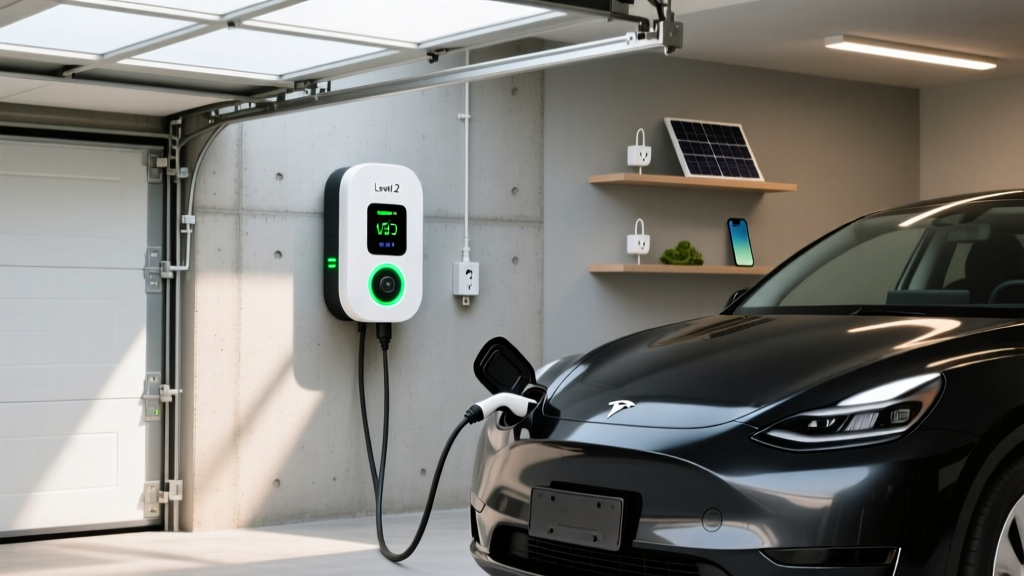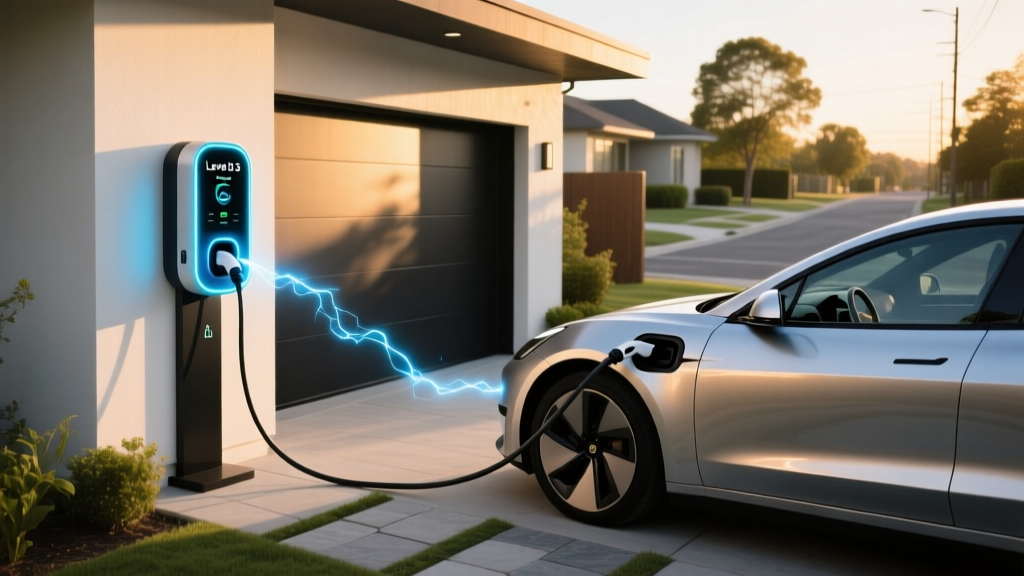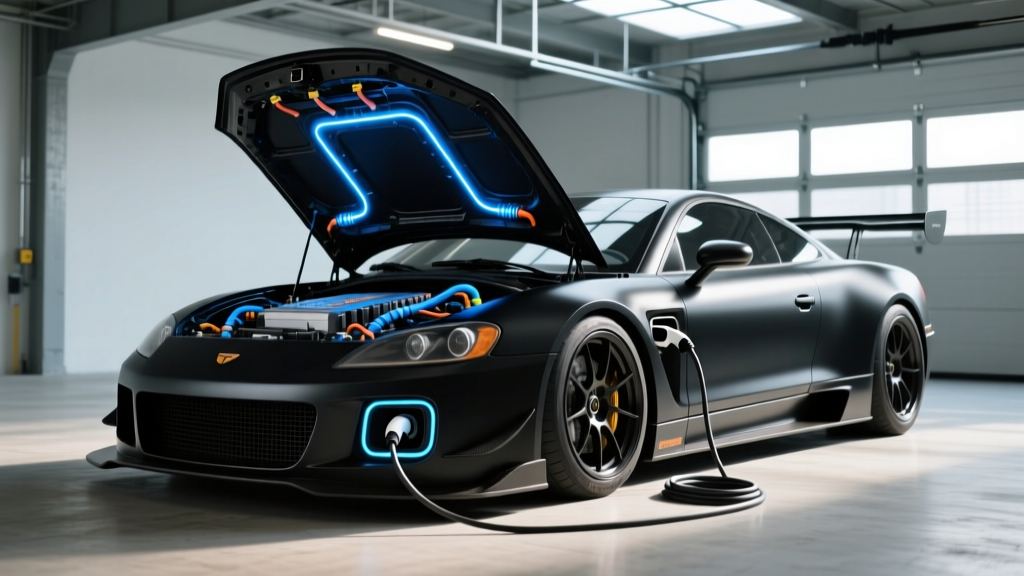
If you're pulling the supercharged 3.8L V6 out of a 2004 Pontiac Grand Prix GTP and dropping in an electric drivetrain, you've picked a solid conversion candidate: a roomy W-body sedan with a spacious engine bay and a curb weight around 3,500 lbs that won't crush a battery pack. But once your EV swap is on the road, the real question begins — how do you actually charge it? This guide covers everything a conversion builder needs to know about EV charging in 2026, from Level 1 trickle charging in the garage to DC fast-charging on the highway, plus the real costs of home installation and daily driving.
Why Charging Matters More in an EV Conversion
Factory-built EVs come with a validated charging system — onboard charger, battery management system (BMS), thermal management, and connector all matched and tested. In a conversion using a salvaged or crate EV powertrain (from a wrecked Tesla Model 3, Nissan Leaf, or a standalone system like NetGain or EV West), you are the integrator. Your charging experience depends on:
- The onboard charger capacity you install (typically 3.3 kW to 11.5 kW for AC charging)
- The connector you wire in (J1772, NACS, or CCS1 combo inlet)
- Your BMS's ability to communicate with DC fast chargers via CAN bus
- The battery chemistry and thermal management you've chosen
Understanding the three charging levels is the foundation of planning your daily routine and any road trips in your converted Grand Prix GTP.
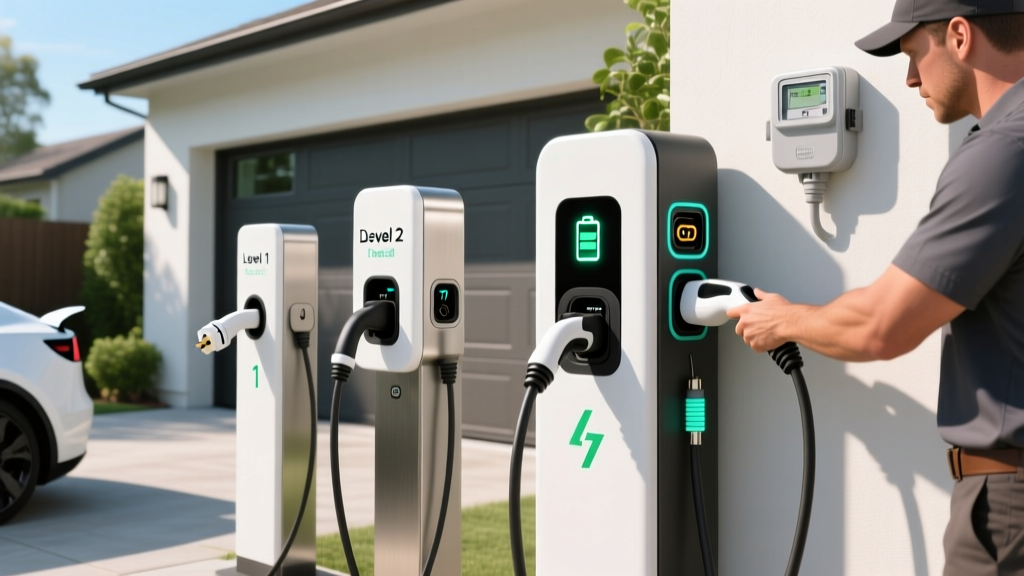
Charging Levels Explained: Speeds, kW, and Miles Per Hour
Before diving in, a critical distinction: kW (kilowatts) measures power — the rate at which energy flows. kWh (kilowatt-hours) measures energy — the total amount stored in your battery. A 60 kWh battery charged at 7.2 kW takes roughly 8.3 hours from empty to full. Confusing these two is the most common EV literacy mistake.
| Level | Voltage / Amps | Power (kW) | Miles of Range Added Per Hour | Typical Use Case |
|---|---|---|---|---|
| Level 1 | 120V / 12A | ~1.4 kW | 3–5 mi/hr | Overnight top-off, emergencies |
| Level 2 | 240V / 16–48A | 3.3–11.5 kW | 12–45 mi/hr | Daily home charging, workplace |
| DC Fast Charge | 200–900V DC | 50–350 kW | 150–1,000+ mi/hr (peak) | Road trips, highway corridors |
For a Grand Prix GTP conversion with a hypothetical 60 kWh pack and ~3.5 mi/kWh efficiency (roughly 210 miles of range), here's what charging times look like in practice:
- Level 1 (1.4 kW): 0–100% in ~43 hours. Useful only for maintaining charge or adding ~40 miles overnight.
- Level 2 (7.2 kW / 32A): 0–100% in ~8.5 hours. A full overnight charge — the sweet spot for daily driving.
- Level 2 (11.5 kW / 48A): 0–100% in ~5.3 hours. Faster, but requires a 60A dedicated circuit.
- DC Fast Charge (50 kW): 10–80% in ~55 minutes. Common at older public stations.
- DC Fast Charge (150 kW): 10–80% in ~22 minutes — assuming your BMS and pack can accept this rate without overheating.
How Much Does It Cost to Install a Home EV Charger?
This is the question every EV owner — and every conversion builder — asks first. The answer depends heavily on your home's electrical panel and the distance from panel to parking spot.
| Component | Low End | High End | Notes |
|---|---|---|---|
| Level 2 EVSE equipment (charger unit) | $300 | $750 | 32A–48A smart chargers; Wi-Fi enabled models cost more |
| Electrician labor | $500 | $2,000 | Depends on run length, wall type, conduit routing |
| Materials (wire, conduit, outlet/hardwire) | $100 | $400 | 6 AWG copper for 48A circuits; longer runs cost more |
| Permit and inspection | $50 | $300 | Varies by municipality; required in most jurisdictions |
| Electrical panel upgrade (if needed) | $1,500 | $4,500 | Upgrading from 100A to 200A service; common in older homes |
| Total (no panel upgrade) | $950 | $3,450 | Most homes with 200A service fall in this range |
| Total (with panel upgrade) | $2,450 | $7,950 | Older homes with 100A panels often need this |
If your 2004-era garage is wired to a home built in the 1970s or '80s with a 100-amp panel already near capacity, adding a 40A EV circuit may push you over the limit. A licensed electrician will perform a load calculation per NEC Article 220 to determine if your panel can handle the draw. Don't skip this step — an overloaded panel is a fire hazard.
What Electrical Upgrades Might You Need?
Beyond the panel itself, consider these common upgrade scenarios:
- Dedicated circuit: A Level 2 charger requires its own breaker — typically 40A for a 32A charger or 60A for a 48A charger (NEC requires the breaker be rated at 125% of the continuous load).
- NEMA 14-50 outlet vs. hardwire: A 14-50 receptacle gives you portability (take the charger when you move) but requires a GFCI breaker in most jurisdictions under current NEC code. Hardwired installations skip the outlet and GFCI requirement, reducing cost and eliminating a common nuisance-trip issue.
- GFCI protection: NEC 2020 and later require GFCI protection for EV receptacles. Some EVSE units have built-in ground-fault detection, which can conflict with GFCI breakers and cause false trips. Hardwiring avoids this.
- Outdoor rating: If your charger is mounted outside or in an unenclosed carport, the EVSE must carry a NEMA 4 or NEMA 4X rating for weather resistance. Look for UL listing (or equivalent NRTL certification) — never use an indoor-rated unit outdoors.
- Conduit and wire gauge: For a 48A charger on a 60A breaker, you'll need 4 AWG copper THHN wire in conduit. Longer runs (over 100 feet) may require upsizing to 3 AWG to limit voltage drop below 3%.
Which Connector Is Compatible with Your EV Conversion?
This is where conversion builders have a real decision to make. In 2026, the North American connector landscape has shifted decisively toward NACS (North American Charging Standard), originally Tesla's proprietary connector and now adopted by Ford, GM, Rivian, Hyundai, and most major automakers. But CCS1 and CHAdeMO still exist in the wild.
| Connector | AC Level 2 Charging | DC Fast Charging | Network Availability | Best For |
|---|---|---|---|---|
| NACS (Tesla/J3400) | Yes (single inlet) | Yes (same inlet) | Tesla Supercharger (20,000+ stalls), growing non-Tesla networks | Best long-term choice for conversions; widest DC network |
| CCS1 (Combo) | Yes (J1772 upper) | Yes (DC pins below) | Electrify America, EVgo, ChargePoint, Ionity | Legacy standard; still widely available |
| CHAdeMO | Requires separate J1772 inlet | Yes (separate connector) | Declining; mostly older Nissan/Mitsubishi stations | Not recommended for new conversions |
| J1772 (AC only) | Yes | No | Universal for AC Level 2 | AC-only conversions; use adapter for DC |
For a Grand Prix GTP conversion, we recommend wiring a NACS inlet. Here's why: the Tesla Supercharger network is the most reliable DC fast-charging infrastructure in North America, with over 20,000 stalls as of 2026. Tesla has opened the network to non-Tesla vehicles via the Tesla app and built-in Magic Dock adapters at select stations. By installing a NACS inlet and a CAN-bus-compatible BMS that speaks Tesla's charging protocol, your conversion gains access to the widest charging network available.
If you source a salvaged Tesla drive unit and battery pack for your swap, you'll likely inherit a NACS inlet and Supercharger-compatible BMS — though Tesla's software authentication for Supercharging a non-Tesla VIN remains a gray area. Many conversion builders use CCS1 inlets with Electrify America and EVgo access instead, which avoids any authentication complications.
Level 2 Charger Equipment Recommendations
If you're choosing a home charger for your converted Grand Prix, here are proven units that conversion builders and factory EV owners alike rely on in 2026:
Emporia Level 2 EV Charger
- Power output: 48A (11.5 kW) max, adjustable down to 16A
- Connector: J1772 (NACS adapter included)
- Cable length: 24 feet
- Smart features: Wi-Fi, app scheduling, solar integration, energy monitoring
- Price: ~$400
- Best for: Budget-conscious builders who want smart scheduling and solar pairing
ChargePoint Home Flex
- Power output: Up to 50A (12 kW), configurable via DIP switch
- Connector: J1772 (NACS adapter available)
- Cable length: 23 feet
- Smart features: Wi-Fi, Alexa/Google Home, detailed app analytics, utility demand-response programs
- Price: ~$550
- Best for: Builders wanting a proven brand with utility rebate eligibility
Tesla Wall Connector
- Power output: 48A (11.5 kW)
- Connector: NACS native (J1772 adapter included)
- Cable length: 24 feet
- Smart features: Wi-Fi, OTA updates, power sharing (daisy-chain up to 6 units on one circuit)
- Price: ~$475
- Best for: NACS-inlet conversions; cleanest integration with Tesla-sourced drivetrains
All three units are UL-listed, NEMA 4 rated for outdoor use, and support hardwired or plug-in (NEMA 14-50) installation. For a conversion, the key consideration is whether your onboard charger can accept the full 48A — many salvaged Nissan Leaf or Chevy Bolt onboard chargers max out at 6.6 kW or 7.2 kW, meaning a 48A charger won't charge any faster than a 32A unit.
Cost Per Mile: EV Charging vs. the Original Supercharged V6
The original 2004 Grand Prix GTP Supercharged was rated at approximately 18 city / 28 highway MPG on premium fuel (the L67 3.8L supercharged engine required 91+ octane). At 2026 national average premium fuel prices of roughly $4.10/gallon, that's about $0.18–$0.23 per mile in fuel cost.
| Scenario | Cost per kWh or Gallon | Efficiency | Cost Per Mile | Annual Cost (12,000 mi) |
|---|---|---|---|---|
| Gas (GTP Supercharged, 23 MPG combined) | $4.10/gal (premium) | 23 MPG | $0.178 | $2,136 |
| Home Level 2 (off-peak utility rate) | $0.12/kWh | 3.5 mi/kWh | $0.034 | $411 |
| Home Level 2 (standard residential rate) | $0.17/kWh | 3.5 mi/kWh | $0.049 | $583 |
| Public Level 2 (ChargePoint, EVgo) | $0.35/kWh | 3.5 mi/kWh | $0.100 | $1,200 |
| DC Fast Charging (Electrify America) | $0.48/kWh | 3.5 mi/kWh | $0.137 | $1,646 |
The math is stark: even at the most expensive DC fast-charging rates, your EV conversion costs less per mile than the original supercharged V6 on premium fuel. Home charging at off-peak rates saves roughly $1,700 per year over gas at 12,000 miles annually. Over five years, that's $8,500 in fuel savings — enough to offset a significant portion of your conversion battery cost.
One caveat for conversion builders: your actual efficiency depends on pack weight, motor choice, and aerodynamic drag. The Grand Prix GTP's 0.33 Cd isn't class-leading, and adding 500+ lbs of battery in the trunk will reduce efficiency. Expect 3.0–3.8 mi/kWh in real-world driving, depending on your build. Cold weather (below 32°F) will reduce range by 15–30% due to battery chemistry slowdown and cabin heating load — plan your pack size accordingly.
Safety and Code Considerations for Your Conversion's Charging Setup
EV conversions sit in a regulatory gray area in some states, but your charging infrastructure must still comply with the National Electrical Code (NEC) and local amendments. Key requirements:
- NEC Article 625: Governs Electric Vehicle Charging System Equipment. Requires GFCI protection for receptacles rated 150V to ground or less, 50A or less. Hardwired EVSE units must have ground-fault protection integral to the equipment.
- Dedicated circuit: Your EV charger must be on its own breaker — no sharing with garage outlets, lights, or other loads.
- Ventilation: If charging indoors (garage), NEC 625.52 requires either mechanical ventilation or an EVSE with integrated ventilation monitoring. For lithium-ion packs with a sealed BMS, this is typically satisfied by the EVSE's built-in safety systems.
- Cable management: NEC requires that charging cables not create a trip hazard. Wall-mounted cord retractors or cable management systems keep your garage safe and code-compliant.
- Conversion-specific: Your BMS must include overcharge protection, cell balancing, and temperature monitoring. A BMS failure during charging can cause thermal runaway. Use a reputable BMS (Orion, SimpBMS, or Thunderstruck) and never bypass safety limits to force faster charging.
Charging FAQ for Your Grand Prix GTP EV Conversion
Can I charge my EV conversion at a Tesla Supercharger?
Technically yes, if you install a NACS inlet and your BMS communicates via CAN bus using Tesla's charging handshake protocol. However, Tesla's Supercharger network authenticates vehicles by VIN, and a non-Tesla VIN may not be recognized. Some conversion builders have successfully registered their conversions through the Tesla app, but this is not guaranteed. CCS1 networks (Electrify America, EVgo) are more straightforward for conversions since they don't require VIN authentication.
How fast will each charging level add range to my conversion?
Assuming 3.5 mi/kWh efficiency: Level 1 adds ~3–5 miles per hour. Level 2 at 7.2 kW adds ~25 miles per hour. Level 2 at 11.5 kW adds ~40 miles per hour. DC fast charging at 50 kW adds ~175 miles per hour at peak, and at 150 kW adds ~525 miles per hour at peak — but expect taper above 60% SoC.
What onboard charger do I need for my conversion?
Your onboard charger determines your maximum AC charging speed. Popular conversion choices include the Elcon PFC series (3.3 kW to 6.6 kW), salvaged Tesla Gen 2 onboard chargers (11.5 kW, but complex to integrate), and the LiquidCool charger from Grin Technologies (up to 3.3 kW). Match the charger to your available home circuit — a 7.2 kW onboard charger needs a 40A/240V circuit to reach full speed.
Do I need a panel upgrade for a Level 2 charger?
Possibly. If your home has a 100A main panel that's already heavily loaded (electric range, dryer, HVAC), adding a 40A EV circuit may exceed the panel's capacity. An electrician will calculate your existing loads per NEC Article 220. A 200A panel can typically accommodate a Level 2 charger without upgrade. Panel upgrades cost $1,500–$4,500 depending on your utility's requirements and local labor rates.
Is there a tax credit for installing a home EV charger?
The federal Alternative Fuel Vehicle Refueling Property Credit (IRS §30C) was revived under the Inflation Reduction Act and offers up to 30% of the cost of home EV charging equipment and installation, capped at $1,000, for installations in eligible census tracts (typically lower-income or non-urban areas). Check the IRS §30C guidelines for current eligibility. This credit applies to both factory EVs and conversions, provided the vehicle and equipment meet the requirements. Consult a tax professional for your specific situation.
How much does it cost to charge at home vs. public stations?
Home charging at $0.12–$0.17/kWh costs roughly $0.03–$0.05 per mile. Public Level 2 stations average $0.30–$0.40/kWh ($0.09–$0.11/mile). DC fast chargers range from $0.35–$0.55/kWh ($0.10–$0.16/mile). Home charging is consistently the cheapest option — aim to do 80%+ of your charging at home for the best economics.