If you've spent years behind the wheel of a 2002 supercharged Nissan Xterra — that whining Eaton M62 supercharger, 210 horsepower, and roughly 14 MPG combined — you already know what it costs to fuel a truck built for a bygone era of cheap gas. The jump to an electric vehicle is one of the biggest ownership shifts you can make, and the single most important decision you'll face isn't which EV to buy. It's how you'll charge it at home.
This guide breaks down every charging scenario you'll encounter, from overnight Level 2 top-ups in your garage to DC fast charging on road trips. We'll cover real installation costs, electrical panel realities for older homes, connector compatibility across every major brand, and exactly how much you'll save per mile compared to that Xterra's 17-gallon thirst.
Charging Levels Explained: kW, Miles Per Hour, and What You Actually Need
Before anything else, let's clear up the most common confusion in EV ownership: kW (kilowatts) measures power — how fast energy flows into your battery. kWh (kilowatt-hours) measures energy — the total capacity of your battery, like gallons in a fuel tank. A 75 kWh battery charged at 7.2 kW takes roughly 10 hours from empty to full. Confusing these two is the number-one mistake new EV buyers make when shopping for chargers.
| Level | Voltage | Max Power (kW) | Miles of Range Added Per Hour | Typical Use Case |
|---|---|---|---|---|
| Level 1 | 120V | 1.4 kW | 3–5 miles | Emergency / low-mileage days |
| Level 2 | 240V | 7.2–19.2 kW | 20–75 miles | Daily home charging |
| DC Fast Charge | 400–800V DC | 50–350 kW | 150–1,200+ miles (theoretical) | Road trips, quick top-ups |
For a former Xterra owner used to five-minute fill-ups, DC fast charging is the closest analog — but it's not something you install at home. Your daily charging will happen on Level 2, and that's where 90% of your setup decisions matter.
- 60 kWh battery (e.g., base Chevrolet Equinox EV): ~8 hours on 7.2 kW Level 2; ~28 minutes on a 150 kW DC fast charger (with taper above 80%).
- 85 kWh battery (e.g., Ford F-150 Lightning Extended Range): ~11 hours on 7.2 kW; ~22 minutes on a 150 kW charger.
- 115 kWh battery (e.g., Rivian R1T Max Pack): ~15 hours on 7.2 kW; ~35 minutes on a 350 kW charger (Rivian supports peak rates up to 220 kW depending on pack).
Note: DC fast charging follows a charge curve — peak kW is only sustained between roughly 10–50% SoC. Above 80%, speeds taper sharply to protect battery health. This is why manufacturers quote 10–80% times rather than 0–100%.
Home Level 2 Installation: Electrical Requirements, Panel Upgrades, and Real Costs
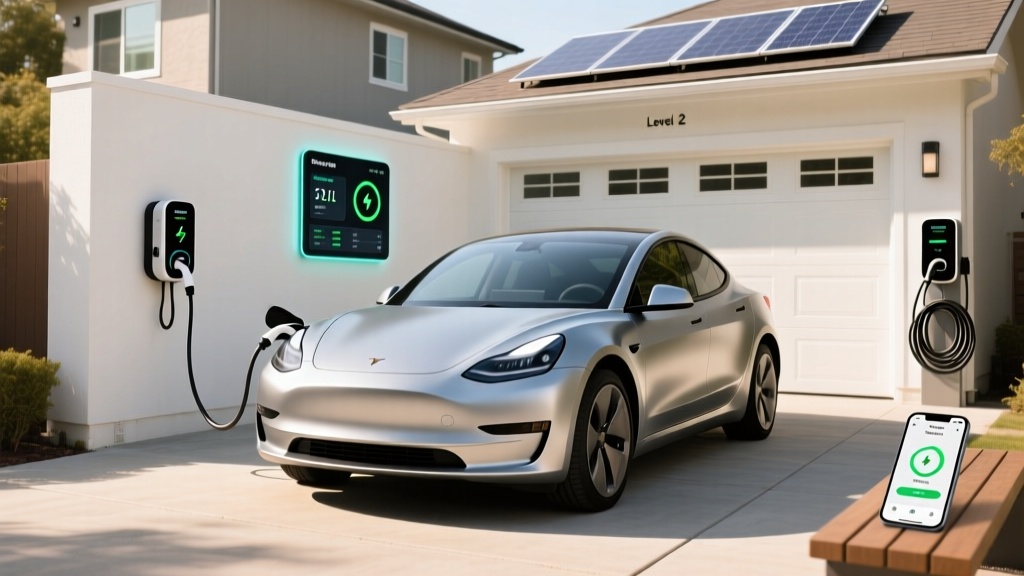
Here's where your home's age matters as much as your EV's specs. A Level 2 charger requires a dedicated 240-volt circuit — the same type of outlet your electric dryer or oven uses. Most installations use a NEMA 14-50 outlet or a hardwired connection on a 40- to 60-amp breaker (the charger itself is typically rated for 32A or 48A continuous draw, and the National Electrical Code requires the breaker to be rated at 125% of continuous load).
The panel upgrade question is the one nobody warns you about until the electrician's quote arrives. If your home was built before 2000 — around the same vintage as that 2002 Xterra — you may have a 100-amp or 150-amp main panel. Adding a 40A or 60A EV circuit can push you past your panel's capacity, especially if you already run electric heat, a dryer, and an electric range. A panel upgrade to 200A typically costs $1,500–$3,500 before any EV work begins.
| Cost Component | Low End | High End | Notes |
|---|---|---|---|
| Level 2 Charger (Equipment) | $250 | $700 | Depends on power output, cable length, smart features |
| Electrician Labor | $400 | $1,700 | Short run from panel = cheap; long run through walls/attic = expensive |
| Permit & Inspection | $50 | $300 | Varies by municipality; some jurisdictions waive for EV installs |
| Electrical Panel Upgrade (if needed) | $1,500 | $3,500 | 100A→200A upgrade; not needed in most modern homes |
| Total (No Panel Upgrade) | $700 | $2,700 | Most homeowners fall in $1,000–$1,800 range |
| Total (With Panel Upgrade) | $2,200 | $6,200 | Common in pre-2000 homes with 100A service |
The federal government offers a tax credit under IRS Form 8911 for home EV charging equipment and installation — up to 30% of costs, capped at $1,000. Eligibility depends on whether you live in a qualifying census tract. Check the IRS guidelines or consult a tax professional before counting on this credit.
Connector Compatibility: NACS, CCS1, CHAdeMO, and What Your EV Needs
The connector landscape has consolidated significantly. As of 2025–2026, the North American Charging Standard (NACS) — originally Tesla's proprietary connector — has been adopted by Ford, GM, Rivian, Volvo, Polestar, Hyundai, Kia, and most other major automakers. CCS1 remains on many vehicles sold between 2019–2024, and CHAdeMO is effectively legacy (Nissan Leaf being the last major holdout).
| Connector | Brands Using It (New Vehicles) | Adapter Needed? |
|---|---|---|
| NACS (Tesla/J3400) | Tesla, Ford, GM, Rivian, Hyundai, Kia, Volvo, Polestar, BMW, Toyota, Subaru | CCS→NACS adapters available ($150–$250) for older CCS vehicles |
| CCS1 | VW ID.4 (pre-2025), some Stellantis models, legacy EVs | NACS→CCS adapters for Tesla Supercharger access |
| CHAdeMO | Nissan Leaf (discontinued after 2025 model year), Mitsubishi Outlander PHEV (older) | Limited adapter options; network shrinking |
For your home Level 2 charger: Most NACS-equipped EVs use a J1772-to-NACS adapter for Level 2 (included with most new Teslas and available from third-party brands). If you buy a NACS-native EV, you can purchase a NACS wall connector directly. If your EV has a CCS port, any J1772 Level 2 charger will plug directly in — J1772 is the universal Level 2 standard in North America.
Charging Cost Per Mile: EV vs. Your Old Xterra
Let's put real numbers to the savings. The 2002 Nissan Xterra with the supercharged 3.3L V6 rated at roughly 14 MPG combined (per fueleconomy.gov archives). At $3.40/gallon (national average), that's $0.243 per mile just in fuel. Here's how EV charging compares across scenarios:
| Scenario | Cost per kWh | Efficiency (kWh/mi) | Cost Per Mile | Savings vs. Xterra |
|---|---|---|---|---|
| Home Level 2 (Off-Peak TOU Rate) | $0.09 | 0.30 | $0.027 | 89% cheaper |
| Home Level 2 (Standard Rate) | $0.16 | 0.30 | $0.048 | 80% cheaper |
| Public Level 2 (ChargePoint, EVgo L2) | $0.35 | 0.30 | $0.105 | 57% cheaper |
| DC Fast Charging (Electrify America, Tesla) | $0.48 | 0.30 | $0.144 | 41% cheaper |
| 2002 Supercharged Xterra (Gas) | — | 14 MPG | $0.243 | Baseline |
At 12,000 miles per year, home off-peak charging saves roughly $2,590 annually compared to fueling the Xterra. Even relying exclusively on DC fast chargers — the most expensive option — still saves over $1,180 per year. And that's before factoring in oil changes, spark plugs, and the supercharger belt tensioner you'll never miss.
Recommended Level 2 Home Chargers: Power, Features, and Pricing
We evaluate chargers on four criteria: power output (determines charge speed), cable length (25 feet is the practical minimum for most garages), smart features (scheduling, load management, utility integration), and build quality. Here are four models that cover the most common setups:
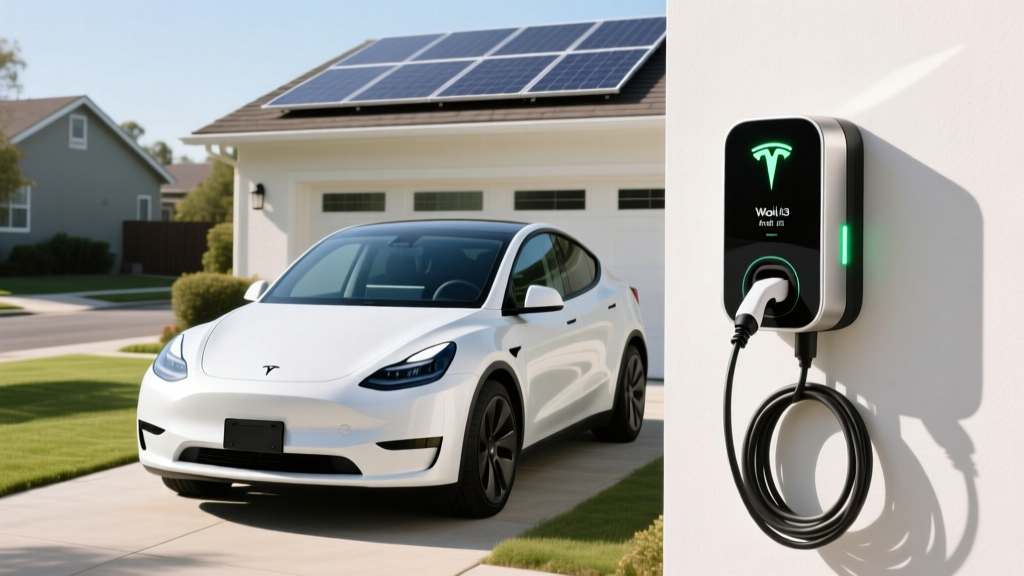
Tesla Wall Connector (Gen 4)
- Power: Up to 11.5 kW (48A) on a 60A circuit
- Connector: NACS native; J1772 adapter included
- Cable: 24 ft
- Smart: Wi-Fi, OTA updates, load sharing between two units
- Price: ~$475
- Best for: Tesla and NACS-equipped Ford/GM/Rivian owners
ChargePoint Home Flex
- Power: Up to 12 kW (50A) configurable on 40–65A circuits
- Connector: J1772 (works with all EVs; NACS adapter for Tesla)
- Cable: 23 ft
- Smart: Wi-Fi, app scheduling, utility demand-response, Alexa
- Price: ~$550–$650
- Best for: Multi-EV households, utility rebate programs
Emporia Vue EV Charger
- Power: Up to 11.5 kW (48A) on a 60A circuit
- Connector: J1772
- Cable: 24 ft
- Smart: Wi-Fi, solar integration, energy monitoring, V2H-ready
- Price: ~$400
- Best for: Solar-panel owners, budget-conscious smart charging
Grizzl-E Smart
- Power: Up to 10 kW (40A) on a 50A circuit
- Connector: J1772 or NACS
- Cable: 24 ft
- Smart: Wi-Fi, OCPP-compatible, adjustable amperage
- Price: ~$450
- Best for: Cold climates (rated to -40°F), outdoor installs
Safety, Electrical Code, and Installation Best Practices
Every Level 2 installation must comply with the National Electrical Code (NEC) Article 625 and your local jurisdiction's amendments. Key requirements:
- Dedicated circuit: Your EV charger must be on its own breaker — no shared circuits with outlets, lights, or appliances.
- GFCI protection: NEC 2020 and later requires ground-fault circuit interrupter protection for all EV charging outlets. Hardwired units have GFCI built into the charger itself. If using a NEMA 14-50 receptacle, your electrician should install a GFCI breaker.
- Outdoor rating: If your charger is mounted outside, both the unit and the receptacle must carry a NEMA 3R or 4 (weatherproof) rating. All chargers listed above are outdoor-rated.
- Wire gauge: A 60A circuit requires 6 AWG copper wire (THHN in conduit). A 50A circuit uses 6 AWG as well in most jurisdictions. Your electrician will spec this based on run length and local code.
- Permit and inspection: Most municipalities require an electrical permit for a new 240V circuit. The inspection verifies wire gauge, breaker sizing, grounding, and GFCI compliance. Skipping the permit can void your homeowner's insurance coverage for electrical fires.
Load management for older panels: If your 100A or 150A panel doesn't have room for a 60A breaker, consider a smart load-management device like the Emporia Smart Load Center or a Tesla Gateway. These devices monitor your home's total draw in real time and throttle the EV charger when other appliances (dryer, HVAC) are running — letting you install a charger without a full panel upgrade.
Public Charging Networks: What to Expect Away From Home
Home charging handles daily needs, but road trips require DC fast charging. The major networks in 2026:
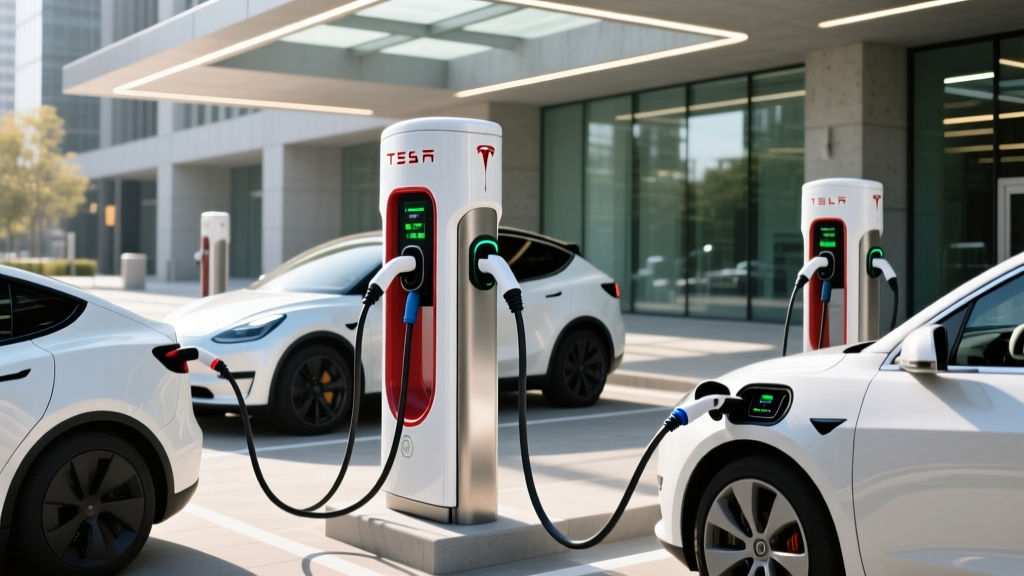
- Tesla Supercharger: 18,000+ stalls in North America, now open to NACS-equipped non-Tesla EVs natively. Peak speeds: 250 kW (V3) and 350 kW (V4). Pricing: $0.25–$0.45/kWh depending on location and time.
- Electrify America: 4,000+ stalls, CCS and NACS connectors at newer stations. Peak: 350 kW. Pricing: $0.43–$0.56/kWh; $0.12/kWh with Pass+ subscription ($4/month).
- EVgo: 2,500+ stalls, mixed CCS/NACS. Peak: 350 kW at newer stations. Pricing: $0.39–$0.52/kWh; subscription discounts available.
- ChargePoint: Primarily Level 2 destination charging; limited DC fast network. Pricing varies by host (retail, hotel, workplace).
On a road trip from Denver to Moab (350 miles) in a Ford F-150 Lightning (Extended Range, 320 miles EPA), you'd need one DC fast stop. Expect 20–25 minutes at a 150+ kW charger to go from 15% to 80%, adding roughly 240 miles. Total charging cost: approximately $18–$25, versus about $60 in gas for the Xterra on the same route.
Frequently Asked Questions
How much does it cost to install a home EV charger?
Most Level 2 installations cost between $700 and $2,700 total (equipment, electrician, and permit) when no panel upgrade is needed. If your home has a 100A panel that needs upgrading to 200A, add $1,500–$3,500. The average homeowner with a modern 200A panel spends about $1,200–$1,600 for a complete installation. Get at least two quotes from licensed electricians and confirm they have specific EV charger installation experience.
How fast will each charging level add range?
Level 1 (120V standard outlet) adds 3–5 miles per hour — sufficient only for PHEVs or EVs driven under 30 miles daily. Level 2 (240V) at 7.2 kW adds roughly 25 miles per hour; at 11.5 kW, about 44 miles per hour. DC fast charging adds 150–300 miles in 20–30 minutes depending on the vehicle's peak charge rate and battery size. For overnight charging, Level 2 at 7.2 kW or higher will fully replenish virtually any EV battery in 8–12 hours.
Which connector and charger is compatible with my EV?
Check your EV's charge port. If it's a 2025+ model from Ford, GM, Rivian, Hyundai, Kia, or Tesla, it almost certainly uses NACS. If it's a 2019–2024 model from VW, BMW, or Stellantis, it likely uses CCS1. The Nissan Leaf uses CHAdeMO. For home Level 2 charging, any J1772 charger works with CCS and CHAdeMO vehicles directly; NACS vehicles use a small J1772-to-NACS adapter. Buy a charger that matches your vehicle's native connector or keep the appropriate adapter in your garage.
How much does charging cost per mile compared to gas?
Home charging at off-peak rates ($0.09/kWh) costs roughly $0.027 per mile for an average EV. Standard home rates ($0.16/kWh) bring that to about $0.048 per mile. Compare that to a 2002 supercharged Xterra at 14 MPG and $3.40/gallon — $0.243 per mile. Even the most expensive DC fast charging at $0.48/kWh costs $0.144 per mile, still 41% cheaper than the Xterra. Annual savings for a 12,000-mile driver range from $1,180 (all DC fast) to $2,590 (all home off-peak).
What electrical upgrades might I need?
The most common upgrade is a new 240V circuit with a 40A, 50A, or 60A breaker. If your panel has open slots and sufficient amperage headroom (calculated using a NEC 220 load calculation), no upgrade is needed beyond the new circuit. If your panel is maxed out — common in homes built before 2000 with original 100A service — you'll need a panel upgrade to 200A ($1,500–$3,500). An alternative is a smart load-management device that shares capacity between the EV charger and other appliances, avoiding the panel upgrade entirely. Your electrician should perform a load calculation before quoting the job.