Will Idling Your EV Charge the Battery? The Short Answer
If you've transitioned from a gas car to an electric vehicle, you might wonder: will idling a car charge the battery? In a conventional vehicle, the alternator tops up the 12V battery whenever the engine runs. But EVs don't work that way — and understanding the difference is critical for new owners.
In an electric vehicle, the high-voltage traction battery (typically 50–120 kWh) can only be charged by plugging into an external power source — a Level 1 wall outlet, a Level 2 home charger, or a DC fast-charging station. There is no alternator. Sitting in your EV with the climate control running does not replenish the main battery; it actually draws energy from it, albeit slowly (roughly 1–3 kW for HVAC depending on outside temperature).
What about the 12V auxiliary battery that powers the lights, infotainment, and onboard computers? Most modern EVs use a DC-DC converter to maintain the 12V battery from the high-voltage pack whenever the vehicle is "on" or in accessory mode. So yes, the 12V battery stays topped up while the car is powered on — but the traction battery itself is only losing charge, never gaining it, unless you're plugged in.
This distinction matters because misconceptions about how EV batteries charge often lead to poor ownership habits and unnecessary anxiety about battery longevity. Let's dig into the real science of EV battery life, degradation, and what you can do to maximize your pack's lifespan.
How EV Batteries Actually Charge — And Why Idling Doesn't Help
EV charging is a one-directional energy flow from the grid into your battery. The process involves:
- Level 1 (120V AC): Delivers ~1.4 kW, adding roughly 3–5 miles of range per hour. Useful for overnight top-ups on low-mileage days.
- Level 2 (240V AC): Delivers 7.2–19.2 kW depending on circuit and onboard charger capacity, adding 25–60+ miles per hour. The standard for daily home charging.
- DC Fast Charging (Level 3): Bypasses the onboard charger and delivers 50–350 kW directly to the battery, adding 150–300+ miles in a 20–30 minute session (10–80% SoC).
None of these methods involve the vehicle's drivetrain. Unlike a hybrid with regenerative braking that recovers energy during deceleration, a stationary EV has no kinetic energy to harvest. The only scenario where an EV's motor acts as a generator is during regen braking while driving — and even then, you're recovering a fraction of the energy you already spent accelerating.
Practical takeaway: If you're low on charge, idling won't help. Plug in, or drive to the nearest charger.
Battery Chemistry: LFP vs NMC — What's Inside Your Pack
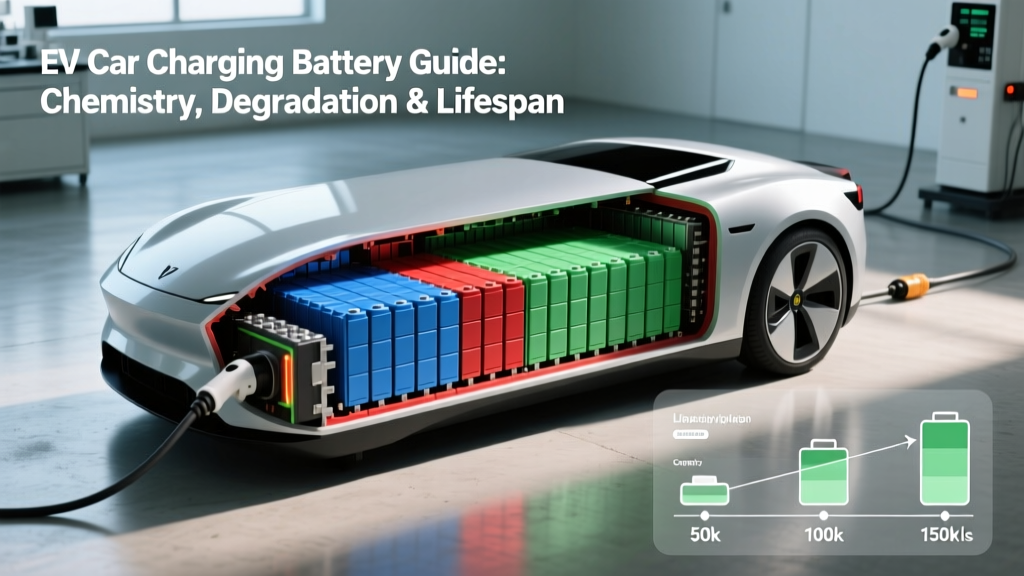
Not all EV batteries are created equal. The two dominant lithium-ion chemistries in 2026 model-year EVs are LFP (lithium iron phosphate) and NMC (nickel manganese cobalt), with NCA (nickel cobalt aluminum) appearing in some Tesla and Rivian applications. Your battery's chemistry dictates its energy density, cycle life, cold-weather performance, and cost.
| Attribute | LFP (LiFePO4) | NMC / NCA |
|---|---|---|
| Energy Density | Lower (~160–180 Wh/kg cell-level) | Higher (~220–300 Wh/kg cell-level) |
| Typical Range per Pack Size | Shorter; used in Standard Range models | Longer; used in Long Range / Performance trims |
| Cycle Life | 3,000–5,000+ cycles to 80% SoH | 1,000–2,000 cycles to 80% SoH |
| Cold-Weather Performance | More range loss in freezing temps (~30–40%) | Better cold retention (~20–30% loss) |
| Recommended Daily SoC | 100% is fine; periodic full charges encouraged | 80% daily; 100% only for trips |
| Cost | Lower (no cobalt or nickel) | Higher (critical mineral costs) |
| Common Applications (2026) | Tesla Model 3 RWD, BYD, base Ford Mustang Mach-E | Hyundai Ioniq 5 Long Range, Chevy Equinox EV, Rivian |
Which is better? It depends on your driving pattern. If you mostly commute under 40 miles daily and can charge at home, LFP's superior cycle life and 100% daily charging tolerance make it the pragmatic choice. If you frequently take road trips and need maximum range per charge, NMC's energy density is worth the trade-off in cycle life. According to fueleconomy.gov, the 2026 Tesla Model 3 RWD (LFP, 60 kWh usable) achieves 363 miles EPA, while the Long Range AWD (NMC, ~79 kWh usable) reaches 363 miles with substantially more power.
Real-World Degradation: How Long Do EV Batteries Last?
The fear that EV batteries will need frequent replacement is largely outdated. Modern thermal management systems and improved cell chemistry have pushed real-world degradation well within acceptable bounds for most owners.
Typical Degradation Curve (Aggregated Fleet Data)
| Time / Mileage | Average Capacity Retained (SoH) | Range Impact (from 300 mi EPA) |
|---|---|---|
| Year 1 / 15,000 mi | ~95–97% | ~285–291 mi |
| Year 3 / 45,000 mi | ~90–93% | ~270–279 mi |
| Year 5 / 75,000 mi | ~87–91% | ~261–273 mi |
| Year 8 / 120,000 mi | ~82–88% | ~246–264 mi |
| Year 10 / 150,000 mi | ~78–85% | ~234–255 mi |
Based on aggregated fleet data from Recurrent Auto and manufacturer warranty thresholds. Individual results vary by climate, charging habits, and chemistry.
Key observations from real-world fleet data:
- The steepest degradation occurs in Year 1 (roughly 3–5% loss), then the curve flattens significantly.
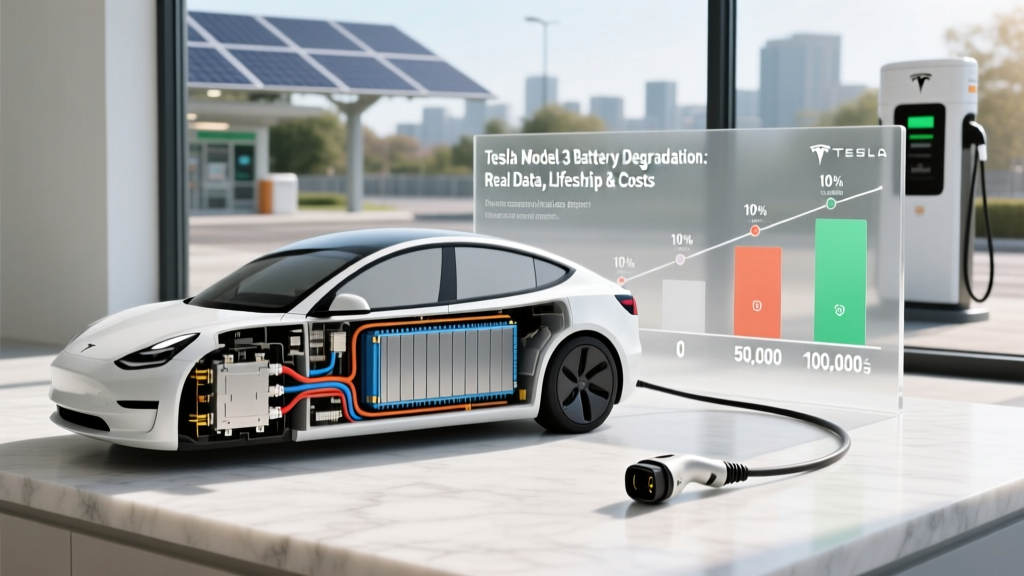
- LFP packs tend to degrade more slowly over time, particularly in moderate climates. Tesla's LFP-equipped Model 3 vehicles have shown roughly 2–3% loss over the first 50,000 miles in Recurrent's dataset.
- Frequent DC fast charging above 80% SoH impact is modest — studies from the Idaho National Lab found roughly 2.3% additional degradation over 40,000 miles for vehicles that exclusively DC fast-charged versus Level 2 charging. Meaningful, but not catastrophic.
- Extreme heat is the bigger enemy. Vehicles regularly parked in 100°F+ environments without active thermal management (some older Nissan Leafs) show accelerated degradation. Most 2026 EVs with liquid-cooled packs handle heat far better.
How long do EV batteries last? Most modern EV batteries will retain 80%+ capacity at 150,000–200,000 miles. In practice, the battery will often outlast other major vehicle components. Complete failure is rare — gradual capacity loss is the norm.
Warranty Coverage: What Manufacturers Guarantee
Federal law mandates that EV batteries carry a minimum warranty of 8 years / 100,000 miles (10 years / 150,000 miles in CARB states like California, New York, and Massachusetts). Most manufacturers exceed this baseline.
| Manufacturer (2026 Models) | Battery Warranty | Capacity Threshold |
|---|---|---|
| Tesla (Model 3/Y RWD — LFP) | 8 yr / 120,000 mi | 70% retention |
| Tesla (Model 3/Y Long Range — NMC) | 8 yr / 120,000 mi | 70% retention |
| Hyundai / Kia | 10 yr / 100,000 mi | 70% retention |
| General Motors (Ultium-based) | 8 yr / 100,000 mi | 70% retention (60% for Lyriq) |
| Ford (Mustang Mach-E, F-150 Lightning) | 8 yr / 100,000 mi | 70% retention |
| Rivian | 8 yr / 175,000 mi | 70% retention |
| BMW (i4, iX) | 8 yr / 100,000 mi | 70% retention |
Source: Manufacturer warranty documentation. CARB-state extensions may apply. Verify at irs.gov for any credit-related battery requirements.
What does the warranty cover? If your battery's State of Health drops below the threshold (typically 70%) within the warranty period, the manufacturer will repair or replace the battery at no cost. This covers defective cells, excessive degradation, and complete failure. It does not cover damage from accidents, flooding, or unauthorized modifications.
EV Battery Replacement Cost: The Real Numbers
Out-of-warranty battery replacement remains the biggest financial fear for EV buyers. Here's the current landscape:
| Vehicle / Pack Size | Battery Replacement Cost (Parts + Labor) | Typical Replacement Timeline |
|---|---|---|
| Tesla Model 3 RWD (60 kWh LFP) | $10,000–$14,000 | Rarely before 200,000+ mi |
| Tesla Model Y LR (79 kWh NMC) | $13,000–$18,000 | Rarely before 180,000+ mi |
| Hyundai Ioniq 5 (77.4 kWh NMC) | $12,000–$16,000 | Rarely before 175,000+ mi |
| Ford F-150 Lightning Ext. Range (131 kWh) | $20,000–$30,000 | Rarely before 150,000+ mi |
| Chevy Equinox EV (85 kWh Ultium) | $12,000–$17,000 | Rarely before 175,000+ mi |
| Rivian R1T (149 kWh Max Pack) | $22,000–$30,000+ | Rarely before 175,000+ mi |
Important context: Battery replacement is rarely needed during typical ownership. According to data from Recurrent Auto, fewer than 5% of EVs in their 10,000-vehicle study needed a battery replacement — and the vast majority of those were covered under warranty. Most EV batteries will retain 80–90% capacity over a 10-year, 150,000-mile ownership period.
If you do face an out-of-warranty replacement, costs are declining roughly 8–12% per year as cell manufacturing scales and refurbished packs become available. By 2028–2030, expect replacement costs to be 30–40% lower than today's figures.
Factors That Accelerate (or Preserve) Battery Life
Your daily habits have a measurable impact on long-term battery health. Here's what the data shows:
Maximize Battery Longevity
- Avoid sustained 100% SoC: For NMC packs, charge to 80% daily and only hit 100% before road trips. LFP owners can charge to 100% regularly — Tesla and BYD actually recommend periodic full charges for LFP to calibrate the BMS.
- Don't habitually drain below 10%: Deep discharges stress cells. Plug in when you hit 15–20%.
- Limit DC fast charging to road trips: Daily Level 2 charging at 7–11 kW is gentler on cells than daily 150 kW+ DC sessions. If you must DC fast-charge daily, try to stay in the 20–80% SoC window where charge rates are highest and heat is lowest.
- Precondition before fast charging: Most EVs (Tesla, Hyundai, GM) warm the battery to ~95°F before a DC session, reducing stress and improving charge speed. Enable navigation-based preconditioning when routing to a charger.
- Park in shade or a garage during extreme heat: Sustained 100°F+ ambient temperatures accelerate chemical degradation. If outdoor parking is unavoidable, limit SoC to 50–60% during prolonged hot-weather storage.
- Don't store at 100% or 0% for weeks: If leaving your EV unused for 2+ weeks, set SoC to ~50% and leave it plugged in (most EVs will maintain this automatically).
- Use scheduled charging: Set your EV to finish charging right before you leave. Batteries degrade faster when sitting at high SoC for extended periods.
How to Check Your Battery's State of Health (SoH)
Monitoring your battery's health is easier than ever in 2026, with multiple methods available:
- In-vehicle displays: Tesla's service menu (accessed via the touchscreen) shows a battery health percentage. Hyundai and Kia's infotainment systems include an EV battery status screen. GM's Ultium vehicles display estimated range vs. original — a proxy for SoH.
- OBD-II diagnostic tools: Devices like the OBDLink MX+ paired with apps such as EV Health or Leaf Spy (for Nissan) can read the battery management system's reported SoH percentage and individual cell voltages.
- Third-party testing services: Companies like Recurrent and Geotab offer fleet and individual battery health reports based on telematics data.
- Dealer diagnostics: Any authorized service center can run a full battery health check, typically as part of a routine service visit. Request this if you're approaching a warranty mileage threshold and suspect excess degradation.
What's a "normal" SoH reading? At 50,000 miles, expect 90–95% SoH. At 100,000 miles, 82–90%. If your SoH drops below 70% within the warranty period, contact your dealer immediately for a warranty claim.
Emerging Battery Technology: What's on the Horizon
The next generation of EV batteries promises step-change improvements, but realistic timelines matter:
- Solid-state batteries: Toyota has announced a solid-state battery targeting 2027–2028 production, claiming ~750 km (466 mi) range and 10-minute fast charging. Samsung SDI and QuantumScape are also advancing solid-state cells. However, manufacturing scale and cost remain significant barriers. Expect initial deployment in premium vehicles only, with mainstream availability unlikely before 2030.
- Silicon anode batteries: Companies like Sila Nanotechnologies and Group14 are replacing graphite anodes with silicon to boost energy density by 20–40%. These are expected in production vehicles by 2027–2028, potentially adding 50–80 miles of range to existing pack sizes.
- Sodium-ion batteries: CATL and BYD have begun producing sodium-ion cells for low-cost, short-range EVs in China. These trade energy density for dramatically lower material costs and better cold-weather performance. US-market availability is estimated for 2027+ in budget segments.
Bottom line: Current lithium-ion technology (LFP and NMC) is mature, reliable, and improving incrementally every model year. If you're buying an EV in 2026, today's batteries are more than adequate — you don't need to wait for solid-state.
Frequently Asked Questions
Will idling an electric car charge the main battery?
No. An EV's high-voltage traction battery can only be charged by plugging into an external power source (Level 1, Level 2, or DC fast charger). Idling with the car powered on will maintain the 12V auxiliary battery via the DC-DC converter, but the main battery will slowly drain from HVAC and electronics use.
How long do EV batteries last in real-world use?
Most modern EV batteries retain 80–90% of their original capacity after 10 years and 150,000 miles. LFP-chemistry packs often last longer, with cycle-life ratings of 3,000–5,000+ cycles. Full battery replacement is rarely needed during typical ownership.
How much does it cost to replace an EV battery?
Out-of-warranty replacement costs range from roughly $10,000 for a 60 kWh pack (Tesla Model 3 RWD) to $30,000+ for a 149 kWh pack (Rivian R1T Max). However, most replacements occur under the manufacturer's 8-year/100,000-mile warranty at no cost to the owner.
Is LFP or NMC better for daily driving?
For daily commuting under 40 miles, LFP is generally better — it tolerates 100% daily charging, has a longer cycle life, and costs less. For frequent long trips requiring maximum range, NMC's higher energy density is the advantage. Choose based on your driving pattern, not just the spec sheet.
Does fast charging damage my EV battery?
DC fast charging causes slightly more degradation than Level 2 charging — roughly 2–3% additional capacity loss over 40,000 miles according to Idaho National Lab research. It's not catastrophic, but daily DC fast charging is not ideal. Use Level 2 for routine charging and reserve DC fast charging for road trips.
Can I check my EV battery health myself?
Yes. Many EVs display SoH data in the infotainment or service menus (Tesla, Hyundai, Kia). You can also use an OBD-II scanner with EV-compatible apps like EV Health or Leaf Spy, or request a dealer diagnostic report during routine service.
Does cold weather permanently damage EV batteries?
No. Cold weather causes temporary range loss (20–40% in freezing temperatures) due to increased internal resistance and HVAC demand, but this is fully reversible when temperatures rise. Permanent damage comes from sustained extreme heat, not cold. Preconditioning your battery before driving in cold weather helps restore performance.
What happens if my EV battery degrades below the warranty threshold?
If your battery's State of Health falls below the manufacturer's threshold (typically 70% retention) within the warranty period (usually 8 years/100,000 miles), the manufacturer will repair or replace the battery at no cost. Contact your dealer for a diagnostic assessment and warranty claim.
For the latest EPA range and efficiency data, visit fueleconomy.gov. For federal EV tax credit rules affecting battery sourcing requirements, see irs.gov.