Search for "where to put jumper cables on battery" and you'll find hundreds of guides written for gas cars. But if you're standing in front of an electric vehicle with a dead battery and a set of jumper cables in hand, the answer is more nuanced—and getting it wrong can be expensive or dangerous.
This guide covers exactly which battery in an EV can be jumped (spoiler: it's not the big one under the floor), how to do it safely, and then goes deep into the high-voltage traction battery that actually powers the car: chemistry, degradation data, warranty terms, replacement costs, and how to maximize lifespan.
EVs Have Two Batteries—You Can Only Jump One
Every mainstream EV on the road in 2026—Tesla Model Y, Ford Mustang Mach-E, Hyundai Ioniq 5, Chevrolet Equinox EV, Rivian R1S—has two completely separate batteries:
- 12V auxiliary battery: A small lead-acid or lithium-ion battery that powers the vehicle's electronics: door locks, infotainment, lights, computers, and critically, the contactors that connect the high-voltage pack to the drivetrain. This is usually a Group 47 or H5 size, similar to what you'd find in a conventional car.
- High-voltage traction battery: The large lithium-ion pack (typically 400V or 800V architecture, ranging from ~50 kWh to 130+ kWh) mounted under the floor. This is what propels the car and stores the energy you pay for at the charger.
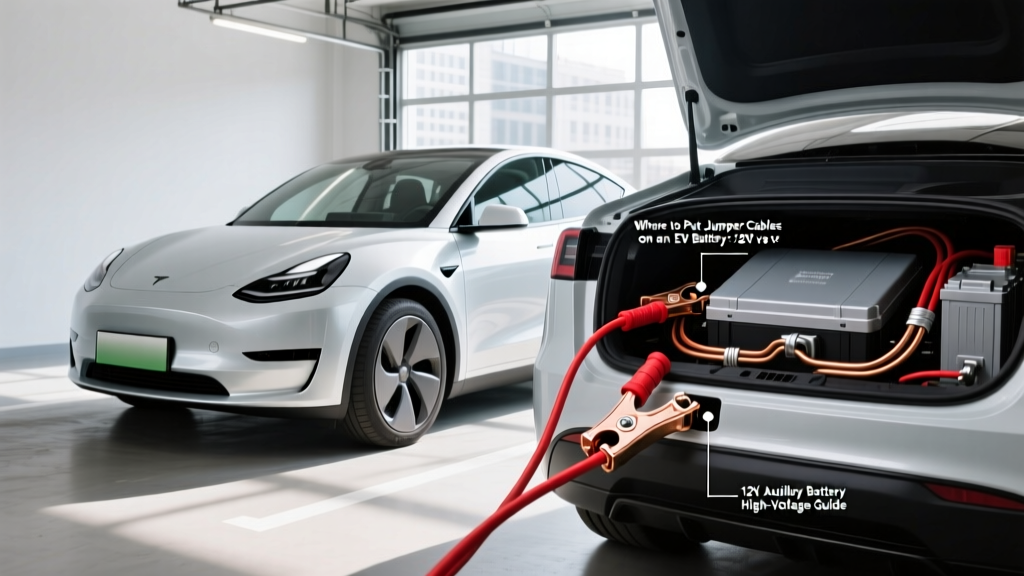
Where Exactly to Put Jumper Cables on an EV's 12V Battery
The process is nearly identical to jumping a gas car, but locating the 12V battery varies by model:
- Tesla Model 3/Y (2024+): The 12V lithium auxiliary battery is under the rear seat area. Tesla provides low-voltage jump posts in the front trunk (frunk) area behind a removable panel—use these, not the battery itself.
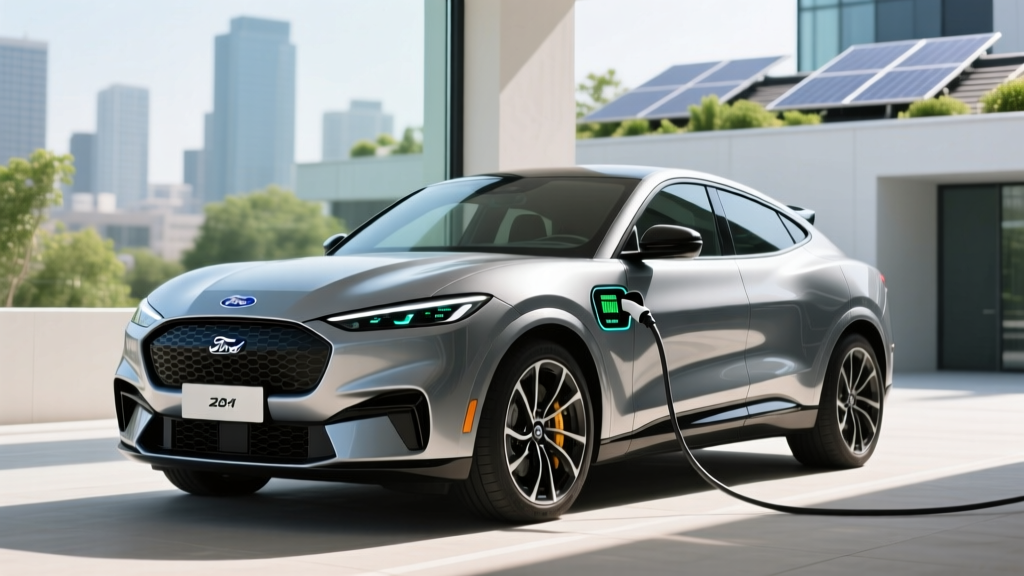
- Ford Mustang Mach-E: The 12V battery is under the front hood (frunk area), with clearly marked positive (+) and negative (−) terminals.
- Hyundai Ioniq 5 / Kia EV6: The 12V battery is located in the frunk, accessible by removing the storage tray.
- Chevrolet Equinox EV / Blazer EV: The 12V battery is under the front hood on the driver's side.
- Rivian R1T / R1S: 12V battery is in the frunk with clearly labeled jump-start terminals.
Step-by-Step: Jumping an EV's 12V Battery
- Locate the 12V battery or designated jump posts (consult your owner's manual for your exact model year).
- Connect the red (+) clamp to the positive terminal or jump post on the dead EV.
- Connect the other red (+) clamp to the positive terminal of the donor vehicle's 12V battery.
- Connect the black (−) clamp to the negative terminal of the donor battery.
- Connect the other black (−) clamp to an unpainted metal ground point on the dead EV's chassis—not the negative battery terminal (to avoid sparking near the battery).
- Start the donor vehicle (if gas) or power it on (if EV), wait 2–3 minutes.
- Power on the dead EV. Once the 12V system is live, the vehicle's computers will boot, and the high-voltage contactors will engage, allowing the traction battery to take over.
- Disconnect in reverse order. Let the EV remain powered on so the DC-DC converter can recharge the 12V battery.
If your EV's 12V battery dies repeatedly, it may be failing and need replacement—a $150–$350 job depending on whether it's lead-acid or lithium. This is unrelated to the traction battery's health.
EV Traction Battery Chemistry: LFP vs NMC/NCA
The high-voltage traction battery is the most expensive component in any EV, and its chemistry determines range, longevity, charging behavior, and cost. In 2026, two chemistries dominate the US market:
| Attribute | LFP (Lithium Iron Phosphate) | NMC / NCA (Nickel Manganese Cobalt / Nickel Cobalt Aluminum) |
|---|---|---|
| Energy Density | Lower (~160–180 Wh/kg cell-level) | Higher (~220–260 Wh/kg cell-level) |
| Cycle Life | 3,000–5,000+ cycles | 1,000–2,000 cycles |
| Cold-Weather Performance | Moderate—more range loss in freezing temps | Better low-temp conductivity |
| Charging to 100% | Recommended regularly (helps BMS calibration) | Daily limit of 80–90% recommended for longevity |
| Cost | ~20–30% cheaper per kWh | Higher due to nickel/cobalt content |
| Thermal Stability | Excellent—very resistant to thermal runaway | Good, but requires more active thermal management |
| Common 2026 Applications | Tesla Model 3/Y RWD, Ford Mustang Mach-E Select (Standard Range), base trims | Tesla Long Range, Hyundai Ioniq 5, Rivian R1S, most AWD/Long Range trims |
Which is better? There's no universal winner. LFP is ideal for daily commuters who can charge to 100% without worry and want maximum cycle life at lower cost. NMC/NCA is better when you need maximum range in a given pack volume, better cold-weather usability, or AWD performance trims. If you live in Minnesota and regularly face −10°F mornings, NMC's cold-weather edge matters. If you're in Southern California commuting 30 miles each way, LFP's longevity and cost advantage win.
How Long Do EV Batteries Actually Last? Degradation Data
"How long do EV batteries last?" is the single most common concern from prospective EV buyers. The data is reassuring: modern EV batteries are outlasting early fears by a wide margin.
Based on aggregated fleet data from sources including Recurrent Auto's battery analytics and manufacturer reports, here's what real-world degradation looks like for 2020–2026 model-year EVs:
- Year 1 / ~15,000 miles: 95–98% capacity retained (initial "break-in" drop)
- Year 3 / ~45,000 miles: 91–95% retained
- Year 5 / ~75,000 miles: 88–93% retained
- Year 8 / ~120,000 miles: 84–90% retained
- Year 10 / ~150,000 miles: 80–88% retained (varies heavily by climate and charging habits)
Note: These figures represent liquid-cooled packs (standard on virtually all 2020+ EVs). Early passive-cooled packs like the 2011–2017 Nissan Leaf degraded significantly faster, sometimes losing 20–30% in 5 years. That era is over.
At 80% capacity, an EV with a 300-mile EPA range when new would still deliver ~240 miles—perfectly usable for most drivers. Many packs are reaching 200,000+ miles before hitting the 70% threshold that triggers a warranty claim.
What Does the EV Battery Warranty Actually Cover?
Federal law (EPA emissions warranty requirements) effectively mandates that automakers warranty EV batteries for at least 8 years or 100,000 miles (whichever comes first). California and states that follow CARB standards require 10 years or 150,000 miles.
| Manufacturer (2026 Models) | Battery Warranty | Capacity Threshold |
|---|---|---|
| Tesla (Model 3/Y) | 8 yr / 120,000 mi (LR/AWD); 8 yr / 100,000 mi (RWD) | 70% retention |
| Hyundai / Kia (Ioniq 5, EV6, EV9) | 10 yr / 100,000 mi | 70% retention |
| Ford (Mach-E, F-150 Lightning) | 8 yr / 100,000 mi | 70% retention |
| GM (Equinox EV, Blazer EV, Silverado EV) | 8 yr / 100,000 mi | 70% retention (some trims: 60% for commercial use) |
| Rivian (R1T / R1S) | 8 yr / 175,000 mi | 70% retention |
| BMW (i4, iX, i5) | 8 yr / 100,000 mi | 70% retention |
What's covered: If your battery's usable capacity drops below the stated threshold (typically 70% of original) within the warranty period, the manufacturer will repair or replace the pack—usually by swapping failed modules rather than the entire pack—at no cost to you.
What's NOT covered: Damage from accidents, flooding, improper modifications, or using non-approved charging equipment. Normal gradual degradation above the threshold is also not a warranty claim—a battery at 72% at year 7 is functioning within spec.
How Much Does an EV Battery Replacement Cost?
If you're outside warranty, the cost of replacing a traction battery is significant but often overstated in headlines. Here's the reality for 2026:
| Vehicle / Pack Size | Full Pack Replacement (Parts + Labor) | Module-Level Repair |
|---|---|---|
| Tesla Model 3 RWD (~57 kWh LFP) | $8,000–$12,000 | $2,000–$4,000 per module |
| Tesla Model Y LR (~75 kWh NMC) | $12,000–$16,000 | $3,000–$5,000 per module |
| Hyundai Ioniq 5 (~77 kWh) | $11,000–$15,000 | $2,500–$4,500 per module |
| Ford F-150 Lightning Ext. Range (~131 kWh) | $18,000–$25,000 | $3,500–$6,000 per module |
| Rivian R1S Max Pack (~149 kWh) | $20,000–$28,000 | $4,000–$7,000 per module |
When is replacement typically needed? For most owners, it isn't. Data from fueleconomy.gov and fleet analyses show that the vast majority of EV batteries from 2018 onward are lasting well beyond 150,000 miles before reaching the 70% capacity threshold. Many are on pace to outlast the vehicle itself. The fear of a $20,000 surprise bill at 100,000 miles is largely a relic of early-generation, passively-cooled packs.
When replacements are needed, they're increasingly modular. Most modern packs are built from 8–16 individual modules, and a single failed module can be replaced for a fraction of a full pack cost.
How to Check and Maximize Your EV Battery Health
Monitoring State of Health (SoH)
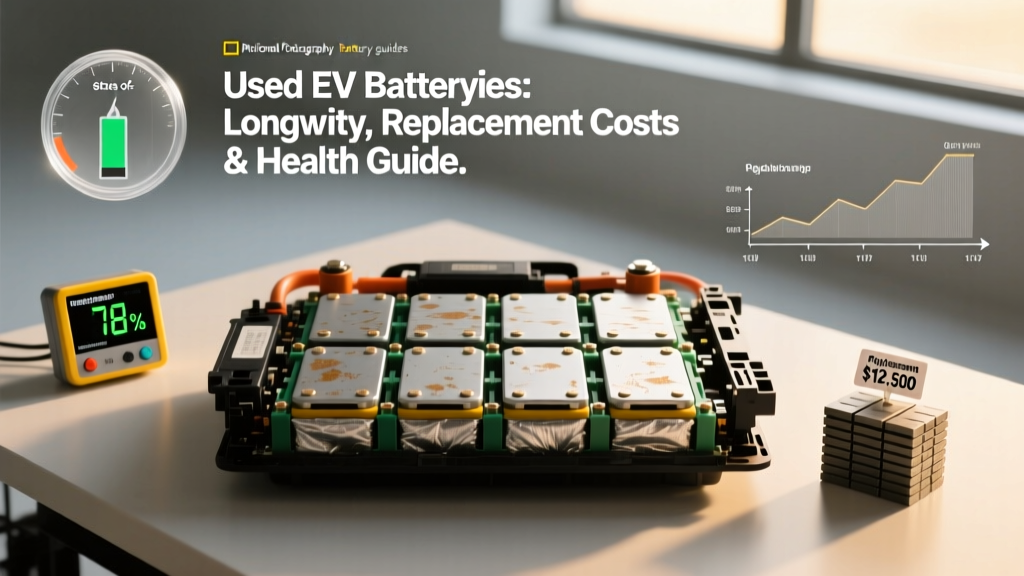
State of Health (SoH) is expressed as a percentage of your battery's current maximum capacity compared to its original capacity when new. Here's how to check it:
- In-vehicle displays: Tesla shows battery health in the Service menu (Settings → Service → Battery Health). Hyundai/Kia provides a battery condition indicator in the EV settings menu. BMW's iDrive includes a battery health report.
- OBD-II apps: Tools like OBDeleven, Car Scanner, or Leaf Spy (for Nissan) can read detailed battery data including SoH, cell voltage variance, and degradation curves via the OBD-II port.
- Manual calculation: Charge to 100% (on LFP) or your normal daily limit (on NMC), note the displayed range, and compare it to the EPA-rated range at the same SoC. If your 300-mile EPA car shows 255 miles at 100%, that's ~85% SoH—reasonable for a 5-year-old pack.
- Third-party diagnostics: Companies like Recurrent and Geotab offer battery health reports, increasingly used by insurers and for pre-purchase inspections on used EVs.
Battery Care Checklist: Maximizing Lifespan
- Keep daily charge between 20–80% for NMC/NCA packs; charge LFP to 100% at least weekly for BMS calibration
- Use Level 2 home charging as your primary method (gentler on cells than frequent DC fast charging)
- Precondition the battery before DC fast charging (most EVs do this automatically when you navigate to a charger)
- Park in shade or a garage during extreme heat when possible
- Plug in during extreme cold so the thermal management system can keep the pack in its ideal temperature range
- Drive the car regularly—batteries degrade faster when sitting at high SoC for weeks
- Repeated DC fast charging to 100%—the charge curve tapers significantly above 80% for a reason (cell stress and heat)
- Letting the battery sit at 0% or below 10% for extended periods
- Storing the vehicle at 100% SoC for more than a few days, especially in hot climates
- Aftermarket "range extenders" or unapproved charging modifications
What's Next: Solid-State and Silicon Anode Batteries
Several next-generation battery technologies are in development, but it's important to separate announcements from availability:
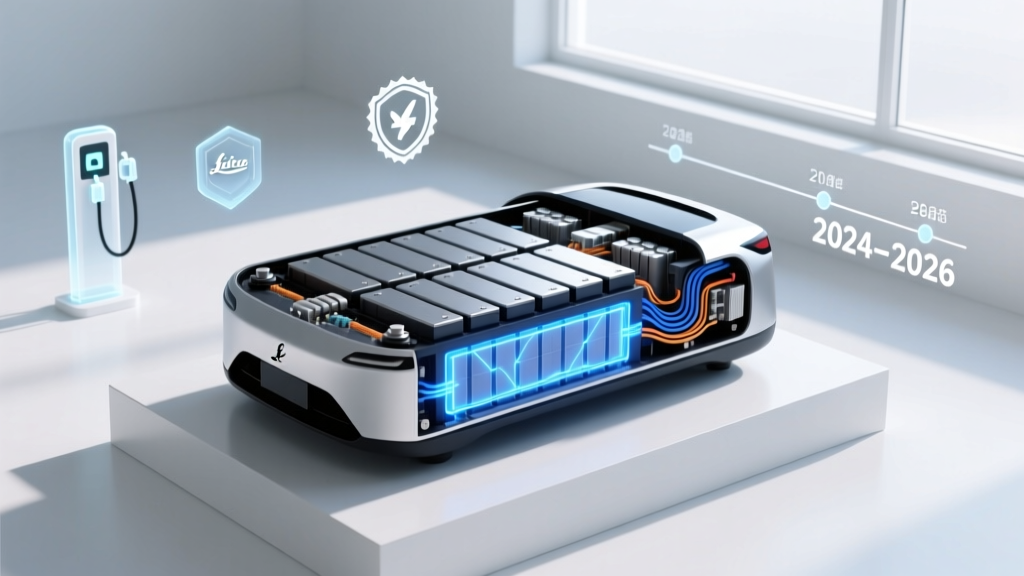
- Solid-state batteries: Toyota, Samsung SDI, and QuantumScape have demonstrated prototype cells with 40–80% higher energy density and faster charging. Toyota has announced a 2027–2028 production timeline for limited models. Not available in any production EV as of 2026. Expect initial deployment in premium/low-volume models first, with mainstream availability likely 2029–2031.
- Silicon anode batteries: Companies like Sila Nanotechnologies and Group14 are replacing graphite anodes with silicon composites, boosting energy density by 15–25%. These are beginning to appear in limited production (e.g., Mercedes-Benz G-Class EV prototypes), with broader rollout expected 2027–2028.
- Sodium-ion batteries: CATL and BYD are producing sodium-ion cells for lower-cost, shorter-range applications. Currently deployed in Chinese-market micro-EVs; US-market adoption is possible by 2028+ for budget segments.
These technologies are genuinely promising but remain forward-looking. If you're buying an EV in 2026, today's LFP and NMC packs—backed by 8–10 year warranties and proven degradation curves—are mature, reliable products.
Frequently Asked Questions
Can I use jumper cables on an EV's high-voltage traction battery?
No. Never. The high-voltage traction battery operates at 400V–800V+ and can deliver lethal current. Only a certified high-voltage technician should service it. Jumper cables are only for the 12V auxiliary battery, which powers the vehicle's computers and accessories.
How long do EV batteries last in years and miles?
Based on current fleet data, most modern liquid-cooled EV batteries retain 80–90% of original capacity at 100,000–150,000 miles (roughly 8–12 years of average driving). Many will outlast the vehicle. The 8-year / 100,000-mile minimum warranty (10/150,000 in CARB states) provides a strong floor.
How much does it cost to replace an EV battery?
Full pack replacements range from roughly $8,000 for a smaller LFP pack (Tesla Model 3 RWD) to $25,000+ for large packs (F-150 Lightning, Rivian Max Pack). However, module-level repairs cost $2,000–$7,000, and most packs never need replacement within the warranty period or the vehicle's useful life.
What does the EV battery warranty cover?
Manufacturers warrant the traction battery against capacity loss below a stated threshold (typically 70% of original capacity) for 8 years/100,000 miles (or 10/150,000 in CARB states). If your battery degrades below that threshold within the warranty period, the manufacturer repairs or replaces it at no cost. Accidental damage and improper modifications are excluded.
LFP vs NMC—which battery chemistry should I choose?
Choose LFP if you prioritize longevity (3,000–5,000+ cycles), lower cost, and the convenience of charging to 100% daily. Choose NMC/NCA if you need maximum range per kWh, better cold-weather performance, or are buying a Long Range/AWD trim (most are NMC). Neither is universally "better"—it depends on your climate, commute, and charging access.
Does fast charging damage my EV battery?
Occasional DC fast charging has minimal impact on modern batteries with active thermal management. However, exclusive reliance on DC fast charging (150+ kW) can accelerate degradation by 1–3% over the battery's life compared to primarily Level 2 charging. The key factors are heat and sustained high C-rates—preconditioning the battery before fast charging and avoiding repeated 100% fast charges mitigates most of this.
How do I check my EV's battery health?
Use the in-vehicle battery health display (available on Tesla, Hyundai/Kia, BMW), an OBD-II diagnostic app like Car Scanner or OBDeleven, or a third-party service like Recurrent. Compare your displayed range at full charge to the original EPA rating for a quick SoH estimate.
Sources: EPA fueleconomy.gov, Recurrent Auto Battery Degradation Data, manufacturer warranty documentation (Tesla, Hyundai, Ford, GM, Rivian). Battery replacement cost estimates based on 2025–2026 service center quotes and industry analysis. Tax credit and warranty terms are subject to change—verify current terms with the manufacturer and IRS §30D guidelines.