If you have been following electric-vehicle news, you have likely seen headlines promising that solid-state batteries will revolutionize EVs with doubled range and ultra-fast charging. The reality is more nuanced. Solid-state technology remains in limited production for select models, and widespread availability in mainstream, affordable EVs is still years away. Meanwhile, today's lithium-ion batteries — using either NMC/NCA or LFP chemistry — have proven remarkably durable, with most packs outlasting the vehicles they power.
This guide covers everything you need to know about current EV battery technology, real-world degradation data, warranty protections, replacement costs, and what solid-state and other emerging chemistries actually mean for your next purchase decision.
How Long Do EV Batteries Actually Last?
The short answer: far longer than most buyers expect. Based on fleet data and long-term ownership reports, the average EV battery pack retains 90% or more of its original capacity after 100,000 miles. Many packs reach 200,000 miles with 80-85% capacity remaining — still well above the threshold where most drivers would notice a meaningful range reduction.
Typical EV Battery Degradation Curve (NMC Chemistry):
- Year 1 / 15,000 miles: ~2-4% capacity loss (initial formation loss)
- Year 3 / 45,000 miles: ~5-8% total loss
- Year 5 / 75,000 miles: ~8-12% total loss
- Year 8 / 120,000 miles: ~12-17% total loss
- Year 10 / 150,000 miles: ~15-20% total loss
Sources: Geotab fleet study, Recurrent Auto long-term data. LFP packs typically show slower degradation in the first 5 years due to more stable chemistry.
Real-world example: Tesla's 2023 Impact Report showed that Model S and Model X vehicles retained approximately 88% of battery capacity after 150,000 miles. Hyundai and Kia's 10-year/100,000-mile battery warranty reflects manufacturer confidence that packs will remain above 70% capacity well beyond a decade of typical use.
The key insight: battery degradation is not linear. Most capacity loss occurs in the first year or two (formation cycling), after which the degradation curve flattens significantly. A 2026-model EV with an EPA range of 300 miles will likely still deliver 250+ miles of range after eight years of normal driving.
LFP vs NMC/NCA: Which Battery Chemistry Is Right for You?
Today's EV batteries use one of two dominant cathode chemistries, and the choice affects range, longevity, charging behavior, and cost.
| Attribute | LFP (Lithium Iron Phosphate) | NMC/NCA (Nickel Manganese Cobalt / Nickel Cobalt Aluminum) |
|---|---|---|
| Energy Density | Lower (~160 Wh/kg cell-level) | Higher (~250-300 Wh/kg cell-level) |
| EPA Range (typical) | 220-270 mi in midsize sedans/SUVs | 280-350+ mi in comparable vehicles |
| Cycle Life | 3,000-5,000+ cycles to 80% SoH | 1,500-2,500 cycles to 80% SoH |
| Calendar Life | Excellent — slower degradation at rest | Good — degrades faster if stored at high SoC |
| Cold-Weather Performance | Weaker — more range loss below freezing | Better — less range loss in cold |
| DC Fast Charging | Can charge to 100% regularly; tolerates frequent DCFC | Best kept 20-80% daily; DCFC causes more wear |
| Cost | ~20-30% cheaper per kWh (no cobalt/nickel) | Higher due to critical mineral content |
| SoC Estimation | Harder — flatter voltage curve makes % gauge less precise | Easier — more linear voltage curve |
| Common In (2026) | Tesla Model 3/Y RWD, Ford Mustang Mach-E Select, Rivian Standard | Tesla Long Range, Hyundai Ioniq 5/6, BMW iX, most premium EVs |
The practical takeaway: If you prioritize maximum range, frequent road-trip DC fast charging, or live in a cold climate, NMC/NCA is the stronger choice. If you want a lower purchase price, plan to keep the vehicle 10+ years, charge mostly at home, and don't mind slightly less range, LFP is increasingly compelling — and its longer cycle life means the battery will likely outlast the car by a wider margin.
What Does the EV Battery Warranty Actually Cover?
Federal law mandates a minimum 8-year/100,000-mile battery warranty for all EVs sold in the United States. California and states adopting CARB standards require 10 years/150,000 miles. Most manufacturers exceed these minimums.
| Manufacturer | Battery Warranty | Capacity Retention Threshold |
|---|---|---|
| Tesla (Model 3/Y) | 8 years / 120,000 mi (LWD) or 100,000 mi (RWD) | 70% minimum |
| Hyundai / Kia | 10 years / 100,000 mi | 70% minimum |
| Ford (Mach-E, F-150 Lightning) | 8 years / 100,000 mi | 70% minimum |
| GM (Ultium-based) | 8 years / 100,000 mi | 70% minimum (some models 60%) |
| Rivian | 8 years / 175,000 mi (Large Pack) | 70% minimum |
| BMW | 8 years / 100,000 mi | 70% minimum |
What triggers a warranty claim: If your battery's State of Health (SoH) drops below the stated threshold (typically 70%) within the warranty period, the manufacturer must repair or replace the pack at no cost. Some manufacturers replace individual modules rather than the entire pack. The warranty covers defects and excessive degradation — not damage from accidents, flooding, or unauthorized modifications.
What is NOT covered: Normal degradation above the threshold (e.g., dropping from 100% to 75% over 8 years is considered normal wear), cosmetic issues, or capacity loss from consistently ignoring manufacturer charging guidelines (e.g., regularly leaving an NMC pack at 100% for extended periods). According to the U.S. Department of Energy via fueleconomy.gov, proper charging habits significantly affect long-term battery health.
How Much Does an EV Battery Replacement Cost?
Battery replacement is the single biggest fear among prospective EV buyers — and the most misunderstood. The vast majority of EV owners will never need a full battery replacement. When they do, it is typically at 150,000+ miles, often beyond the vehicle's economic life. But if you do face an out-of-warranty replacement, here is what to expect.
| Vehicle / Battery Size | Battery Capacity | Replacement Cost Range (2026) | Notes |
|---|---|---|---|
| Tesla Model 3 RWD (LFP) | ~60 kWh | $8,000 - $12,000 | LFP cells cheaper; module-level repair sometimes possible |
| Tesla Model Y Long Range | ~82 kWh | $12,000 - $16,000 | NMC pack; prices dropping as supply increases |
| Hyundai Ioniq 5 | ~77.4 kWh | $10,000 - $15,000 | E-GMP platform; module replacement available |
| Ford F-150 Lightning (Extended) | ~131 kWh | $18,000 - $28,000 | Largest consumer pack; highest replacement cost |
| Chevrolet Equinox EV | ~85 kWh | $10,000 - $14,000 | Ultium modular architecture reduces full-pack swaps |
When is replacement typically needed? Almost never during normal ownership. Data from Recurrent Auto shows that less than 1.5% of EVs in their dataset of 15,000+ vehicles required a battery replacement — and most of those were covered under warranty due to manufacturing defects, not degradation. The few owners who pay out of pocket are typically at 200,000+ miles on vehicles 10-12 years old.
Cost trend: Battery pack prices have fallen from over $1,000/kWh in 2010 to approximately $110-$130/kWh in 2026 (cell-level). As recycling infrastructure scales and second-life markets mature, out-of-warranty replacement costs will continue declining. Some independent shops now offer refurbished packs at 40-60% of OEM pricing.
Factors That Affect EV Battery Life — and How to Maximize It
Battery longevity is not purely a function of time and mileage. How you charge, drive, and store your EV meaningfully affects its State of Health over the years.
EV Battery Care Best Practices:
- State of Charge (SoC) habits: For NMC/NCA packs, keep daily charging between 20-80%. LFP packs can (and should) be charged to 100% regularly to help the BMS calibrate — Tesla and Ford both recommend this.
- DC fast charging frequency: Occasional DCFC on road trips is fine. Daily reliance on DCFC (150-350 kW) accelerates degradation by ~1-3% over the pack's lifetime vs. Level 2 home charging. Preconditioning the battery before fast charging reduces stress.
- Extreme temperatures: Avoid leaving the vehicle at 100% SoC in sustained heat (above 95°F/35°C) for days. In extreme cold (below 10°F/-12°C), plug in when parked to let the thermal management system maintain battery temperature using grid power instead of pack energy.
- Storage: If storing for weeks, leave NMC at ~50% SoC and LFP at ~50-60%. Avoid storing at 100% or below 10%.
- Regenerative braking: Standard regen settings do not harm the battery. The BMS manages charge acceptance to prevent over-stress during high-power regen events.
- Software updates: Keep the vehicle updated. Manufacturers periodically refine BMS algorithms to improve charge management and longevity.
The biggest misconception: Many buyers worry that DC fast charging will destroy their battery. The reality, supported by data from Idaho National Laboratory testing, is that even frequent DCFC causes only marginally more degradation than Level 2 charging over 100,000 miles — roughly a 2-4 percentage-point difference in SoH. The convenience of road-trip fast charging far outweighs the negligible long-term impact.
How to Check and Monitor Your Battery's State of Health
State of Health (SoH) is the metric that tells you how much capacity your battery retains compared to its original specification. A new EV has 100% SoH; a pack at 85% SoH has lost 15% of its original capacity.
Built-in methods:
- Tesla: Navigate to Service Mode (tap the car icon → Software → hold model name for 3 seconds → enter "service"). The Battery Health screen shows SoH percentage and individual module voltages.
- Hyundai/Kia: The infotainment system's EV menu includes a battery health indicator. Dealership diagnostic tools provide granular SoH readings.
- Ford: The FordPass app and in-vehicle settings display battery health status. Full diagnostics available via dealership OBD-II scan.
- GM (Ultium): The myChevrolet/myCadillac app shows battery health. OnStar diagnostics can provide detailed reports.
Third-party tools: OBD-II dongles paired with apps like ABRP (A Better Route Planner), Scan My Tesla, or LeafSpy (for Nissan) can read real-time battery data including SoH, cell voltage variance, and pack temperature. Services like Recurrent offer battery health reports that are useful for resale valuation.
What to watch for: A sudden drop in SoH (more than 2-3% in a single month) may indicate a module imbalance or defect worth investigating under warranty. Gradual, linear decline of 1-2% per year is completely normal and not a cause for concern.
When Will Solid-State Batteries Be Available?
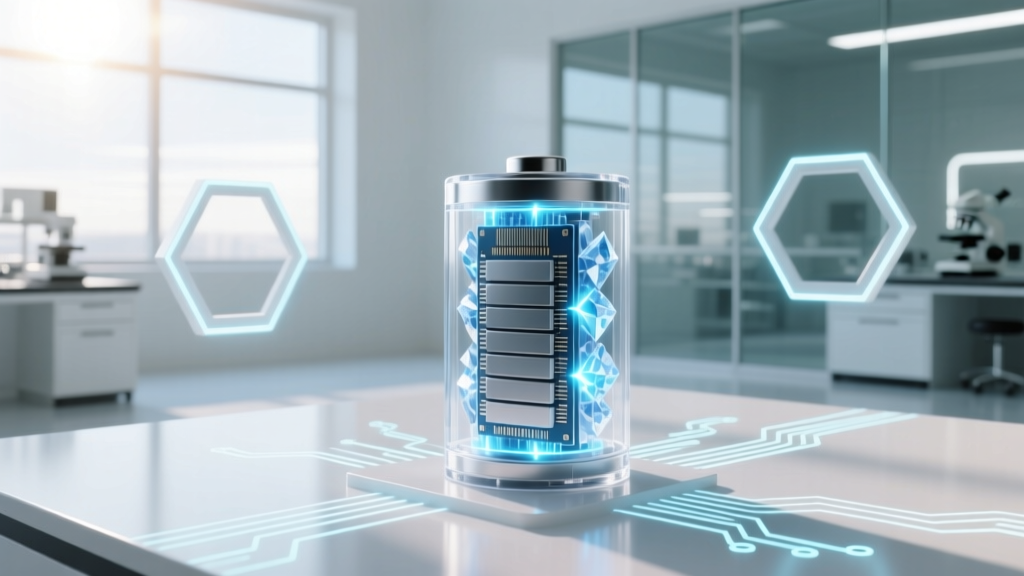
Solid-state batteries replace the liquid electrolyte in conventional lithium-ion cells with a solid material (ceramic, polymer, or sulfide-based). The promised advantages are significant: higher energy density (potentially 400+ Wh/kg at the cell level, roughly double current NMC), faster charging (10-80% in under 10 minutes), improved safety (no flammable liquid electrolyte), and longer cycle life.
Current status (2026):
- Toyota: Has announced a solid-state battery for limited production in a next-generation EV expected around 2027-2028, with initial availability in Japan and possibly select markets. Toyota claims 750 km (466 mi) of range and 10-minute 10-80% charging. These are preliminary, manufacturer-claimed figures — independent verification is pending.
- Samsung SDI: Has begun sample production of solid-state cells for automotive clients, targeting mass production around 2027-2028.
- Nissan: Has a pilot production line operational and targets a solid-state EV by 2028.
- QuantumScape (VW-backed): Continues to develop solid-state cells with prototype validation, but commercial-scale production for consumer EVs remains targeted for 2028-2030.
- BMW / Solid Power: Testing solid-state prototype cells; BMW has stated production vehicles are not expected before 2030.
Realistic timeline for mainstream availability: Based on current development trajectories, solid-state batteries will likely appear in limited, premium EVs starting around 2028-2029, with broader availability in mid-priced vehicles not expected until 2030-2032. Manufacturing challenges — particularly achieving consistent quality at scale and reducing per-kWh costs to competitive levels — remain the primary bottleneck.
Should you wait? Almost certainly not. Today's NMC and LFP batteries already deliver 250-350+ miles of EPA range, 15-30 minute DC fast charging, 10-20 year lifespans, and strong warranty protection. Waiting 4-6 years for solid-state means missing years of EV ownership savings and driving a vehicle with today's already-excellent battery technology. By the time solid-state reaches mainstream pricing, current EVs purchased today will still have substantial battery life remaining.
Other Emerging Battery Technologies to Watch
Solid-state is not the only advancement in the pipeline:
- Silicon anode batteries: Companies like Sila Nanotechnologies and Group14 are integrating silicon-dominant anodes into lithium-ion cells, boosting energy density by 20-40% without requiring a full solid-state architecture. Mercedes-Benz's next-generation G-Class EV (announced for 2025-2026) is among the first to use silicon anode cells from Group14. This technology is arriving sooner than solid-state and offers meaningful range gains with existing manufacturing processes.
- Sodium-ion batteries: CATL and other Chinese manufacturers have begun producing sodium-ion cells for lower-cost, shorter-range EVs. Sodium is abundant and cheap, but energy density is ~30-40% lower than LFP, limiting sodium-ion to city cars and fleet vehicles. Not expected in the U.S. market in the near term.
- Lithium-sulfur (Li-S): Promises very high energy density at low material cost, but cycle life remains a challenge (currently ~100-300 cycles). Still in the research stage for automotive applications, with commercial viability likely 10+ years away.
- Improved LFP formulations: Manufacturers like CATL are developing higher-density LFP variants (sometimes called LMFP, adding manganese) that close the energy density gap with NMC while retaining LFP's cost and longevity advantages. These are entering production in 2025-2026 and will appear in U.S.-market vehicles within 1-2 years.
Frequently Asked Questions
How long do EV batteries last in years and miles?
Most EV batteries are designed to last 15-20 years or 200,000+ miles before dropping below 70-80% of original capacity. Fleet data from Geotab and Recurrent Auto confirms that the average pack retains ~88-92% capacity after 100,000 miles. The battery will typically outlast other major vehicle components.
How much does it cost to replace an EV battery?
Out-of-warranty replacement costs range from approximately $8,000 for a 60 kWh LFP pack (Tesla Model 3 RWD) to $28,000 for a 131 kWh pack (F-150 Lightning Extended Range). However, fewer than 1.5% of EVs require replacement, and most failures occur within the 8-10 year warranty period. Prices continue to decline as cell costs fall and refurbished options emerge.
What does the federal battery warranty cover?
U.S. federal law requires a minimum 8-year/100,000-mile warranty covering defects and capacity loss below a stated threshold (typically 70% of original capacity). CARB states mandate 10 years/150,000 miles. The warranty covers repair or replacement of the high-voltage traction battery — not the 12V auxiliary battery or damage from accidents, misuse, or unauthorized modifications.
How do I check my EV battery's State of Health?
Most modern EVs display battery health information in the infotainment system or companion app. Tesla owners can access Service Mode for detailed SoH data. Third-party OBD-II tools and services like Recurrent provide independent health assessments. A dealership diagnostic scan offers the most comprehensive reading.
LFP vs NMC — which battery chemistry should I choose?
Choose NMC/NCA if you need maximum range (280-350+ mi), drive frequently in cold weather, or take regular road trips requiring DC fast charging. Choose LFP if you want a lower purchase price, plan to keep the vehicle 10+ years, charge primarily at home, and can accept 220-270 miles of range. LFP's longer cycle life and tolerance for 100% daily charging make it ideal for high-mileage commuters.
When will solid-state batteries be available in affordable EVs?
Limited production in premium EVs is expected around 2028-2029 (Toyota, Samsung SDI, Nissan). Mainstream, affordable solid-state EVs are not realistically expected until 2030-2032 at the earliest. Manufacturing scale, cost reduction, and supply chain development remain significant hurdles. Current lithium-ion technology is mature, reliable, and improving incrementally every year.
Does frequent DC fast charging damage the battery?
The impact is smaller than commonly believed. Idaho National Laboratory testing found that exclusive DCFC use over 50,000 miles resulted in only 2-4 percentage points more degradation compared to exclusive Level 2 charging. Modern battery management systems actively manage charge rates and temperatures to minimize stress. Occasional DCFC on road trips has negligible impact on long-term battery health.
Is it safe to charge an LFP battery to 100% every day?
Yes — and it is recommended. LFP cells have a very flat voltage curve, which makes State of Charge estimation difficult for the battery management system. Charging to 100% regularly allows the BMS to recalibrate and maintain accurate range estimates. Tesla, Ford, and other manufacturers explicitly recommend 100% charging for LFP-equipped vehicles. This is the opposite of NMC/NCA guidance, where 80% daily is preferred.