VW ID.4 Battery Degradation: What Owners Actually See
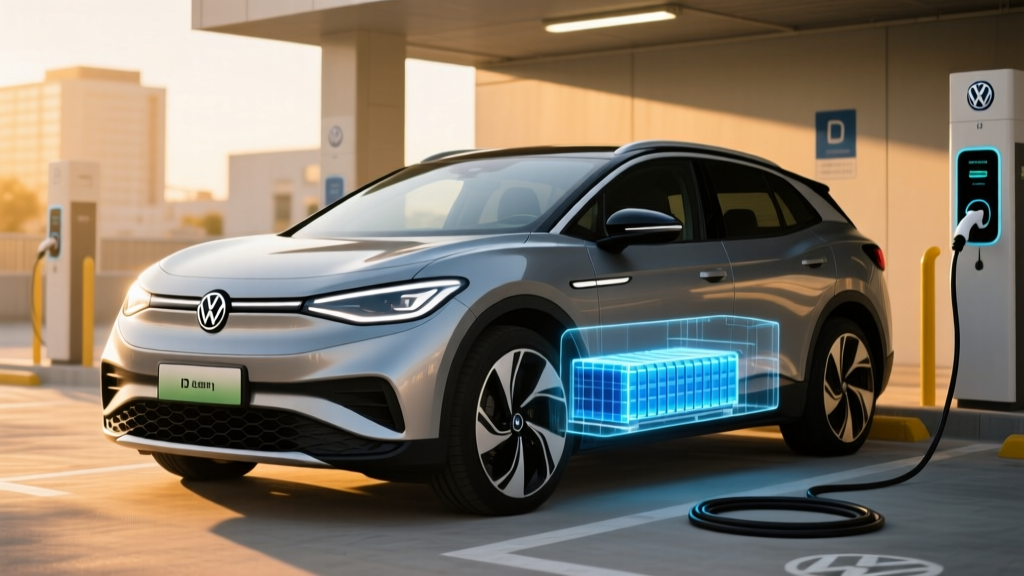
If you own a Volkswagen ID.4 — or are shopping for one — battery longevity is likely top of mind. The ID.4 uses lithium-ion packs ranging from 62 kWh (Standard Range) to 82 kWh usable (Pro/Pro S) and, for 2026 models, up to 91 kWh on the new long-range trims. Unlike smaller electronics, these traction batteries are engineered for a 15-year service life, but they do lose capacity gradually over time and miles.
VW ID.4 battery degradation is not a cliff — it's a curve. Most owners see a steeper drop in the first year or two (roughly 2–4%), followed by a much slower, nearly linear decline for the remainder of the pack's life. Based on fleet data from Recurrent Auto and owner-reported telemetry across model years 2021–2025, the average ID.4 retains approximately 93–96% of its original capacity after three years and 45,000 miles. By year five and 75,000 miles, retention typically sits between 89% and 93%.
ID.4 Battery Chemistry: NMC Under the Floor
The Volkswagen ID.4 uses NMC (nickel-manganese-cobalt) lithium-ion cells supplied primarily by LG Energy Solution and SK On, depending on model year and production batch. NMC chemistry was chosen for its high energy density, which allows VW to package a large-capacity battery within the MEB platform's skateboard architecture without compromising cabin or cargo space.
Understanding the trade-offs between NMC and LFP (lithium iron phosphate) chemistry helps explain why VW selected this cell type — and what it means for your battery's aging profile.
| Factor | NMC (ID.4) | LFP (e.g., Tesla Model 3 RWD, some BYD) |
|---|---|---|
| Energy Density | High (~250 Wh/kg cell-level) | Moderate (~170 Wh/kg cell-level) |
| Cycle Life | 1,000–2,000 full cycles to 80% SoH | 3,000–5,000+ full cycles to 80% SoH |
| Cold-Weather Performance | Better low-temp conductivity | More range loss below 20°F |
| Cost per kWh | Higher (cobalt, nickel) | Lower (iron, phosphate) |
| Recommended Daily SoC | 80% for longevity | 100% OK (per manufacturer) |
| Thermal Runaway Risk | Higher (managed by BMS/cooling) | Significantly lower |
For the ID.4, NMC's energy density advantage translates directly to the 275–291 mile EPA range figures on Pro and Pro S trims. The trade-off is that NMC cells are more sensitive to sustained high state-of-charge and elevated temperatures — factors that accelerate degradation if not managed through good charging habits.
Degradation Data: What the Numbers Show
Volkswagen does not publish a single degradation curve, but aggregated owner data from platforms like Recurrent, Geotab, and the ID.4 Owners Club forums paint a consistent picture. Here is what typical degradation looks like across the ID.4 fleet:
- Year 1 / 15,000 mi: 2–4% capacity loss (initial formation settling)
- Year 3 / 45,000 mi: 4–7% cumulative loss (93–96% retained)
- Year 5 / 75,000 mi: 7–11% cumulative loss (89–93% retained)
- Year 8 / 100,000 mi: 10–15% cumulative loss (85–90% retained, within warranty threshold)
- Year 10+ / 150,000+ mi: 13–20% loss projected; many packs still functional above 80% SoH
Sources: Recurrent Auto battery health reports, Geotab EV Battery Degradation study, aggregated owner telemetry. Individual results vary based on climate, charging habits, and DC fast-charge frequency.
The key takeaway: ID.4 battery degradation is front-loaded. The initial capacity loss in the first 12–24 months is the steepest portion of the curve. After that, the decline slows considerably. This pattern is consistent with most liquid-cooled NMC packs in modern EVs and is a primary reason most EV batteries outlast the vehicles they're installed in.
VW ID.4 Battery Warranty: What's Covered
Volkswagen backs the ID.4's high-voltage traction battery with an 8-year / 100,000-mile limited warranty (whichever comes first), which is standard across the US EV market and aligns with federal requirements. The critical threshold is 70% capacity retention: if your ID.4 battery drops below 70% of its original usable capacity within the warranty period, VW will repair or replace it at no cost.
| Warranty Element | VW ID.4 Coverage |
|---|---|
| Duration | 8 years / 100,000 miles |
| Capacity Retention Threshold | 70% of original usable capacity |
| What's Covered | Cell/module failure, excessive degradation below 70%, BMS defects |
| What's Not Covered | Damage from accidents, modifications, flooding, or unauthorized repairs |
| Transferable? | Yes — transfers to subsequent owners automatically |
| Powertrain Warranty (motor, electronics) | 8 years / 100,000 miles |
| Bumper-to-Bumper | 4 years / 50,000 miles |
In practice, the 70% threshold is conservative. Given the degradation data above, an ID.4 would need to experience significantly worse-than-average aging to trigger a warranty claim. The fleet data suggests that even at year 8 and 100,000 miles, most packs retain 85–90% — well above the warranty line. For a detailed breakdown of the official warranty language, refer to Volkswagen's ID.4 specifications page.
How Much Does an ID.4 Battery Replacement Cost?
This is the question that generates the most anxiety — and the most misinformation. Let's ground it in real numbers.
| Battery Pack | Approximate Replacement Cost (Parts + Labor) | When Typically Needed |
|---|---|---|
| ID.4 Standard Range (62 kWh) | $8,000 – $12,000 | Rarely; most packs last 150,000+ mi |
| ID.4 Pro / Pro S (82 kWh) | $12,000 – $18,000 | Rarely; typically beyond 10 years if at all |
| ID.4 Long Range (91 kWh, 2026+) | $14,000 – $20,000 (estimated) | Too new for replacement data |
These figures assume an out-of-warranty, full-pack replacement at a VW dealer. However, context matters enormously:
- Most ID.4 batteries never need replacement. Current data shows the vast majority of packs retain above 80% capacity at 150,000 miles.
- Module-level repair is possible. VW's MEB platform allows individual battery modules to be replaced rather than the entire pack, reducing costs to $2,000–$5,000 for a single faulty module.
- Battery prices continue to fall. Pack-level pricing has declined roughly 80% since 2013 (per BloombergNEF). By the time an ID.4 actually needs a new battery in the 2030s, replacement costs will likely be substantially lower.
- Warranty covers the most vulnerable period. Manufacturing defects and early degradation failures are caught within the 8-year coverage window.
The realistic scenario: if you plan to own your ID.4 for 8–12 years and 100,000–150,000 miles, you are extremely unlikely to face an out-of-pocket battery replacement. The car's other components (suspension, interior, electronics) are more likely to determine its end of life.
Factors That Accelerate ID.4 Battery Degradation
Not all miles are created equal when it comes to battery wear. The following factors have the most measurable impact on how quickly your ID.4's NMC pack loses capacity:
DC Fast-Charging Frequency
The ID.4 supports peak DC fast charging at up to 175 kW (2024+ Pro models; earlier 2021–2023 models peak at 125 kW). Occasional DC fast charging is fine — the battery management system (BMS) and liquid cooling handle heat well. However, daily reliance on DC fast charging, especially at high power in hot weather, accelerates cell wear. Data from Geotab's fleet study shows that vehicles fast-charged more than 3 times per week exhibited roughly double the degradation rate of those charged primarily on Level 2.
State of Charge Habits
NMC cells experience the most stress at the extremes — sitting at 100% SoC or dropping below 10% SoC for extended periods. VW's BMS includes a top and bottom buffer (roughly 3–5 kWh combined) to protect the cells, but owners can further reduce stress by:
- Setting the charge limit to 80% for daily use (configurable in the ID.4's infotainment or VW app)
- Reserving 100% charges for road trips when you'll drive immediately after
- Avoiding letting the car sit below 10% for more than a day or two
Extreme Temperatures
The ID.4's liquid thermal management system actively heats and cools the battery, which significantly reduces temperature-related degradation compared to passively cooled packs (like early Nissan Leafs). That said, prolonged exposure to ambient temperatures above 95°F — particularly when combined with high SoC — still accelerates chemical aging. Owners in hot climates (Arizona, Texas, Southern California) should be especially diligent about avoiding 100% SoC parking in summer heat.
Calendar Aging vs. Cycle Aging
Batteries degrade from two sources: cycle aging (charge/discharge use) and calendar aging (time-dependent chemical changes regardless of use). A low-mileage ID.4 that sits at 90% SoC in a hot garage may actually degrade faster than a high-mileage one charged to 80% and driven regularly. Moderate SoC and regular use are your battery's best friends.
How to Monitor and Maximize Your ID.4 Battery Health
- ✅ Set daily charge limit to 80% (use 100% only for trips)
- ✅ Prioritize Level 2 home charging (7–11 kW) over daily DC fast charging
- ✅ Avoid leaving the car at 100% SoC for more than a few hours
- ✅ In extreme heat, park in shade or a garage when possible
- ✅ In winter, use preconditioning while plugged in to warm the battery before driving
- ✅ Keep tire pressure at spec — underinflated tires increase energy draw and heat
- ❌ Don't routinely drain below 10% before recharging
- ❌ Don't rely exclusively on DC fast charging unless your routine demands it
- ❌ Don't store the vehicle at very low or very high SoC for weeks at a time
Checking State of Health (SoH)
The ID.4 does not display a dedicated SoH percentage in its infotainment system, unlike some competitors. However, you can assess your battery's health through several methods:
- VW Car-Net / myVW app: Provides charging history and energy consumption data. While not a direct SoH readout, tracking your kWh-per-100-mile efficiency over time reveals degradation trends.
- OBD-II diagnostic tools: Third-party apps like Carista or OBDeleven, paired with a Bluetooth OBD-II dongle, can read the battery's reported SoH value from the BMS. Expect readings within 1–2% of actual capacity.
- Dealer diagnostic: VW service centers can run a full battery health report during scheduled maintenance. Request this if you're approaching the warranty threshold or evaluating a used ID.4.
- Range tracking: The simplest method — note your full-charge range estimate at 80% SoC when new, then compare it periodically. A consistent decline beyond normal seasonal variation signals degradation.
What's Next: Solid-State and Beyond
If you're reading this and wondering whether to wait for better battery tech, here's the honest landscape as of 2026:
- Solid-state batteries — which promise 30–40% more energy density, faster charging, and dramatically longer cycle life — remain in limited pilot production. Toyota and Samsung SDI have announced small-scale production for select models, but widespread, affordable solid-state EVs are not expected before 2029–2031. They will not be retrofit-compatible with the ID.4's MEB platform.
- Silicon-dominant anodes (from companies like Sila Nanotechnologies and Group14) are entering production in 2026–2027 model-year vehicles from select OEMs, offering 10–20% energy density gains. These may appear in future VW Group models but are not yet in the ID.4 lineup.
- LFP expansion: VW Group has signaled interest in LFP cells for entry-level models in other markets (Europe, China). A US-market ID.4 with LFP chemistry is plausible for a future base trim, which would trade some range for lower cost and longer cycle life.
For current buyers, the ID.4's NMC pack is mature, well-managed, and backed by real-world data showing strong longevity. Waiting for solid-state means waiting at least 3–5 years for vehicles that will carry a significant price premium at launch.
Frequently Asked Questions
How long do VW ID.4 batteries last in years and miles?
Based on current fleet data, most ID.4 batteries retain above 85% capacity at 100,000 miles and 8 years. Many are projected to remain functional (above 70% SoH) well past 150,000 miles and 12–15 years. The pack is engineered to outlast the vehicle's typical ownership lifecycle.
How much does it cost to replace a VW ID.4 battery?
A full pack replacement runs approximately $12,000–$18,000 for the 82 kWh Pro/Pro S battery, out of warranty. However, most ID.4 batteries never require replacement, and module-level repairs (for isolated cell failures) cost $2,000–$5,000. By the time a replacement might be needed in the 2030s, battery prices are projected to be significantly lower.
What does the VW ID.4 battery warranty cover?
VW covers the high-voltage battery for 8 years or 100,000 miles, guaranteeing at least 70% capacity retention. If the battery degrades below that threshold within the warranty period, VW will repair or replace it at no charge. The warranty transfers to subsequent owners.
How do I check my ID.4's battery health?
The ID.4 doesn't show a SoH percentage on its dashboard. Use an OBD-II scanner with apps like OBDeleven or Carista to read the BMS-reported SoH, request a health report from your VW dealer during service, or track your range-at-charge over time to spot degradation trends.
Is NMC or LFP better for the ID.4?
NMC (used in the ID.4) offers higher energy density and better cold-weather performance, which translates to the ID.4's strong EPA range figures. LFP offers longer cycle life, lower cost, and greater thermal stability, but at the expense of energy density and cold-weather range. For the ID.4's size and range targets, NMC is the appropriate choice — and proper charging habits mitigate NMC's longevity trade-offs.
Does frequent DC fast charging hurt my ID.4 battery?
Occasional DC fast charging is fine and the ID.4's liquid cooling system manages heat effectively. However, data shows that vehicles fast-charged more than three times per week degrade roughly twice as fast as those primarily using Level 2. For daily charging, a home Level 2 setup at 7–11 kW is the best balance of speed and battery longevity.
Should I charge my ID.4 to 100% every night?
No. For NMC chemistry, sustained 100% SoC accelerates degradation. Set your daily charge limit to 80% using the VW app or in-vehicle settings. Reserve 100% charges for road trips when you'll begin driving shortly after reaching full charge.