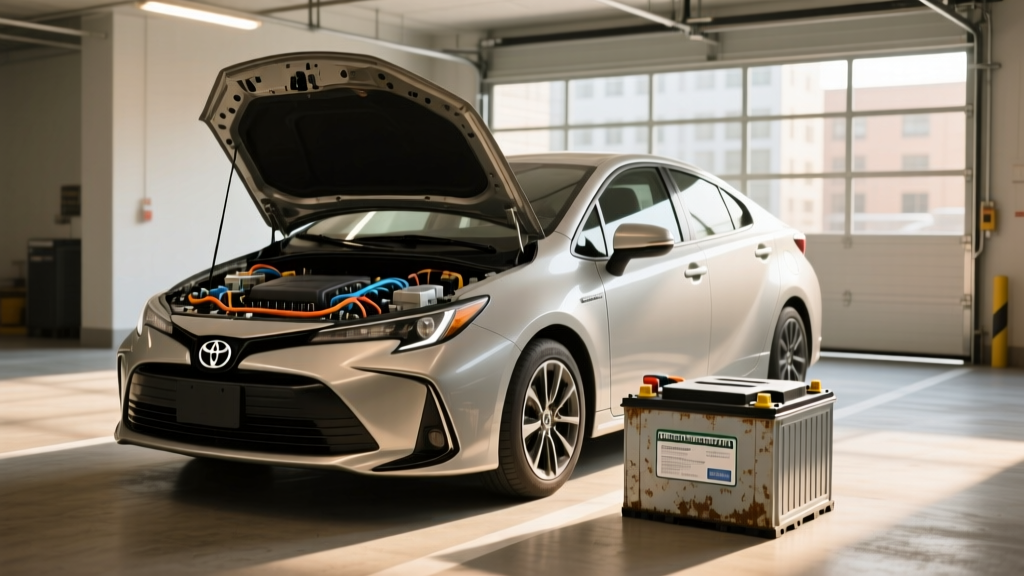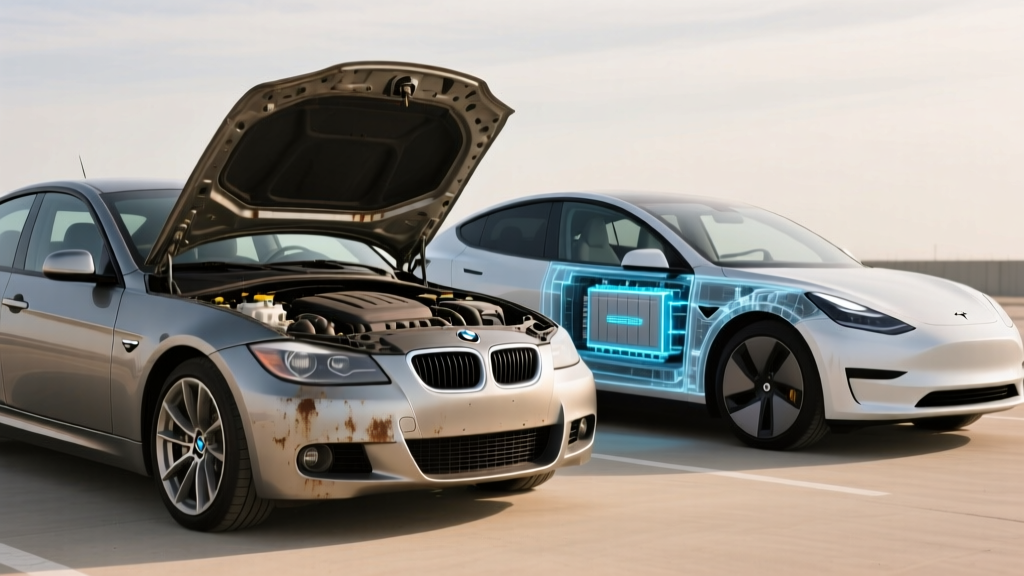
If you've searched for a 2006 BMW 325i battery, you're likely dealing with a familiar problem: a dead 12-volt lead-acid starter battery in a legacy internal-combustion sedan. That battery is a small, ~70 Ah, ~$180 component that cranks a 2.5L inline-six. But if that search has you thinking about batteries in general — perhaps because you're considering a modern electric vehicle — the contrast is staggering.
A 2026 EV traction battery stores between 58 and 130+ kWh of energy, weighs 700–1,200 lbs, and costs $8,000–$22,000 to replace. Understanding how these high-voltage batteries work, degrade, and endure is the single most important piece of EV ownership literacy. This guide breaks down everything you need to know about modern EV battery technology, from chemistry to replacement economics.
From 12V Lead-Acid to High-Voltage Traction: The Battery Gap
The 2006 BMW 325i uses a Group 49 (H8) 12V lead-acid or AGM battery rated at roughly 80 Ah and 800 cold-cranking amps. Its job is simple: start the engine and run accessories when the alternator isn't spinning. Replacement takes 15 minutes and costs $150–$280 at any auto parts store.
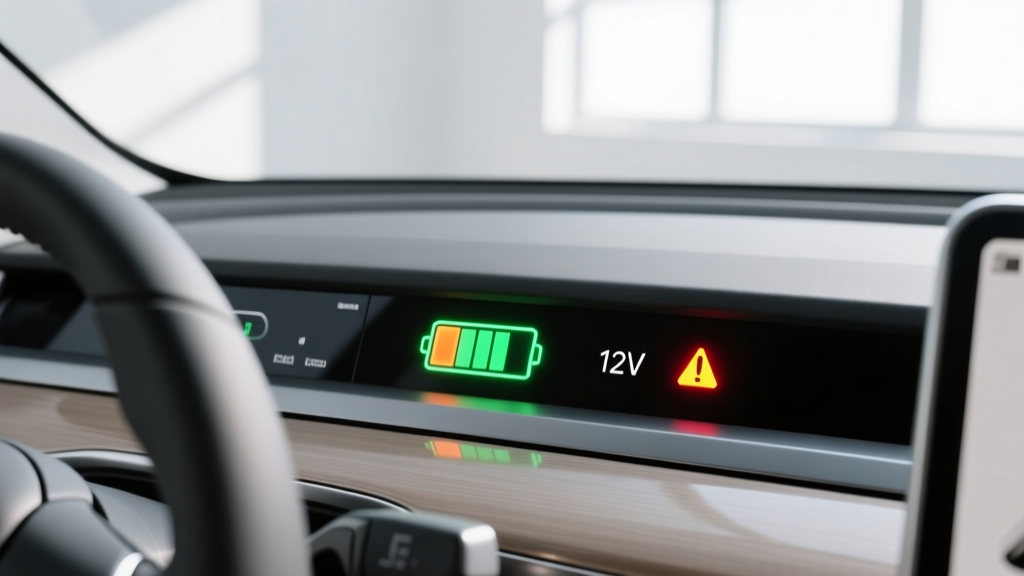
Modern EVs have two batteries: a 12V auxiliary battery (similar in concept to the BMW's) and a high-voltage traction battery that actually powers the vehicle. When EV owners talk about "the battery," they mean the traction pack. This guide focuses entirely on that high-voltage system. The 12V auxiliary battery in an EV is a minor, low-cost component — not the $10,000+ concern that drives purchase anxiety.
EV Battery Chemistry: LFP vs. NMC Explained
Two lithium-ion chemistries dominate the 2026 EV market: LFP (lithium iron phosphate) and NMC (nickel manganese cobalt), with NCA (nickel cobalt aluminum) used by Tesla in some performance variants. The chemistry inside your battery pack determines range, longevity, cold-weather behavior, and cost.
| Attribute | LFP (Lithium Iron Phosphate) | NMC / NCA |
|---|---|---|
| Energy Density | Lower (~160–180 Wh/kg cell-level) | Higher (~220–300 Wh/kg cell-level) |
| Cycle Life | 3,000–6,000+ cycles to 80% SoH | 1,000–2,500 cycles to 80% SoH |
| Cold Performance | Moderate loss; slower charge acceptance below 32°F | Better low-temp charge/discharge |
| Thermal Stability | Excellent — inherently safer, higher thermal runaway threshold | Good but requires more active thermal management |
| Cost (per kWh, 2026) | ~$85–$100/kWh at pack level | ~$110–$135/kWh at pack level |
| Recommended SoC Daily | 100% OK — LFP tolerates full charge well | 80% recommended for daily use |
| Common 2026 Vehicles | Tesla Model 3/Y RWD, Ford Mustang Mach-E Select (base), BYD models, Rivian Standard | Hyundai Ioniq 5/6, Kia EV6/EV9, Tesla Long Range/Performance, BMW iX, GM Ultium vehicles |
Which is better? It depends on your use case. If you prioritize maximum range in a lighter package and live in a cold climate, NMC's higher energy density and better cold-weather charge acceptance make it the stronger choice. If you plan to keep the vehicle 10+ years, charge to 100% daily, and want lower cost, LFP's superior cycle life and thermal stability are compelling. Neither chemistry is universally "better" — the trade-offs are deliberate engineering choices.
How Long Do EV Batteries Actually Last?
The short answer: most EV traction batteries will outlast the vehicle they're installed in. The long answer requires looking at real degradation data.
- Year 1: ~2–5% capacity loss (initial formation loss)
- Years 2–4: ~1–2% per year (linear, gradual)
- Years 5–8: ~1% per year (plateau phase)
- Year 8 average SoH: ~88–92% across major brands (per Geotab fleet data)
- Year 10 projection: ~84–90% SoH for liquid-cooled packs
Tesla's 2025 Impact Report showed that Model 3/Y batteries retained approximately 85% capacity at 200,000 miles. Hyundai/Kia's 8-year/100,000-mile warranty guarantees 70% capacity retention — a conservative floor that most packs never approach in normal use.
The critical insight is that battery degradation is non-linear. The largest drop happens in the first year, then the curve flattens significantly. A pack that shows 95% State of Health (SoH) after year one is likely to hold 88–90% at year eight with normal use.
Factors That Accelerate Degradation
Not all batteries age equally. These factors have the most measurable impact on longevity:
- Frequent DC fast charging above 150 kW: Occasional road-trip fast charging is fine. Daily reliance on 250–350 kW chargers without preconditioning accelerates wear by generating sustained heat above 40°C at the cell level.
- Sustained high State of Charge: Storing an NMC battery at 100% SoC for days or weeks (especially in heat) stresses the cathode. LFP chemistry tolerates this much better.
- Extreme heat exposure: Ambient temperatures above 95°F combined with high SoC are the single worst condition for lithium-ion longevity. Liquid-cooled packs (standard on virtually all 2026 EVs) mitigate this significantly.
- Deep discharge cycles: Regularly driving below 10% SoC stresses the anode. Most EVs have a buffer (typically 2–5 kWh below the displayed 0%) to prevent actual cell damage.
- High-mileage, high-C-rate use: Fleet vehicles that charge and discharge at high rates daily will show more degradation than personal-use vehicles. This is why Geotab's fleet data shows slightly steeper curves than consumer averages.
Battery Warranty Coverage: What's Actually Guaranteed
Federal law mandates a minimum 8-year/100,000-mile warranty on EV battery packs (extended to 10 years/150,000 miles in CARB states like California, New York, and others). Here's how major manufacturers structure their coverage in 2026:
| Manufacturer | Duration | Capacity Threshold | Notes |
|---|---|---|---|
| Tesla | 8 yr / 100k–150k mi (varies by model) | 70% retention | Module-level replacement when possible |
| Hyundai / Kia | 10 yr / 100,000 mi | 70% retention | Among the longest coverage in the market |
| Ford | 8 yr / 100,000 mi | 70% retention | Covers battery management system components |
| GM (Ultium) | 8 yr / 100,000 mi | 70% retention (60% for Bolt-era) | Module-replaceable Ultium architecture |
| BMW | 8 yr / 100,000 mi | 70% retention | Gen5 eDrive packs; modular repair capability |
| Rivian | 8 yr / 175,000 mi | 70% retention | Higher mileage cap benefits high-use owners |
What triggers a warranty claim? If your battery's State of Health drops below the threshold (usually 70%) within the warranty period, the manufacturer will repair or replace the pack — or individual modules if the architecture supports it. The vast majority of owners never file a battery warranty claim. According to data from manufacturer service networks, fewer than 1% of EV battery packs require warranty replacement due to premature degradation.
EV Battery Replacement Cost: The Real Numbers
This is the question that dominates EV forums and the reason some shoppers hesitate. Here's what full-pack replacement actually costs in 2026, based on manufacturer service data and third-party repair networks:
| Vehicle / Pack Size | Battery Capacity | Full Pack Replacement (Parts + Labor) | Module Repair (if applicable) |
|---|---|---|---|
| Tesla Model 3 RWD (LFP) | ~60 kWh | $8,000–$12,000 | $3,000–$5,000 per module section |
| Tesla Model Y Long Range (NMC) | ~75 kWh | $12,000–$16,000 | $4,000–$6,500 per module section |
| Hyundai Ioniq 5 (NMC) | 77.4 kWh | $13,000–$18,000 | $3,500–$6,000 per module |
| Ford F-150 Lightning Ext. Range | 131 kWh | $18,000–$25,000 | $5,000–$8,000 per module |
| BMW iX xDrive50 | 111.5 kWh | $18,000–$22,000 | $5,000–$7,500 per module |
Critical context: These costs sound alarming until you factor in lifespan. The average EV battery pack is engineered to retain 80%+ capacity at 200,000 miles. For most owners driving 12,000–15,000 miles annually, that's 13–17 years of service — by which point the vehicle's residual value is minimal regardless of powertrain. Catastrophic battery failure (sudden, out-of-warranty) is rare; gradual degradation is the norm and doesn't require replacement, just range acceptance.
Module-level repair is a growing trend. BMW's Gen5 eDrive, GM's Ultium, and Hyundai's E-GMP platforms all support replacing individual modules rather than the entire pack. If one module group degrades prematurely, a technician can swap just that section for $3,000–$8,000 rather than replacing the full $15,000+ assembly.
How to Check and Maximize Battery Health
State of Health (SoH) is the metric that tells you how much capacity your battery retains compared to when it was new. A new pack is 100% SoH; at 70%, it holds only 70% of its original energy.
How to Check SoH
- In-car display: Tesla shows battery health percentage in the Service menu (2024+ models). Hyundai/Kia display SoH through the infotainment diagnostics screen. BMW iDrive includes a battery health indicator under Vehicle Settings → Battery.
- OBD-II diagnostic tools: Devices like the OBDLink SX paired with apps such as ABRP (A Better Route Planner) or Car Scanner can read SoH directly from the BMS (Battery Management System).
- Dealer diagnostic report: Any authorized service center can pull a full battery health report showing individual cell voltage variance, internal resistance, and overall SoH. Request this during routine service.
- Manual calculation: Charge to 100%, note the displayed range, and compare to the EPA-rated range when new. A car rated for 310 miles showing 280 miles at full charge is at approximately 90% SoH (accounting for temperature and driving-style variables).
Battery Care Best Practices
| Practice | NMC/NCA Vehicles | LFP Vehicles |
|---|---|---|
| Daily charge limit | Set to 80% | 100% is fine; periodic 100% calibrations recommended |
| DC fast charging | Use for road trips; prefer Level 2 for daily | Same guidance; LFP tolerates heat slightly better |
| Preconditioning before DCFC | Always — navigate to charger via the car's system | Always — preconditioning warms cells for faster, safer charging |
| Storage (extended parking) | ~50% SoC, plugged in if possible | ~50–60% SoC, plugged in if possible |
| Extreme heat mitigation | Park in shade/garage; avoid 100% SoC in heat | Same — thermal management handles most scenarios |
| Cold-weather charging | Always precondition; expect slower initial charge rates | Precondition essential; LFP charge acceptance drops more below 32°F |
The single most impactful habit is home Level 2 charging. Charging at 7–11 kW (240V) generates minimal heat compared to 150–350 kW DC fast charging. Owners who charge primarily at home on Level 2 consistently show the best long-term SoH numbers in fleet data studies.
What's Next: Solid-State and Silicon Anode Batteries
Next-generation battery technologies are in active development, but realistic timelines matter more than press-release promises.
Solid-state batteries replace the liquid electrolyte with a solid ceramic or polymer separator. The theoretical benefits are significant: 30–50% higher energy density, faster charging (potentially 10–80% in under 10 minutes), and improved safety. Toyota has announced solid-state battery production for select 2027–2028 models in Japan, with limited US availability likely not before 2029. Samsung SDI and QuantumScape are also progressing toward commercial production, but volume manufacturing at automotive scale remains the primary bottleneck. Expect solid-state to appear in premium, low-volume models first, with mainstream adoption projected for the early 2030s.
Silicon anode technology is closer to reality. Companies like Sila Nanotechnologies and Group14 Technologies are supplying silicon-dominant anode materials that boost energy density by 15–25% over graphite anodes. The 2026 Mercedes-Benz G-Class EV (announced) and select upcoming GM models are expected to incorporate silicon anode cells. This is an incremental improvement within existing lithium-ion architecture, not a wholesale chemistry change, making it more likely to reach production at scale sooner.
Sodium-ion batteries are emerging as a low-cost alternative for budget EVs and stationary storage. CATL has begun shipping sodium-ion packs in Chinese-market vehicles. Energy density is lower than LFP, but raw material costs are dramatically cheaper. US-market vehicles with sodium-ion packs are not expected before 2028 at the earliest.
From the 2006 BMW 325i to a 2026 EV: The Ownership Math
If you're coming from a 2006 BMW 325i — or any older ICE vehicle — the battery concern is understandable but often overstated relative to the costs you already accept without thinking.
Consider: over 10 years and 150,000 miles, a 2006 325i would likely need at least one starter battery replacement ($200), multiple oil changes ($50–$80 each, totaling $1,500+), transmission fluid service, spark plugs, a water pump, possibly a valve cover gasket, and fuel system maintenance. The cumulative powertrain maintenance cost for a high-mileage ICE vehicle routinely exceeds $3,000–$5,000 over a decade.
An EV eliminates all of that. No oil, no spark plugs, no transmission fluid, no exhaust system. Brake pad life extends to 100,000+ miles thanks to regenerative braking. The battery is the single large-cost risk — but it's warrantied for 8–10 years, statistically unlikely to need replacement during typical ownership, and declining in cost every year (pack-level prices have fallen from ~$400/kWh in 2010 to ~$100–$130/kWh in 2026, per BloombergNEF tracking).
The 2006 BMW 325i was an excellent car for its era. But the battery conversation that matters for your next vehicle isn't about a $200 lead-acid block — it's about understanding a $10,000+ lithium-ion system that, with basic care, will likely outlast the car it powers.
Frequently Asked Questions
How long do EV batteries last in years and miles?
Based on fleet data from Geotab and manufacturer reports, most liquid-cooled EV batteries retain 85–92% capacity at 8 years and 100,000 miles. Many packs reach 200,000+ miles with 80%+ capacity. Complete failure is rare; gradual degradation is the norm, and a pack at 80% SoH is still fully functional — it simply has 20% less range than new.
How much does it cost to replace an EV battery?
Full pack replacement ranges from ~$8,000 for a 60 kWh Tesla Model 3 LFP pack to ~$25,000 for a 131 kWh Ford F-150 Lightning pack (parts + labor). However, most modern platforms support module-level repair for $3,000–$8,000. Warranty coverage (8–10 years / 100,000+ miles) absorbs this cost entirely for the vast majority of degradation-related claims.
What does the EV battery warranty actually cover?
Battery warranties cover capacity loss below a defined threshold (typically 70% State of Health) within the warranty period (8–10 years, 100,000–175,000 miles depending on brand). They also cover manufacturing defects and BMS component failures. They do not cover damage from accidents, flooding, or unauthorized modifications. Check IRS guidelines if you're also tracking tax credit eligibility, as battery sourcing requirements affect the §30D credit.
How do I check my EV battery's State of Health?
Most 2026 EVs display SoH through the infotainment system or a service menu. You can also use an OBD-II adapter with apps like Car Scanner or ABRP to read SoH from the BMS. For the most detailed report, request a battery diagnostic during dealer service — this includes cell-level voltage variance and internal resistance data.
Is LFP or NMC better for long-term ownership?
For pure longevity, LFP has a measurable advantage: 3,000–6,000 cycle life vs. 1,000–2,500 for NMC, plus tolerance for daily 100% charging. However, NMC offers higher energy density (more range per pound) and better cold-weather performance. If you plan to keep the car 10+ years and live in a moderate climate, LFP is the stronger longevity play. If you need maximum range and drive in cold winters, NMC is the pragmatic choice.
Will the battery in a modern EV need replacing like the 12V battery in my 2006 BMW 325i?
No. The 2006 BMW 325i's 12V lead-acid battery typically lasts 3–5 years and costs ~$200 to replace. An EV's high-voltage traction battery is engineered for 15–20 years of service. Most EVs also have a 12V auxiliary battery (for accessories and computers), which follows the same 3–5 year replacement cycle as any car — but the traction battery is an entirely different system with an entirely different lifespan profile.