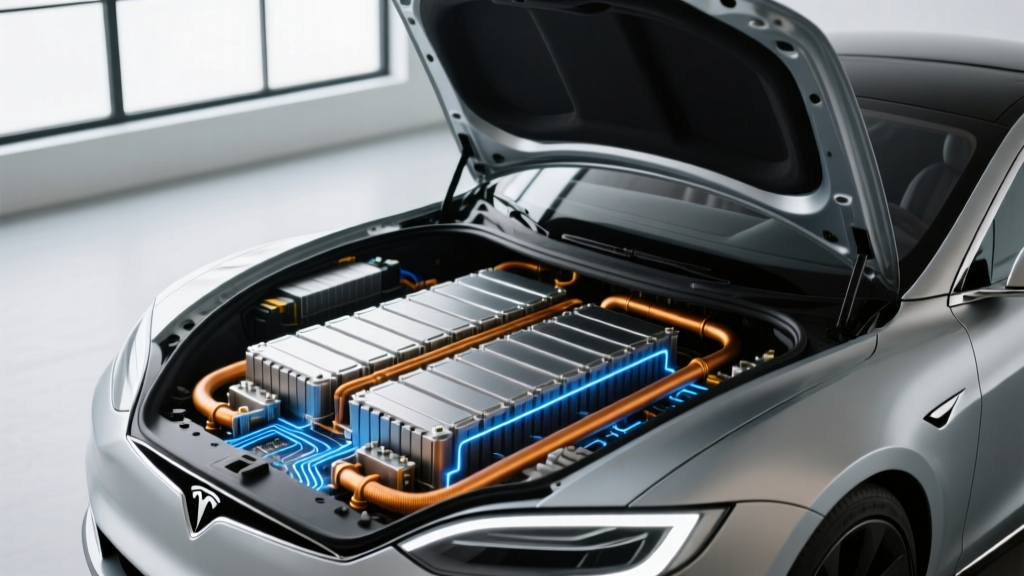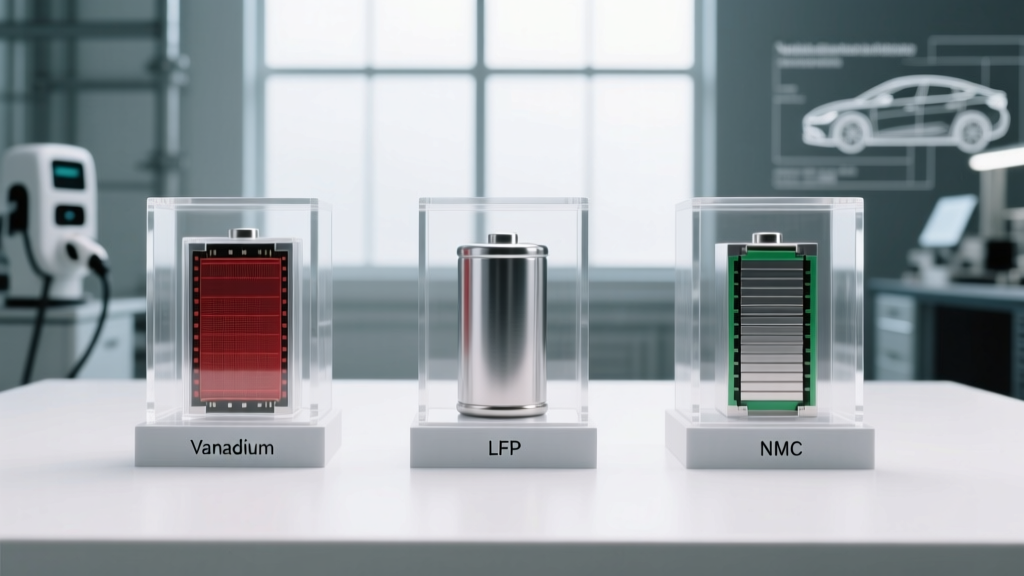
If you have been following energy-storage headlines, you may have encountered the term vanadium batteries — more precisely, vanadium redox flow batteries (VRFBs) — and wondered whether they are coming to your next EV. The short answer: not anytime soon, and probably not ever in passenger cars. But understanding why vanadium flow chemistry struggles in vehicles while dominating grid storage is one of the fastest ways to understand what actually makes a good EV battery. It also clarifies why today's dominant chemistries — lithium iron phosphate (LFP) and nickel manganese cobalt (NMC/NCA) — won the automotive race, and what buyers should actually be watching.
This guide uses the vanadium battery conversation as a lens to cover every practical EV battery question that matters at the point of purchase: chemistry trade-offs, degradation curves, warranty fine print, replacement costs, and the habits that add or subtract years from your pack. We will also touch the forward-looking tech — solid-state, silicon anodes — with realistic timelines rather than press-release optimism.
Why Vanadium Batteries Keep Coming Up (and Why They Are Not in Your EV)
A vanadium redox flow battery stores energy in liquid electrolyte tanks containing vanadium ions in different oxidation states. Power is generated by pumping those liquids through a membrane stack. The architecture is elegant for one specific use case: stationary, multi-hour grid storage at the multi-megawatt scale. VRFBs offer very long cycle life (15,000–20,000+ cycles), near-zero capacity degradation over decades, and easy capacity scaling — just add bigger tanks.
But those same traits become fatal liabilities in a vehicle:
- Energy density: VRFBs sit around 15–25 Wh/kg at the system level. A modern NMC pack delivers 160–220 Wh/kg at the cell level and roughly 130–160 Wh/kg at the pack level. You would need a vanadium system 6–10× heavier than an LFP pack to store the same energy.
- Volume: Two electrolyte tanks plus pumps, plumbing, and a membrane stack cannot be packaged under a sedan floor.
- Power-to-weight: EV traction motors demand 150–400 kW bursts; flow batteries are optimized for steady multi-hour discharge at far lower specific power.
- Cost per kWh: VRFB system cost has fallen but remains well above $300/kWh installed, versus roughly $110–140/kWh at the cell level for LFP in 2025–2026 (per BloombergNEF lithium-ion price surveys).
So if you see a headline about a vanadium battery breakthrough, read the fine print: it is almost certainly about grid-scale storage, solar-farm buffering, or microgrids — not passenger vehicles. The chemistries that matter for your EV purchase today are LFP and NMC/NCA.
Chemistry Face-Off: LFP vs NMC/NCA for Passenger EVs
Every mainstream EV sold in the US in 2026 uses one of two lithium-ion cathode families. Understanding which one is under your floor affects range, charging behavior, longevity, cold-weather performance, and price.
| Attribute | LFP (Lithium Iron Phosphate) | NMC / NCA (Nickel-based) |
|---|---|---|
| Cell energy density | 140–180 Wh/kg | 220–300 Wh/kg |
| Pack-level energy density | ~110–150 Wh/kg | ~130–180 Wh/kg |
| Typical cycle life | 2,500–5,000+ full cycles | 1,000–2,500 full cycles |
| Cold performance (−10°C) | Moderate range loss (~25–35%) | Better retention (~15–25% loss) |
| Thermal stability | Excellent — very low runaway risk | Good — requires more BMS safeguards |
| Recommended daily SoC | Up to 100% (no penalty) | ~80% daily, 100% for trips only |
| Cell cost (2025–2026) | ~$90–120/kWh | ~$110–150/kWh |
| Cobalt / nickel content | None | Significant — supply-chain risk |
| Notable 2026 vehicles | Tesla Model 3 RWD, Model Y RWD, Ford Mustang Mach-E Select (LFP option), Rivian R1S Standard | Hyundai Ioniq 5/6, Kia EV6/EV9, BMW iX, Chevy Equinox EV, Tesla Long Range/Performance trims |
Bottom line: LFP wins on cycle life, safety, and cost — ideal for standard-range models and owners who want to charge to 100% without guilt. NMC/NCA wins on energy density and cold-weather performance — ideal for long-range trims and cold-climate buyers. Neither is universally "better"; the right choice depends on your daily driving distance, climate, and charging access.
How Long Do EV Batteries Actually Last? (Degradation Data)
The single most persistent myth in EV ownership is that the battery will need replacement like a smartphone after three years. Real-world fleet data from the last decade has put that fear to rest. Modern thermal management — liquid cooling and heating — is the main reason.
Observed degradation benchmarks (compiled from fleet studies, Recurrent Auto, and manufacturer data):
- Year 1 / ~15,000 miles: 2–5% capacity loss (initial formation settling)
- Year 3 / ~45,000 miles: 5–9% loss
- Year 5 / ~75,000 miles: 7–12% loss
- Year 8 / ~120,000 miles: 9–16% loss (varies widely by chemistry and thermal management)
- Year 10+ / 150,000+ miles: Many packs still above 80% State of Health (SoH)
LFP packs tend to cluster at the lower end of those loss figures because of their inherently longer cycle life. Early-generation air-cooled packs (e.g., 2011–2017 Nissan Leaf) degraded far faster — sometimes 20–30% by year 5 — which is why liquid thermal management is now standard on virtually every mainstream EV.
A concrete example: a 2023 Tesla Model 3 RWD with a ~57.5 kWh usable LFP pack showing 88% SoH at 72,000 miles would still deliver roughly 235 miles of real-world range versus the EPA's original 272 miles. That is a usable car, not a paperweight.
What the Battery Warranty Actually Covers (Read the Fine Print)
US federal law effectively mandates a minimum 8-year / 100,000-mile battery warranty, but the details vary significantly by manufacturer — especially the capacity-retention threshold below which a claim is honored.
| Manufacturer / Model | Warranty Term | Capacity Threshold | Notes |
|---|---|---|---|
| Tesla (Model 3/Y RWD — LFP) | 8 yr / 120,000 mi | 70% SoH | Long Range/Performance: 8yr/120k mi, 70% |
| Hyundai / Kia (Ioniq 5, EV6, EV9) | 10 yr / 100,000 mi | 70% SoH | Among the longest terms in the market |
| Ford (Mach-E, F-150 Lightning) | 8 yr / 100,000 mi | 70% SoH | Component coverage separate |
| GM (Ultium-based: Equinox, Blazer, Silverado EV) | 8 yr / 100,000 mi | 70% SoH (some trims 60%) | Verify specific trim terms at purchase |
| Rivian (R1S, R1T) | 8 yr / 175,000 mi | 70% SoH | Higher mileage cap — good for high-mileage drivers |
| BMW (i4, iX, i7) | 8 yr / 80,000 mi | 70% SoH | Lower mileage cap than most competitors |
What the warranty does NOT typically cover: cosmetic range loss within the threshold (e.g., dropping from 100% to 72% SoH is not a claim), damage from accidents, improper charging equipment, or unauthorized modifications. The warranty also usually does not cover the 12V auxiliary battery — that is a separate component with a typical 3-year warranty.
EV Battery Replacement Cost: When, Why, and How Much
Most EV batteries outlive the economic life of the vehicle. The cases where replacement is actually needed tend to involve manufacturing defects (caught under warranty), physical damage from collisions or flooding, or extreme high-mileage fleet use. But if you do need an out-of-warranty replacement, here is what the market looks like in 2026.
| Battery Size / Vehicle Class | Part Cost Range | Labor | Total Installed |
|---|---|---|---|
| 40–60 kWh (compact / standard range) | $6,000–$10,000 | $1,500–$3,000 | $7,500–$13,000 |
| 70–90 kWh (mid-size / long range) | $10,000–$16,000 | $2,000–$4,000 | $12,000–$20,000 |
| 100–135 kWh (truck / large SUV) | $14,000–$24,000 | $2,500–$5,000 | $16,500–$29,000 |
A few important nuances:
- Module-level repair: Many modern packs (especially GM Ultium and some Hyundai/Kia designs) allow individual module replacement rather than the whole pack, cutting costs to $2,000–$6,000 for a single failed module.
- Remanufactured packs: A growing secondary market offers refurbished packs at 40–60% of new-pack cost.
- Cell cost decline: Pack-level pricing has fallen roughly 80% since 2013 (per BloombergNEF). By the time most 2026 EVs need out-of-warranty service in the 2034–2038 window, replacement costs will likely be substantially lower than today's figures.
Six Factors That Accelerate (or Preserve) Battery Life
- Fast-charging frequency: Occasional DC fast charging (1–2× per week) has minimal impact. Daily 150–250 kW sessions without preconditioning can add 1–3% extra annual degradation. Use Level 2 (7–11 kW) for daily charging whenever possible.
- State of charge extremes: For NMC/NCA, sitting at 100% SoC for days accelerates calendar aging. Target 80% daily, 100% only when departing on a trip within hours. LFP owners can charge to 100% routinely — the chemistry tolerates it, and periodic full charges help the BMS recalibrate cell balancing.
- Temperature extremes: Battery degradation accelerates above ~35°C (95°F) cell temperature and below −20°C (−4°F). Garage parking in summer heat and preconditioning in winter cold both help. Most modern packs have active thermal management, but it cannot fully overcome physics in Phoenix summers or Minnesota winters.
- Depth of discharge: Shallow cycles (e.g., 40–80% SoC daily) are gentler than full 100–0% cycles. You do not need to obsess over this — the BMS manages buffers — but avoiding habitual deep discharges below 10% is sensible.
- Preconditioning before fast charging: Cold batteries charge slowly and experience lithium plating if forced to accept high current. Always use the vehicle's navigation-to-charger preconditioning feature (Tesla, Rivian, Hyundai/Kia, and most others support this). It warms the pack to ~30–40°C for optimal charge acceptance.
- Storage habits: If storing an EV for weeks, leave it at ~50% SoC, plugged in if possible so the BMS can maintain thermal management. Storing at 100% or below 10% for extended periods accelerates calendar degradation.
How to Check and Monitor Battery Health (SoH)
State of Health (SoH) is the percentage of original capacity your pack can still hold. A new pack is 100% SoH; a pack that holds 85% of its original kWh is at 85% SoH. Here is how to check it:
- In-vehicle displays: Some manufacturers (notably Tesla via the service menu, Hyundai/Kia via the infotainment diagnostics screen) expose SoH or a related health metric directly.
- OBD-II dongles + apps: Tools like OBDLink SX/MX+ paired with apps such as EV Health or Leaf Spy (Nissan-specific) can read BMS-reported SoH, cell voltage variance, and pack temperature.
- Dealer diagnostics: A service visit can pull a full BMS report. Useful for pre-purchase inspections on used EVs.
- Third-party services: Companies like Recurrent Auto (now part of Cox Automotive) aggregate anonymized fleet data and offer individual battery health reports based on your charging telemetry.
- Manual calculation: Charge to 100%, note the displayed range or kWh-remaining figure, and compare to the original EPA-rated range adjusted for your driving conditions. This is imprecise but directionally useful.
For used-EV buyers, a pre-purchase SoH check is the single most important diagnostic — more important than cosmetic condition or tire wear, because battery replacement is the largest single cost in EV ownership.
Emerging Battery Tech: Solid-State, Silicon Anodes, and Realistic Timelines
The battery R&D pipeline is real, but timelines are consistently overpromised. Here is an honest assessment as of 2026:
- Solid-state batteries: Toyota, Samsung SDI, and QuantumScape have all announced pilot production, but no mass-market vehicle with a full solid-state pack is on US roads yet. Toyota's announced 2027–2028 launch targets a limited-production vehicle with ~750 km (WLTP) range. Realistic volume production for US-market models: 2029–2032 at the earliest. Advantages: higher energy density (~350–500 Wh/kg cell-level), faster charging, improved safety. Challenges: manufacturing cost, interfacial degradation, scaling.
- Silicon-dominant anodes: Already in limited use (Porsche Taycan, some GM Ultium cells use silicon-enhanced graphite). Pure silicon anodes promise 10× the capacity of graphite but suffer from ~300% volume expansion during cycling. Companies like Sila Nanotechnologies and Group14 are shipping partial-silicon anodes now; full silicon-anode cells in volume production are likely 2028–2030.
- Sodium-ion batteries: CATL and BYD have begun shipping sodium-ion packs in Chinese-market small EVs. Energy density (~120–160 Wh/kg) is lower than LFP, but raw materials are cheaper and more abundant. US-market adoption is plausible for budget compact EVs by 2028–2030.
- Lithium-sulfur: Still in lab and early-prototype stage. Promising energy density (~400–600 Wh/kg theoretical) but cycle life remains far below automotive requirements. Not expected in production vehicles before 2032+.
For buyers deciding today: do not delay a purchase waiting for solid-state. Current LFP and NMC packs, properly cared for, will last the life of the vehicle and cost far less than any first-generation solid-state pack will at launch.
Frequently Asked Questions
Are vanadium batteries coming to electric cars?
No. Vanadium redox flow batteries are designed for stationary grid storage, where their heavy liquid electrolyte tanks and low energy density (15–25 Wh/kg) are acceptable. Passenger EVs require 130–180+ Wh/kg at the pack level — roughly 6–10× what VRFBs can deliver. There is no announced production EV using vanadium chemistry.
How long do EV batteries last in years and miles?
Modern liquid-cooled EV batteries typically retain 70–85% of original capacity at 150,000 miles and 10+ years. Many packs outlast the economic life of the vehicle. Early air-cooled packs (pre-2018 Nissan Leaf, early Fiat 500e) degraded faster, but that generation is largely off the new-car market.
How much does it cost to replace an EV battery?
Out-of-warranty replacement ranges from roughly $7,500 for a compact standard-range pack to $29,000 for a large truck/SUV pack, including labor. Most replacements are covered under the 8–10 year / 100,000–175,000 mile warranty. Module-level repairs, where supported, can cost $2,000–$6,000.
What does the EV battery warranty cover?
Typically, capacity loss below a threshold (usually 70% SoH) within the warranty term (8–10 years / 100,000–175,000 miles depending on manufacturer). It does not cover damage from accidents, misuse, or unauthorized modifications. The 12V auxiliary battery is covered separately.
LFP or NMC — which should I choose?
Choose LFP if you want lower cost, longer cycle life, can charge to 100% daily without worry, and do not need maximum range. Choose NMC/NCA if you need long range (300+ miles EPA), live in a cold climate, or want the highest energy density. Both chemistries are proven and well-supported in 2026 model-year vehicles.
Does fast charging damage my EV battery?
Occasional DC fast charging has minimal impact. Daily fast charging without preconditioning can add 1–3% extra annual degradation. For daily use, Level 2 charging at 7–11 kW is gentler. Always use your vehicle's preconditioning feature when navigating to a DC fast charger.
How do I check my EV battery's State of Health?
Check via the vehicle's built-in diagnostics (if available), an OBD-II dongle with an EV-specific app, a dealer diagnostic report, or a third-party service like Recurrent. For used-EV purchases, a SoH check is essential before committing.
Understanding battery chemistry, degradation patterns, and warranty terms is the highest-leverage knowledge an EV buyer can have. Vanadium flow batteries are a fascinating technology — just not for your driveway. For that, LFP and NMC remain the proven, cost-effective, long-lasting choices that will carry the EV market through the rest of this decade and likely beyond.