If you've popped the hood of a Toyota — whether it's a Prius, a RAV4 Hybrid, or the all-electric bZ4X — you may have noticed a yellow-and-black label reading Toyota TrueStart. It's a natural question for any Toyota owner or shopper: who makes Toyota TrueStart batteries? And more importantly, if you're driving or considering a Toyota electrified vehicle, how does that 12V battery relate to the high-voltage traction battery that actually propels the car?
This guide answers the TrueStart origin question, then pivots to what really matters for EV and hybrid buyers in 2026: the chemistry, longevity, warranty, and replacement economics of the high-voltage traction batteries powering Toyota's electrified lineup — and the broader EV market.
Who Manufactures Toyota TrueStart Batteries?
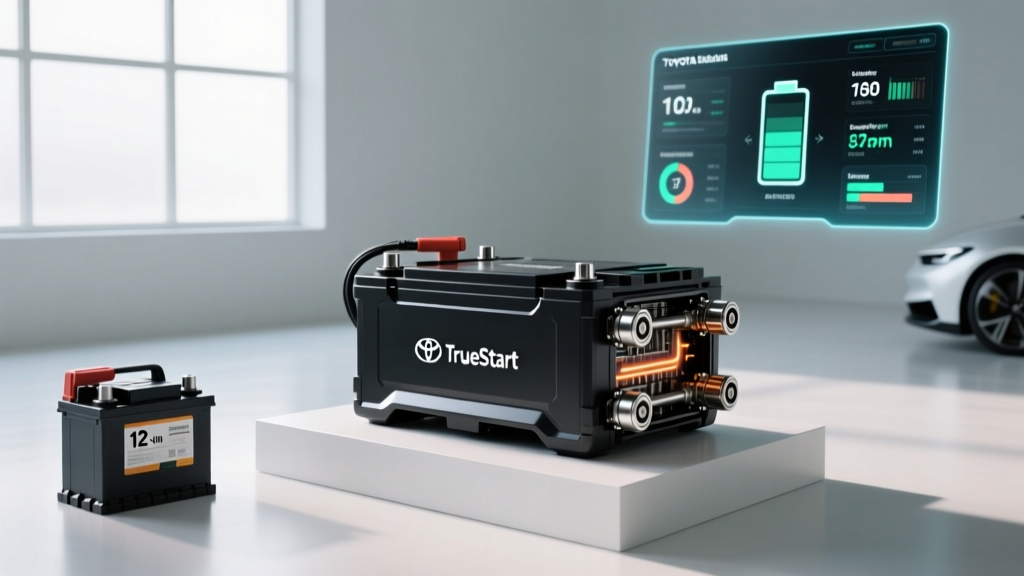
Toyota TrueStart batteries are 12-volt auxiliary batteries — not the high-voltage traction batteries that drive an electric or hybrid vehicle. Toyota does not manufacture these cells in-house. Instead, TrueStart batteries are produced by third-party battery manufacturers under contract to Toyota's specifications and sold through Toyota dealerships as OEM replacement parts.
The primary manufacturer behind TrueStart-branded batteries has historically been Clarios (formerly Johnson Controls Power Solutions), one of the world's largest suppliers of lead-acid and AGM (Absorbent Glass Mat) automotive batteries. Clarios also supplies batteries for many other OEM brands. In some markets and model years, Panasonic and GS Yuasa have also supplied 12V batteries for Toyota vehicles, particularly for hybrid models where an AGM or lithium-ion 12V unit is specified.
The TrueStart line includes conventional flooded lead-acid, AGM, and in some applications, lithium-ion 12V batteries. The specific chemistry depends on the vehicle: a Prius or bZ4X, for instance, uses the 12V battery primarily to power electronics, computers, and accessories — not to crank a starter motor — so Toyota often specifies an AGM or lithium 12V unit for weight savings and longevity.
EV Traction Battery Chemistry: LFP vs. NMC vs. NCA
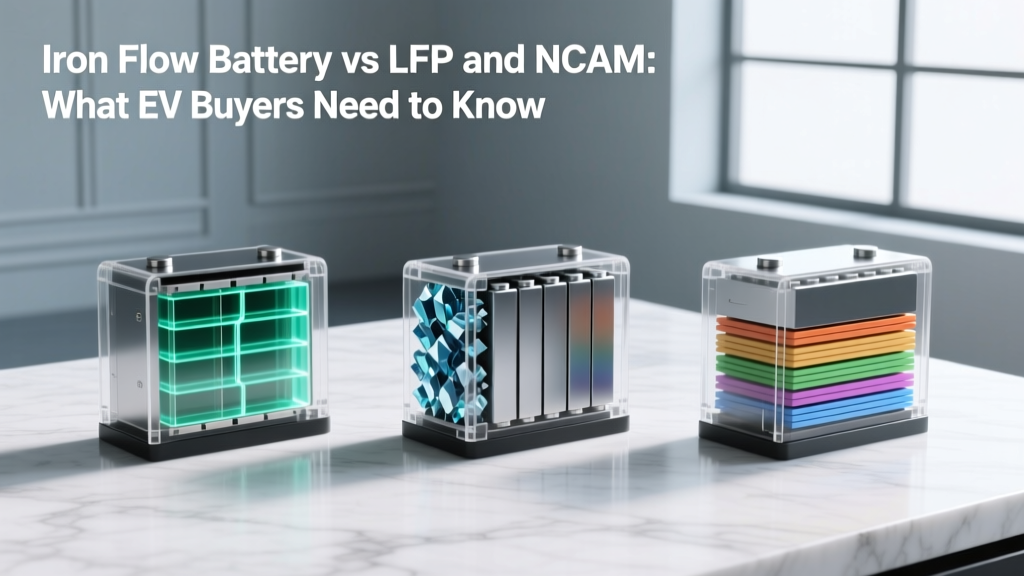
The high-voltage traction battery is the single most expensive component in any electric vehicle. Its chemistry dictates range, charging speed, longevity, cold-weather behavior, and cost. In 2026, three lithium-ion chemistries dominate the EV market:
- NMC (Nickel Manganese Cobalt) — the most common chemistry in mainstream EVs, balancing energy density with cost.
- NCA (Nickel Cobalt Aluminum) — used by Tesla and a few others for high energy density.
- LFP (Lithium Iron Phosphate) — rapidly growing in popularity for its durability, safety, and lower cost, though with reduced energy density.
| Attribute | LFP | NMC | NCA |
|---|---|---|---|
| Energy Density (Wh/kg) | ~150–180 | ~200–260 | ~220–270 |
| Cycle Life (full cycles to 80% SoH) | 3,000–5,000+ | 1,000–2,000 | 800–1,500 |
| Cold-Weather Performance | Moderate (more range loss below freezing) | Good | Good |
| Thermal Stability / Safety | Excellent (very resistant to thermal runaway) | Good (requires robust BMS) | Fair (requires robust BMS) |
| Cost per kWh | Lowest (~$80–100/kWh at pack level) | Mid (~$110–140/kWh) | Higher (~$120–150/kWh) |
| Recommended Charging Habit | Can charge to 100% daily | Best kept 20–80% for daily; 100% for trips | Best kept 20–80% for daily; 100% for trips |
| Notable EVs Using | Tesla Model 3 RWD, Ford Mustang Mach-E Select (some trims), BYD models | Hyundai Ioniq 5, Kia EV6, VW ID.4, Toyota bZ4X, most long-range EVs | Tesla Model S/X, some Rivian packs |
Toyota's bZ4X, for example, uses a 71.4 kWh (usable) NMC lithium-ion battery co-developed with Panasonic's Prime Planet Energy & Solutions (PPES) joint venture. Toyota has stated its intent to introduce LFP batteries in lower-cost models and is investing heavily in bipolar LFP and solid-state battery development for future vehicles.
Which is better? There is no universal winner. NMC/NCA gives you more range per kilogram — critical for long-range and performance vehicles. LFP gives you dramatically longer cycle life, better safety margins, and a lower price tag, making it ideal for standard-range daily drivers that will be charged frequently. If you plan to keep a car 10+ years and charge daily, LFP's cycle-life advantage is significant. If you need maximum range for road trips, NMC/NCA remains the pragmatic choice.
How Long Do EV Batteries Last? Degradation Data
EV batteries don't suddenly fail — they gradually lose capacity over time, a process called degradation. The metric used is State of Health (SoH): a battery at 90% SoH holds 90% of its original energy capacity, meaning roughly 10% less range.
Real-world degradation data from fleet studies, owner surveys, and manufacturer testing paints a reassuring picture:
- Year 1–2: Typical loss of 2–5% as the battery undergoes initial formation settling.
- Year 3–5: Degradation slows to roughly 1–2% per year for liquid-cooled packs.
- Year 8–10: Most modern EVs retain 80–90% of original capacity.
- Year 12–15: Many packs still hold 70–80%, depending on chemistry and usage.
Concrete data points from the field:
- Tesla Impact Report (2023 data): Model 3/Y packs showed approximately 12% degradation at 200,000 miles — meaning 88% SoH after high mileage.
- Geotab fleet study (2024 update, ~6,300 EVs): Average annual degradation across all brands was 1.8% per year, with liquid-cooled batteries outperforming passively cooled ones.
- Toyota bZ4X: Toyota targets 90% capacity retention after 10 years of typical use, one of the most conservative (and confidence-signaling) targets in the industry, achieved through restricted usable buffer and careful thermal management.
LFP batteries consistently show slower degradation curves than NMC, with some fleet data suggesting less than 10% loss over 300,000+ miles. This is the primary reason LFP is gaining share in high-utilization applications like ride-hailing and delivery fleets.
What Does the EV Battery Warranty Cover?
Federal law in the United States mandates that EV and hybrid battery warranties cover a minimum of 8 years / 100,000 miles. In CARB states (California and states that follow California emissions standards), the mandate extends to 10 years / 150,000 miles. Most manufacturers meet or exceed these thresholds.
| Manufacturer / Model | Warranty Term | Capacity Retention Threshold |
|---|---|---|
| Toyota bZ4X | 8 yr / 100,000 mi | 70% SoH |
| Tesla Model 3 / Model Y (LFP) | 8 yr / 100,000 mi | 70% SoH |
| Tesla Model S / Model X | 8 yr / 150,000 mi | 70% SoH |
| Hyundai Ioniq 5 / Ioniq 6 | 10 yr / 100,000 mi | 70% SoH |
| Ford Mustang Mach-E / F-150 Lightning | 8 yr / 100,000 mi | 70% SoH |
| Kia EV6 / EV9 | 10 yr / 100,000 mi | 70% SoH |
| Volkswagen ID.4 | 8 yr / 100,000 mi | 70% SoH |
| Chevrolet Equinox EV / Blazer EV | 8 yr / 100,000 mi | 60% SoH |
What the warranty covers: If the battery's State of Health drops below the stated threshold (typically 70%) within the warranty period, the manufacturer will repair or replace the battery to bring it back above that threshold. This covers defects, premature cell failure, and abnormal degradation.
What it does NOT cover: Damage from accidents, flooding, improper modifications, or use outside normal operating parameters. Normal gradual degradation above the threshold is not a warranty claim — a battery at 72% SoH after 9 years is functioning within expectations.
For detailed warranty terms, always check the manufacturer's official warranty booklet and the EPA's fueleconomy.gov listings for model-specific data.
How Much Does It Cost to Replace an EV Battery?
This is the question that generates the most anxiety — and the most misinformation. Let's put it in context with actual numbers.
| Vehicle | Battery Size (kWh usable) | Estimated Replacement Cost |
|---|---|---|
| Nissan Leaf (40 kWh) | 40 | $6,500–$9,000 |
| Chevrolet Bolt EV (65 kWh) | 65 | $9,000–$14,000 |
| Tesla Model 3 Standard Range (LFP, ~60 kWh) | ~60 | $8,000–$12,000 |
| Hyundai Ioniq 5 (77.4 kWh) | 77.4 | $12,000–$18,000 |
| Toyota bZ4X (71.4 kWh) | 71.4 | $11,000–$16,000 |
| Ford F-150 Lightning Extended Range (131 kWh) | 131 | $20,000–$30,000 |
| Tesla Model S (100 kWh) | 100 | $15,000–$22,000 |
Important context: The vast majority of EV batteries never need full replacement during the vehicle's useful life. Data from warranty claims across major manufacturers shows replacement rates well under 2% during the warranty period. Module-level repairs (replacing a few degraded cells or modules rather than the entire pack) are increasingly common and cost significantly less — typically $2,000–$6,000.
Battery pack prices have also been declining steadily. According to BloombergNEF, average pack-level prices fell below $120/kWh in 2025, meaning replacement costs in 2030 or 2035 — when today's EVs might actually need a new pack — will likely be substantially lower than today's estimates.
Factors That Affect EV Battery Life
While modern battery management systems (BMS) do an excellent job protecting the pack, owner habits still influence long-term degradation. Here are the factors that matter most:
- Limit DC fast charging to road trips. Occasional fast charging is fine, but daily 150+ kW sessions accelerate degradation. Use Level 2 (7–11 kW) for routine home charging.
- Avoid extreme State of Charge for storage. For NMC/NCA, store at ~50% SoC if the car will sit for weeks. LFP tolerates 100% storage better.
- Use daily charge limits. Set your charge limit to 80% for NMC/NCA daily driving (most EV apps allow this). LFP owners can charge to 100% daily — in fact, periodic 100% charges help LFP BMS calibration.
- Precondition the battery. Use your EV's preconditioning feature before fast charging in cold weather. A cold battery charges slower and experiences more stress.
- Park in shade or a garage when possible. Sustained high ambient temperatures (above 95°F / 35°C) accelerate calendar degradation, especially at high SoC.
- Drive normally. Aggressive acceleration generates heat, but the BMS manages this. Moderate driving is marginally better for longevity; the difference is small.
- Keep software updated. Manufacturers regularly refine BMS algorithms via OTA updates to improve thermal management and charging curves.
The single most impactful habit for NMC/NCA owners is avoiding prolonged time at 100% SoC. A battery sitting at full charge in hot weather degrades faster than almost any other normal-use scenario. Set the charge limit, plug in when you get home, and let the car manage the rest.
How to Check and Monitor Battery Health (SoH)
Most EVs provide some level of battery health visibility, though the granularity varies by manufacturer:
- In-vehicle displays: Tesla, Hyundai/Kia, and some others show estimated range that adjusts based on recent driving and battery condition. A noticeable, sustained drop in max range at 100% SoC compared to when the car was new is the simplest SoH indicator.
- Manufacturer apps: The Toyota app (for bZ4X), Tesla app, and Hyundai Bluelink app provide battery status and charging data. Some show explicit SoH percentages; others show it indirectly.
- OBD-II diagnostic tools: Devices like the OBDLink SX paired with apps such as EV Bat Life or LeafSpy (for Nissan Leaf) can read the battery management system's internal SoH estimate directly. This is the most accurate consumer-accessible method.
- Dealer diagnostic reports: Any authorized dealer can run a full battery health report. Request one during routine service visits, especially before and after the warranty period.
- Third-party services: Companies like Recurrent Auto offer battery health reports based on connected-car data, often providing more granular trend lines than the OEM app.
For buyers considering a used EV, a battery health report is as important as a vehicle history report. Request the SoH reading and compare it against the expected degradation curve for that model and mileage.
What's Next? Solid-State Batteries and Beyond
Every EV buyer has heard about solid-state batteries — the promised technology that will deliver faster charging, more range, and longer life. Here's where the technology actually stands in 2026:
Toyota has announced a solid-state battery targeting 750 km (~466 miles) of range and a 10-minute 10–80% charge time, with initial production planned for 2027–2028. However, Toyota has cautioned that initial production volumes will be very limited — likely confined to a few hundred units in a premium Lexus model.
Samsung SDI is targeting 2027 for solid-state production, while Nissan has announced a pilot production line for 2028. QuantumScape continues to work with Volkswagen's PowerCo on validation, but commercial availability in consumer vehicles remains 2028 at the earliest.
Silicon anode batteries — which replace graphite anodes with silicon to increase energy density — are closer to market. Companies like Sila Nanotechnologies and Group14 Technologies are already supplying silicon anode materials for limited production, and broader adoption is expected in the 2026–2028 timeframe.
Frequently Asked Questions
Is the Toyota TrueStart battery the same as the hybrid or EV traction battery?
No. The TrueStart is a 12V auxiliary battery that powers accessories, computers, and lighting. The traction battery (e.g., the 71.4 kWh pack in the bZ4X or the 13.6 kWh pack in the Prius Prime) is an entirely separate, much larger high-voltage battery that powers the electric drive motors. They have different chemistries, different warranties, and different replacement costs.
How long do EV batteries last in years and miles?
Modern liquid-cooled EV batteries typically retain 80–90% of their original capacity after 10 years or 150,000–200,000 miles. LFP chemistries often outlast NMC, with some fleet data showing less than 10% degradation at 300,000 miles. Most EV batteries will outlast the vehicle they're installed in.
What does the battery warranty actually cover?
The warranty covers the battery dropping below a specified State of Health threshold (usually 70%) within the warranty period (typically 8 years / 100,000 miles). If that happens, the manufacturer repairs or replaces the battery at no cost. It does not cover accident damage, misuse, or normal gradual degradation above the threshold.
LFP vs. NMC — which battery should I choose?
Choose LFP if you prioritize longevity, daily charging tolerance, safety, and lower cost — and you don't need maximum range. Choose NMC/NCA if you need the longest possible range per charge for frequent road trips or live in a very cold climate where LFP's cold-weather range loss is more pronounced.
Can I check my EV battery health myself?
Yes. Monitor your maximum range at full charge over time, use your manufacturer's app, or invest in an OBD-II adapter with EV-specific software to read the BMS-reported State of Health directly. For used EV purchases, always request a dealer diagnostic report.
Will I need to replace my EV battery?
Statistically, probably not. Warranty replacement rates across the industry are well under 2%. When replacements are needed, module-level repairs are increasingly available at a fraction of full-pack cost. And pack prices continue to decline — by the time a 2026 EV might need a new battery in the 2038–2040 timeframe, costs will likely be significantly lower than today's estimates.
For authoritative data on EV efficiency and range, consult the U.S. Department of Energy's fueleconomy.gov. For tax credit eligibility on new EV purchases, review current rules at IRS.gov's Clean Vehicle Credits page.