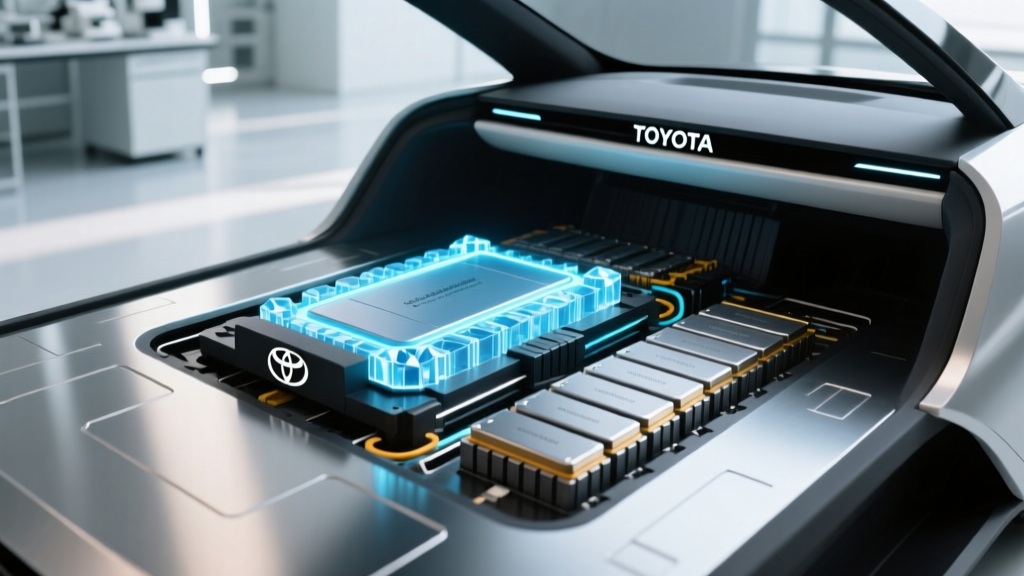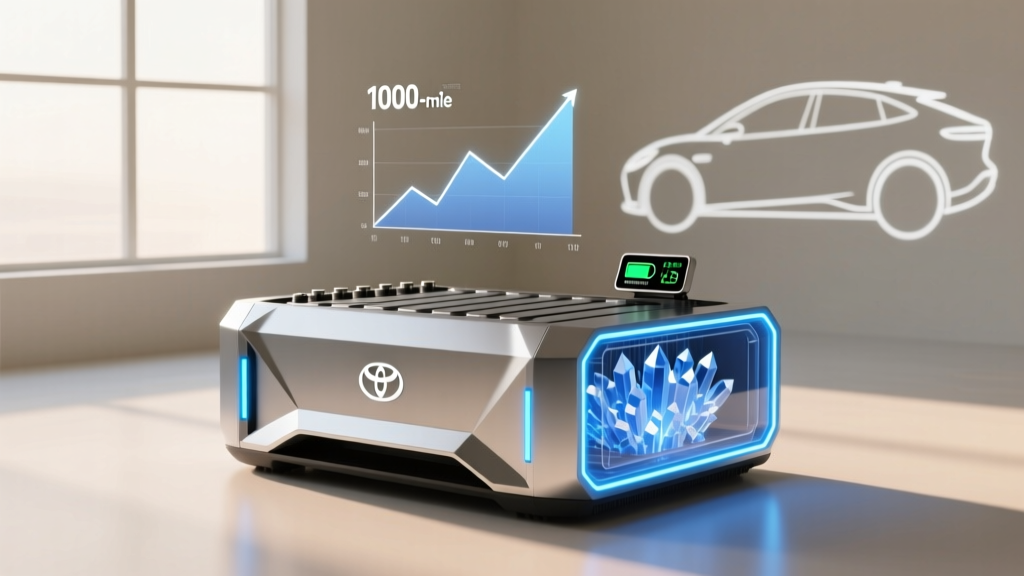
The headline is irresistible: Toyota says it can build an EV battery that delivers 1,000 kilometers (about 621 miles) of range, charges in 10 minutes, and uses solid-state technology. Searches for the Toyota 1000 mile battery have spiked every time the company releases an update, and for good reason — if delivered, it would reset the entire EV landscape. But as of 2026, no Toyota production vehicle ships with a solid-state traction battery, and the 1,000-kilometer claim refers to a future target, not a car you can buy today.
What you can buy — and what actually matters for your next EV purchase — is the current generation of lithium-ion batteries using NMC, NCA, and LFP chemistries. These packs are powering millions of vehicles right now, with well-documented degradation curves, standardized warranties, and predictable replacement economics. This guide puts the Toyota solid-state promise in proper context, then gives you the exact data you need to evaluate any EV battery on the market in 2026.
Toyota's Solid-State Battery: What's Been Announced vs. What's Available
Toyota has been the most vocal legacy automaker on solid-state battery R&D. Here is where the program stands based on the company's public statements and patent filings through early 2026:
- Target spec: ~1,000 km (621 miles) of range on a full charge, with a 10-minute 10–80% DC fast-charge capability.
- Timeline: Toyota initially announced limited production around 2027–2028, with broader commercialization targeted for 2030. As of 2026, these dates remain announced estimates, not confirmed model-year commitments.
- Chemistry: Solid-state batteries replace the liquid electrolyte in conventional lithium-ion cells with a solid material (sulfide-based or oxide-based), enabling lithium-metal anodes that dramatically increase energy density.
- Challenges: Manufacturing scalability, dendrite formation at the anode-electrolyte interface, thermal management under high C-rates, and unit cost remain unsolved at production volume.
Toyota's own battery roadmap also includes near-term "bipolar" NiMH and high-performance lithium-ion packs targeting 800 km (497 miles) and a lower-cost LFP-based pack targeting 600 km (373 miles) for more affordable models. None of these have appeared in a US-market Toyota EV as of 2026.
LFP vs. NMC vs. NCA: The Chemistry Trade-Offs That Matter Now
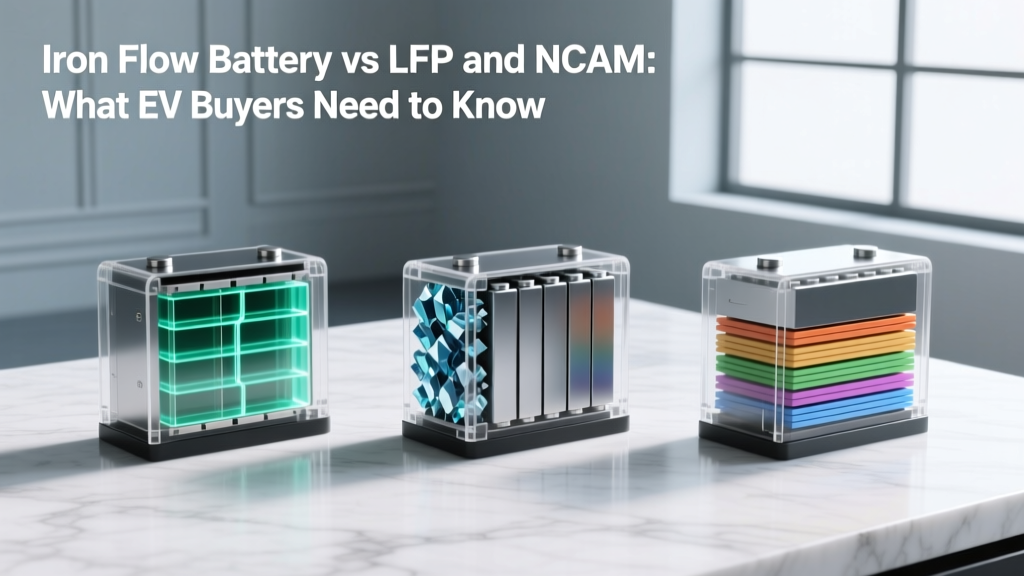
While the industry waits for solid-state, today's EV buyers choose between three dominant cathode chemistries. Each has measurable trade-offs in energy density, cycle life, thermal behavior, and cost.
| Attribute | LFP (Lithium Iron Phosphate) | NMC (Nickel Manganese Cobalt) | NCA (Nickel Cobalt Aluminum) |
|---|---|---|---|
| Energy density (cell-level) | ~160–180 Wh/kg | ~220–260 Wh/kg | ~250–270 Wh/kg |
| Typical cycle life | 3,000–5,000+ cycles | 1,000–2,000 cycles | 1,000–1,500 cycles |
| Cold-weather performance | Moderate — greater range loss below 32°F | Better low-temp discharge | Better low-temp discharge |
| Thermal stability | Excellent — lowest thermal runaway risk | Good with BMS management | Good with BMS management |
| Cobalt content | None | Varies (low-cobalt trending) | Low but present |
| Cost per kWh (pack-level) | ~$95–$115 | ~$120–$145 | ~$120–$145 |
| Common applications (2026) | Tesla Model 3/Y RWD, BYD, Ford Mustang Mach-E Select | Hyundai Ioniq 5/6, VW ID.4, BMW iX, most long-range EVs | Tesla Model S/X, Rivian, some Panasonic-supplied packs |
| Recommended charge habit | Can charge to 100% regularly | Best kept 20–80% daily; 100% for trips | Best kept 20–80% daily; 100% for trips |
The practical takeaway: LFP is the better choice if you want maximum cycle life, can charge to 100% without worry, and don't need the longest single-charge range. NMC/NCA delivers more miles per kilogram of battery — critical for long-range and performance trims — but demands more careful state-of-charge management for longevity. Neither chemistry is "better" universally; the right choice depends on your driving pattern.
How Long Do EV Batteries Actually Last? Degradation Data
EV batteries don't suddenly fail — they gradually lose capacity over time and charge cycles. The metric that matters is State of Health (SoH), expressed as the percentage of original capacity remaining.
Based on fleet data from sources including Geotab's long-term EV battery study and manufacturer-reported figures, here is what real-world degradation looks like:
- Year 1–2: ~2–4% capacity loss (initial "break-in" drop)
- Year 3–5: ~1–2% per year (linear phase)
- Year 6–10: ~1–1.5% per year (gradual taper)
- At 150,000 miles / 8 years: expect ~85–90% SoH for most liquid-cooled packs
Key data points from specific models:
- Tesla Model 3/Y (NMC/LFP): Tesla's 2024 Impact Report cited fleet data showing less than 15% degradation at 200,000 miles for NMC packs. LFP variants show even slower fade.
- Nissan Leaf (passive air-cooled, older generations): Historically showed 20–30% degradation by year 8 in hot climates — a cautionary example of how thermal management matters more than chemistry alone.
- Hyundai/Kia E-GMP platform (Ioniq 5, EV6): Liquid-cooled 77.4 kWh NMC packs have shown ~5–7% loss in the first 60,000 miles in owner-reported data.
How long do EV batteries last? For a modern liquid-cooled pack, expect 15–20 years of usable service before capacity drops below 70%. Most will outlast the vehicle's body, suspension, and interior. Catastrophic failure (sudden cell death) is exceedingly rare and covered under warranty.
Battery Warranty Terms: What's Covered and What Isn't
Federal law mandates a minimum 8-year/100,000-mile warranty on EV traction batteries for vehicles sold in the US. California-emissions states (CARB states) extend that to 10 years/150,000 miles. Most automakers meet or exceed these minimums.
| Manufacturer | Warranty Period | Mileage Cap | Capacity Threshold | Notes |
|---|---|---|---|---|
| Tesla (Model 3/Y LFP) | 8 years | 120,000 mi | 70% retention | LFP packs get higher mileage cap |
| Tesla (Model 3/Y Long Range, S, X) | 8 years | 120,000–150,000 mi | 70% retention | Varies by model |
| Hyundai / Kia | 10 years | 100,000 mi | 70% retention | Among the longest coverage |
| Ford (Mach-E, F-150 Lightning) | 8 years | 100,000 mi | 70% retention | Standard across EV lineup |
| GM (Ultium platform) | 8 years | 100,000 mi | 70% retention | Covers battery and EV components |
| VW (ID.4) | 8 years | 100,000 mi | 70% retention | Transferable to second owner |
| Toyota (bZ4X) | 8 years | 100,000 mi | 70% retention | 10 yr/150k mi in CARB states |
What the warranty covers: If your battery's State of Health drops below the stated threshold (typically 70%) within the warranty period, the manufacturer will repair or replace the pack at no cost. This includes defective modules, BMS failures, and abnormal degradation.
What it does NOT cover: Damage from accidents, flooding, improper charging equipment, or modifications. Normal degradation above the 70% threshold is considered expected wear. Always check your specific owner's manual for exclusions.
EV Battery Replacement Cost: Numbers by Model and When It's Needed
The fear of a $20,000+ battery replacement bill is the single biggest psychological barrier to EV adoption. Let's ground that fear in data.
When is replacement actually needed? For the vast majority of EV owners, it isn't — at least not within the typical ownership period. Battery replacement outside of warranty claims is uncommon before 200,000+ miles. Most EVs are scrapped or sold for reasons unrelated to the battery (body damage, electronics, owner preference).
| Model | Battery Size (kWh) | Chemistry | Estimated Pack Cost (parts) | Labor + Total Estimate |
|---|---|---|---|---|
| Tesla Model 3 RWD | 60 kWh | LFP | $7,000–$9,000 | $9,000–$12,000 |
| Tesla Model Y Long Range | 75 kWh | NMC | $10,000–$13,000 | $12,000–$16,000 |
| Hyundai Ioniq 5 | 77.4 kWh | NMC | $11,000–$14,000 | $13,000–$17,000 |
| Ford Mustang Mach-E ER | 91 kWh (usable) | NMC | $13,000–$16,000 | $15,000–$20,000 |
| Ford F-150 Lightning ER | 131 kWh | NMC | $18,000–$22,000 | $21,000–$28,000 |
| Chevy Bolt EV/EUV | 65 kWh | NMC | $8,000–$11,000 | $10,000–$14,000 |
These figures are out-of-warranty estimates. Pack-level battery prices have fallen from over $400/kWh in 2015 to roughly $120–$140/kWh in 2026, according to BloombergNEF data. Module-level repair (replacing only degraded modules rather than the full pack) is increasingly available and can cut costs by 50–70%. Independent EV repair shops are expanding this service.
The honest framing: A full pack replacement on a large-battery EV is expensive. But the probability of needing one outside of warranty coverage within a normal ownership window (8–12 years) is low — and declining as pack quality improves and module-level repair becomes more accessible.
Factors That Accelerate (or Protect) Battery Health
Battery degradation is not purely time-based. Your habits meaningfully influence how quickly your pack loses capacity.
- Limit DC fast charging to road trips. Frequent use of 150+ kW DCFC stresses cells thermally and chemically. Reserve it for when you need it; daily Level 2 charging at home is far gentler.
- Avoid prolonged 100% or 0% SoC. For NMC/NCA packs, the 20–80% window is the longevity sweet spot. LFP packs tolerate 100% better and benefit from periodic full charges for BMS calibration.
- Precondition before fast charging. Most EVs do this automatically when you navigate to a charger. A warm battery (ideally 70–95°F) charges faster and with less stress. This is why preconditioning — heating the battery before a high-power session — is critical in cold weather.
- Park in shade or a garage when possible. Sustained high ambient temperatures (above 95°F) accelerate calendar degradation, especially at high SoC. Liquid-cooled packs mitigate this, but thermal exposure still matters.
- Don't leave the car at 100% for days. If you charge to full for a road trip, try to depart the same day. Sitting at 100% SoC in heat is the most damaging combination.
- Drive normally. Aggressive acceleration and frequent hard regen don't meaningfully harm modern packs, but extreme sustained high-C-rate discharge (track use, heavy towing in heat) adds cumulative stress.
How to Check and Monitor Your Battery's State of Health
Knowing your SoH gives you confidence in your remaining range and resale value. Here are the primary methods:
- In-vehicle displays: Many EVs (Tesla, Hyundai/Kia, BMW) show a battery health or degradation indicator in the settings menu. Tesla's service mode provides detailed cell-level data.
- OBD-II diagnostic tools: Devices like the OBDLink MX+ paired with apps such as EV Health or ABRP can read the BMS-reported SoH directly. This is the most accurate consumer-accessible method.
- Dealer/Service center readout: Any authorized service center can pull a full battery health report, including individual module voltage variance and internal resistance trends.
- Range comparison method: Charge to 100%, note the displayed range, and compare it to the original EPA-rated range (adjusted for temperature). A rough but useful check — if your 310-mile EPA car now shows 275 miles at full charge in moderate weather, that's roughly 89% SoH.
Track SoH every 6–12 months. A sudden drop (more than 3–4% in a short period) warrants a dealer visit, as it may indicate a failing module that's covered under warranty.
Beyond Lithium-Ion: Solid-State, Silicon Anode, and What Comes Next
The Toyota 1000 mile battery is the highest-profile example of solid-state development, but it's far from the only program. Here's where next-generation technologies stand as of 2026:
- Solid-state batteries: Toyota, Samsung SDI, QuantumScape, and Solid Power are all pursuing sulfide- or oxide-based solid electrolytes. Advantages include 2–3× energy density vs. current cells, faster charging, and improved safety (no flammable liquid electrolyte). Challenge: manufacturing at automotive scale and cost remains unsolved. Realistic availability in volume production vehicles: 2029–2032.
- Silicon-dominant anodes: Companies like Sila Nanotechnologies and Group14 are replacing graphite anodes with silicon composites, boosting energy density by 20–40%. These are already appearing in limited applications (Mercedes EQG, some consumer electronics). Automotive-scale adoption expected 2026–2028.
- Sodium-ion batteries: CATL and BYD are commercializing sodium-ion cells for lower-cost, shorter-range EVs. Energy density is ~30% lower than LFP, but raw material cost is far cheaper. Best suited for urban commuter vehicles and stationary storage. Not expected in US-market long-range EVs.
- Lithium-sulfur: Theoretical energy density exceeds 500 Wh/kg, but cycle life remains too short for automotive use. Still in lab/prototype phase. Timeline: 2032+.
What This Means for Your Next EV Purchase
If you're waiting for Toyota's solid-state battery before buying an EV, understand the trade-off: you're likely waiting until at least 2030 for a vehicle you can actually purchase in the US, at a price that may initially be premium-tier. Meanwhile, today's lithium-ion packs — particularly LFP for longevity and NMC for range — offer proven, warrantied, and increasingly affordable electrification.
A 2026 EV with a 77–91 kWh NMC pack, EPA-rated at 280–320 miles, and backed by an 8-year/100,000-mile warranty at 70% retention will serve most drivers for 15+ years before the battery becomes a concern. The Toyota 1000 mile battery, if and when it arrives, will be a genuine leap — but it's not the prerequisite for going electric today.
Frequently Asked Questions
Is Toyota's 1000-mile battery available in any car I can buy now?
No. As of 2026, Toyota has not released any production vehicle with a solid-state battery. The 1,000-kilometer (621-mile) range target is part of Toyota's announced roadmap, with commercial availability estimated for 2028–2030 at the earliest. The current Toyota bZ4X uses a conventional 71.4 kWh NMC lithium-ion battery with an EPA-estimated 252 miles of range.
How long do EV batteries last in years and miles?
Modern liquid-cooled EV batteries typically retain 85–90% of their original capacity after 8 years and 150,000 miles. Most will remain functional (above 70% SoH) for 15–20 years or 200,000+ miles. LFP chemistry packs tend to outlast NMC/NCA in cycle count, though NMC offers higher energy density per kilogram.
How much does it cost to replace an EV battery?
Out-of-warranty replacement costs range from roughly $9,000–$12,000 for a 60 kWh pack (e.g., Tesla Model 3 RWD) to $21,000–$28,000 for a 131 kWh pack (e.g., F-150 Lightning Extended Range). However, most batteries outlast the vehicle, and module-level repair can reduce costs by 50–70%. Under the federal minimum warranty (8 yr/100k mi), abnormal degradation below 70% SoH is covered at no charge.
What does the EV battery warranty actually cover?
The standard warranty covers defects and abnormal degradation — specifically, if your battery falls below 70% of its original capacity within 8 years/100,000 miles (or 10 years/150,000 miles in CARB states). It does not cover damage from accidents, misuse, unauthorized modifications, or normal wear above the 70% threshold.
LFP vs. NMC — which battery chemistry should I choose?
Choose LFP if you prioritize longevity (3,000–5,000+ cycles), want to charge to 100% without concern, and accept slightly lower energy density (shorter range per kWh). Choose NMC/NCA if you need maximum range, better cold-weather performance, and can manage a 20–80% daily charge routine. Neither is universally superior — the right choice depends on your driving habits and charging access.
Does frequent DC fast charging damage the battery?
Occasional DC fast charging has minimal impact on modern liquid-cooled packs. However, daily use of 150+ kW DCFC does accelerate degradation compared to Level 2 home charging. Studies and fleet data suggest a 1–3% additional capacity loss over 100,000 miles for vehicles that rely heavily on DCFC. Use fast charging for road trips; charge at home on Level 2 for daily use.
Sources: fueleconomy.gov (EPA range and efficiency data), IRS §30D clean vehicle credit guidelines, Geotab EV Battery Health Study.