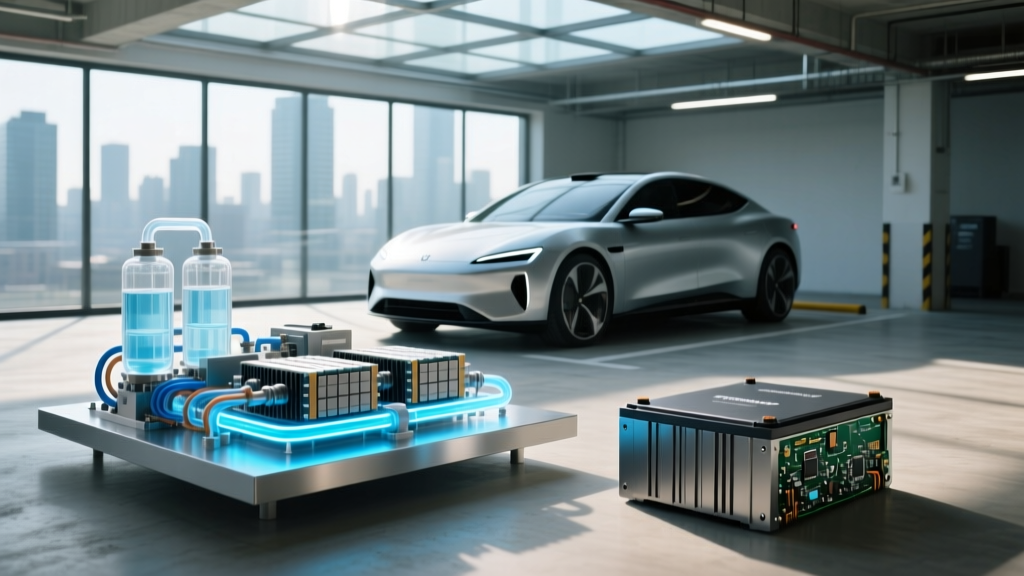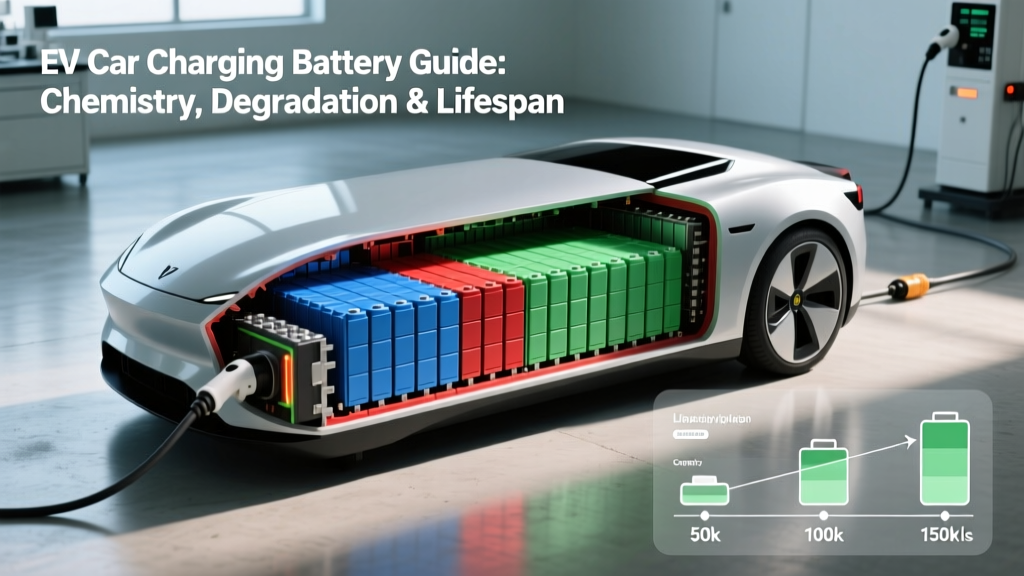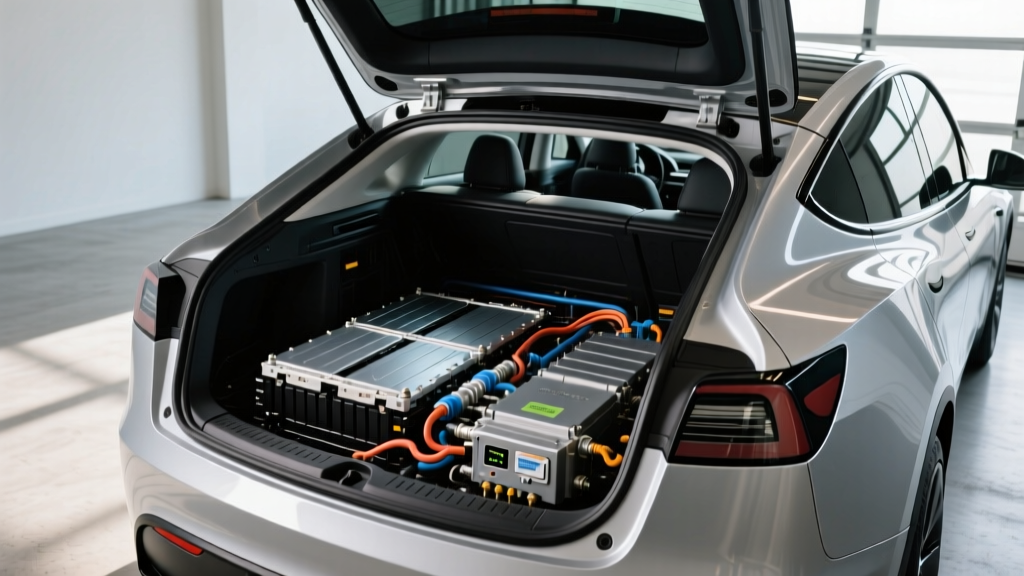
If you own a Tesla Model Y—or are shopping for one—the high-voltage (HV) traction battery is the single most expensive component in the vehicle. Search queries around replacing it, the impact of fast charging on longevity, and the HV battery power switch reflect real ownership concerns. This guide breaks down the chemistry inside the Model Y's battery pack, what degradation actually looks like after 100,000+ miles, what a replacement costs in 2026, and how daily habits like DC fast charging influence the pack's lifespan.
First, a critical distinction: the HV traction battery (the large pack under the floor that powers the motors) is entirely separate from the 12V or 16V lithium-ion auxiliary battery that runs lights, screens, and computers. When we discuss "battery replacement" here, we mean the HV pack—not the small auxiliary unit.
Model Y Battery Chemistry: LFP vs NMC/NCA Explained
The Tesla Model Y has been offered with two distinct battery chemistries depending on trim, model year, and market. Understanding which chemistry your Model Y uses is foundational to predicting its longevity, charging behavior, and replacement cost.
Nickel Manganese Cobalt (NMC) / Nickel Cobalt Aluminum (NCA) cells power the Long Range and Performance variants. Tesla has used both Panasonic NCA and LG Energy Solution / CATL NMC cells across different production runs. These chemistries prioritize energy density, enabling the Long Range AWD's EPA-rated 320+ miles from a ~75 kWh usable pack.
Lithium Iron Phosphate (LFP) cells are used in the Standard Range / Rear-Wheel Drive trims. LFP offers lower energy density (resulting in ~260-279 EPA miles from a ~60 kWh usable pack) but brings significant advantages in cycle life, thermal stability, and cost. Tesla recommends charging LFP packs to 100% regularly—something you should avoid with NMC for daily use.
| Attribute | NMC / NCA (Long Range, Performance) | LFP (RWD / Standard Range) |
|---|---|---|
| Usable Capacity | ~75 kWh | ~60 kWh |
| EPA Range (2025-2026) | 320-330 mi | 260-279 mi |
| Energy Density | Higher (more range per kg) | Lower |
| Cycle Life (to 80% SoH) | ~1,000-1,500 cycles | ~2,500-4,000+ cycles |
| Cold-Weather Performance | Better low-temp output | More range loss below 32°F |
| Daily Charge Recommendation | 80-90% SoC | 100% SoC (weekly at minimum) |
| Thermal Stability | Good (requires active management) | Excellent (inherently safer chemistry) |
| Cost (OEM replacement) | Higher | Lower |
Which is better? It depends on your use case. If you need maximum range and drive in cold climates, NMC/NCA is the stronger choice. If you prioritize longevity, lower cost, and mostly commute in moderate temperatures, LFP is arguably the more durable chemistry. LFP's cycle-life advantage means the pack can endure significantly more charge-discharge cycles before degrading to 80% of original capacity.
How Long Do Tesla Model Y Batteries Actually Last?
Tesla publishes fleet data showing that their vehicles retain roughly 85-90% of original battery capacity after 200,000 miles. Independent data from owner communities and third-party analyses align broadly with this, though individual results vary based on charging habits, climate, and production batch.
Typical Model Y Degradation Curve (NMC/NCA Long Range):
- Year 1 / ~15,000 miles: 2-5% capacity loss (initial "break-in" degradation)
- Year 3 / ~45,000 miles: 5-8% total loss
- Year 5 / ~75,000 miles: 8-12% total loss
- Year 8 / ~120,000 miles: 10-15% total loss
- Year 10+ / 150,000-200,000 miles: 12-18% total loss
LFP variants typically show slower degradation—often remaining above 90% SoH past 100,000 miles, thanks to the chemistry's inherent cycle-life advantage.
Sources: Tesla Impact Reports, Tesla 2023 Impact Report; Recurrent Auto battery data analyses; owner-reported data from TeslaFi and Tessie apps.
The key insight: degradation is non-linear. Most capacity loss occurs in the first 20,000-30,000 miles, after which the curve flattens considerably. A Model Y with 100,000 miles that shows 88% State of Health (SoH) is performing normally and likely has many years of useful life remaining.
Fast Charging and the HV Battery: Impact on Longevity
DC fast charging (DCFC) at Tesla Superchargers or third-party networks delivers 50-250 kW of power directly to the HV battery. The concern is legitimate: pushing high current into lithium-ion cells generates heat, and heat accelerates chemical degradation.
However, Tesla's thermal management system is among the most sophisticated in the industry. The Model Y actively preconditions the battery before a Supercharging session—heating or cooling cells to an optimal temperature window (typically 35-45°C at the cell level). This preconditioning is why navigation-routed Supercharger stops charge faster than walk-up sessions.
What the data shows:
- Exclusive DCFC users see approximately 1-3% additional degradation over 100,000 miles compared to exclusive Level 2 home chargers, according to analyses by Recurrent Auto.
- The difference is measurable but not catastrophic—a Model Y charged primarily on Superchargers might show 85% SoH at 100k miles vs. 88% for a home-charged counterpart.
- Frequent charging above 90% SoC combined with DCFC has a compounding negative effect. The worst scenario is repeated 0-100% DCFC cycles.
Practical guidance: If you road-trip frequently, DCFC is fine—the battery management system handles it well. For daily use, Level 2 home charging (7-11.5 kW) remains gentler on the pack. Keep NMC packs between 20-80% SoC for daily driving. LFP owners can charge to 100% but should still minimize unnecessary DCFC sessions.
Regarding the HV battery power switch (the service disconnect): this is not a consumer-operable component. It is a safety disconnect used by technicians during HV system service. Owners should never attempt to manually disconnect the HV battery. First responders and service personnel are trained on its location and operation per Tesla's emergency response guides. If your Model Y displays an "Isolation Fault" or HV system warning, contact Tesla Service immediately—do not attempt to reset or disconnect the pack yourself.
Battery Warranty Coverage: What Tesla Guarantees
Tesla's battery warranty provides meaningful protection against premature degradation. Here are the current terms for the Model Y:
| Model Y Variant | Warranty Period | Mileage Limit | Capacity Retention Threshold |
|---|---|---|---|
| RWD (LFP) | 8 years | 100,000 miles | 70% of original capacity |
| Long Range AWD (NMC/NCA) | 8 years | 120,000 miles | 70% of original capacity |
| Performance (NMC/NCA) | 8 years | 120,000 miles | 70% of original capacity |
What's covered: If the battery degrades below 70% of its original usable capacity within the warranty period, Tesla will replace or refurbish the pack at no cost. This also covers manufacturing defects, cell failures, and BMS malfunctions.
What's not covered: Damage from accidents, flooding, fire, unauthorized modifications, or neglect (such as ignoring coolant service intervals). Cosmetic issues and minor range loss above the 70% threshold are also excluded.
The 70% threshold is conservative by design—most Model Y packs never approach it under normal ownership. A Long Range owner would need to lose over 90 miles of range before filing a warranty claim. According to Tesla's warranty documentation, the replacement pack may be new or remanufactured but will meet or exceed the 70% capacity floor.
Tesla Model Y Battery Replacement Cost: What to Expect
Out-of-warranty HV battery replacement is the scenario that generates the most concern. Here are realistic 2026 cost ranges based on service reports and third-party EV repair shops:
| Model Y Variant | Battery Pack Size | Estimated Replacement Cost (OEM) | Third-Party / Remanufactured | Typical Replacement Timeline |
|---|---|---|---|---|
| RWD (LFP) | ~60 kWh | $10,000 – $14,000 | $7,000 – $10,000 | 150,000-300,000+ mi (if ever) |
| Long Range AWD | ~75 kWh | $13,000 – $18,000 | $9,000 – $14,000 | 150,000-300,000+ mi (if ever) |
| Performance | ~75 kWh | $14,000 – $18,000 | $10,000 – $15,000 | 150,000-300,000+ mi (if ever) |
Critical context: The vast majority of Model Y batteries never require full replacement. Based on current degradation data, most packs will outlast the vehicle's economic life. Catastrophic failures (cell shorts, BMS faults) are rare and typically occur within the warranty period. The scenarios where you'd pay out-of-pocket are:
- Physical damage from road debris or collision (covered by insurance)
- Flood or water intrusion damage
- Extreme mileage (200,000+ miles) with degradation approaching 60-65% SoH
Independent EV repair shops are increasingly offering module-level repairs—replacing individual faulty cell modules rather than the entire pack—for $2,000-$5,000. This is a growing option as the Model Y ages and more vehicles exit warranty coverage.
Maximizing Model Y Battery Health: An Owner's Checklist
- Set charge limits correctly: 80% for NMC/NCA daily use; 100% for LFP (Tesla recommends at least weekly 100% charges for LFP to maintain BMS calibration).
- Minimize time at extreme SoC: Don't leave an NMC pack sitting at 100% for days. If you charge to 100% for a road trip, depart soon after.
- Precondition before DCFC: Always navigate to a Supercharger via the car's built-in navigation—this triggers battery preconditioning for faster, healthier charging.
- Use Level 2 for daily charging: A home Level 2 charger at 32-48 amps (7.7-11.5 kW) is the optimal daily charging method.
- Avoid deep discharges: Try not to regularly drop below 10-15% SoC. The buffer protects the cells, but repeated deep cycling stresses them.
- Manage extreme heat exposure: In hot climates, park in shade or garages when possible. The thermal management system runs even when parked, but ambient heat adds load.
- Keep coolant system maintained: The battery cooling loop requires periodic service. Follow Tesla's maintenance schedule to prevent thermal management degradation.
- Monitor SoH regularly: Use the Tessie app, TeslaFi, or the built-in energy app to track range trends over time.
How to Check Your Model Y Battery State of Health (SoH)
Tesla does not display a simple "battery health percentage" on the vehicle's screen, which frustrates many owners. Here are the methods available:
1. In-Car Energy App: Navigate to the Energy app and view the "Trip" or "Average" consumption data. By comparing your current projected range at 100% SoC to the original EPA rating, you can estimate SoH. For example, if your Long Range originally showed 330 miles at 100% and now shows 295, your SoH is approximately 89%.
2. Third-Party Apps (Tessie, TeslaFi): These apps pull data from Tesla's API and calculate SoH more precisely by analyzing charge sessions, energy added, and SoC changes. Tessie provides a battery health score; TeslaFi offers detailed charge logs with degradation tracking over time.
3. Service Mode (Advanced): Tesla's Service Mode (accessible via the Software screen with a long-press) displays nominal full-pack energy (kWh). Comparing this to the pack's original rated capacity gives the most accurate SoH figure. Note: accessing Service Mode is at your own risk—do not change settings you don't understand.
4. Tesla Service Center Diagnostic: If you suspect abnormal degradation, schedule a service appointment. Tesla can run a full HV battery diagnostic and provide an official SoH reading.
Emerging Battery Technology: What's Next Beyond the Model Y
While current Model Y owners are well-served by existing lithium-ion technology, the industry is advancing rapidly. Here's a realistic assessment of upcoming developments:
Solid-State Batteries: Companies like Toyota, QuantumScape, and Samsung SDI have demonstrated solid-state cells with 50%+ higher energy density and faster charging. However, mass production remains challenging. Toyota has announced limited solid-state deployment in select models by 2027-2028, but widespread availability in vehicles at the Model Y's price point is unlikely before 2030+. Solid-state is not currently available in any production vehicle sold in the US.
Silicon Anode Cells: Companies like Sila Nanotechnologies and Amprius are replacing graphite anodes with silicon to boost energy density by 20-40%. These cells are entering production in limited applications (drones, premium EVs) in 2025-2026 and may reach mainstream EVs by 2027-2029.
Sodium-Ion Batteries: CATL has begun shipping sodium-ion packs in Chinese-market vehicles. These offer lower energy density but dramatically lower cost and better cold-weather performance. They may appear in budget EV trims globally by 2027, though US availability depends on supply chain and trade policy.
None of these technologies are available in the current Model Y. If you're buying now, today's LFP and NMC packs are mature, well-understood, and backed by extensive warranty coverage.
Tesla Model Y Battery FAQ
Does frequent Supercharging ruin the Model Y battery?
No, but it does accelerate degradation slightly. Data shows exclusive DCFC users lose 1-3% more capacity over 100,000 miles compared to Level 2 charging. Tesla's preconditioning and thermal management significantly mitigate the impact. Road-trip Supercharging is fine; just prioritize Level 2 for daily use.
What is the HV battery power switch on a Tesla Model Y?
The HV battery service disconnect (sometimes called the "power switch") is a safety mechanism for technicians and first responders to isolate the high-voltage system. It is not intended for owner use. If your vehicle shows an HV isolation fault, contact Tesla Service—do not attempt to manually disconnect the pack.
Will my Model Y battery need to be replaced?
Statistically, very unlikely during typical ownership. Most Model Y packs retain 80-88% capacity at 150,000 miles and continue functioning well beyond 200,000 miles. Full replacements are typically only needed due to physical damage or extreme degradation well past the warranty period.
How much does a Tesla Model Y battery replacement cost in 2026?
OEM replacement runs $10,000-$18,000 depending on the variant (LFP vs. NMC/NCA). Third-party and remanufactured options range from $7,000-$15,000. Module-level repairs for isolated cell failures can cost $2,000-$5,000 at independent EV shops.
LFP vs NMC: which Model Y battery is better for longevity?
LFP wins on pure longevity—its cycle life of 2,500-4,000+ cycles far exceeds NMC's 1,000-1,500 cycles. If you plan to keep the vehicle 10+ years or drive high annual mileage, the LFP (RWD) variant offers the most durable pack. NMC offers more range and better cold-weather performance, making it preferable for long-distance drivers in northern climates.
How do I check my Model Y's battery health percentage?
Use the in-car Energy app to compare current 100% range to original EPA range, or use third-party apps like Tessie or TeslaFi for more precise SoH calculations. Tesla Service can run a full diagnostic if you need an official reading.
Does the Tesla battery warranty cover normal degradation?
Yes—but only if capacity drops below 70% within 8 years or 100,000-120,000 miles (depending on trim). Normal degradation above 70% is considered expected wear. See Tesla's warranty documentation for full terms.
For EPA range and efficiency data, refer to fueleconomy.gov. For federal EV tax credit eligibility under IRS §30D, consult irs.gov—note that income caps, MSRP limits, and battery sourcing requirements apply and change annually.