Quick Verdict: The Tesla Model Y Battery in 2026
If you own or are shopping for a Tesla Model Y, the high-voltage traction battery is the single most expensive component in the vehicle — and the one buyers worry about most. The good news, backed by fleet data and Tesla's own impact reports, is that Model Y batteries are outlasting initial projections. Most 2021–2025 Model Y packs retain 88–93% of original capacity after 100,000 miles, and catastrophic failures requiring full replacement remain rare within the warranty period.
But the details matter. The Model Y has shipped with two fundamentally different battery chemistries — NMC (nickel manganese cobalt) and LFP (lithium iron phosphate) — and each demands different care habits, delivers different range characteristics, and ages differently. This guide breaks down exactly what's inside the Tesla Model Y battery, how it degrades, what the warranty actually covers, and what a replacement would cost if you ever need one.
What Chemistry Is Inside the Tesla Model Y Battery?
Not all Model Y batteries are the same. Tesla has used two distinct cell chemistries depending on trim level, model year, and manufacturing origin. Understanding which one your Model Y has is critical because it changes how you should charge, store, and think about long-term health.
| Attribute | LFP (Lithium Iron Phosphate) | NMC (Nickel Manganese Cobalt) |
|---|---|---|
| Used In | Model Y Standard Range / RWD (Austin-built, 2022+) | Model Y Long Range AWD, Performance |
| Usable Capacity | ~57–60 kWh | ~75–82 kWh |
| EPA Range | 260 mi (Standard Range RWD) | 320–303 mi (Long Range / Performance) |
| Energy Density | Lower — heavier pack for same kWh | Higher — more range per kg |
| Cycle Life | 3,000–5,000+ cycles to 80% SoH | 1,000–2,000 cycles to 80% SoH |
| Cold-Weather Performance | More range loss in freezing temps (~30–40%) | Better cold performance (~20–30% loss) |
| Recommended Daily Charge | 100% — Tesla recommends periodic full charges | 80–90% daily; 100% only for trips |
| Cost (Cell-Level) | Lower — no cobalt or nickel | Higher — commodity-sensitive pricing |
| Thermal Stability | Superior — less prone to thermal runaway | Good — managed by active thermal system |
Why it matters: If you bought a 2023–2026 Model Y RWD built at Giga Texas, you almost certainly have an LFP pack. Tesla explicitly recommends charging LFP packs to 100% at least once per week to keep the battery management system (BMS) calibrated. With NMC packs in the Long Range and Performance trims, daily charging to 80–90% prolongs lifespan, and you should only charge to 100% before long trips.
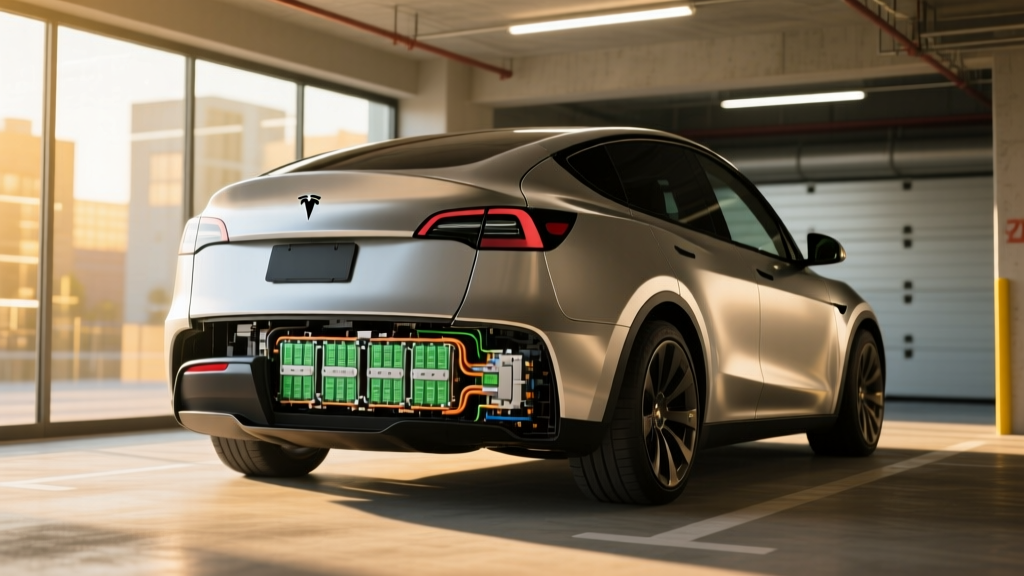
The LFP cells in the Standard Range Model Y primarily come from CATL (prismatic cells), while the NMC packs in Long Range variants use cylindrical 2170 or 4680 cells from Panasonic and Tesla's own production lines. The 4680 structural battery pack, introduced in select Austin-built vehicles, integrates cells as a stressed member of the chassis — reducing weight but complicating replacement.
How Long Does the Tesla Model Y Battery Last?
The short answer: far longer than most buyers assume. Tesla's 2024 Impact Report (the most recent comprehensive dataset available) showed that Model 3 and Model Y batteries retained approximately 88% of original capacity after 200,000 miles. This aligns with independent fleet data from sources like Recurrent Auto, which tracks thousands of Tesla vehicles in real-world conditions.
Typical Tesla Model Y Battery Degradation Curve (Fleet Averages):
- Year 1 / 15,000 mi: ~2–4% capacity loss (initial "break-in" degradation, largely calendar-based)
- Year 2 / 30,000 mi: ~4–6% total loss from new
- Year 3 / 50,000 mi: ~6–8% total loss — degradation rate slows significantly
- Year 5 / 80,000 mi: ~8–11% total loss
- Year 7 / 120,000 mi: ~10–14% total loss
- 150,000+ mi: ~12–17% total loss (varies heavily by charging habits and climate)
Sources: Tesla Impact Report 2024, Recurrent Auto battery research, fleet telematics aggregations. Individual results vary based on climate, charging patterns, and chemistry.
The degradation curve is not linear. Most capacity loss occurs in the first 20,000–30,000 miles, after which the curve flattens considerably. LFP packs tend to show slightly less early degradation but may lose range faster in sustained cold climates. NMC packs degrade more noticeably in the first year but maintain more consistent performance across temperature ranges.
Tesla Model Y Battery Warranty: What's Actually Covered?
Tesla provides a dedicated battery and drive unit warranty that is separate from the basic vehicle limited warranty. Here are the current terms for 2024–2026 Model Y vehicles:
| Trim | Warranty Period | Mileage Limit | Capacity Retention Threshold |
|---|---|---|---|
| Model Y RWD (Standard Range, LFP) | 8 years | 100,000 miles | 70% of original capacity |
| Model Y Long Range AWD | 8 years | 120,000 miles | 70% of original capacity |
| Model Y Performance | 8 years | 120,000 miles | 70% of original capacity |
Key details buyers miss:
- The warranty guarantees the battery will retain at least 70% of its original usable capacity. If it drops below 70% within the warranty period, Tesla will repair or replace it at no cost.
- "Repair" may mean replacing individual modules rather than the entire pack, depending on the failure mode.
- The warranty covers manufacturing defects and abnormal degradation — it does not cover damage from accidents, flooding, or unauthorized modifications.
- Warranty coverage transfers to subsequent owners, which supports resale value.
- Tesla's basic vehicle warranty is 4 years / 50,000 miles — the battery warranty extends well beyond this.
For context, the Tesla New Vehicle Limited Warranty page details full terms. The 70% threshold is standard across the industry; Hyundai offers a similar 70% threshold on Ioniq 5/6, while GM's Ultium-backed vehicles also use 70%.
How Much Does a Tesla Model Y Battery Replacement Cost?
Let's address the fear directly: most Tesla Model Y batteries will never need a full replacement during normal ownership. The degradation data above shows that even at 150,000 miles, most packs retain 83–88% of capacity — well above the 70% warranty threshold. Full replacements are typically needed only after manufacturing defects, physical damage, or extreme edge cases.
That said, if you're buying a used Model Y out of warranty or planning to keep one past 200,000 miles, here's what replacement costs look like:
| Pack Type | Approximate Capacity | Replacement Cost Range | Notes |
|---|---|---|---|
| LFP (Standard Range / RWD) | ~57–60 kWh | $8,000–$12,000 | CATL prismatic cells; simpler pack design |
| NMC 2170 (Long Range AWD) | ~75–82 kWh | $12,000–$16,000 | Panasonic cells; most common pack |
| 4680 Structural (selected Austin builds) | ~82+ kWh | $15,000–$20,000+ | Integrated chassis pack; higher labor complexity |
These figures include parts and labor at Tesla Service Centers. Independent EV shops may offer refurbished packs for 20–30% less, though availability is limited and warranty terms vary. Tesla has historically replaced packs under warranty with refurbished units that meet the 70%+ capacity threshold rather than brand-new packs.
When is replacement typically needed? In practice, full pack replacements are most common between 150,000–250,000 miles for vehicles that have experienced above-average degradation — often linked to frequent DC fast charging in extreme heat, sustained 100% SoC storage on NMC packs, or manufacturing defects that manifest early. For most owners driving 12,000–15,000 miles per year, the battery will outlast the vehicle's economic life.
Factors That Affect Tesla Model Y Battery Lifespan
Battery degradation is governed by electrochemistry, not just mileage. The following factors have the largest measurable impact on how quickly your Model Y's pack loses capacity:
Battery Care Checklist: Maximize Your Model Y's Pack Life
- Daily charge limit: Set to 80% for NMC (Long Range/Performance); 100% for LFP (Standard Range RWD). Use the Tesla app or in-car scheduler.
- Avoid prolonged 100% SoC: On NMC packs, charging to 100% is fine before a road trip — just don't leave it sitting at 100% for days. Charge to 100% the morning you leave, not the night before.
- DC fast charging frequency: Occasional Supercharging (1–2x per week) has minimal impact. Daily DC fast charging — especially at 250 kW V3 stalls — accelerates degradation by an estimated 1–3% over the pack's life compared to predominantly Level 2 home charging.
- Extreme heat exposure: Sustained ambient temperatures above 95°F (35°C) with high SoC is the single worst combination for lithium-ion longevity. Tesla's active thermal management mitigates this significantly, but parking in shade and preconditioning still help.
- Extreme cold: Cold doesn't degrade the battery permanently, but it reduces available range temporarily (20–40% depending on chemistry and temperature). Always precondition before driving and charging in freezing weather.
- Preconditioning: Use Scheduled Departure in the Tesla app to warm the battery before driving or charging. This reduces internal resistance, improves regen braking, and enables faster DC charging.
- Storage: If storing the Model Y for weeks, leave NMC packs at ~50% SoC and LFP packs at ~50–60%. Enable Sentry Mode sparingly during storage, as it draws from the 12V and traction battery.
The single most impactful habit: if you have an NMC Long Range or Performance Model Y and charge primarily at home on Level 2, setting your daily limit to 80% and only charging to 100% for road trips will meaningfully extend pack life. LFP owners should do the opposite — regular 100% charges keep the BMS accurate and don't harm LFP chemistry.
How to Check Tesla Model Y Battery Health (State of Health)
Tesla does not display a direct "battery health percentage" on the dashboard the way some competitors do. However, there are several reliable methods to estimate your Model Y's State of Health (SoH):
Method 1: Range Comparison at 100% SoC
Charge your Model Y to 100% and note the projected range displayed. Compare this to the original EPA-rated range for your trim. For example, if your 2023 Long Range AWD originally displayed 330 miles at 100% and now shows 300 miles, that's roughly ~91% SoH. Note that Tesla periodically adjusts displayed range via OTA updates to reflect updated EPA methodology, so this isn't perfectly precise.
Method 2: Tesla Service Mode (DIY)
Some owners access Tesla's Service Mode (available through the software menu on most 2022+ vehicles) to view detailed battery telemetry, including nominal full-pack energy (kWh) and energy remaining. Comparing the current nominal full-pack value to the original spec gives a more accurate SoH estimate than the range display alone.
Method 3: Third-Party Tools
Apps like TeslaFi, Stats (iOS), and Tessie log detailed charge data over time, allowing you to calculate SoH by comparing energy added during a full charge cycle to the original pack capacity. Recurrent Auto also offers a free battery health report for participating Tesla owners, comparing your pack against their fleet database.
Method 4: Tesla Service Center Diagnostic
If you suspect abnormal degradation (e.g., range dropping faster than the fleet average curve above), schedule a service appointment. Tesla can run a full diagnostic that reads individual module voltages, internal resistance, and precise capacity measurements. This is the most authoritative SoH reading available.
Emerging Battery Tech: What's Next Beyond the Current Model Y Pack?
While today's Model Y relies on proven LFP and NMC lithium-ion cells, several next-generation technologies are in development that could reshape future Tesla battery packs:
- Solid-state batteries: Companies like QuantumScape and Toyota have demonstrated prototype solid-state cells with higher energy density and faster charging. However, mass production at automotive scale remains announced for 2028–2030 at the earliest. Tesla has not confirmed adoption timelines. Expect solid-state to debut in premium/low-volume applications before reaching the Model Y platform.
- Silicon-dominant anodes: Replacing graphite anodes with silicon can increase energy density by 20–40%. Companies like Sila Nanotechnologies and Group14 are in early production with automotive partners, but costs remain high. Realistic timeline: 2027–2029 for meaningful integration into high-volume vehicles.
- Tesla's 4680 dry-electrode process: Tesla has been iterating on dry-electrode coating for its 4680 cells, which reduces manufacturing energy and cost. This is already in limited production at Giga Texas and is expected to scale through 2026–2027. It doesn't change chemistry fundamentally but reduces cell cost by an estimated 15–20%.
- Sodium-ion batteries: CATL and others are producing sodium-ion cells for lower-cost, lower-range applications. These are unlikely to appear in the Model Y (which targets 260+ mile range) but could power a future sub-$25,000 Tesla model.
Bottom line: None of these technologies are available in the current Model Y. If you're buying now, the existing LFP and NMC packs are mature, well-understood, and backed by substantial real-world longevity data. Waiting for solid-state is not a practical purchase strategy for anyone who needs a vehicle in the next 2–3 years.
Frequently Asked Questions: Tesla Model Y Battery
How long do Tesla Model Y batteries last in years and miles?
Based on fleet data, most Model Y batteries retain 85–90% of original capacity at 100,000 miles and 80–88% at 150,000 miles. In terms of calendar years, degradation is manageable for 15–20+ years of typical use (12,000–15,000 mi/yr). The battery will likely outlast the vehicle's economic life before reaching the 70% warranty threshold under normal conditions.
How much does it cost to replace a Tesla Model Y battery?
Full replacement costs range from approximately $8,000–$12,000 for LFP Standard Range packs to $12,000–$20,000+ for NMC Long Range and 4680 structural packs, including parts and labor at Tesla Service. Most owners never need a replacement — the pack typically retains 80%+ capacity through 150,000 miles.
What does the Tesla battery warranty cover?
Tesla covers the battery and drive unit for 8 years / 100,000 miles (Standard Range RWD) or 8 years / 120,000 miles (Long Range and Performance). The warranty guarantees at least 70% capacity retention and covers manufacturing defects and abnormal degradation. It does not cover accident damage, flood damage, or unauthorized modifications.
How do I check my Tesla Model Y battery health?
Compare your displayed range at 100% charge to the original EPA rating, use Tesla's Service Mode to read nominal pack energy, log charge data with third-party apps like TeslaFi or Tessie, or request a full diagnostic at a Tesla Service Center for the most accurate State of Health reading.
LFP vs NMC — which Tesla Model Y battery is better?
Neither is universally "better." LFP offers superior cycle life (3,000–5,000 cycles), lower cost, better thermal stability, and allows 100% daily charging — making it ideal for Standard Range buyers who prioritize longevity and simplicity. NMC delivers higher energy density (more range in a lighter pack) and better cold-weather performance, making it the choice for Long Range and Performance buyers who need 300+ mile range. Your use case determines the right chemistry.
Does frequent Supercharging damage the Model Y battery?
Occasional Supercharging (1–3 times per week) has a minimal measurable impact on degradation — studies and fleet data suggest roughly 1–3% additional capacity loss over the pack's lifetime versus exclusive Level 2 charging. Daily DC fast charging at peak rates (250 kW) in hot climates has a more noticeable effect, but Tesla's thermal management system actively cools the pack during charging to mitigate damage. For daily use, Level 2 home charging is gentler, but Supercharging is not something most owners need to avoid entirely.
Should I be worried about battery replacement cost?
For the vast majority of buyers, no. Battery replacement is most commonly needed beyond 200,000 miles — at which point the vehicle's resale value and overall economics make replacement a personal decision rather than a financial emergency. Under the 8-year warranty, abnormal degradation or defects are covered at no cost. The data consistently shows that EV battery "replacement anxiety" exceeds the real-world risk for typical ownership periods of 5–10 years.