The Real Lifespan of EV Car Batteries: What the Data Shows
The single most persistent concern among prospective EV buyers isn't range or charging speed — it's whether the high-voltage traction battery will outlast the car itself. The short answer, backed by millions of real-world miles: it almost certainly will. But the nuances matter, especially as automakers in 2026 increasingly offer two distinct battery chemistries with very different aging profiles.
Modern EV car batteries are engineered for longevity that far exceeds the lithium-ion cells in your phone or laptop. While a smartphone battery might lose 20% of its capacity within two to three years, automotive-grade packs use sophisticated thermal management systems, buffer zones, and conservative charge limits to stretch usable life well beyond a decade. According to data compiled by Recurrent Auto from over 15,000 vehicles in their fleet monitoring program, the median EV battery retains roughly 90-95% of its original capacity after five years and 60,000+ miles of real-world driving.
That said, "lasting" doesn't mean "never degrading." Every lithium-ion cell loses capacity over time and charge cycles. The key questions are: how fast, under what conditions, and at what point does degradation become a practical problem? This guide walks through the chemistry, the numbers, the warranties, and the daily habits that determine how your EV's battery ages.
LFP vs NMC vs NCA: Choosing the Right Battery Chemistry
In 2026, nearly every mainstream EV sold in the U.S. uses one of two cathode chemistries: lithium iron phosphate (LFP) or nickel manganese cobalt (NMC). A third variant, nickel cobalt aluminum (NCA), appears primarily in Tesla's performance and long-range models. The chemistry inside your battery pack determines its energy density, cycle life, cold-weather behavior, cost, and even how you should charge it daily.
Here's how the three mainstream chemistries stack up across the metrics that matter to owners:
| Attribute | LFP (Lithium Iron Phosphate) | NMC (Nickel Manganese Cobalt) | NCA (Nickel Cobalt Aluminum) |
|---|---|---|---|
| Energy Density | Lower (~160 Wh/kg cell-level) | Higher (~220-260 Wh/kg) | Highest (~260-300 Wh/kg) |
| Cycle Life | 3,000-5,000+ cycles | 1,000-2,000 cycles | 1,000-1,500 cycles |
| Cold-Weather Performance | Weaker — more range loss below 32°F | Better low-temp efficiency | Better low-temp efficiency |
| Recommended Daily Charge Limit | 100% (LFP benefits from full charges) | 80-90% for daily use | 80-90% for daily use |
| Cost per kWh | Lower — no cobalt or nickel | Higher — commodity-priced metals | Higher — commodity-priced metals |
| Thermal Stability / Safety | Excellent — highly resistant to thermal runaway | Good — requires robust BMS | Good — requires robust BMS |
| Common 2026 Applications | Tesla Model 3/Y RWD, Ford Mustang Mach-E Select, standard-range BYD models | Hyundai Ioniq 5/6 Long Range, Kia EV6, VW ID.4, Chevrolet Equinox EV | Tesla Model 3/Y Long Range & Performance, Rivian R1T/R1S Max Pack |
Which Is Better — LFP or NMC?
Neither is universally "better." The right choice depends on your driving pattern:
Choose LFP if: You primarily commute and charge at home, you want maximum cycle life and longevity, you don't regularly need 300+ miles of range in a single stretch, and you live in a moderate climate. LFP's tolerance for 100% daily charging also simplifies ownership — no need to babysit charge limits.
Choose NMC/NCA if: You need maximum range per charge, you frequently drive in cold climates where LFP's efficiency penalty compounds, or you regularly road-trip and need the energy density advantage. Just be disciplined about keeping daily charges at 80-90% and only charging to 100% before long trips.
EV Battery Degradation: What Real-World Data Tells Us
Degradation is not linear. Most EV car batteries experience a steeper capacity drop in the first year or two (typically 2-5%), then settle into a slow, gradual decline for the remainder of their life. This initial drop is sometimes called the "break-in" loss and is largely attributable to solid electrolyte interphase (SEI) layer formation on the anode — a normal electrochemical process.
Typical Degradation Curve (NMC Battery, Average Climate):
| Time / Mileage | Average Capacity Retained | Notes |
|---|---|---|
| Year 1 / ~12,000 mi | 95-97% | Initial SEI formation loss |
| Year 3 / ~36,000 mi | 92-94% | Gradual, linear decline |
| Year 5 / ~60,000 mi | 90-92% | Most owners notice minimal practical impact |
| Year 8 / ~96,000 mi | 86-90% | Approaching warranty threshold territory |
| Year 10 / ~120,000 mi | 83-88% | Still functional; range reduced but usable |
Sources: Recurrent Auto fleet data (2025 report), Geotab fleet analysis of 6,300+ EVs. LFP batteries tend to show slower degradation in the 3-10 year window, often retaining 90%+ at year 8.
A concrete example: a 2023 Tesla Model 3 Long Range (NCA, 75 kWh usable battery, EPA 358 miles) driven 15,000 miles per year in a temperate climate might show roughly 340 miles of estimated range at the three-year mark and around 320 miles at five years. That's a noticeable but hardly debilitating loss — and it's still more range than most drivers use in a day.
Cold-weather caveat: Range loss in cold temperatures (below 32°F) is a temporary efficiency reduction, not permanent degradation. An EV might lose 20-30% of its range on a 10°F morning due to battery resistance and cabin heating demands, but that capacity returns when temperatures rise. This is physics, not battery damage.
What Does the Battery Warranty Actually Cover?
Federal law mandates that EV manufacturers provide a minimum battery warranty of 8 years or 100,000 miles (whichever comes first). In California Air Resources Board (CARB) states — which include California, Colorado, Connecticut, Maine, Maryland, Massachusetts, New Jersey, New York, Oregon, Rhode Island, Vermont, Virginia, and Washington — the mandate extends to 10 years or 150,000 miles.
However, warranties don't guarantee zero degradation. They guarantee that the battery will retain a minimum percentage of its original capacity — typically 70% — over the warranty period. If your battery drops below that threshold within the covered time and mileage, the manufacturer must repair or replace it at no cost to you.
| Manufacturer (2026 Models) | Warranty Period | Capacity Retention Threshold | Notes |
|---|---|---|---|
| Tesla (Model 3/Y RWD — LFP) | 8 yr / 100,000 mi | 70% | LFP pack replacement |
| Tesla (Model 3/Y LR/Performance) | 8 yr / 120,000 mi | 70% | NCA pack |
| Hyundai / Kia (Ioniq 5, EV6, EV9) | 10 yr / 100,000 mi | 70% | Among the longest coverage |
| Ford (Mustang Mach-E, F-150 Lightning) | 8 yr / 100,000 mi | 70% | Covers battery and hybrid/electric components |
| General Motors (Equinox EV, Blazer EV, Silverado EV) | 8 yr / 100,000 mi | 70% | Ultium platform warranty |
| Volkswagen (ID.4, ID.7) | 8 yr / 100,000 mi | 70% | Covers capacity loss below threshold |
| Rivian (R1T, R1S) | 8 yr / 175,000 mi | 70% | Highest mileage cap among major OEMs |
| BMW (i4, i5, i7, iX) | 8 yr / 80,000 mi | 70% | Lower mileage cap than most competitors |
What's covered: Capacity loss below the stated threshold, manufacturing defects, and failures of battery management system (BMS) components. Some manufacturers also cover individual module replacement rather than a full pack swap, which is less disruptive and less wasteful.
What's typically NOT covered: Gradual degradation above the threshold (even if you've lost 25% of capacity, if you're still above 70%, it's considered normal wear), damage from accidents, flooding, or unauthorized modifications, and range reduction from tire changes or accessory additions.
EV Battery Replacement Cost: What to Actually Expect
This is where fear-mongering runs rampant. Headlines love to cite $20,000 battery replacement figures without context. Here's the reality: the vast majority of EV car batteries never need replacement during the original owner's tenure, and for those that do, it's typically well outside the warranty period — meaning 12-15+ years into the vehicle's life.
That said, if you're buying a used EV out of warranty or planning to keep your vehicle for 15+ years, knowing the replacement cost landscape matters:
| Vehicle / Pack Size | Battery Capacity | Estimated Replacement Cost (2026) | Context |
|---|---|---|---|
| Tesla Model 3 RWD (LFP) | ~60 kWh | $8,000 – $12,000 | LFP packs are cheaper; third-party options emerging |
| Tesla Model Y Long Range | ~75 kWh | $12,000 – $16,000 | NCA pack; OEM replacement |
| Hyundai Ioniq 5 Long Range | 77.4 kWh | $11,000 – $15,000 | NMC; module-level repair may reduce cost |
| Ford F-150 Lightning Extended Range | ~131 kWh | $18,000 – $25,000 | Largest consumer pack; highest replacement cost |
| Chevrolet Equinox EV | ~85 kWh (Ultium) | $10,000 – $14,000 | GM's modular Ultium architecture allows partial replacement |
| Nissan LEAF (40/62 kWh) | 40 or 62 kWh | $6,500 – $10,000 | Passive cooling design led to faster degradation; well-documented replacement path |
Several important factors moderate these figures:
- Cell prices continue to fall. Battery pack prices averaged roughly $115/kWh at the pack level by late 2025, down from $150+/kWh in 2022, according to BloombergNEF. Replacement costs will continue declining.
- Module-level repairs are increasingly common. Many modern packs (especially GM's Ultium and Hyundai's E-GMP platform) are designed with serviceable modules. A single degraded or failed module can be replaced for a fraction of a full pack swap — often $2,000-$5,000.
- The used EV battery market is growing. Refurbished packs from salvaged vehicles offer a lower-cost replacement path, typically 40-60% less than new OEM packs.
- Most batteries outlive the car. Data from Geotab's analysis of over 6,300 electric vehicles shows that at the current degradation rates, most EV batteries will retain sufficient capacity to remain functional for 15-20 years — well past the point where other vehicle components (suspension, electronics, body) make the car uneconomical to maintain.
Factors That Accelerate (or Slow) Battery Degradation
Not all miles are created equal when it comes to battery wear. The following factors have the most measurable impact on how quickly your EV's battery loses capacity:
1. State of Charge Habits
Lithium-ion cells experience the most stress at the extremes — below 10% and above 90% SoC. For NMC and NCA batteries, the single most impactful habit is avoiding prolonged storage at 100% charge. If you charge to 100%, try to drive within a few hours rather than letting the car sit fully charged overnight repeatedly. LFP batteries are an exception — they actually benefit from periodic 100% charges for cell balancing and BMS calibration.
2. DC Fast Charging Frequency
Exclusive reliance on DC fast charging (Level 3, 50-350 kW) accelerates degradation compared to primarily Level 2 home charging. The high currents generate more heat within the cells. Studies from the Idaho National Laboratory found that vehicles charged exclusively on DC fast chargers showed roughly 2-3% more degradation over 50,000 miles compared to those charged primarily on Level 2. This doesn't mean you should avoid fast charging — just that daily home Level 2 charging should be your baseline, with DC fast charging reserved for road trips and occasions when you need it.
3. Extreme Temperatures
Heat is the long-term enemy of lithium-ion chemistry. Vehicles regularly parked and charged in ambient temperatures above 95°F without active thermal management (or with thermal management that only activates during charging) will degrade faster. Cold weather, by contrast, causes temporary range loss but doesn't permanently damage the battery — the BMS restricts charging speed and power output when cells are cold to prevent lithium plating.
4. Depth of Discharge
Shallow cycles (driving from 80% down to 30% and back up) are gentler on cells than deep cycles (100% down to 5%). You don't need to obsess over this — modern BMS systems manage it well — but if your daily commute uses only 20-30% of your battery, you're in an ideal usage pattern for longevity.
Battery Longevity Best Practices
- NMC/NCA daily limit: Set charge limit to 80-90% for everyday use; charge to 100% only before long trips
- LFP daily limit: Charge to 100% at least once per week for cell balancing; daily 100% is fine
- Avoid prolonged low SoC: Don't store the car below 10% for more than a few days
- Precondition before fast charging: Use your car's navigation-based preconditioning to warm the battery before arriving at a DC fast charger — this improves charge speed AND reduces cell stress
- Level 2 as your baseline: Install a home Level 2 charger (7-11 kW) for daily charging; use DCFC for trips
- Park in shade or a garage in extreme heat: Reducing ambient soak temperature slows calendar aging
- Don't stress about occasional 100% charges: A single full charge causes negligible wear — it's prolonged storage at 100% that matters
How to Monitor Your EV's Battery Health (State of Health)
State of Health (SoH) is the metric that tells you what percentage of your battery's original capacity remains. Unlike your phone, most EVs don't display a simple SoH percentage on the dashboard — but there are several ways to check it:
1. In-car range estimation trend: The simplest method. Track your car's estimated full-charge range over time. If your Ioniq 5 showed 303 miles at full charge when new and now shows 280 miles at full charge after three years, that's roughly a 7.5% capacity loss — consistent with normal NMC degradation.
2. OBD-II diagnostic apps: Third-party apps like LeafSpy (for Nissan LEAF), Scan My Tesla, or Car Scanner ELM OBD2 can read the BMS-reported SoH directly from the vehicle's CAN bus. These readings are typically accurate to within 1-2% and give you the most granular picture of your battery's condition.
3. Manufacturer apps and service reports: Tesla's in-app battery health information, Hyundai's Bluelink diagnostics, and Ford's connected services can provide capacity estimates. Additionally, any dealership service visit typically includes a battery health report — request one if it's not offered.
4. Third-party testing services: Companies like AVILOO and Recurrent offer battery health certifications based on standardized drive-cycle testing. These are increasingly valuable when buying or selling a used EV, providing an independent SoH assessment that both parties can trust.
What to watch for: A sudden, non-linear drop in estimated range (e.g., losing 10+ miles of range in a single month) can indicate a cell imbalance or module issue and warrants a service visit. Gradual, linear decline is normal and expected.
Emerging Battery Technology: What's Next and When
The battery landscape is evolving rapidly, but it's critical to separate laboratory announcements from production reality. Here's where the most-discussed next-generation technologies stand as of 2026:
Solid-state batteries: These replace the liquid electrolyte with a solid material, promising higher energy density (potentially 400+ Wh/kg at the cell level), faster charging, and improved safety. Toyota has announced a solid-state battery targeting 2027-2028 production in limited volumes, and Samsung SDI is targeting 2027 for sample production. However, manufacturing scalability and cost remain unsolved challenges. Realistically, solid-state batteries won't appear in mainstream, affordably priced EVs until the early 2030s at the earliest. Current NMC and LFP chemistries will dominate through the end of this decade.
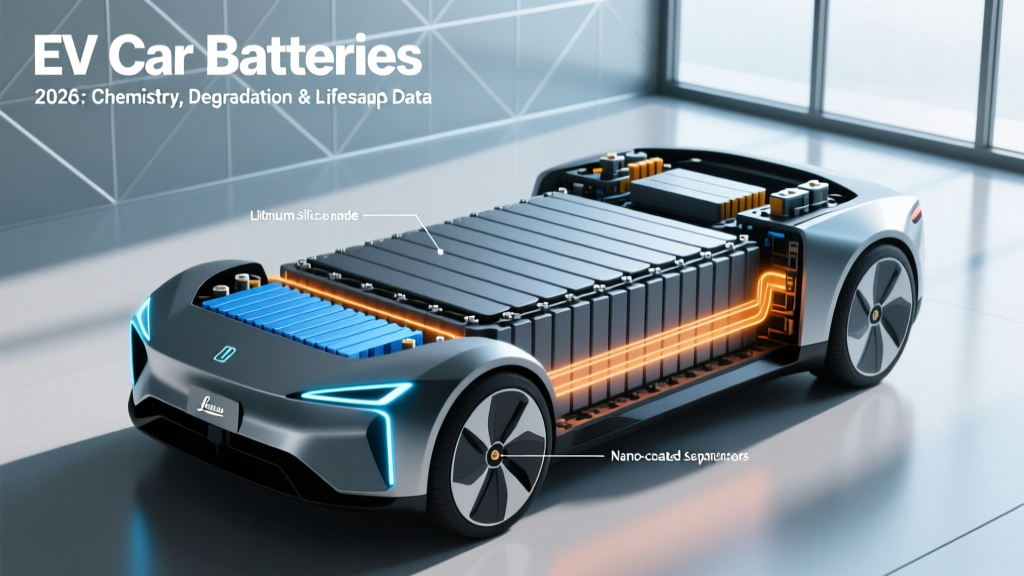
Silicon anode batteries: Companies like Sila Nanotechnologies and Group14 are commercializing silicon-dominant anodes that can boost energy density by 20-40% over conventional graphite anodes. These are closer to market — appearing in limited production vehicles as early as 2026-2027 — and represent an incremental improvement to existing lithium-ion architecture rather than a wholesale replacement.
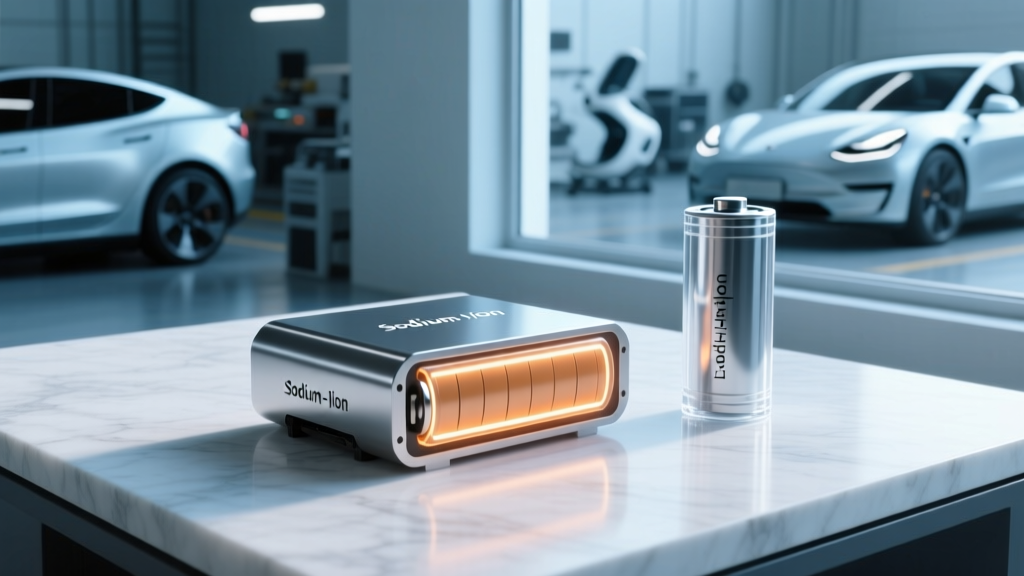
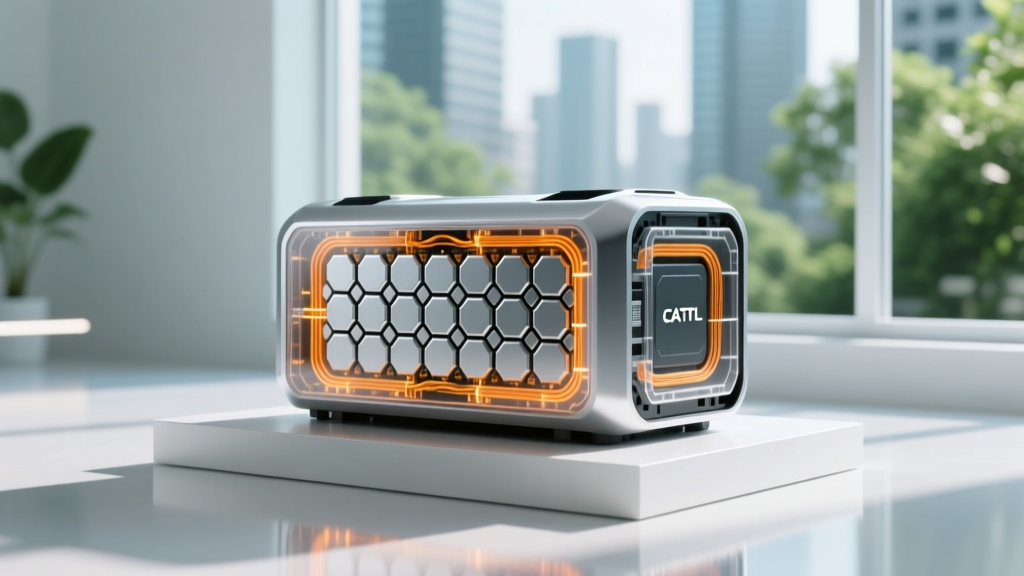
Sodium-ion batteries: CATL and other Chinese manufacturers have begun producing sodium-ion packs for lower-cost, shorter-range applications. These use no lithium, cobalt, or nickel, dramatically reducing cost and supply-chain risk. Expect to see sodium-ion in budget EVs and urban runabouts, likely arriving in the U.S. market by 2028-2029. Energy density is lower than LFP, so these won't replace lithium-ion in long-range vehicles.
Lithium manganese iron phosphate (LMFP): An evolution of LFP that adds manganese to boost energy density by roughly 15-20% while retaining LFP's cost and safety advantages. Several Chinese automakers have begun deploying LMFP packs, and the chemistry is expected to reach global markets by 2027-2028.
The practical takeaway for today's buyer: don't delay a purchase waiting for next-generation batteries. Current LFP and NMC packs are mature, well-understood, and backed by robust warranties. The improvements coming are real but incremental, and they'll arrive in new vehicles at premium prices before trickling down.
Frequently Asked Questions About EV Car Batteries
How long do EV car batteries last in years and miles?
Based on fleet data from Recurrent Auto and Geotab, the average EV battery retains 85-90% of its original capacity at 10 years or 120,000 miles. Most batteries remain functional (above 70% capacity) for 15-20 years. The battery will almost certainly outlast other major vehicle components. Permanent failure requiring replacement before 100,000 miles is rare and typically covered under the 8-year/100,000-mile federal warranty mandate.
How much does it cost to replace an EV battery?
Full pack replacement costs range from roughly $6,500 for a Nissan LEAF to $25,000 for a Ford F-150 Lightning Extended Range pack, depending on battery size and chemistry. However, most batteries never need replacement during typical ownership, and module-level repairs (replacing individual failed sections rather than the entire pack) often cost $2,000-$5,000. Cell prices continue to decline, meaning replacement costs in 2030 will likely be significantly lower than today's figures.
What does the EV battery warranty cover?
Federal law requires a minimum 8-year/100,000-mile battery warranty (10 years/150,000 miles in CARB states). The warranty guarantees the battery will retain at least 70% of its original capacity. If it drops below that threshold within the covered period, the manufacturer must repair or replace the battery at no cost. The warranty covers manufacturing defects and abnormal degradation but not gradual capacity loss above the threshold, accident damage, or misuse.
How do I check my EV battery's health?
Monitor your vehicle's estimated full-charge range over time for a basic trend. For precise State of Health data, use an OBD-II diagnostic app (Scan My Tesla, LeafSpy, Car Scanner) that reads BMS-reported SoH directly. Request a battery health report at any dealership service visit. Third-party services like AVILOO and Recurrent offer independent battery health certifications useful for used-EV transactions.
Is LFP or NMC better for my EV?
LFP offers longer cycle life (3,000-5,000+ cycles vs. 1,000-2,000), lower cost, better thermal safety, and tolerance for 100% daily charging — but sacrifices energy density and cold-weather efficiency. NMC provides higher energy density (more range in a smaller, lighter pack) and better cold-weather performance but requires more careful charge management (80-90% daily limit). For commuters in moderate climates, LFP is often the smarter longevity play. For road-trippers and cold-climate drivers, NMC's range advantage is worth the trade-off.
Does fast charging damage my EV battery?
Exclusively relying on DC fast charging accelerates degradation by roughly 2-3% over 50,000 miles compared to Level 2 charging, according to Idaho National Laboratory testing. Occasional fast charging on road trips has negligible impact. The best practice is Level 2 home charging as your daily routine, with DC fast charging for trips. Always use your vehicle's preconditioning feature before fast charging to warm the battery and reduce cell stress.
Should I worry about my EV battery in extreme heat or cold?
Cold weather causes temporary range loss (20-30% in sub-freezing temperatures) but does not permanently damage the battery — the BMS protects cells by limiting power and charge speed when cold. Extreme heat (prolonged exposure above 95°F) is more concerning for long-term degradation, as heat accelerates chemical aging. Parking in shade or a garage and avoiding 100% SoC during hot weather are the most effective mitigations. Active thermal management systems in modern EVs handle most scenarios well.