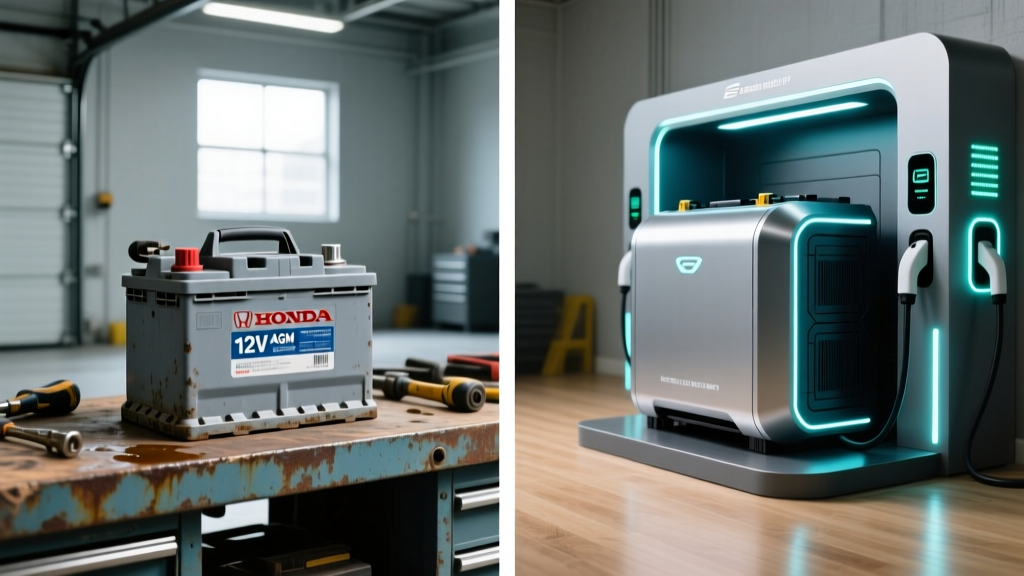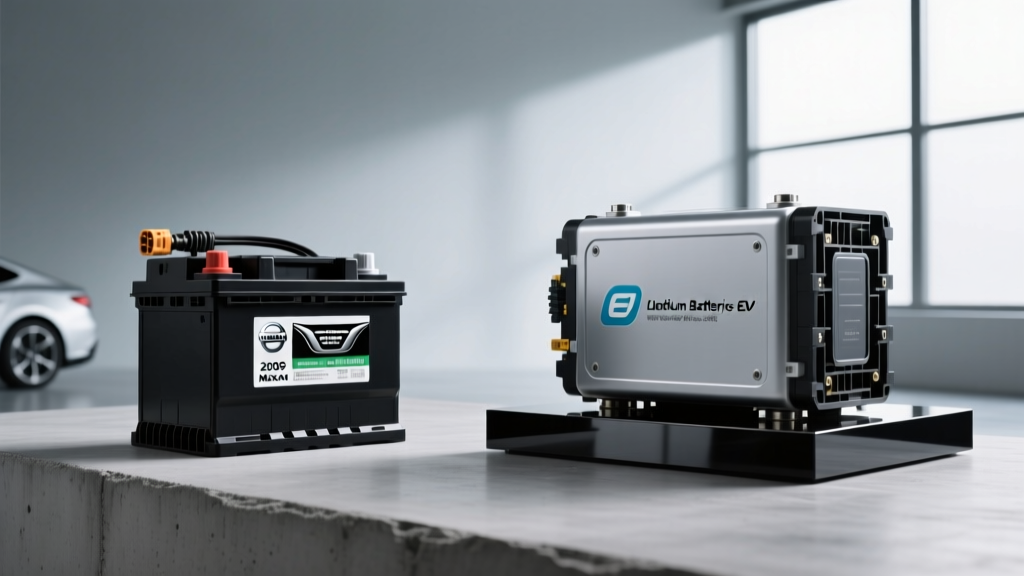
If you've searched for a 2009 Nissan Maxima battery, you're likely dealing with a conventional 12V lead-acid unit — a Group 35 or Group 24F cell that costs $150–$250 and lasts 3–5 years. But that same search often surfaces a deeper question: how do today's high-voltage EV traction batteries compare to the simple starter batteries we've replaced for decades? The gap is enormous — chemically, economically, and technologically. This guide breaks down exactly what powers a modern electric vehicle, how long it lasts, what it costs to replace, and what's coming next.
From Lead-Acid to Lithium-Ion: The 2009 Nissan Maxima Battery Baseline
The 2009 Nissan Maxima used a 12V lead-acid battery rated around 550–650 cold cranking amps (CCA). Its sole job was starting a 3.5L V6 engine and powering accessories when the alternator wasn't spinning. Replacement is a five-minute DIY job. Total cost: under $250.
Fast-forward to 2026, and a modern EV like the Nissan Ariya carries a 91 kWh lithium-ion traction battery weighing over 1,000 pounds, operating at 350–400V, and delivering an EPA-estimated 304 miles of range. This isn't just a bigger battery — it's a fundamentally different technology with different care requirements, degradation patterns, and economics.
Understanding this shift matters whether you're cross-shopping a used Maxima and a new EV, or simply trying to understand why EV batteries cost what they do.
LFP vs NMC: The Two Chemistries Powering Today's EVs
Modern EV batteries use one of two dominant lithium-ion chemistries: NMC (nickel manganese cobalt) or LFP (lithium iron phosphate). The choice affects your range, longevity, charging habits, and price.
| Attribute | LFP (LiFePO₄) | NMC / NCA |
|---|---|---|
| Energy Density | ~160–180 Wh/kg (lower) | ~220–260 Wh/kg (higher) |
| Cycle Life | 3,000–5,000+ cycles | 1,500–2,500 cycles |
| Cold-Weather Performance | Weaker below 32°F; slower charging | Better cold-weather discharge/charge |
| Cost per kWh | ~$85–$100 (lower) | ~$110–$140 (higher) |
| Optimal Daily SoC | Can charge to 100% daily | 80% recommended for daily use |
| Cobalt Content | None | Contains cobalt/nickel |
| Common In (2026) | Tesla Model 3 RWD, Ford Mustang Mach-E Select, BYD | Hyundai Ioniq 5, Chevy Equinox EV, Rivian, long-range trims |
The trade-off in plain terms: LFP batteries are heavier and less energy-dense, so they yield less range per pound. But they last dramatically longer (more charge cycles), tolerate 100% daily charging without accelerated degradation, and cost less. NMC batteries deliver more range in a lighter, more compact pack — critical for long-range and performance trims — but they degrade faster if routinely charged to 100% or exposed to extreme heat.
For a commuter who charges at home nightly and drives under 60 miles daily, LFP is often the better long-term bet. For road-trippers who need maximum range per charge, NMC still wins.
How Long Do EV Batteries Actually Last?
The short answer: almost certainly longer than you'll own the car. Data from fleet operators and long-term owners paints a reassuring picture.
According to fueleconomy.gov, most modern EV batteries are engineered to retain at least 70–80% of their original capacity after 150,000–200,000 miles. Tesla's 2023 Impact Report (the most recent fleet-wide data published) showed Model S/X batteries retaining approximately 88% capacity at 200,000 miles. Hyundai/Kia's battery management systems have shown similar retention curves in independent testing by Recurrent Auto, a battery-data analytics firm.
Typical EV Battery Degradation Curve (NMC chemistry, average climate):
- Year 1 (0–15k mi): ~2–4% loss (initial formation drop)
- Year 3 (~45k mi): ~6–8% total loss from new
- Year 5 (~75k mi): ~8–12% total loss
- Year 8 (~120k mi): ~12–18% total loss
- Year 10+ (~150k+ mi): ~15–22% total loss; most packs still above 70% SoH
LFP packs typically lose 1–2% less over the same period due to superior cycle life, though they may show slightly more variance in the first year as the BMS calibrates.
For context, a 2009 Nissan Maxima with 150,000 miles would have gone through 3–5 lead-acid battery replacements in its lifetime. A modern EV at the same mileage is likely still on its original traction battery with 80%+ capacity remaining.
What Does the Battery Warranty Actually Cover?
Federal law mandates a minimum 8-year / 100,000-mile EV battery warranty. In California and states adopting CARB standards (including Colorado, Maine, Massachusetts, New York, Oregon, Vermont, and Washington), the requirement extends to 10 years / 150,000 miles.
| Manufacturer | Warranty Term | Capacity Threshold | Chemistry Notes |
|---|---|---|---|
| Tesla (Model 3 RWD / LFP) | 8 yr / 120,000 mi | 70% retention | LFP; covers defects + degradation below threshold |
| Hyundai / Kia | 8 yr / 100,000 mi (10/150k in CARB states) | 70% retention | NMC; among the most generous standard coverage |
| Ford (Mach-E, F-150 Lightning) | 8 yr / 100,000 mi | 70% retention | Both LFP and NMC depending on trim |
| GM (Ultium platform) | 8 yr / 100,000 mi | 70% retention | NMC; covers module-level replacement |
| Nissan (Ariya) | 8 yr / 100,000 mi | 66% retention (9 bars of 12) | NMC; legacy Leaf warranty was 8yr/100k at 66% |
| BMW / Mercedes | 8 yr / 100,000 mi | 70% retention | NMC; some offer extended purchase options |
Key detail most buyers miss: The warranty covers capacity loss below the stated threshold, not gradual degradation above it. If your 80 kWh pack degrades to 58 kWh (72.5%) at year 7, that's considered normal wear. If it drops to 55 kWh (68.75%), you have a valid warranty claim. Manufacturers typically replace individual modules rather than the full pack when possible, reducing cost and downtime.
EV Battery Replacement Cost: What to Expect in 2026
Battery replacement remains the single biggest fear among prospective EV buyers. The numbers are large — but context matters enormously.
| Vehicle / Pack Size | Battery Size | Replacement Cost Range | Typical Replacement Timeline |
|---|---|---|---|
| Tesla Model 3 (LFP) | ~60 kWh | $10,000–$13,000 | Rarely needed; 300k+ mi projected lifespan |
| Hyundai Ioniq 5 (NMC) | 77.4 kWh | $13,000–$18,000 | 150k–250k mi before significant degradation |
| Ford F-150 Lightning (Ext. Range) | 131 kWh | $20,000–$28,000 | Largest consumer packs; module repair more common |
| Chevy Equinox EV | ~85 kWh | $12,000–$16,000 | Ultium platform supports module swaps |
| Nissan Ariya | 91 kWh | $14,000–$19,000 | Nissan has extensive Leaf-era replacement experience |
| Rivian R1S / R1T | ~128 kWh | $18,000–$25,000 | Large pack; independent shop network still developing |
When is replacement actually needed? In practice, full pack replacement is rare before 150,000 miles. More common is module-level repair — replacing 1–2 degraded cell modules within the pack for $2,000–$5,000. Manufacturers like GM (Ultium) and Hyundai (E-GMP) designed their platforms specifically for modular service.
It's also worth noting that battery costs per kWh have dropped over 85% since 2010, from roughly $1,100/kWh to approximately $120–$140/kWh at the pack level in 2025–2026 (per BloombergNEF data). Replacement costs will continue declining through the rest of the decade.
What Kills an EV Battery? Five Degradation Factors You Can Control
EV batteries don't die suddenly — they fade. And the rate of fade depends heavily on how you treat them. Here are the five biggest factors, ranked by impact:
- 1. Extreme heat exposure (biggest factor): Sustained ambient temperatures above 95°F accelerate electrolyte decomposition. Parking in shade or a garage in hot climates can add years to pack life. Active thermal management (liquid cooling) in modern EVs mitigates this significantly compared to early passive-cooled packs like the 2011–2017 Nissan Leaf.
- 2. Routine DC fast charging at high power: Frequent use of 150+ kW DC fast chargers generates internal heat that stresses cells. Occasional road-trip fast charging is fine; daily fast charging can accelerate degradation by 2–4% over 5 years versus Level 2 home charging. NREL research confirms that predominantly Level 2 charging correlates with measurably better long-term capacity retention.
- 3. Sustained 100% or 0% state of charge (NMC only): NMC batteries under high-voltage stress (above 90% SoC) or deep discharge (below 10% SoC) degrade faster. The 20–80% daily window is ideal. LFP batteries are exempt from this concern — manufacturers actively recommend periodic 100% charges for BMS calibration.
- 4. Cold-weather fast charging without preconditioning: Charging a cold battery below 32°F at high power can cause lithium plating on the anode — a permanent, irreversible capacity loss. Modern EVs with battery preconditioning (Tesla, Hyundai, Ford, GM) warm the pack before charging begins. Always enable navigation to the charger to trigger preconditioning.
- 5. Long-term storage at extreme SoC: Storing an EV for weeks at 100% or near 0% accelerates calendar aging. The ideal storage SoC is 40–60%, plugged in with the charge limit set to 50%.
How to Check Your EV's Battery Health (State of Health)
State of Health (SoH) is the percentage of original battery capacity remaining. A new EV has 100% SoH; at 85% SoH, your 80 kWh pack effectively holds 68 kWh. Here's how to monitor it:
Method 1: Built-In Vehicle Displays
Some manufacturers surface SoH directly. Tesla's service menu (accessible via the software screen) shows battery health percentage on recent software versions. Hyundai/Kia's infotainment includes a battery condition indicator in the EV settings menu. Nissan's Leaf and Ariya display a 12-bar capacity gauge — each bar lost represents roughly 8.3% degradation.
Method 2: Third-Party Apps and OBD-II Readers
Apps like Teslalogger, Scan My Tesla, and LeafSpy Pro (for Nissan) connect via OBD-II Bluetooth adapters to read raw BMS data, including pack voltage, cell imbalance, and precise SoH percentage. For $30–$60 in hardware, you get dealer-level battery diagnostics.
Method 3: Dealer or Independent EV Shop Assessment
Any authorized service center can pull a full battery health report. Independent EV shops are increasingly offering this service for $50–$100, often including a cell-balance analysis that reveals if individual modules are degrading unevenly.
Method 4: Recurrent Auto or Geotab Fleet Data
Services like Recurrent Auto offer free battery health tracking by connecting to your vehicle's telematics. They compare your pack's degradation against thousands of identical vehicles, giving you a percentile ranking.
What's Next: Solid-State and Silicon-Anode Batteries
The next generational leap in EV batteries is already in limited production and approaching broader availability:
Silicon-anode batteries replace the graphite anode with silicon, which can store roughly 10x more lithium ions per unit mass. Companies like Sila Nanotechnologies and Group14 are supplying silicon-anode materials to manufacturers including Mercedes-Benz (for the upcoming G-Class EV) and Panasonic (for next-generation Tesla cells). Expect silicon-anode packs to appear in production vehicles starting in 2027–2028, offering 15–25% more energy density at similar weight.
Solid-state batteries replace the liquid electrolyte with a solid ceramic or polymer separator, enabling lithium-metal anodes, faster charging (potentially 10–80% in under 10 minutes), and improved safety (no flammable liquid electrolyte). Toyota has announced solid-state production for 2028–2029, initially in limited volumes for premium models. Nissan and Samsung SDI have similar timelines. These are not yet available in any production vehicle as of 2026, and initial costs will be high — expect them in $60,000+ vehicles first, with mainstream adoption likely in the early 2030s.
For buyers shopping today, current lithium-ion technology (both LFP and NMC) is mature, well-understood, and backed by real-world data spanning over a decade. Waiting for solid-state means a 3–5 year delay with no guarantee of affordable pricing at launch.
Frequently Asked Questions
How long do EV batteries last in years and miles?
Most modern EV batteries (2020 and newer) are projected to last 15–20 years or 200,000–300,000 miles before degrading below 70% capacity. LFP packs may exceed 300,000 miles. Fleet data from Tesla, Hyundai, and GM support these projections. The battery will almost certainly outlast the rest of the vehicle's mechanical components.
How much does it cost to replace an EV battery in 2026?
Full pack replacement ranges from $10,000 to $28,000 depending on pack size and vehicle, with most mainstream EVs falling in the $12,000–$18,000 range. However, full replacement before 150,000 miles is rare. Module-level repairs ($2,000–$5,000) are more common and are covered under warranty if capacity drops below the manufacturer's threshold (typically 70%) within 8 years/100,000 miles.
What does the EV battery warranty actually cover?
The federally mandated minimum is 8 years / 100,000 miles against defects and capacity loss below a stated threshold (usually 70% of original capacity). In CARB-adopting states, coverage extends to 10 years / 150,000 miles. The warranty covers both manufacturing defects and abnormal degradation — but normal, gradual capacity loss above the threshold is considered expected wear.
How do I check and maximize my EV battery health?
Check SoH through your vehicle's built-in display, a third-party OBD-II app (LeafSpy, Teslalogger), or a dealer diagnostic report. To maximize longevity: charge primarily on Level 2 at home, keep NMC packs between 20–80% SoC for daily use (LFP can go to 100%), avoid frequent DC fast charging in extreme heat, enable battery preconditioning before fast charging in cold weather, and park in shade or a garage when possible.
LFP vs NMC — which battery chemistry is better for me?
Choose LFP if: you charge at home nightly, drive under 80 miles daily, want maximum cycle life, live in a moderate-to-warm climate, and value lower cost. LFP tolerates 100% daily charging and lasts 3,000–5,000+ cycles.
Choose NMC if: you need maximum range per charge (300+ miles), take frequent road trips, live in a cold climate where LFP's cold-weather limitations matter, or want a lighter vehicle. NMC offers higher energy density but requires more careful SoC management (20–80% daily) for optimal longevity.
Can the 2009 Nissan Maxima's 12V battery be compared to an EV traction battery?
Not directly. The 2009 Maxima's 12V lead-acid battery (Group 35, ~$180 replacement) serves a fundamentally different purpose — engine cranking and accessory power. An EV's high-voltage traction battery (60–130+ kWh, $10,000–$28,000 replacement) stores all driving energy. However, EVs still carry a separate 12V auxiliary battery for computers, lights, and safety systems — and that 12V battery follows the same 3–5 year replacement cycle as the Maxima's.