If you're researching Tesla lithium ion batteries—whether you're considering a Model 3, Model Y, or planning long-term ownership of an existing Tesla—understanding battery chemistry, degradation patterns, and warranty coverage is essential. Tesla uses two distinct lithium-ion chemistries across its lineup, each with different trade-offs in energy density, longevity, and daily-use behavior. This guide covers the hard data behind Tesla's battery performance, what degradation actually looks like over time, and what it costs if a replacement is ever needed.
LFP vs NCA/NMC: The Two Chemistries in Tesla's Lineup
Tesla currently sources battery cells in two primary chemistries: lithium iron phosphate (LFP) and nickel-cobalt-aluminum (NCA), a variant of the broader nickel-manganese-cobalt (NMC) family. Which chemistry your Tesla has depends on the model, trim, and model year.
As of the 2026 model year, the standard-range Model 3 and Model Y rear-wheel-drive variants use LFP cells (primarily supplied by CATL), while Long Range and Performance trims use NCA/NMC cells (from Panasonic and LG Energy Solution). The Model S and Model X exclusively use NCA cells in their 100 kWh-class packs.
| Attribute | LFP (LiFePO₄) | NCA / NMC (Nickel-based) |
|---|---|---|
| Energy Density | Lower (~160 Wh/kg cell-level) | Higher (~260 Wh/kg cell-level) |
| Typical Tesla Use | Model 3/Y RWD (Standard Range) | Model 3/Y Long Range, Model S/X |
| Cycle Life | 3,000–5,000+ cycles to 80% SoH | 1,000–2,000 cycles to 80% SoH |
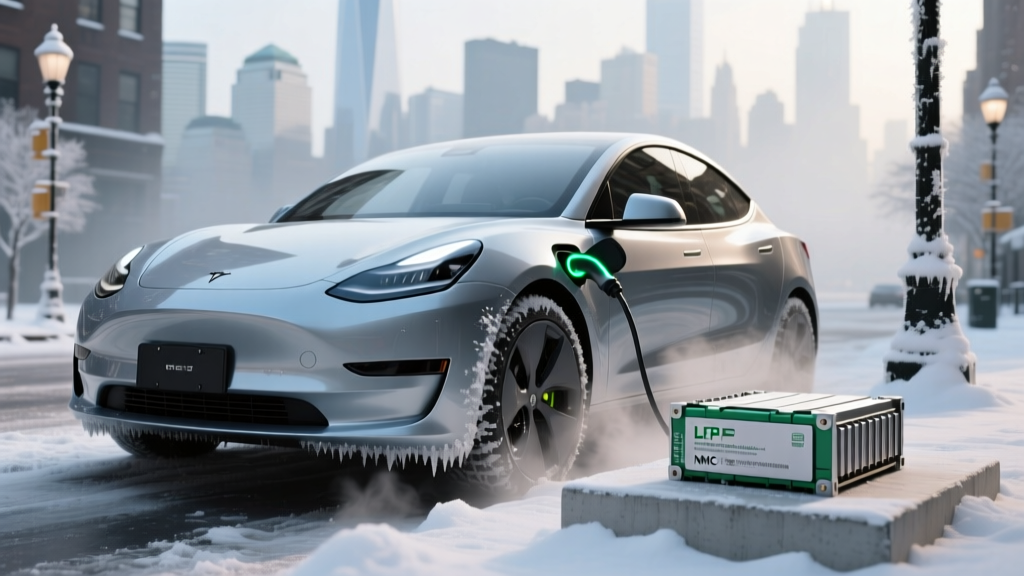
| Cold-Weather Performance | More range loss in freezing temps (~30-40%) | Better cold performance (~20-30% loss) |
| Daily Charging Recommendation | 100% SoC is fine; Tesla recommends periodic full charges | 80% SoC daily; 100% for trips only |
| Cost | Lower per kWh (no cobalt or nickel) | Higher per kWh (commodity-sensitive metals) |
| Thermal Stability | Excellent; inherently more stable | Good; requires robust thermal management |
Which is better? Neither is universally superior—it depends on your usage pattern. If you charge at home nightly, want maximum cycle life, and don't need 330+ miles of range, LFP is the more durable and cost-effective choice. If you regularly take long road trips, live in a cold climate, or need maximum range per charge, NCA/NMC delivers the energy density to make that work. Tesla's decision to split chemistries by trim is deliberate: LFP for daily-driver affordability and longevity, NCA for range and performance.
How Long Do Tesla Lithium Ion Batteries Actually Last?
The short answer: almost certainly longer than you'll own the car. Tesla's battery packs are engineered to outlast the vehicle's economic life, and real-world fleet data supports this.
According to Tesla's 2024 Impact Report (the most recent comprehensive fleet data published), Model 3 and Model Y batteries retain approximately 85% of their original capacity after 200,000 miles. That's a 15% loss over what is, for most owners, 13–15 years of driving at the US average of ~13,500 miles per year. Model S and Model X data shows slightly higher degradation in early model years (2012–2016), but packs from 2017 onward show similar ~85% retention at 200,000 miles.
- Year 1 / 15,000 mi: ~3–5% loss (initial formation loss, steepest part of the curve)
- Year 3 / 45,000 mi: ~6–8% total loss
- Year 5 / 75,000 mi: ~8–10% total loss
- Year 8 / 120,000 mi: ~10–13% total loss
- Year 10+ / 150,000–200,000 mi: ~13–17% total loss
Note: Degradation is non-linear. The steepest loss occurs in the first 10,000–20,000 miles, then the curve flattens significantly. Many owners report barely perceptible loss between years 3 and 7.
LFP packs appear to degrade even more slowly. While Tesla has not published granular LFP-specific fleet data, independent analyses from sources like Recurrent Auto suggest LFP packs lose less capacity in early cycles, consistent with LFP's known 3,000+ cycle-life advantage. An LFP-equipped Model 3 charged daily to 100% could theoretically cycle 3,000 times before hitting 80% State of Health—that's roughly 750,000 miles of rated range throughput, far beyond any realistic ownership period.
Tesla Battery Warranty: What's Covered and for How Long
Tesla's battery and drive unit warranty is one of the strongest in the EV industry, and it has remained consistent across recent model years.
| Model | Warranty Period | Mileage Limit | Minimum Capacity Retention |
|---|---|---|---|
| Model 3 RWD (LFP) | 8 years | 100,000 miles | 70% |
| Model 3 Long Range / Performance | 8 years | 120,000 miles | 70% |
| Model Y (all trims) | 8 years | 120,000 miles | 70% |
| Model S | 8 years | 150,000 miles | 70% |
| Model X | 8 years | 150,000 miles | 70% |
What this means in practice: If your Tesla's battery drops below 70% of its original usable capacity within the warranty period, Tesla will replace or refurbish the pack at no cost. The 70% threshold is significant—even at 70% retention, a Long Range Model Y with an original EPA range of 310 miles would still deliver ~217 miles, which remains practical for most daily driving.
The warranty covers defects and abnormal degradation but does not cover damage from accidents, flooding, or unauthorized modifications. It also does not cover gradual range loss from normal use above the 70% threshold. Full terms are available on Tesla's official warranty page.
Battery Replacement Cost: What It Actually Costs and When It's Needed
This is the question that generates the most anxiety—and the most misinformation. Let's anchor the discussion in reality: the vast majority of Tesla owners will never need a battery replacement. The packs are designed to last the life of the vehicle. But if you're buying a high-mileage used Tesla or planning to keep one for 15+ years, here's what the numbers look like.
| Model | Battery Size (Usable) | Chemistry | Estimated Replacement Cost |
|---|---|---|---|
| Model 3 RWD | ~57.5 kWh | LFP | $7,000 – $10,000 |
| Model 3 Long Range | ~75 kWh | NCA | $12,000 – $16,000 |
| Model Y Long Range | ~75 kWh | NCA | $12,000 – $16,000 |
| Model S (current gen) | ~95 kWh | NCA | $15,000 – $22,000 |
| Model X (current gen) | ~95 kWh | NCA | $15,000 – $22,000 |
These figures include the battery pack and labor but can vary by service center and whether Tesla installs a new, refurbished, or remanufactured pack. Tesla increasingly uses remanufactured packs for out-of-warranty replacements, which helps keep costs toward the lower end of these ranges.
When is replacement actually needed? Based on fleet data, battery replacements due to degradation alone are rare before 200,000 miles. Most out-of-warranty replacements involve physical damage (collision, ground strike), manufacturing defects that surface late, or coolant intrusion. If you're buying a used Tesla with 80,000–120,000 miles, the battery is statistically very likely to have 88–92% of its original capacity remaining—hardly a replacement concern.
Factors That Affect Tesla Battery Life
While Tesla's thermal management system is among the best in the industry—active liquid cooling and heating keep cells in their optimal temperature window—your habits still influence long-term degradation.
- State of Charge (SoC) habits: For NCA/NMC packs, set your daily charge limit to 80%. Reserve 100% charges for road trips and use them promptly—don't let the car sit at 100% for days. For LFP packs, Tesla recommends charging to 100% at least once per week to allow the BMS to calibrate cell voltages accurately.
- DC fast charging frequency: Occasional Supercharging does not meaningfully accelerate degradation. However, exclusive reliance on DC fast charging (250 kW) with no Level 2 charging has been correlated with slightly higher degradation rates in fleet studies—roughly 1–2% additional loss over 100,000 miles compared to predominantly Level 2 charging.
- Extreme temperatures: Tesla's thermal management mitigates most temperature-related stress. However, consistently parking in extreme heat (110°F+ ambient) without being plugged in can accelerate calendar aging. In cold weather, range loss is temporary (the energy is still in the pack but less accessible)—preconditioning via the Tesla app before driving recovers much of this.
- Deep discharges: Avoid regularly running the battery below 10% SoC. Storing the car at very low SoC (below 5%) for extended periods can cause irreversible cell damage. If storing for weeks, leave the car plugged in at 50% SoC.
- Sentry Mode and vampire drain: Continuous Sentry Mode use can cycle the battery through small discharge/recharge events more frequently. Over years, this marginally increases cycle count. If you're parked in a safe location, consider disabling it.
How to Monitor Your Tesla's Battery Health (State of Health)
Tesla does not display a direct State of Health (SoH) percentage in the vehicle's UI, which frustrates some owners accustomed to tools like LeafSpy on the Nissan Leaf. However, there are reliable ways to assess your pack's condition:
Method 1: The Range Calculation
Charge your Tesla to 100% (for NCA, do this occasionally for testing purposes). Note the displayed range at 100%. Compare this to the original EPA-rated range for your model. For example, if your 2023 Model Y Long Range originally displayed 310 miles at 100% and now shows 275 miles, your approximate SoH is 275/310 = ~88.7%. This isn't perfectly precise—displayed range is affected by driving style and temperature—but it provides a solid estimate when tested under similar conditions.
Method 2: Third-Party Apps
Apps like Tessie and TeslaFi track your charging sessions and can estimate SoH over time by analyzing energy added during charges versus the battery's known capacity. These tools are more reliable when you have months of consistent data.
Method 3: Service Mode
Tesla's Service Mode (accessible in newer software versions) provides access to detailed battery data, including nominal full-pack energy (kWh) compared to the original. This is the closest thing to an official SoH reading Tesla provides to owners.
Method 4: Pre-Purchase Inspection
If you're buying a used Tesla, request a battery health check at a Tesla Service Center. They can pull the pack's logged data and provide a capacity assessment. Some independent EV shops also offer this service using OBD-II diagnostic tools.
Looking Ahead: Solid-State and Next-Gen Battery Tech
The battery industry is actively developing next-generation chemistries, and Tesla is part of that effort—but it's important to separate announcements from production reality.
Solid-state batteries promise higher energy density, faster charging, and improved safety by replacing the liquid electrolyte with a solid material. Companies like QuantumScape and Toyota have demonstrated promising prototypes, but mass production at automotive scale remains unsolved. Realistic industry timelines place solid-state batteries in limited production vehicles no earlier than 2028–2030, with broad availability likely in the early 2030s.
Silicon anode technology is closer to commercialization. By incorporating silicon into the graphite anode, cells can store more lithium ions, boosting energy density by 10–20%. Tesla's own 4680 cell design incorporates incremental anode improvements, and suppliers like Sila Nanotechnologies are scaling production. Expect gradual energy-density improvements in Tesla packs over the 2026–2029 timeframe rather than a single breakthrough moment.
Sodium-ion batteries are also under development for lower-cost, lower-range applications. CATL (a Tesla LFP supplier) has begun shipping sodium-ion cells in some Chinese-market vehicles. These could eventually appear in a future ultra-affordable Tesla model, but no US-market Tesla currently uses sodium-ion chemistry.
For buyers today, these technologies are forward-looking context—not purchase factors. Current Tesla lithium ion batteries are mature, well-proven products with extensive real-world track records.
Frequently Asked Questions
How long do Tesla lithium ion batteries last in years and miles?
Based on Tesla's fleet data, Model 3 and Model Y batteries retain approximately 85% capacity after 200,000 miles, which translates to roughly 15 years at average US driving distances. LFP packs may last even longer given their higher cycle-life ratings of 3,000–5,000+ cycles. Most Tesla batteries will outlast the vehicle's useful economic life.
How much does it cost to replace a Tesla battery?
Out-of-warranty replacement costs range from approximately $7,000 for a Model 3 RWD LFP pack to $22,000 for a Model S or Model X NCA pack, including labor. However, the need for replacement due to degradation alone is rare—most replacements involve physical damage or manufacturing defects. Under warranty (8 years / 100,000–150,000 miles depending on model), replacement is free if capacity drops below 70%.
What does the Tesla battery warranty cover?
Tesla's Battery and Drive Unit Limited Warranty covers the battery pack and drive unit against defects and capacity loss below 70% for 8 years and 100,000–150,000 miles (varies by model). It does not cover damage from accidents, misuse, flooding, or unauthorized modifications. Full warranty terms are published on Tesla's website and in the owner's agreement.
Should I charge my Tesla to 100% every day?
It depends on your battery chemistry. If you have an LFP pack (Model 3 RWD, some Model Y RWD), Tesla recommends charging to 100% regularly—at least once per week—to maintain accurate BMS calibration. If you have an NCA/NMC pack (Long Range, Performance, Model S/X), set your daily limit to 80% and only charge to 100% when you need the full range for a trip.
Does frequent Supercharging damage the battery?
Occasional DC fast charging at Superchargers does not cause significant additional degradation. Tesla's thermal management system actively cools the pack during fast charging to protect cell health. However, fleet data suggests that exclusive reliance on DC fast charging (with minimal Level 2 use) may add 1–2% extra degradation over 100,000 miles. For daily charging, a home Level 2 charger is ideal; Supercharge on road trips without worry.
LFP vs NCA — which Tesla battery is better for me?
Choose LFP if you want maximum longevity, can charge at home nightly, don't need 300+ miles of range, and want the simplicity of charging to 100% without worry. Choose NCA/NMC if you need maximum range for road trips, live in a very cold climate where LFP's cold-weather losses are more pronounced, or want the highest performance. For most daily commuters, LFP offers the better long-term ownership experience.
Can I check my Tesla battery's State of Health myself?
Yes, though Tesla doesn't show a direct SoH percentage. The simplest method is to charge to 100% and compare the displayed range to the original EPA rating. Third-party apps like Tessie or TeslaFi can estimate SoH from charging data over time. Tesla Service Mode also shows nominal pack energy. For a definitive reading, request a battery health check at a Tesla Service Center.