Open the window sticker on a 2026 Tesla Model 3 and you will find two very different battery packs wearing the same badge. One relies on lithium iron phosphate (LFP) cells shipped from CATL's Yibin gigafactory in China. The other packs nickel-based NCA cells built by Panasonic inside Tesla's own Nevada Gigafactory. The answer to "where does Tesla get their batteries" is no longer a single supplier — it is a diversified, chemistry-split supply chain that directly affects the range, charging behavior, and long-term degradation you will experience as an owner.
This guide maps Tesla's 2026 battery suppliers, explains the LFP versus NMC/NCA trade-offs with hard numbers, reviews real-world degradation data, and walks through warranty coverage, replacement costs, and daily habits that extend pack life.
Tesla's Battery Suppliers in 2026: A Multi-Source Strategy
Tesla sources high-voltage traction battery cells from four primary partners, with allocation determined by model, trim, and build region:
- Panasonic — Supplies 2170-format NCA (nickel-cobalt-aluminum) cells from Gigafactory Nevada for Model 3 Long Range and Model Y Long Range built in Fremont and Austin. Panasonic also ramps the new 4680-format cells for Cybertruck and selected Model Y AWD builds.
- CATL — Provides prismatic LFP (lithium iron phosphate) cells for the Model 3 Rear-Wheel Drive and Model Y Standard Range sold in North America and Europe. CATL cells ship from Shanghai and Yibin plants.
- LG Energy Solution — Supplies NMC (nickel-manganese-cobalt) 2170 cells primarily for Model Y Long Range and Performance variants destined for European and Asia-Pacific markets, shipped from LG's Nanjing and Wroclaw factories.
- BYD — Provides Blade-format LFP cells for Model Y Rear-Wheel Drive builds out of Gigafactory Berlin, leveraging BYD's structural cell-to-pack architecture.
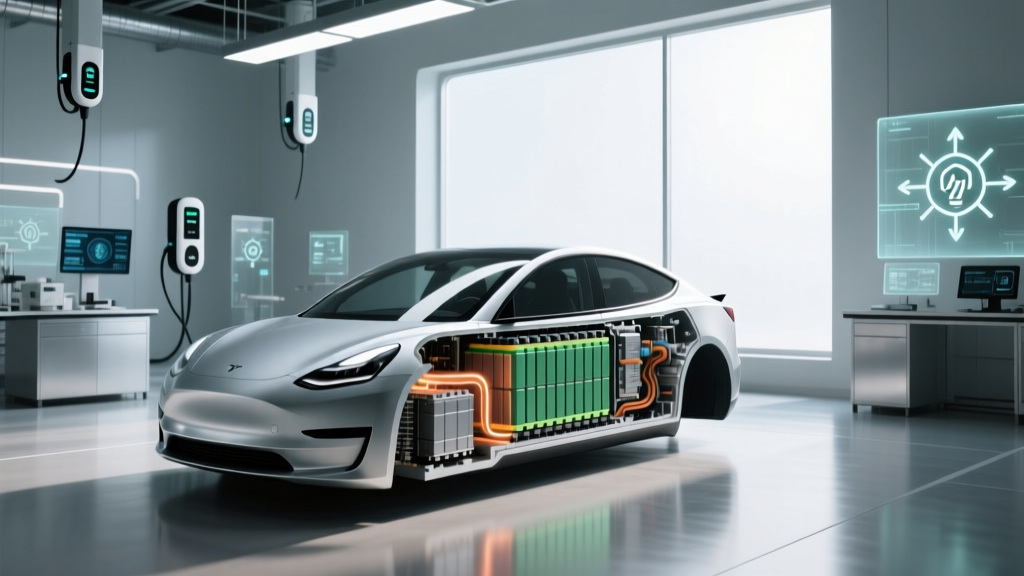
This multi-source approach insulates Tesla from single-supplier disruptions and lets the company match chemistry to trim: cheaper, longer-life LFP for base models; higher-energy-density NCA/NMC for Long Range and Performance variants where range-per-kilogram matters more than cycle count.
LFP vs NMC vs NCA: Chemistry Trade-Offs Explained
The supplier question is really a chemistry question. Tesla uses three distinct cathode chemistries across its 2026 fleet, and each carries measurable trade-offs in energy density, longevity, cold-weather behavior, and cost.
| Attribute | LFP (CATL / BYD) | NCA (Panasonic) | NMC (LG Energy Solution) |
|---|---|---|---|
| Typical pack size | 57.5 kWh usable (Model 3 RWD) | 78.1 kWh usable (Model 3 LR) | 75–78 kWh usable (Model Y LR) |
| Energy density (cell-level) | ~160–170 Wh/kg | ~260–270 Wh/kg | ~240–260 Wh/kg |
| Cycle life to 80% SoH | 3,000–5,000 cycles | 1,500–2,000 cycles | 1,500–2,500 cycles |
| Cold-weather range loss (20°F) | ~30–35% reduction | ~22–28% reduction | ~25–30% reduction |
| Recommended daily SoC | 100% (per Tesla) | 80% daily, 100% for trips | 80% daily, 100% for trips |
| Cobalt content | Zero | Low (~5%) | Moderate (~10%) |
| Relative cell cost | Lowest | Highest | Moderate |
What this means in practice: A Model 3 RWD with CATL LFP can be charged to 100% nightly without accelerating degradation, which simplifies ownership if you rely on public chargers or have short commutes. But you sacrifice roughly 40–50 miles of EPA range versus the Long Range NCA pack, and LFP's flatter voltage curve makes state-of-charge estimation slightly less precise — Tesla occasionally asks LFP owners to charge to 100% so the BMS can recalibrate.
NCA and NMC packs deliver more range per kilogram and handle cold weather with less range penalty thanks to better low-temperature conductivity. The trade-off: Tesla recommends limiting daily charge to 80% to slow calendar degradation, which effectively shrinks your usable daily range unless you are leaving on a road trip.
Real-World Degradation: What the Data Actually Shows
Tesla's 2025 Impact Report (the most recent published dataset) states that Model 3 and Model Y packs retain approximately 85% of original capacity after 200,000 miles — roughly 15 years of driving at the US average of 13,500 miles per year. Independent data from fleet analytics firm Recurrent corroborates this, showing median degradation curves that flatten after the first 20,000–30,000 miles.
Typical Tesla degradation trajectory (NCA/NMC packs):
- Year 1 / 15,000 mi: ~3–5% loss (initial SEI layer formation)
- Year 3 / 45,000 mi: ~7–9% total loss
- Year 5 / 75,000 mi: ~9–11% total loss
- Year 8 / 120,000 mi: ~12–14% total loss
- Year 12 / 180,000 mi: ~15–18% total loss
LFP packs (CATL/BYD) typically show 1–2% less degradation at each interval, owing to the more stable olivine crystal structure of iron phosphate cathodes.
These numbers assume mixed driving with a combination of Level 2 home charging and occasional DC fast charging. Owners who exclusively Supercharge at 250 kW and habitually charge to 100% on nickel-based packs can expect the upper end of these loss ranges — or slightly worse.
Tesla's Battery Warranty: Coverage, Thresholds, and Fine Print
Tesla structures its high-voltage battery warranty by model and pack size, with a clear capacity-retention threshold that triggers a replacement or refurbishment at no cost to the owner.
| Model / Trim | Warranty Period | Mileage Cap | Minimum Retention |
|---|---|---|---|
| Model 3 RWD (LFP, 57.5 kWh) | 8 years | 100,000 miles | 70% |
| Model 3 Long Range / Performance (NCA) | 8 years | 120,000 miles | 70% |
| Model Y RWD / LR / Performance | 8 years | 120,000 miles | 70% |
| Model S / Model X (all trims) | 8 years | 150,000 miles | 70% |
| Cybertruck (all trims) | 8 years | 120,000 miles | 70% |
Critical detail: The warranty covers capacity loss below 70% as measured by Tesla's diagnostic tools — not the range displayed on the instrument cluster, which fluctuates with temperature, driving style, and BMS estimation. It also covers manufacturing defects and drive-unit failures. It does not cover damage from collisions, flooding, or unauthorized modifications. If your pack falls to 69% State of Health within the warranty window, Tesla will replace or remanufacture it to bring retention back above the threshold.
For context, NHTSA does not mandate a specific EV battery warranty period — Tesla's 8-year terms are in line with or slightly above the industry norm of 8 years/100,000 miles established by Hyundai, Kia, and most legacy automakers.
Battery Replacement Cost: What Owners Actually Pay
Most Tesla battery packs outlast the vehicle itself. But for out-of-warranty replacements — relevant to second- and third-owners, or high-mileage fleet vehicles — here are current 2026 service-center estimates:
| Model / Pack | Battery Size | Parts Cost | Labor | Total Estimate |
|---|---|---|---|---|
| Model 3 RWD (LFP) | 57.5 kWh | $8,500–$10,000 | $1,500–$2,500 | $10,000–$12,500 |
| Model 3 Long Range (NCA) | 78.1 kWh | $12,000–$14,500 | $1,500–$2,500 | $13,500–$17,000 |
| Model Y LR (NCA/NMC) | 75–78 kWh | $12,500–$15,000 | $1,800–$2,800 | $14,300–$17,800 |
| Model S / X (Plaid) | 100 kWh | $18,000–$22,000 | $2,000–$3,000 | $20,000–$25,000 |
| Cybertruck (4680 pack) | ~123 kWh | $20,000–$25,000 | $2,500–$3,500 | $22,500–$28,500 |
These figures reflect Tesla's shift toward module-level repairs where possible. Rather than swapping an entire pack, Tesla service centers can now diagnose and replace individual modules (typically 4–5 modules per pack) at $2,000–$4,000 per module, significantly reducing out-of-pocket cost for partial degradation or isolated cell failures. Full-pack replacement is typically only needed when structural damage, widespread cell imbalance, or coolant intrusion affects the entire assembly.
For perspective: at the US average of 13,500 miles per year, reaching 200,000 miles takes nearly 15 years. The vast majority of Teslas are retired, sold, or totaled in accidents before the battery requires replacement.
Factors That Accelerate (or Slow) Battery Degradation
Battery longevity is not a fixed number — it is a function of how you charge, drive, and store the vehicle. The five highest-impact factors:
- DC fast-charging frequency: Occasional Supercharging (1–2 times per week) has negligible long-term impact. Daily DC fast charging at 250 kW, especially without preconditioning, accelerates electrolyte decomposition. Tesla's thermal management system mitigates this, but sustained high-C-rate charging still adds up over years.
- State of charge habits: For NCA/NMC packs, storing the car at 100% SoC for days at a time causes calendar aging via cathode oxidation. Keep daily charge at 80% and only raise to 100% within hours of a long drive. LFP packs are the exception — Tesla recommends periodic 100% charges for BMS calibration.
- Extreme temperatures: Sustained exposure to ambient heat above 95°F accelerates SEI layer growth. In cold climates, charging a frozen pack without preconditioning causes lithium plating on the anode — a permanent capacity loss mechanism. Always enable preconditioning via the Tesla app before winter charging sessions.
- Depth of discharge: Shallow cycles (charging from 40% to 80%) are less stressful than deep cycles (10% to 100%). If your commute uses only 20% of the pack, you are in the ideal longevity window.
- Storage conditions: If leaving a Tesla for weeks (airport parking, vacation), set charge to 50% and plug in if possible so the 12V and thermal systems can maintain the pack without cycling the traction battery.
How to Check and Monitor Battery Health (SoH)
Tesla does not expose a direct State of Health percentage in the vehicle's touchscreen — unlike some competitors (Hyundai, BMW) that display SoH in the diagnostic menu. Here are the reliable methods:
- Tesla Service Mode (DIY): Hold the model badge on the "Software" screen for 5 seconds, enter "service" as the access code, and navigate to the battery health panel. This shows pack voltage, nominal full-pack capacity (in kWh), and an estimated SoH percentage derived from recent charge cycles.
- Tesla app energy graph: Track your rated range at 100% charge over time. A Model 3 LR that showed 358 miles EPA when new and now shows 322 miles at 100% has roughly 10% degradation — consistent with expected loss at ~60,000 miles.
- Third-party OBD-II tools: Devices like the OBDeleven or Scan My Tesla app (paired with an OBDLink adapter) pull live BMS data, including nominal full-pack energy, cell-level voltage variance, and cycle count.
- Tesla service center diagnostic: Request a battery health report during annual service. Tesla can provide a certified SoH printout useful for resale negotiations.
Red flag: Cell voltage variance above 0.10V at rest, or a nominal full-pack reading that drops more than 2 kWh in a single month, may indicate a module imbalance covered under warranty.
Emerging Battery Technology: What's Next After 2026
Tesla's 4680 cell format — a 46mm-diameter, 80mm-tall cylindrical cell with a tabless electrode design — is the company's in-house bet on cost reduction and energy density improvement. As of early 2026, 4680 cells are in production at Gigafactory Texas for Cybertruck and select Model Y builds, delivering approximately 16% more energy density than the 2170 format and enabling a structural battery pack that reduces vehicle mass.
Silicon-anode cells: Companies like Sila Nanotechnologies and Group14 are supplying silicon-dominant anode materials that replace graphite, boosting energy density by 20–40%. Tesla has not confirmed a production timeline, but industry analysts expect limited integration in performance-oriented models by 2028–2029.
Solid-state batteries: Toyota, Samsung SDI, and QuantumScape have announced solid-state prototypes promising 500+ mile range and 10-minute charging. However, no automaker — Tesla included — has committed to volume production before 2029–2030. Solid-state cells remain in the pilot-line phase with unresolved challenges in manufacturing yield and interfacial resistance. Treat any "solid-state is imminent" headline with skepticism; the technology is real but the supply chain is not.
For buyers in 2026, the practical takeaway: today's LFP and NCA/NMC cells are mature, well-characterized, and backed by robust warranty terms. Waiting for solid-state means waiting 4+ years with no guarantee of affordable pricing at launch.
Frequently Asked Questions
How long do Tesla batteries actually last?
Based on Tesla's published fleet data and independent analysis by Recurrent, the median Tesla Model 3/Y battery retains approximately 85% of original capacity at 200,000 miles — roughly 15 years of average US driving. LFP packs (CATL/BYD) trend toward the higher end of this range due to superior cycle life. Most packs will outlast the vehicle's useful economic life.
How much does it cost to replace a Tesla battery?
Out-of-warranty full-pack replacement ranges from approximately $10,000 (Model 3 RWD LFP) to $25,000+ (Model S/X or Cybertruck). However, Tesla increasingly performs module-level repairs at $2,000–$4,000 per module. Under warranty, replacement is free if capacity drops below 70% within 8 years or the applicable mileage cap.
What does Tesla's battery warranty actually cover?
Tesla warrants the high-voltage battery against capacity loss below 70% (measured by Tesla diagnostics) and manufacturing defects for 8 years and 100,000–150,000 miles depending on model. It does not cover collision damage, flooding, or unauthorized modifications. The drive unit (motor and inverter) is covered under the same terms.
Is LFP better than NMC for daily driving?
For most owners, yes. LFP allows 100% daily charging without accelerated degradation, contains no cobalt, costs less, and offers 3,000–5,000 cycle life versus 1,500–2,500 for NMC/NCA. The trade-offs are lower energy density (shorter EPA range per kWh) and greater cold-weather range loss (~30–35% at 20°F versus ~25% for NMC). If you need maximum range or live in a cold climate, NCA/NMC is the better fit.
Does frequent Supercharging damage the battery?
Occasional Supercharging (a few times per week) has minimal measurable impact thanks to Tesla's active thermal management, which precondition the pack and limits charge rate as cells warm. Daily exclusive Supercharging, especially to 100% on NCA/NMC packs, does accelerate degradation modestly — expect 1–2% additional loss over 100,000 miles versus Level 2 home charging. The bigger risk is charging a cold pack without preconditioning.
Where are Tesla batteries manufactured?
Tesla battery cells come from four primary sources in 2026: Panasonic (Gigafactory Nevada, USA — NCA 2170 and 4680 cells), CATL (Shanghai and Yibin, China — LFP prismatic cells), LG Energy Solution (Nanjing, China and Wroclaw, Poland — NMC 2170 cells), and BYD (Shenzhen and Blade factories, China — LFP Blade cells for Berlin-built Model Y). Final pack assembly occurs at Tesla's Fremont, Austin, Berlin, and Shanghai vehicle factories.