If you own a Tesla or are shopping for one, the high-voltage traction battery is the single most expensive component in the vehicle. Searches for how much is a Tesla battery spike every time a viral social-media post claims a $20,000+ replacement bill. The reality is more nuanced: most Tesla batteries outlast the cars they're installed in, warranty coverage is robust, and actual out-of-pocket replacement costs depend heavily on model, chemistry, and whether you need a full pack or a module-level repair.
This guide breaks down 2026 Tesla battery replacement costs, warranty terms, degradation data from real-world fleets, the chemistry differences between LFP and NMC/NCA packs, and exactly what you can do to maximize battery health over 150,000+ miles.
Tesla Battery Replacement Cost by Model (2026 Estimates)
Out-of-warranty battery replacement costs vary by model, pack size (kWh), and chemistry. Tesla does not publish a public price list for replacement packs, so the figures below are synthesized from service-center invoices shared by owners, independent EV repair shops, and Tesla's own service estimates as of early 2026.
| Model | Pack Size (usable kWh) | Chemistry | Estimated Replacement Cost | Labor (est.) |
|---|---|---|---|---|
| Model 3 RWD (Standard Range) | 57.5 kWh | LFP | $12,000 – $14,500 | $1,500 – $2,500 |
| Model 3 Long Range / Performance | 75 kWh | NMC/NCA | $14,000 – $17,000 | $1,500 – $2,500 |
| Model Y RWD | 57.5 kWh | LFP | $12,500 – $15,000 | $1,500 – $2,500 |
| Model Y Long Range / Performance | 75 kWh | NMC/NCA | $14,000 – $17,500 | $1,500 – $2,500 |
| Model S (2021+ Plaid/Long Range) | 95 kWh | NMC/NCA | $18,000 – $22,000 | $2,000 – $3,000 |
| Model X (2021+ Plaid/Long Range) | 95 kWh | NMC/NCA | $19,000 – $23,000 | $2,000 – $3,500 |
| Cybertruck (AWD / Cyberbeast) | ~123 kWh | NMC (4680 cells) | $20,000 – $25,000+ | $2,500 – $4,000 |
Key context: These are worst-case, full-pack replacement figures. In practice, many battery issues are resolved through module-level repairs or individual cell-group replacements at significantly lower cost ($3,000–$8,000). Tesla's diagnostic process determines whether a full pack swap is necessary or if targeted repair suffices. Remanufactured packs are also increasingly available at lower price points, typically 20–35% below new-pack pricing.
How Long Do Tesla Batteries Last? Degradation Data
Tesla's 2023 Impact Report (the most recent with long-term fleet data) stated that Model 3 and Model Y batteries retain approximately 85% of original capacity after 200,000 miles. For the Model S and Model X, Tesla reported roughly 88% retention at 150,000 miles. Independent fleet data from sources like Teslanomics and Recurrent Auto corroborate these figures with slight variance by climate and usage pattern.
Here's what typical degradation looks like across a Tesla battery's lifespan:
- Year 1 / 15,000 mi: ~3–5% loss (initial formation loss — steepest part of the curve)
- Year 3 / 45,000 mi: ~7–9% total loss
- Year 5 / 75,000 mi: ~9–12% total loss
- Year 8 / 120,000 mi: ~12–15% total loss
- Year 10 / 150,000 mi: ~14–18% total loss
- Year 12+ / 200,000 mi: ~15–20% total loss (varies significantly by care)
Note: LFP packs (Model 3/Y RWD) show a flatter degradation curve with slightly less total loss at equivalent mileage, but begin with lower energy density and therefore lower starting range.
When is replacement actually needed? Most EV owners never need a battery replacement. A pack is typically considered "end of life" in-vehicle when it drops below 70% capacity — the threshold Tesla's warranty guarantees. At 70% of a Model 3 Long Range's 75 kWh pack, you'd still have ~52.5 kWh usable, yielding roughly 230 miles of real-world range (down from ~330 EPA). Many owners find this still acceptable for daily driving and choose to keep the car.
According to data aggregated by Recurrent Auto, fewer than 5% of Tesla vehicles have required a full battery replacement outside of warranty-covered defects. The vast majority of replacements occur due to manufacturing defects caught within the 8-year warranty period, not end-of-life degradation.
Tesla Battery Warranty: What's Covered and for How Long
Tesla's battery and drive unit warranty is one of the more straightforward in the EV industry. Here's the breakdown for current (2026 model year) vehicles:
| Model | Warranty Period | Mileage Limit | Minimum Capacity Retention |
|---|---|---|---|
| Model 3 RWD (LFP) | 8 years | 100,000 miles | 70% |
| Model 3 Long Range / Performance | 8 years | 120,000 miles | 70% |
| Model Y RWD (LFP) | 8 years | 100,000 miles | 70% |
| Model Y Long Range / Performance | 8 years | 120,000 miles | 70% |
| Model S / Model X | 8 years | 150,000 miles | 70% |
| Cybertruck | 8 years | 120,000 miles | 70% |
What the warranty covers: Battery failure, defects in materials or workmanship, and capacity loss below the 70% threshold within the warranty period. If your battery drops below 70% State of Health (SoH) before 8 years or the mileage limit (whichever comes first), Tesla will repair or replace it at no cost.
What it does NOT cover: Damage from accidents, flooding, fire (non-defect), unauthorized modifications, or use of the vehicle as a stationary power source (unless using an approved Tesla Powerwall integration). Normal degradation above the 70% threshold is also not covered — a battery at 72% SoH at year 7 is considered within spec.
Practical tip: If you suspect abnormal degradation, request a battery health report from Tesla Service. The car's internal BMS (Battery Management System) logs detailed cell-voltage data that Tesla can review remotely. Document your concerns in writing through the Tesla app before the warranty expires.
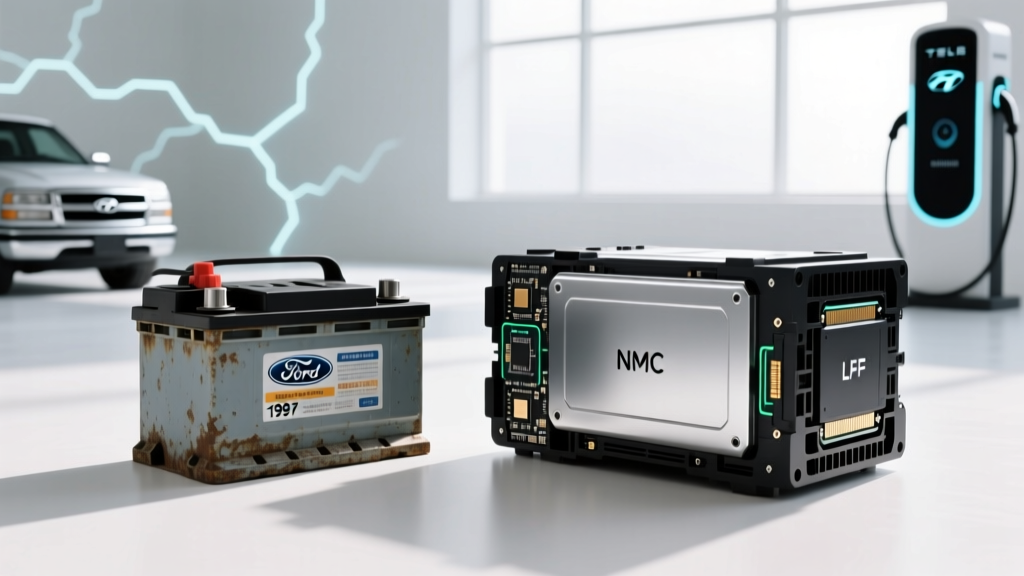
LFP vs NMC/NCA: Which Tesla Battery Chemistry Is Better?
Tesla uses two primary battery chemistries across its 2026 lineup. Understanding the trade-offs is essential to evaluating long-term cost, range, and durability.
| Attribute | LFP (Lithium Iron Phosphate) | NMC/NCA (Nickel Manganese Cobalt / Nickel Cobalt Aluminum) |
|---|---|---|
| Used in (2026 Tesla) | Model 3 RWD, Model Y RWD | Model 3 LR/Perf, Model Y LR/Perf, Model S/X, Cybertruck |
| Energy density | Lower (~160 Wh/kg cell-level) | Higher (~250–300 Wh/kg cell-level) |
| Typical pack range (EPA) | 272 mi (Model 3 RWD) | 341 mi (Model 3 LR) |
| Cycle life | 3,000–5,000+ cycles | 1,000–2,000 cycles |
| Degradation rate | Slower, flatter curve | Slightly faster, especially early |
| Cold-weather performance | Weaker — more range loss below 32°F | Better — less range loss in cold |
| Charging recommendation | Can (and should) charge to 100% regularly | Recommended daily limit: 80%; 100% for trips only |
| Cost | Lower — no cobalt or nickel | Higher — commodity-sensitive materials |
| Weight | Heavier for equivalent kWh | Lighter for equivalent kWh |
The bottom line: LFP is the better choice if you prioritize longevity, lower replacement cost, and plan to keep the car 10+ years. NMC/NCA is better if you need maximum range, better cold-weather performance, or faster acceleration. Neither is objectively "better" — they serve different ownership profiles.
For LFP owners: Tesla explicitly recommends charging to 100% at least once per week. This is because LFP's voltage curve is extremely flat, making it difficult for the BMS to estimate State of Charge accurately without regular full charges. Ignoring this can lead to range-estimation errors, not actual battery damage.
What Affects Tesla Battery Lifespan? 5 Key Factors
Battery degradation is inevitable, but the rate at which it occurs depends heavily on how you use and store the vehicle. Here are the five most impactful factors:
- 1. Avoid chronic DC fast charging. Supercharging is convenient but generates significant heat. Tesla's BMS actively manages thermal loads, but frequent 250 kW sessions accelerate degradation vs. predominantly Level 2 home charging. Aim for <20% of total charging via DCFC when possible.
- 2. Manage State of Charge (SoC) range. For NMC/NCA packs, set your daily charge limit to 80% and only charge to 100% when you need the full range for a trip. Storing the car at 100% SoC for extended periods (days or weeks) stresses the cathode. For LFP packs, charge to 100% regularly as Tesla recommends.
- 3. Minimize extreme-temperature exposure. Parking in a garage or shaded area in summer and using Tesla's built-in battery preconditioning in winter both help. The car's thermal management system draws power to keep the battery in its optimal 68–86°F (20–30°C) window — let it work by plugging in when possible.
- 4. Avoid deep discharges. Regularly running the battery below 10% SoC stresses the cells. Tesla reserves a buffer below 0% displayed (roughly 2–4 kWh), but habitually arriving at 0% and leaving the car unplugged for hours can cause cell imbalance.
- 5. Keep software updated. Tesla pushes BMS refinements via over-the-air updates that can improve charge algorithms, thermal management, and cell-balancing routines. These updates measurably affect long-term health.
How to Check Your Tesla's Battery Health (State of Health)
Tesla does not display a State of Health (SoH) percentage directly in the car's UI — unlike some competitors (e.g., Hyundai's Bluelink or Nissan's battery health bars). However, there are several reliable methods to assess your pack's condition:
Method 1: Range vs. Odometer Tracking
Set your display to show "rated" or "ideal" range (not the percentage-based estimate). At 100% charge, note the displayed range. Compare this to the original EPA-rated range for your model. A Model 3 Long Range that originally displayed 341 miles at 100% now showing 300 miles has roughly 88% SoH — consistent with normal degradation at moderate mileage.
Method 2: TeslaFi or Third-Party Telematics
Services like TeslaFi and Tessie log detailed battery data including estimated capacity in kWh, charge/discharge curves, and cell-level voltage deltas. Over time, these tools build a degradation trend line that's more accurate than the in-car range estimate (which is affected by temperature, driving style, and BMS calibration).
Method 3: Tesla Service Diagnostic
Request a battery health report through the Tesla app. Tesla Service can pull a comprehensive BMS log showing actual usable capacity (kWh), cell imbalance data, and a computed SoH percentage. This is the most authoritative source and the one Tesla uses for warranty determinations.
Method 4: Manual Calculation
Charge to 100%, then drive a known distance (e.g., 50 miles) at steady highway speed. Note the kWh consumed from the trip meter. If your 75 kWh pack uses 18 kWh for 50 miles but the car's energy screen shows you consumed 22 kWh from the battery, you can estimate remaining capacity. This method is approximate but useful for a sanity check.
Emerging Battery Tech: What's Next After Lithium-Ion?
Current Tesla batteries use proven lithium-ion technology, but several next-generation chemistries are in development. Here's a realistic assessment — none of these are available in production Teslas as of 2026:
- Solid-state batteries: Promising higher energy density (potentially 400+ Wh/kg) and improved safety (no flammable liquid electrolyte). Companies like QuantumScape and Toyota are targeting limited production in 2027–2029, but cost and manufacturing scalability remain major hurdles. Realistic timeline for mass-market EVs: 2029–2032.
- Silicon-dominant anodes: Replacing graphite anodes with silicon can boost energy density by 20–40%. Sila Nanotechnologies and Group14 are supplying early production runs for non-Tesla applications. Tesla's 4680 cells already incorporate some silicon in the anode. Broader adoption: 2026–2028 (incremental, not a step-change).
- Sodium-ion batteries: Lower cost, no lithium or cobalt required, but significantly lower energy density (~120 Wh/kg). CATL has begun production for Chinese-market EVs. Unlikely to appear in Tesla's US lineup before 2028+, and only in budget-oriented models if at all.
- Lithium iron manganese phosphate (LMFP): An evolution of LFP with ~15–20% higher energy density while retaining cobalt-free cost advantages. CATL and BYD are ramping production. Possible Tesla adoption in Standard Range models: 2027–2028.
Practical takeaway: If you're buying a Tesla in 2026, you're getting mature, well-proven lithium-ion technology with extensive real-world data behind it. Waiting for solid-state or next-gen batteries means waiting 3–6+ years with no guaranteed pricing advantage.
Frequently Asked Questions
How much is a Tesla battery out of warranty?
Between $12,000 and $25,000+ depending on model and pack size, including labor. Model 3/Y RWD (LFP) packs are at the lower end ($12K–$15K), while Cybertruck and Model S/X packs are at the higher end ($18K–$25K). Remanufactured packs can reduce cost by 20–35%.
How long do Tesla batteries last before needing replacement?
Most Tesla batteries retain 80–85% capacity at 200,000 miles based on fleet data. With proper care, a Tesla battery should last 15–20 years or 300,000+ miles before reaching 70% SoH. Fewer than 5% of Teslas have required out-of-warranty battery replacements.
Does Tesla replace the whole battery or just bad modules?
Tesla's service approach depends on the fault. Module-level issues (a single weak cell group, localized damage) can sometimes be repaired without a full pack swap. However, widespread cell degradation or BMS-detected faults typically trigger a full pack replacement. Remanufactured packs are commonly used for out-of-warranty replacements.
Is LFP better than NMC for Tesla batteries?
LFP offers longer cycle life (3,000–5,000 cycles vs. 1,000–2,000), lower cost, and the ability to charge to 100% daily. NMC/NCA offers higher energy density (more range per pound), better cold-weather performance, and faster acceleration. LFP is ideal for cost-conscious, long-term owners in moderate climates. NMC is better for range-priority buyers in cold regions.
Does Supercharging damage the Tesla battery?
Occasional Supercharging does not meaningfully harm the battery — Tesla's thermal management system is highly effective. However, chronic daily DC fast charging (especially at 250 kW) does accelerate degradation compared to predominantly Level 2 (7–11 kW) home charging. Tesla's own data shows vehicles that primarily Supercharge exhibit slightly faster capacity loss over 100,000+ miles.
Should I charge my Tesla to 100% every night?
For NMC/NCA packs (Long Range, Performance, Model S/X): No. Set the daily limit to 80% and charge to 100% only before long trips. For LFP packs (Model 3/Y RWD): Yes — Tesla recommends charging to 100% at least weekly to maintain BMS calibration.
What voids the Tesla battery warranty?
Accident damage, flooding, unauthorized modifications (aftermarket battery heaters, non-Tesla V2H integrations), using the vehicle as a stationary power source without approved equipment, and evidence of tampering with the BMS. Normal use, Supercharging, and standard degradation are all covered.
Sources: Tesla 2023 Impact Report, Recurrent Auto battery health data, Tesla Battery Warranty, EPA fueleconomy.gov for range figures.