Why a 2003 Ford Expedition Battery Comparison Still Matters for EV Buyers
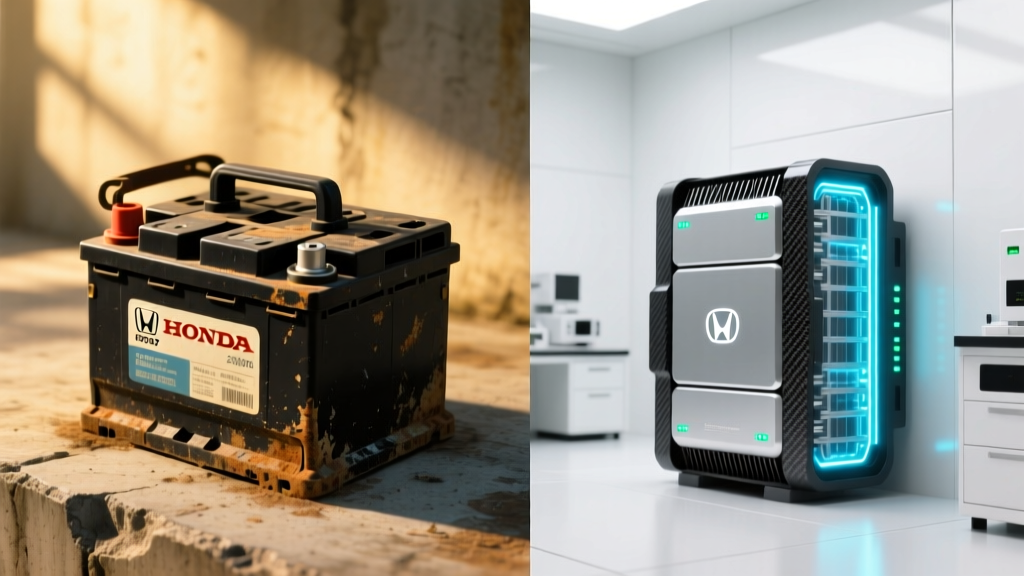
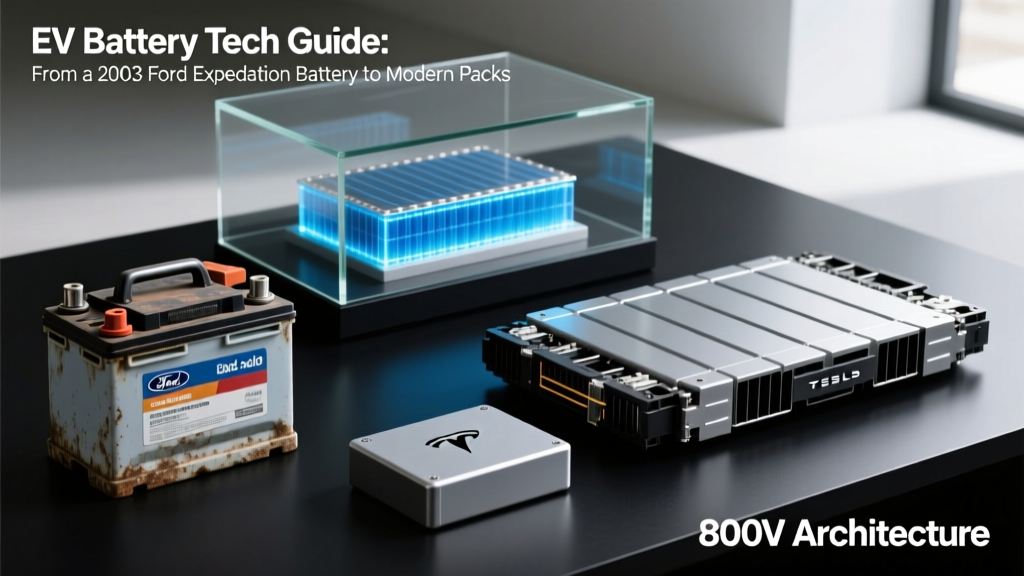
If you have ever owned a 2003 Ford Expedition, you know the drill: every three to five years, the 12V lead-acid battery dies, you spend $150–$250 at an auto parts store, and move on. That simple, inexpensive swap colors how many buyers think about any vehicle battery — and it is exactly the wrong mental model for a modern electric vehicle's high-voltage traction battery.
An EV traction battery is a 60–130+ kWh lithium-ion (or lithium iron phosphate) pack that powers the drivetrain, manages its own thermal state, and is engineered to last the life of the vehicle. The 2003 Ford Expedition battery is a 12V starting battery whose only job is to crank a 5.4L V8 and run the radio when the engine is off. Conflating the two leads to bad purchase decisions and unnecessary anxiety.
This guide breaks down exactly how modern EV batteries work, what they cost, how they degrade, and what the warranty actually covers — with real data, not marketing copy.
LFP vs NMC/NCA: The Chemistry Decision You Actually Have to Make
Not all lithium-ion batteries are the same. In 2026, two chemistries dominate the US EV market, and the choice between them affects range, longevity, cold-weather behavior, and price.
NMC (Nickel Manganese Cobalt) and NCA (Nickel Cobalt Aluminum) chemistries offer higher energy density — more kWh in a smaller, lighter pack. That translates to longer EPA range in a given vehicle footprint. Most long-range EVs (Tesla Model 3 Long Range, Hyundai Ioniq 5, Ford Mustang Mach-E Extended Range) use NMC/NCA.
LFP (Lithium Iron Phosphate) trades some energy density for dramatically longer cycle life, better thermal stability, and lower cost. Tesla uses LFP in the Model 3 and Model Y Standard Range (Rear-Wheel Drive). BYD, the world's largest EV maker, uses LFP exclusively in its Blade Battery architecture.
| Attribute | LFP (LiFePO₄) | NMC / NCA |
|---|---|---|
| Energy Density | ~150–180 Wh/kg | ~220–300 Wh/kg |
| Typical Cycle Life | 3,000–5,000+ cycles | 1,000–2,000 cycles |
| Cold-Weather Performance | Moderate — slower charge below 32°F | Better low-temp conductivity |
| Thermal Stability | Excellent — higher runaway threshold | Good — requires more active management |
| Cost (per kWh) | ~$80–$100 | ~$110–$140 |
| Recommended Daily SoC | 100% OK regularly | 80% daily; 100% for trips only |
| Typical Use Case | Standard-range, fleet, high-mileage | Long-range, performance, AWD |
Which is better? Neither, universally. If you charge at home nightly, drive under 300 miles a day, and want the longest calendar life, LFP is the pragmatic choice — and you can charge to 100% without guilt. If you need maximum range in a single charge for road trips or live in a region with extreme cold, NMC/NCA's density and cold performance justify the slightly shorter cycle life.
How Long Do EV Batteries Actually Last? Real Degradation Data
The short answer: most EV batteries outlast the car they are installed in. The long answer requires looking at actual fleet data.
According to a longitudinal analysis by Geotab tracking over 10,000 EVs in fleet service, the average EV battery loses approximately 2.3% of its capacity per year in the first few years, then the degradation curve flattens. After 10 years, the average pack retains roughly 80–85% of its original capacity.
Real-world data points from major manufacturers and fleet operators:
- Tesla Model 3/Y (NMC, 2018–2022 cohorts): ~5–7% loss at 100,000 miles, per Tesla's 2023 Impact Report.
- Nissan Leaf (early air-cooled packs, 2011–2017): Higher degradation — 15–25% loss by 100,000 miles — largely due to passive air cooling in hot climates. A cautionary tale for thermal management.
- Chevrolet Bolt EV/EUV (NMC, liquid-cooled): ~6–8% loss at 100,000 miles, consistent with industry averages.
- Hyundai Ioniq 5 (NMC, 84 kWh pack): Early fleet data suggests ~4–6% loss at 80,000 miles, aided by robust thermal management and preconditioning.
Typical Degradation Curve (NMC, liquid-cooled, moderate climate): Year 1: ~2–3% loss. Year 2–4: ~1.5–2% per year. Year 5–10: ~1% per year. The curve is non-linear — initial formation losses give way to a long, slow decline. Most packs never reach the 70% capacity threshold that triggers a warranty claim within the warranty period.
Battery Warranties Explained: What Is — and Isn't — Covered
Federal law (EPA emissions warranty provisions and California Air Resources Board requirements adopted by multiple states) has pushed manufacturers toward robust battery warranties. In 2026, the baseline across most major automakers is:
| Manufacturer | Warranty Period | Mileage Cap | Capacity Threshold |
|---|---|---|---|
| Tesla (Model 3/Y RWD — LFP) | 8 years | 100,000 miles | 70% retention |
| Tesla (Model 3/Y LR — NMC) | 8 years | 120,000 miles | 70% retention |
| Hyundai / Kia | 10 years | 100,000 miles | 70% retention |
| Ford (Mustang Mach-E, F-150 Lightning) | 8 years | 100,000 miles | 70% retention |
| GM (Chevrolet, Cadillac, GMC EVs) | 8 years | 100,000 miles | 70% retention |
| Volkswagen (ID.4) | 8 years | 100,000 miles | 70% retention |
What the warranty covers: If your battery's usable capacity drops below the stated threshold (typically 70% of original) within the warranty period, the manufacturer will repair or replace it — often by swapping in a refurbished pack with at least 70% capacity, not necessarily a brand-new one.
What it does NOT cover: Normal degradation above the threshold. If your pack is at 78% after 8 years, that is considered acceptable wear. Damage from accidents, floods, unauthorized modifications, or using non-approved charging equipment may void coverage. Always read the specific warranty booklet for your model year.
EV Battery Replacement Cost: The Numbers and the Context
Replacement cost is the single biggest fear for prospective EV buyers — often inflated by viral headlines about $20,000+ bills. Context matters.
| Battery Size / Vehicle Class | Approximate Replacement Cost (2026) | When Typically Needed |
|---|---|---|
| 40–60 kWh (Compact / Standard Range — e.g., base Nissan Leaf, early Bolt) | $6,000 – $10,000 | Rarely before 200,000+ miles |
| 75–90 kWh (Mid-size / Long Range — e.g., Model 3 LR, Ioniq 5, Mach-E ER) | $10,000 – $16,000 | Rarely before 200,000+ miles |
| 100–135 kWh (Full-size / Truck — e.g., F-150 Lightning ER, Rivian R1T Max Pack) | $15,000 – $25,000 | Rarely before 150,000+ miles |
Compare that to the 2003 Ford Expedition battery: a Group 65 12V lead-acid unit costs roughly $150–$250 and needs replacement every 3–5 years. Over 15 years and 200,000 miles, you might buy four or five of those 12V batteries for a total of $600–$1,250. The EV traction battery is a single, far larger expense — but one that most owners will never incur because the pack outlasts the vehicle's economic life.
According to data from Consumer Reports, the majority of EV batteries are never replaced under owner expense. When they are, it is typically due to a manufacturing defect (covered by warranty) or collision damage (covered by insurance). Out-of-pocket replacement due to age-related degradation alone is uncommon in the first 15 years of ownership.
Factors That Accelerate (or Preserve) Battery Life
Battery longevity is not purely a function of time and miles. How you use and charge the pack has a measurable impact on its State of Health (SoH) over a decade.
Battery Care Checklist for Maximum Longevity
- Limit DC fast charging to road trips. Frequent use of 150+ kW DC fast charging stresses the pack thermally. For daily use, Level 2 home charging at 7–11 kW is gentler and cheaper.
- Avoid extreme State of Charge (SoC) for NMC/NCA. Keep daily charge between 20–80%. Charge to 100% only when you need the full range for a trip, and drive off soon after. LFP owners can charge to 100% regularly — this chemistry tolerates it and actually benefits from periodic full charges for cell balancing.
- Use preconditioning. Most EVs let you precondition the battery before a fast-charge stop (the car warms or cools the pack to the optimal temperature). This reduces charge time and thermal stress. Enable it in your navigation settings.
- Park in shade or a garage in extreme heat. Sustained high ambient temperatures (above 95°F / 35°C) accelerate calendar degradation. Liquid-cooled packs handle this better than air-cooled, but thermal soak still matters.
- Don't let the pack sit at 0% or 100% for extended periods. If storing the vehicle for weeks, aim for ~50% SoC.
- Keep up with software updates. Manufacturers refine battery management algorithms over the air. These updates can improve thermal management and charge profiles.
How to Check Your Battery's State of Health (SoH)
State of Health (SoH) is the percentage of your battery's original usable capacity that remains. A new pack is at 100% SoH; a pack that has degraded to 85 kWh from an original 100 kWh is at 85%.
Methods for checking SoH in 2026:
- In-app battery health displays: Tesla, Hyundai, Ford, and GM offer battery health or degradation readouts in the vehicle's app or settings menu. Accuracy varies — some show estimated SoH, others show a range estimate based on recent usage patterns.
- OBD-II diagnostic tools: Third-party apps like Leaf Spy (Nissan Leaf), Teslalogger, or generic EV diagnostic scanners can read the Battery Management System (BMS) directly and report SoH, cell voltage variance, and cycle count.
- Dealer diagnostic reports: Request a battery health report during service visits. The dealer can pull BMS data that shows capacity retention and flag any outlier cells.
- Real-world range tracking: The simplest method — track your actual miles per kWh over time. If your 2022 Ioniq 5 originally achieved 3.2 mi/kWh on your commute and now achieves 2.9 mi/kWh under the same conditions, that roughly correlates to ~9% degradation.
What Comes Next: Solid-State, Silicon Anodes, and Realistic Timelines
Next-generation battery technology is frequently hyped. Here is what is actually on the horizon, with grounded timelines:
Silicon-dominant anodes: Companies like Sila Nanotechnologies and Group14 are shipping silicon-composite anode materials that boost energy density by 20–40% over graphite. These are entering production vehicles in 2025–2027 (Mercedes-Benz has announced silicon-anode cells for the upcoming G-Class EV). This is incremental but real.
Semi-solid-state batteries: NIO (in China) has deployed a 150 kWh semi-solid-state pack in the ET7 sedan, achieving over 600 miles of range on the CLTC cycle. However, these packs are currently extremely expensive and limited to battery-swap stations — not broadly available for purchase.
Full solid-state batteries: Toyota, Samsung SDI, and QuantumScape have demonstrated prototype cells with solid electrolytes that promise faster charging, higher density, and improved safety. Toyota has stated a commercialization target of 2027–2028 for limited production, with mass-market availability not expected before 2030. QuantumScape's cells are in validation with Volkswagen's PowerCo but remain pre-production.
Realistic expectation: Solid-state batteries will not retroactively improve your current EV. They will debut in premium, low-volume applications first and take 5–8 years to reach mainstream price points. For buyers in 2026, today's liquid-electrolyte LFP and NMC packs are the relevant technology — and they are good enough for 200,000+ miles of service.
Frequently Asked Questions
How long do EV batteries last in years and miles?
Based on fleet data from Geotab and manufacturer reports, most modern liquid-cooled EV batteries retain 80–85% of their original capacity after 10 years or 150,000–200,000 miles. Many packs will function adequately for 15+ years, though with reduced range. Catastrophic failure (sudden, total loss) is extremely rare — degradation is gradual.
How much does it cost to replace an EV battery?
In 2026, out-of-warranty replacement costs range from approximately $6,000 for a small 40–60 kWh pack to $15,000–$25,000 for a 100+ kWh truck or SUV pack. However, the vast majority of EV batteries are never replaced at owner expense — they are covered by the 8-year/100,000-mile warranty if they degrade below 70% capacity, and most outlast the vehicle.
What does the EV battery warranty actually cover?
The standard warranty covers capacity loss below a defined threshold (usually 70% of original capacity) within 8 years or 100,000 miles (Hyundai/Kia offer 10 years). If your battery falls below that threshold, the manufacturer repairs or replaces it. Normal degradation above the threshold is not covered. Damage from accidents, misuse, or unauthorized modifications may void the warranty.
How do I check and maximize my EV battery health?
Check SoH through your vehicle's app, an OBD-II diagnostic tool, or a dealer service report. To maximize longevity: use Level 2 home charging for daily needs, keep NMC/NCA packs between 20–80% SoC (LFP can go to 100%), precondition before fast charging, avoid prolonged storage at extreme SoC levels, and park in shaded or climate-controlled areas in extreme heat.
LFP vs NMC — which chemistry is better for me?
LFP is better if you want maximum cycle life (3,000–5,000+ cycles), lower cost, and the ability to charge to 100% daily without concern — ideal for standard-range commuters and high-mileage drivers. NMC/NCA is better if you need maximum range per charge, better cold-weather performance, or are buying a long-range or performance model. Neither is universally superior; the right choice depends on your driving patterns and climate.
Is an EV battery anything like the 12V battery in my old gas car?
No. A 2003 Ford Expedition battery is a 12V lead-acid starting battery that costs ~$200 and lasts 3–5 years. An EV traction battery is a 60–135+ kWh lithium-based pack that costs thousands but is designed to last 15+ years. (EVs also have a separate 12V auxiliary battery for accessories — that one is more comparable to the Expedition's battery and may need replacement every 4–6 years.)