How Long Do Tesla Batteries Actually Last?
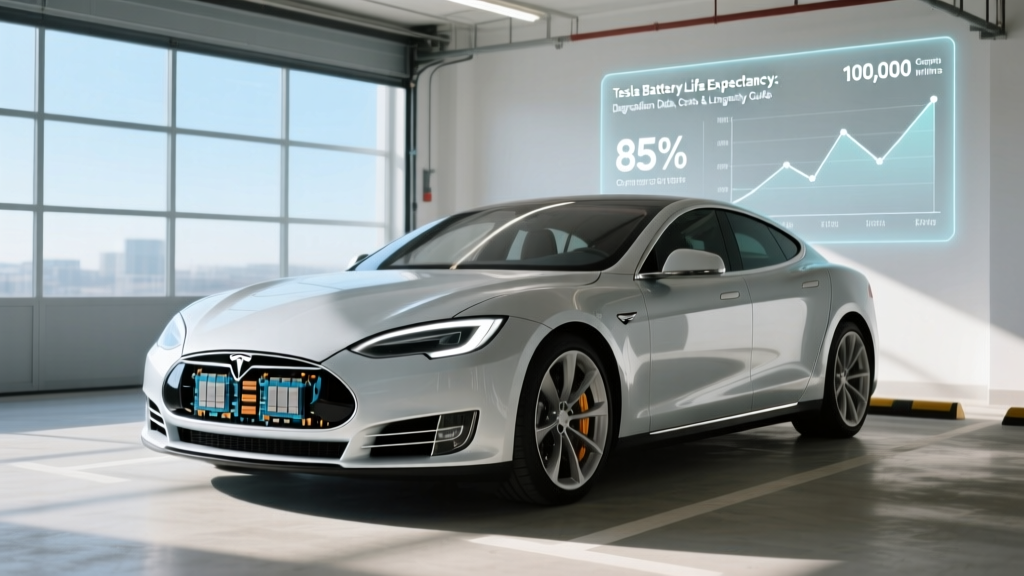
Based on Tesla's own Impact Report and long-term fleet data, the average Tesla battery pack retains approximately 88% of its original capacity after 200,000 miles. That translates to a realistic life expectancy of 300,000 to 500,000 miles before capacity drops to the 70% threshold most owners consider end-of-life — well beyond the point where most vehicles are retired for unrelated mechanical or collision reasons.
But averages mask important nuances. A Model 3 Standard Range with an LFP (lithium iron phosphate) battery degrades differently than a Model S Plaid with an NMC (nickel manganese cobalt) pack. Climate, charging habits, and whether you DC fast-charge daily or trickle-charge at home all shift the curve. Here's what the data actually shows.
Battery Chemistry: LFP vs NMC in Tesla Vehicles
Tesla currently uses two primary battery chemistries across its lineup, and understanding which one your vehicle has is essential for predicting longevity and optimizing care.
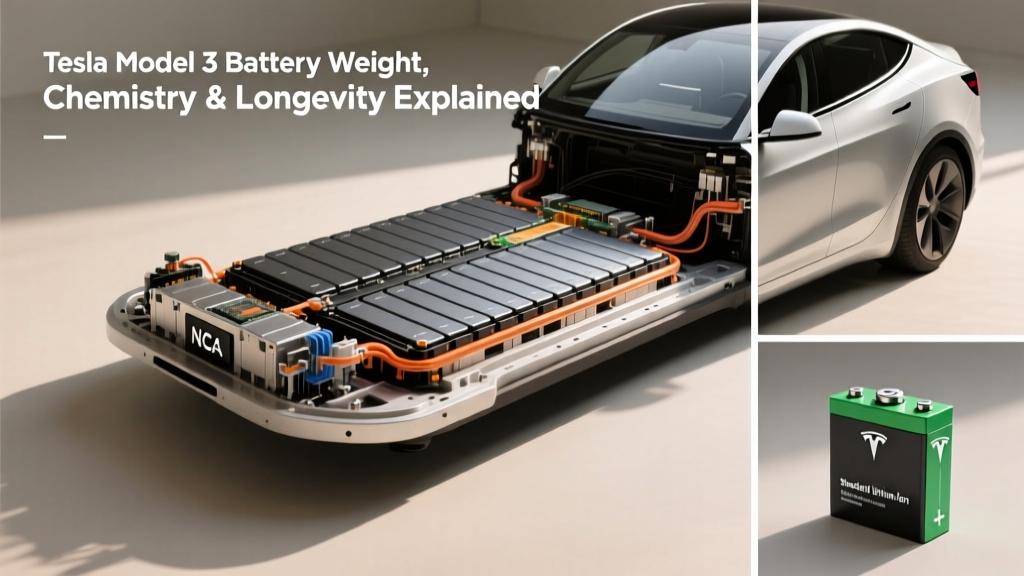
LFP (Lithium Iron Phosphate) cells are used in the Model 3 Rear-Wheel Drive and Model Y Long Range Rear-Wheel Drive. These are sourced primarily from CATL. LFP batteries trade lower energy density for exceptional cycle life — they can handle 3,000+ full charge cycles with minimal degradation. Tesla recommends charging LFP packs to 100% regularly, which is the opposite of NMC guidance.
NMC (Nickel Manganese Cobalt) and NCA (Nickel Cobalt Aluminum) cells power the Model 3/Y Long Range AWD, Performance variants, and all Model S/X trims. These are supplied by Panasonic (primarily at Gigafactory Nevada) and LG Energy Solution. NMC/NCA packs deliver higher energy density (more range per kilogram) but are more sensitive to sustained high states of charge and benefit from an 80% daily charge limit.
| Factor | LFP (CATL) | NMC/NCA (Panasonic/LG) |
|---|---|---|
| Energy Density | ~160 Wh/kg (lower) | ~250–270 Wh/kg (higher) |
| Cycle Life | 3,000–5,000 cycles | 1,000–2,000 cycles |
| Cold-Weather Performance | Moderate — slower charging below 32°F | Better low-temp conductivity |
| Cost per kWh | Lower (~$80–100/kWh at pack level) | Higher (~$120–140/kWh at pack level) |
| Daily Charge Recommendation | Charge to 100% weekly minimum | Set to 80% for daily; 100% for trips |
| Thermal Stability | Excellent — higher runaway threshold | Good — managed via active thermal system |
| Found In | Model 3 RWD, Model Y LR RWD | Model 3/Y LR AWD, Perf, Model S/X |
The practical takeaway: if you plan to keep your Tesla for 10+ years and 200,000+ miles, an LFP-equipped Model 3 RWD may outlast an NMC-equipped Long Range in terms of pure battery cycle endurance — though you'll sacrifice roughly 50–70 miles of EPA range and notice slower DC charging speeds in freezing weather.
Tesla Battery Degradation: What the Data Shows
Battery degradation is not linear. The pattern Tesla owners experience follows a consistent curve across both chemistries:
- 0–30,000 miles: Rapid initial degradation of 3–5%. This is normal SEI (solid electrolyte interphase) layer formation and should not alarm new owners.
- 30,000–100,000 miles: Gradual, nearly linear loss of roughly 1–2% per 20,000 miles.
- 100,000–200,000 miles: Curve flattens further. Many high-mileage Teslas lose only 1–3% total in this bracket.
- 200,000+ miles: Degradation continues slowly. Packs reaching 300,000 miles typically retain 75–82% of original capacity based on fleet telemetry.
At 50,000 mi → ~95% capacity retained
At 100,000 mi → ~92% capacity retained
At 150,000 mi → ~90% capacity retained
At 200,000 mi → ~88% capacity retained
At 250,000 mi → ~85% capacity retained (projected from fleet data)
Sources: Tesla 2024 Impact Report, Teslanomics by Recurrent Auto fleet data.
Real-world variables shift these numbers. Owners in Arizona who Supercharge daily and park in 110°F heat will see faster degradation than a garage-kept, Level-2-charged vehicle in Oregon. But the variance is typically within 3–5 percentage points at 200,000 miles — not the catastrophic failure scenarios some forums describe.
Tesla Battery Warranty Terms Explained
Tesla's battery and drive unit warranty covers defects and excessive capacity loss. Here's what each model's warranty guarantees as of the 2026 model year:
| Model | Warranty Period | Mileage Limit | Minimum Capacity Retention |
|---|---|---|---|
| Model 3 RWD (LFP) | 8 years | 100,000 miles | 70% |
| Model 3 Long Range / Performance | 8 years | 120,000 miles | 70% |
| Model Y (all trims) | 8 years | 120,000 miles | 70% |
| Model S / Model X | 8 years | 150,000 miles | 70% |
The 70% retention threshold means that if your battery drops below 70% of its original usable capacity within the warranty period, Tesla will repair or replace it at no cost. In practice, warranty claims for capacity loss are rare. According to fleet data from Recurrent Auto, fewer than 1.5% of Tesla vehicles have required battery replacement under warranty — and most of those were due to manufacturing defects, not gradual degradation.
Important caveat: the warranty covers the high-voltage traction battery and drive unit only. The 12V auxiliary battery (or lithium-ion 16V low-voltage battery in newer models) is a separate component with its own shorter warranty, typically 4 years/50,000 miles. Confusion between these two systems is common — when people report a "dead Tesla battery" on social media, they're almost always describing the 12V/16V auxiliary system, not the main pack.
Battery Replacement Cost: What to Expect
If your battery fails outside of warranty — or you purchase a used Tesla with a degraded pack — replacement costs vary significantly by model and battery size:
| Model | Battery Size (Usable) | Chemistry | Estimated Replacement Cost |
|---|---|---|---|
| Model 3 RWD | ~57 kWh | LFP | $5,000–$8,000 |
| Model 3 Long Range | ~75 kWh | NMC | $8,000–$12,000 |
| Model Y Long Range | ~75 kWh | NMC | $8,000–$12,000 |
| Model S / X | ~95 kWh | NMC/NCA | $12,000–$16,000 |
These figures include the refurbished or new pack and labor at a Tesla Service Center. Third-party EV repair shops are beginning to offer module-level repairs — replacing individual degraded modules rather than the entire pack — for $3,000–$6,000 depending on the number of modules affected. This option is not available through Tesla directly but is becoming more common through independent EV specialists.
Context that matters: battery pack costs have dropped roughly 90% since 2010, from over $1,100/kWh to approximately $130/kWh at the cell level (per BloombergNEF 2025 data). By the time a 2026 Model 3 actually needs an out-of-warranty replacement in the 2035–2038 timeframe, replacement costs are projected to be substantially lower — potentially 40–60% less than today's pricing.
Factors That Accelerate (or Preserve) Battery Life
Not all miles are created equal when it comes to battery wear. The following factors have the most measurable impact on long-term degradation:
Charging Habits
- NMC/NCA: Keeping daily charge between 20–80% State of Charge (SoC) reduces stress on the cathode. Charging to 100% is fine for road trips — just don't let the car sit at 100% for extended periods.
- LFP: Tesla explicitly recommends charging to 100% at least once per week. LFP chemistry benefits from periodic full charges for cell balancing and accurate SoC calibration.
- DC fast charging: Occasional Supercharging does not meaningfully accelerate degradation thanks to Tesla's active thermal preconditioning. However, exclusive reliance on DC fast charging (zero Level 2 use) has been correlated with 1–3% additional loss at 100,000 miles in fleet studies.
Temperature Management
- Extreme heat: Sustained exposure to ambient temperatures above 95°F, especially combined with high SoC, accelerates electrolyte decomposition. Tesla's liquid cooling system mitigates this significantly, but garage parking in hot climates measurably helps.
- Extreme cold: Cold temperatures reduce available range temporarily (expect 20–30% range loss below 20°F) but do not permanently damage the battery. The bigger cold-weather risk is attempting to DC fast-charge a cold-soaked pack without preconditioning — this can cause lithium plating. Always use the Tesla app to precondition before fast charging in cold weather.
Depth of Discharge
Shallow cycles (e.g., charging from 40% to 70%) cause less wear than deep cycles (10% to 90%). If your daily commute uses only 20% of the battery, you're in an ideal usage pattern for longevity.
- Set charge limit to 80% for daily driving (NMC/NCA) or 100% (LFP)
- Precondition the battery before DC fast charging, especially in cold weather
- Avoid letting the car sit below 10% SoC for more than a few hours
- Use scheduled charging to minimize time spent at maximum SoC
- Park in shade or a garage during extreme heat when possible
- Update firmware regularly — Tesla's BMS (Battery Management System) algorithms improve with OTA updates
How to Check Your Tesla's Battery Health (SoH)
Tesla does not expose a direct State of Health percentage in the vehicle UI the way some competitors do. However, there are several reliable methods to assess your pack's condition:
Method 1: Range Calculation. Charge your Tesla to 100% (or your normal limit) and note the displayed range. Compare this to the EPA-rated range for your specific model and year. If your Model 3 Long Range (EPA 341 miles) shows 306 miles at 100%, your battery has roughly 10% degradation — approximately 90% SoH.
Method 2: Tesla Service Mode. On newer software versions, you can access Service Mode by long-pressing the "Model" text on the About screen. Navigate to High Voltage Battery → Health Test. This runs a diagnostic that estimates capacity retention. Note: results can vary based on recent driving patterns and temperature.
Method 3: Third-Party Telemetry. Apps like Tessie, TeslaFi, and Stats track your battery's estimated capacity over time using OBD-II data or Tesla's API. These tools provide trend lines that are often more informative than a single point-in-time measurement.
Method 4: Tesla Service Diagnostic. If you suspect abnormal degradation, you can request a battery health check through the Tesla app. A technician will run a full diagnostic that includes internal resistance measurements and module balancing data — more thorough than what's available to owners.
Emerging Battery Technology: What's Next
While current Tesla batteries use proven lithium-ion chemistries, several next-generation technologies are in development. It's critical to understand that these are not currently available in any production Tesla vehicle:
4680 Cells with Dry Electrode: Tesla's in-house 4680 cell format, manufactured at Giga Texas, is already in production for some Model Y vehicles. The dry electrode coating process reduces manufacturing cost and energy use. Tesla has stated this process also enables future chemistry flexibility, including silicon-dominant anodes. As of early 2026, 4680 cells use a conventional graphite anode with incremental improvements.
Silicon Anode: Replacing graphite with silicon in the anode can theoretically increase energy density by 20–40%. However, silicon expands significantly during charge cycles, causing mechanical degradation. Companies like Sila Nanotechnologies and Group14 are working on silicon-carbon composites, but mass-production viability for automotive use remains estimated at 2028–2030.
Solid-State Batteries: These replace the liquid electrolyte with a solid material, promising higher energy density, faster charging, and improved safety. Toyota, Samsung SDI, and QuantumScape have announced prototype demonstrations, but no automaker — Tesla included — has confirmed a production timeline. Industry consensus places solid-state EV batteries in limited production no earlier than 2029–2031, with broad availability likely in the mid-2030s. Tesla has not publicly committed to solid-state development and continues to invest heavily in liquid-electrolyte lithium-ion optimization.
The realistic near-term improvement for Tesla owners is incremental: better BMS algorithms, refined thermal management, and gradual cost reductions in existing chemistries — not a technology revolution that makes today's batteries obsolete.
Frequently Asked Questions
How long do Tesla batteries last in years?
In terms of calendar aging, Tesla batteries show minimal time-based degradation when stored properly. A 10-year-old Tesla with low mileage typically retains 85–92% capacity. The primary degradation driver is cycle count (miles driven), not age. Most Tesla battery packs will function well beyond 15–20 years of typical ownership.
Does frequent Supercharging damage the battery?
Tesla's Battery Management System actively manages temperature during DC fast charging, preconditioning the pack to optimal temperature before peak charging begins. Fleet data shows that vehicles that Supercharge frequently have only 1–3% more degradation at 100,000 miles compared to vehicles that exclusively use Level 2 home charging. It's a measurable but small difference — not a reason to avoid road trips.
What happens when a Tesla battery reaches 70% capacity?
Nothing dramatic. A battery at 70% State of Health still functions normally — it simply provides 70% of its original range. A Model 3 Long Range that originally delivered 341 EPA miles would offer approximately 239 miles. For many owners, this remains practical daily transportation. "End of life" for an EV battery is an economic decision, not a functional failure.
Is the Tesla battery warranty transferable to a second owner?
Yes. Tesla's battery and drive unit warranty is tied to the vehicle VIN, not the original purchaser. If you buy a used 2023 Model Y with 45,000 miles, the remaining battery warranty (approximately 5 years and 75,000 miles) transfers automatically. No registration or paperwork is required.
LFP vs NMC — which Tesla battery is better for longevity?
For pure cycle life, LFP wins decisively. CATL's LFP cells are rated for 3,000–5,000 full cycles, compared to 1,000–2,000 for NMC. If you plan to drive 200,000+ miles, an LFP-equipped Model 3 RWD will likely show less degradation. However, NMC offers roughly 50–70 more miles of EPA range and better cold-weather DC charging performance — trade-offs that matter for road-trip-heavy drivers.
Can I replace individual battery modules instead of the whole pack?
Tesla Service Centers replace complete packs, not individual modules. However, independent EV repair shops increasingly offer module-level replacement for $1,500–$3,000 per module. A Tesla battery pack contains 4–5 modules (structural pack) or up to 16 modules (older Model S/X). Module-level repair is viable when degradation is uneven across modules, but it requires specialized diagnostic equipment and is not endorsed by Tesla.
How much does it cost to charge a Tesla vs. gas?
At the US average electricity rate of $0.17/kWh, fully charging a Model 3 Long Range (~75 kWh) costs approximately $12.75 for 341 miles of range — roughly $0.037 per mile. A comparable gas vehicle at 30 MPG and $3.40/gallon costs $0.113 per mile. Over 100,000 miles, that's approximately $3,700 in electricity vs. $11,300 in fuel — a savings of $7,600 that substantially offsets any future battery replacement concern.