The Real Question Behind Tesla Battery Extended Warranty Searches
Search interest in a Tesla battery extended warranty usually spikes around two moments: when a Model 3 or Model Y crosses the 60,000-mile mark, and when owners start reading Reddit threads about $15,000+ out-of-warranty battery replacements. The anxiety is understandable — the high-voltage traction battery is the single most expensive component in any EV. But before you commit to an extended service agreement, you need hard data on how Tesla batteries actually age, what the factory warranty already covers, and whether your specific chemistry (LFP or NMC/NCA) changes the calculus entirely.
This guide breaks down Tesla battery longevity with real degradation figures, replacement cost ranges by model, the chemistry trade-offs that affect your warranty decision, and practical steps to maximize your pack's State of Health (SoH) whether you buy extra coverage or not.
Tesla's Factory Battery Warranty: What You Already Get
Before evaluating any extended warranty, understand the baseline protection Tesla provides. As of the 2025–2026 model years, Tesla's New Vehicle Limited Warranty covers the battery pack and drive unit under the following terms:
| Model | Warranty Period | Mileage Limit | Minimum Capacity Retention |
|---|---|---|---|
| Model 3 RWD (LFP) | 8 years | 100,000 miles | 70% |
| Model 3 Long Range / Performance (NCA) | 8 years | 120,000 miles | 70% |
| Model Y Long Range / Performance (NCA) | 8 years | 120,000 miles | 70% |
| Model S / Model X | 8 years | 150,000 miles | 70% |
The 70% retention threshold means Tesla will replace or repair the battery if its usable capacity drops below 70% of the original kWh within the warranty window. This is a capacity-based warranty — it covers degradation that falls outside the expected curve, not just catastrophic failure. It does not cover cosmetic issues, 12V auxiliary battery failure, or damage from accidents, flooding, or unauthorized modifications.
Critical context: Tesla does not currently sell a manufacturer-backed extended battery warranty beyond these terms. Third-party providers like XCare, Extend, and others offer vehicle service contracts that may include battery coverage, but terms, exclusions, and claim processes vary significantly. Always read the sample contract before purchasing.
Tesla Battery Degradation: What the Data Actually Shows
Tesla's 2023 Impact Report (the most recent with published fleet data) showed that Model 3 and Model Y battery packs retain approximately 88% of original capacity at 200,000 miles. This aligns with independent analyses from Recurrent Auto and Tesloop fleet data. Let's put that in perspective:
Typical Tesla Battery Degradation Curve (NMC/NCA packs, fleet averages):
- Year 1 / 15,000 mi: ~95–97% capacity retained (initial drop as SEI layer forms)
- Year 3 / 45,000 mi: ~92–94% retained
- Year 5 / 75,000 mi: ~90–92% retained
- Year 8 / 120,000 mi: ~87–90% retained
- Year 10 / 150,000 mi: ~85–88% retained
Sources: Tesla Impact Report 2023, Recurrent Auto battery research, fleet operator data. Individual results vary based on charging habits, climate, and chemistry.
The key insight: degradation is non-linear. Most capacity loss occurs in the first 10,000–20,000 miles as the solid-electrolyte interphase (SEI) layer stabilizes on the anode. After that, the curve flattens considerably. A pack that shows 95% health at 30,000 miles is statistically likely to remain above 85% at 150,000 miles.
For LFP (lithium iron phosphate) packs in the Model 3 RWD, the degradation profile differs. LFP cells degrade more slowly overall — Recurrent's data shows LFP packs averaging 92–95% retention at 60,000 miles — but they also have a flatter voltage curve, which makes state-of-charge estimation less precise. Tesla recommends charging LFP packs to 100% regularly (unlike NMC/NCA), which simplifies daily use.
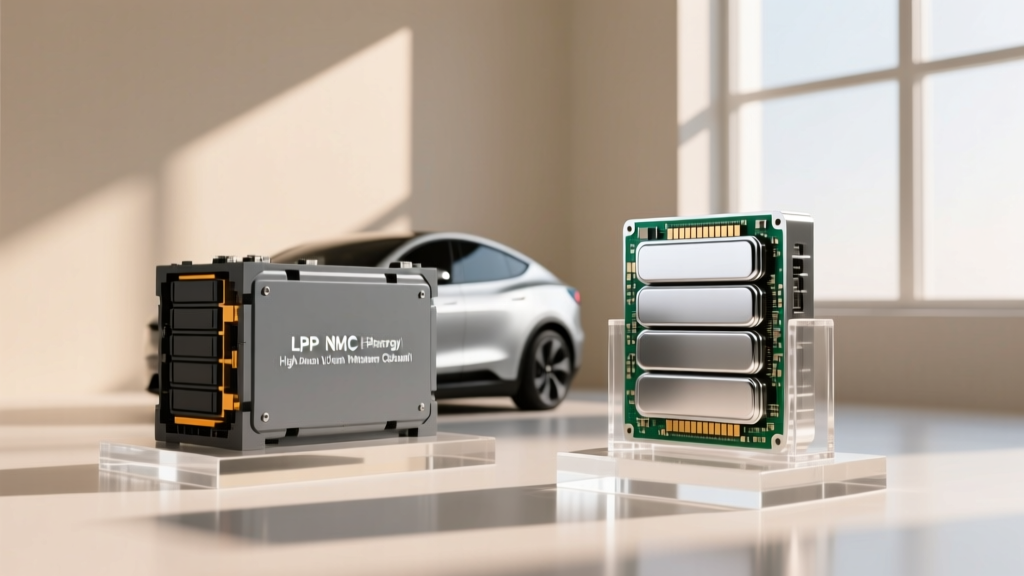
LFP vs NMC/NCA: Which Chemistry Is in Your Tesla?
Your battery chemistry directly affects longevity, range, cold-weather performance, and whether an extended warranty is a rational purchase. Here's the breakdown:
| Attribute | LFP (Lithium Iron Phosphate) | NMC/NCA (Nickel-based) |
|---|---|---|
| Found in | Model 3 RWD (Standard Range) | Model 3 LR/Perf, Model Y LR/Perf, Model S/X |
| Energy density | Lower (~160 Wh/kg cell-level) | Higher (~250–270 Wh/kg cell-level) |
| Cycle life | 3,000–5,000+ cycles to 80% | 1,000–2,000 cycles to 80% |
| Degradation rate | Slower overall | Moderate; more sensitive to high SoC + heat |
| Cold performance | Weaker below 32°F (reduced range, slower charge) | Better low-temp performance |
| Daily charge recommendation | 100% (Tesla recommends weekly 100%) | 80–90% daily; 100% for trips only |
| Cost per kWh | Lower (~$80–100/kWh cell-level) | Higher (~$110–140/kWh cell-level) |
| Typical usable pack size | ~57–60 kWh (Model 3 RWD) | ~75–82 kWh (LR), ~100 kWh (Model S/X) |
Bottom line: If you own a Model 3 RWD with an LFP pack, your battery is statistically likely to outlast the car itself under normal use. The extended-warranty value proposition is weaker here. If you own a Long Range or Performance model with an NMC/NCA pack — especially in a hot climate or with frequent DC fast-charging — the risk calculus shifts slightly, though the factory 8-year/120,000-mile coverage is already robust.
Tesla Battery Replacement Cost: When and How Much
Out-of-warranty battery replacement is the scenario that drives extended-warranty purchases. Here's what it actually costs in 2025–2026, based on service invoices shared by owners and independent repair shops:
| Model | Battery Size (Usable) | Chemistry | Replacement Cost Range | Typical Replacement Trigger |
|---|---|---|---|---|
| Model 3 RWD | ~57–60 kWh | LFP | $12,000–$15,000 | Cell imbalance, BMS fault, physical damage |
| Model 3 Long Range | ~75–82 kWh | NCA | $14,000–$18,000 | Capacity below 70%, module failure |
| Model Y Long Range | ~75–82 kWh | NCA | $14,000–$18,000 | Capacity below 70%, coolant intrusion |
| Model S (2020+) | ~100 kWh | NCA | $18,000–$25,000 | Age-related degradation, module failure |
| Model X (2020+) | ~100 kWh | NCA | $18,000–$25,000 | Same as Model S |
Important context on replacement frequency: Catastrophic battery failure requiring full-pack replacement is rare in modern Teslas. According to data aggregated by fueleconomy.gov and owner surveys, fewer than 2–3% of Tesla battery packs require replacement within the first 150,000 miles. When replacements do occur, they're more often due to manufacturing defects (covered under warranty), coolant leaks, or physical damage than to gradual degradation reaching unusable levels.
Tesla also increasingly performs module-level repairs rather than full-pack replacements, particularly on 4680-cell structural packs. A single module replacement can cost $3,000–$5,000 rather than the full-pack price. Third-party EV repair shops (like Electrified Garage and others) are also emerging as lower-cost alternatives for out-of-warranty service.
Factors That Accelerate (or Preserve) Tesla Battery Life
Whether your battery reaches 200,000 miles at 88% health or drops to 75% depends heavily on how you use it. Here's the hierarchy of impact:
Highest-impact factors:
- State of charge habits: For NMC/NCA packs, consistently storing at 100% SoC accelerates calendar degradation. Tesla's default 80% daily limit exists for a reason. LFP packs tolerate 100% storage far better.
- Heat exposure: Sustained ambient temperatures above 95°F (35°C) — especially combined with high SoC — are the single biggest enemy of lithium-ion longevity. Garage parking in hot climates measurably extends pack life.
- DC fast-charging frequency: Occasional Supercharging (1–2x/week) has minimal impact. Daily Supercharging at 250 kW, especially without preconditioning, increases degradation rate by an estimated 1–3% over 100,000 miles compared to Level 2 home charging.
Moderate-impact factors:
- Preconditioning: Always precondition before DC fast charging (navigate to a Supercharger in the Tesla app or nav, and the car warms the battery). Cold batteries charged at high power suffer lithium plating, which permanently reduces capacity.
- Depth of discharge: Running the battery to very low SoC (below 10%) regularly stresses cells. Aim to stay between 20–80% for NMC/NCA daily driving.
- Regen braking settings: Standard regen is fine. There's no meaningful evidence that regen intensity affects long-term battery health.
Lower-impact factors:
- Mileage alone: Cycle count matters less than calendar age + SoC + temperature. A 5-year-old Tesla with 30,000 miles stored at 100% in Phoenix may have worse health than one with 80,000 miles stored at 70% in Portland.
- Aftermarket accessories: Third-party battery heaters or cooling mods can void warranty coverage. Avoid.
How to Check Your Tesla's Battery Health (State of Health)
Tesla does not display a native "battery health percentage" in the vehicle UI the way some competitors (like Hyundai's Bluelink or BMW's iDrive) do. Here's how to assess your SoH:
Method 1: Range Comparison
Charge your Tesla to 100% (for LFP) or to your typical daily limit and extrapolate. Compare the displayed range at full charge to the original EPA-rated range. A Model 3 Long Range that originally showed 350 miles at 100% but now shows 315 miles has approximately 90% SoH. Account for temperature — cold weather temporarily reduces displayed range by 10–20%.
Method 2: Tesla Service Mode (2024+ Software)
Some 2024+ software versions expose a "Battery Health" test in Service Mode (accessed via the Software screen by holding your model name for 3 seconds, then entering "service" as the access code). This runs a static capacity estimate. Availability varies by firmware version and model.
Method 3: Third-Party Apps
Apps like Tessie, Stats for Tesla, and Scan My Tesla (with an OBD-II adapter) can read the BMS-reported capacity estimate, which is more accurate than the range display. These tools log degradation trends over time, giving you a clearer picture of your pack's trajectory.
Method 4: Tesla Service Center Diagnostic
Request a battery health check at a Tesla Service Center. They can pull a detailed log showing measured vs. nominal capacity, cell balancing data, and any flagged modules. This is the most authoritative method, particularly if you're approaching a warranty claim.
Third-Party Extended Warranties for Tesla: What's Available
Since Tesla does not offer its own extended battery warranty, the market is served by third-party vehicle service contract providers. Here's what to evaluate:
- XCare (by XCover): Offers Tesla-specific plans covering battery and drive unit beyond the factory warranty. Plans typically extend coverage by 2–4 years or 25,000–50,000 additional miles. Pricing ranges from roughly $2,500–$4,500 depending on model and coverage tier. Exclusions often include pre-existing degradation, cosmetic issues, and 12V battery.
- Extend: Provides EV coverage plans through dealer partnerships. Battery inclusion varies by plan level. Read the sample contract — some plans cap battery payouts at a percentage of replacement cost.
- Endurance / CARCHEX: General-purpose extended warranty providers that have added EV coverage. Battery-specific terms are often less favorable than Tesla-specialist providers. Confirm in writing that the high-voltage traction battery is included and what the capacity-retention trigger is.
Key questions to ask any provider:
- Does the contract cover gradual degradation below 70%, or only sudden failure?
- Is the payout based on a Tesla OEM replacement pack, or can they use refurbished/third-party packs?
- What is the claims process — do you pay upfront and get reimbursed, or does the provider pay Tesla directly?
- Are there mileage or condition exclusions (e.g., salvage title, modified firmware, accident history)?
- Is the contract backed by an insured entity (check the underwriter)?
Do You Actually Need a Tesla Battery Extended Warranty?
Here's a decision framework based on your situation:
Consider an extended warranty if:
- You own a Model S or Model X with a 100 kWh NCA pack approaching 80,000+ miles (higher replacement cost, older pack designs).
- You live in a hot climate (Arizona, Texas, Florida) and regularly charge to high SoC.
- You rely on your Tesla for commercial use (rideshare, delivery) and are accumulating 30,000+ miles/year.
- You plan to keep the vehicle well past the 8-year / 120,000-mile factory warranty and want predictable cost protection.
Skip the extended warranty if:
- You own a Model 3 RWD with an LFP pack — the degradation data strongly favors these packs lasting 200,000+ miles with minimal loss.
- You're within the factory warranty period and your SoH is tracking above 90% at your current mileage.
- You plan to sell or trade the vehicle before the factory warranty expires.
- The extended warranty cost exceeds $4,000 and you could reasonably self-insure by setting aside that amount for potential module-level repair.
Looking Ahead: Solid-State and Next-Gen Battery Tech
The battery landscape is evolving, but it's critical to separate announced research from production reality:
- Solid-state batteries: Companies like QuantumScape, Toyota, and Samsung SDI have demonstrated solid-state cells with higher energy density and improved cycle life in lab settings. However, no solid-state pack is in mass production for consumer EVs as of early 2026. Realistic timeline for commercial availability in a Tesla or comparable vehicle: 2028–2032 at earliest, likely starting in premium/limited models.
- Silicon-dominant anodes: Startups like Sila Nanotechnologies and Group14 are shipping silicon-carbon anode materials that increase energy density by 15–25%. These are beginning to appear in select consumer electronics and are expected in EV cells by 2027–2029. They improve range per kWh but don't fundamentally change the degradation conversation.
- Tesla 4680 cells: Tesla's in-house 4680 cell production (Austin, TX) continues to scale. These cells use a tabless design for better thermal management and a dry-electrode manufacturing process. Early 4680 packs in Model Y show comparable or slightly better degradation than 2170-based packs, but long-term fleet data is still maturing.
Practical takeaway: Don't delay an EV purchase waiting for solid-state. Current-generation Tesla batteries are demonstrably lasting 200,000+ miles with manageable degradation, and the technology you buy today will serve well for a decade or more.
Frequently Asked Questions
How long do Tesla batteries last in years and miles?
Based on fleet data from Tesla's Impact Report and independent analyses by Recurrent Auto, the average Tesla battery pack retains approximately 88% of its original capacity at 200,000 miles. In terms of years, most packs are designed to last 15–20 years under typical use (12,000–15,000 miles/year) before degradation would make the vehicle impractical for daily driving. LFP packs in the Model 3 RWD show even slower degradation, with many projected to exceed 300,000 miles before reaching 70% capacity.
How much does it cost to replace a Tesla battery?
Out-of-warranty Tesla battery replacement costs range from approximately $12,000 (Model 3 RWD LFP) to $25,000 (Model S/X 100 kWh pack), including parts and labor at a Tesla Service Center. However, full-pack replacement is rare — most out-of-warranty service involves module-level repairs at $3,000–$5,000. Fewer than 2–3% of Tesla packs require replacement within 150,000 miles.
What does the Tesla battery warranty actually cover?
Tesla's factory battery warranty covers the high-voltage traction battery pack and drive unit for 8 years and 100,000–150,000 miles (depending on model), guaranteeing a minimum of 70% capacity retention. If your battery degrades below 70% within that window, Tesla will repair or replace it at no cost. The warranty covers manufacturing defects, premature degradation, and drive unit failure. It does not cover the 12V auxiliary battery, cosmetic damage, accident damage, or modifications.
How do I check my Tesla battery's State of Health?
The most accessible method is charging to 100% and comparing displayed range to the original EPA rating. For more precision, third-party apps like Tessie or Stats for Tesla can read BMS-reported capacity via the vehicle's API. Tesla Service Centers can run a full diagnostic showing measured capacity, cell balance data, and module health. Some 2024+ firmware versions include a Battery Health test accessible through Service Mode.
Is LFP or NMC/NCA better for battery longevity?
LFP (lithium iron phosphate) chemistry has a clear longevity advantage: 3,000–5,000+ charge cycles to 80% capacity vs. 1,000–2,000 cycles for NMC/NCA. LFP packs also tolerate daily 100% charging without accelerated degradation. The trade-off is lower energy density (less range per pound), weaker cold-weather performance, and a less precise state-of-charge display. For pure longevity and lower cost of ownership, LFP wins. For maximum range and cold-climate performance, NMC/NCA remains preferable.
Does frequent Supercharging damage my Tesla battery?
Occasional Supercharging (1–3 sessions per week) has a minimal measurable impact on battery health — estimated at 1–3% additional degradation over 100,000 miles compared to exclusive Level 2 home charging. The bigger risks are daily high-power DC charging combined with high ambient temperatures and consistently charging to 100% on NMC/NCA packs. Always precondition the battery before Supercharging (the car does this automatically when you navigate to a Supercharger) to avoid lithium plating on cold cells.
Can I buy a Tesla extended warranty directly from Tesla?
No. As of 2026, Tesla does not sell a manufacturer-backed extended battery warranty beyond the standard 8-year / 100,000–150,000-mile coverage. Extended coverage is available only through third-party vehicle service contract providers like XCare, Extend, and others. Terms, pricing, and exclusions vary — always request and read the full sample contract before purchasing.