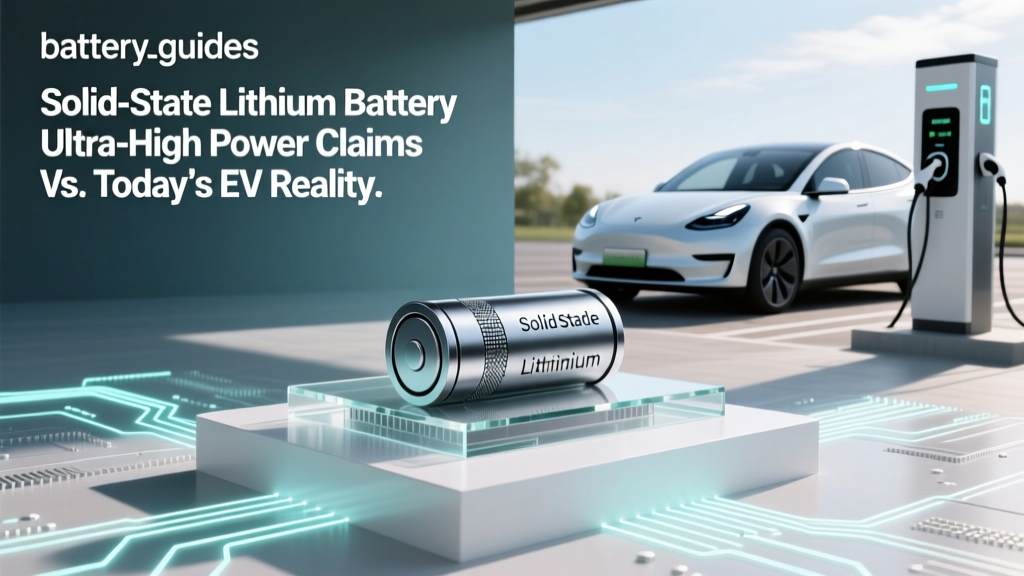
Every few months a headline declares that a solid-state lithium battery with ultra-high power density will "revolutionize" electric vehicles. Toyota, Samsung SDI, QuantumScape, and Solid Power have all demonstrated promising prototype cells. But as of 2026, no mass-production vehicle on U.S. roads uses a solid-state traction battery. The lithium-ion cells powering today's EVs — whether NMC, NCA, or LFP — remain the standard, and they are far more durable and capable than early skeptics predicted.
This guide cuts through the hype. We break down exactly how today's EV battery chemistries perform, what degradation data actually shows, how warranties protect you, what a replacement costs if you ever need one, and where solid-state and silicon-anode technologies realistically stand on the timeline.
Today's EV Battery Chemistries: LFP vs. NMC vs. NCA
Every battery-electric and plug-in hybrid vehicle sold in the U.S. in 2026 uses a lithium-ion variant. The two dominant cathode chemistries are NMC (nickel manganese cobalt) / NCA (nickel cobalt aluminum) and LFP (lithium iron phosphate). The choice between them involves real engineering trade-offs — not just marketing.
NMC/NCA cells offer higher energy density (more kWh packed into a lighter, smaller pack), which translates to longer range in a given vehicle platform. They perform better in extreme cold and accept faster DC charge rates at low states of charge. The trade-off: they degrade slightly faster over time, are more expensive per kWh to manufacture, and rely on cobalt and nickel supply chains with ethical and cost-volatility concerns.
LFP cells sacrifice roughly 15–25% in energy density but gain substantially in cycle life (often 3,000+ full cycles vs. 1,000–1,500 for NMC), thermal stability, and lower cost. Tesla's standard-range Model 3 and Model Y, the base Ford Mustang Mach-E Select, and several BYD models now use LFP. The trade-off: LFP cells lose more range in sub-freezing temperatures and typically accept slower peak DC charge rates.
| Attribute | LFP (Lithium Iron Phosphate) | NMC / NCA |
|---|---|---|
| Energy Density | ~160–180 Wh/kg (cell level) | ~220–270 Wh/kg (cell level) |
| Typical Cycle Life | 3,000–5,000 full cycles | 1,000–2,000 full cycles |
| Cold-Weather Range Loss | ~30–40% at 20°F | ~20–30% at 20°F |
| Peak DC Charge Rate | ~150–170 kW typical | ~200–350 kW typical |
| Thermal Stability | Excellent (less prone to thermal runaway) | Good (requires more active cooling) |
| Cost per kWh (pack level) | ~$90–$110 | ~$120–$145 |
| SoC Recommendation | Can charge to 100% daily | Best kept 20–80% for daily use |
Which is better? There is no universal winner. If you need maximum range in a single charge, live in a cold climate, or want the fastest road-trip charging, NMC/NCA is the better fit. If you plan to own the vehicle for 10+ years, charge primarily at home, and want to minimize degradation worry, LFP's longer cycle life and 100% daily charging tolerance make it compelling — especially as automakers offset the density penalty with larger packs.
How Long Do EV Batteries Actually Last?
The most persistent myth in EV ownership is that batteries need replacing every few years like a smartphone. Real-world data tells a different story.
According to aggregated fleet data from sources including Recurrent Auto and manufacturer warranty claims, the average EV battery in 2026 loses approximately 5–8% of its original capacity after 5 years / 75,000 miles and roughly 10–15% after 10 years / 150,000 miles. Some packs — particularly LFP-equipped vehicles driven in moderate climates — show less than 5% loss at the 100,000-mile mark.
Here is what the degradation curve typically looks like:
Year 0: 100% State of Health (SoH)
Year 1 / 15,000 mi: ~96–97% SoH (initial drop is normal)
Year 3 / 45,000 mi: ~93–95% SoH
Year 5 / 75,000 mi: ~91–93% SoH
Year 8 / 120,000 mi: ~87–90% SoH
Year 10 / 150,000 mi: ~85–88% SoH
Sources: Recurrent Auto fleet data, Geotab battery health studies. LFP packs typically show 2–4% less loss at equivalent intervals.
The initial 2–4% drop in the first year is a known electrochemical settling effect and is not cause for alarm. After that, degradation slows considerably. A battery reaching 70–80% SoH is still functional — it simply offers reduced range. Most EV batteries will outlast the vehicle's body, suspension, and interior before reaching a point where replacement is economically justified.
What Does the Battery Warranty Cover?
Federal law mandates that EV battery warranties cover a minimum of 8 years / 100,000 miles (10 years / 150,000 miles in California Air Resources Board states). Most automakers exceed this floor. The warranty guarantees that the battery will retain a specified percentage of its original capacity — typically 70% — over the warranty period.
| Manufacturer | Warranty Term | Capacity Retention Threshold | Notes |
|---|---|---|---|
| Tesla (Model 3/Y NMC) | 8 yr / 120,000 mi | 70% | Long-range and Performance trims |
| Tesla (Model 3/Y LFP) | 8 yr / 100,000 mi | 70% | Rear-wheel-drive base trims |
| Hyundai / Kia | 10 yr / 100,000 mi | 70% | Among the longest terms in the industry |
| Ford (Mach-E, F-150 Lightning) | 8 yr / 100,000 mi | 70% | Covers battery and electric powertrain components |
| GM (Ultium-platform vehicles) | 8 yr / 100,000 mi | 70% | Includes module-level replacement capability |
| Rivian | 8 yr / 120,000 mi | 70% | R1T and R1S |
| BMW (i4, iX, i7) | 8 yr / 100,000 mi | 70% | Modular pack allows individual module replacement |
Key detail: The warranty covers defects and abnormal degradation — not damage from accidents, flooding, or unauthorized modifications. If your battery drops below the threshold within the warranty period, the manufacturer will repair or replace it at no cost. In practice, very few owners ever file a battery warranty claim; degradation simply does not reach 30% loss within 8 years under normal use.
EV Battery Replacement Cost: What to Expect
If a battery does need replacing outside of warranty — typically due to physical damage or extremely high mileage well beyond 150,000 miles — the cost is significant but declining. Prices vary dramatically by pack size, chemistry, and whether the manufacturer supports module-level repair.
| Vehicle / Pack Size | Chemistry | Full Pack Replacement | Module Repair (if supported) |
|---|---|---|---|
| Tesla Model 3 RWD (~60 kWh) | LFP | $8,000–$12,000 | N/A (structural pack) |
| Tesla Model Y LR (~82 kWh) | NMC | $12,000–$16,000 | N/A (structural pack) |
| Hyundai Ioniq 5 (~77 kWh) | NMC | $11,000–$15,000 | ~$2,500–$4,000 per module |
| Ford F-150 Lightning Ext. (~131 kWh) | NMC | $18,000–$28,000 | Available (modular design) |
| Chevrolet Equinox EV (~85 kWh) | NMC (Ultium) | $12,000–$16,000 | Available (modular design) |
| Rivian R1T Max Pack (~149 kWh) | NMC | $22,000–$30,000 | Limited module access |
When is replacement typically needed? In the vast majority of cases, it isn't. Data from Geotab's fleet study of over 10,000 EVs shows that fewer than 2% of EV batteries have been replaced due to degradation alone. Most replacements result from collision damage. The pack cost per kWh has fallen from over $1,000 in 2010 to approximately $110–$135 at the pack level in 2026, and the trend continues downward.
Factors That Accelerate (or Preserve) Battery Life
Not all miles are equal when it comes to battery wear. Six factors dominate the degradation equation:
- Limit DC fast charging frequency. Occasional road-trip fast charging is fine. Daily reliance on 150+ kW DC charging accelerates degradation by an estimated 1–3% per year versus exclusive Level 2 home charging.
- Avoid extreme State of Charge. For NMC/NCA: keep daily SoC between 20–80%. For LFP: charging to 100% regularly is recommended for cell balancing. Never store any EV at 100% or below 10% for extended periods.
- Manage temperature exposure. Park in shade or a garage when possible. Battery thermal management systems work harder (and draw energy) in extreme heat. Preconditioning before DC fast charging in cold weather protects the cells and improves charge speed.
- Use Level 2 home charging as your primary method. A 7–11 kW Level 2 charger adds 25–44 miles of range per hour and is the gentlest charging method on cell chemistry.
- Keep software updated. OTA updates frequently refine thermal management and charging algorithms. Tesla, Ford, GM, and Hyundai regularly ship battery-management improvements.
- Don't obsess over the buffer. Automakers build in a top and bottom buffer (typically 3–8% of total capacity) that you cannot access. Your displayed "0%" and "100%" are already within safe operating limits.
How to Monitor Your Battery's State of Health
State of Health (SoH) is the percentage of your battery's original usable capacity that remains. A new battery is 100% SoH; a battery that held 75 kWh usable when new and now holds 67.5 kWh is at 90% SoH.
How to check SoH in 2026:
- In-vehicle displays: Tesla shows battery health in the Service menu (Software 2025.32+). Hyundai/Kia's infotainment includes a battery health diagnostic screen. Ford's SYNC 4 displays estimated SoH under EV settings.
- OBD-II apps: Tools like OBDeleven, Leaf Spy (for Nissan), and Scan My Tesla read the BMS (Battery Management System) directly for a precise SoH figure.
- Third-party services: Recurrent offers free battery health reports by connecting to your vehicle's telematics. Several pre-purchase inspection services now include SoH readouts.
- Manual calculation: Charge to 100% (or your known max), note the displayed range, and compare it to the EPA-rated range when new. A 310-mile EPA vehicle showing 280 miles at full charge is at roughly 90% SoH — accounting for the fact that EPA range is itself an estimate.
Checking SoH quarterly is sufficient. Weekly monitoring creates unnecessary anxiety; degradation is measured in months and years, not days.
Solid-State Batteries and Ultra-High Power: Where the Technology Actually Stands
This is where the target of this article — solid-state lithium battery ultra-high power claims — deserves a grounded assessment.
What solid-state batteries promise: By replacing the liquid electrolyte in conventional lithium-ion cells with a solid material (ceramic, sulfide, or polymer), solid-state cells can theoretically use a lithium-metal anode instead of graphite. This could yield energy densities of 400–500 Wh/kg (roughly double today's NMC), faster charging (potentially 10–80% in under 10 minutes), and improved safety (no flammable liquid electrolyte).
Where the technology stands in 2026:
- Toyota has announced a solid-state battery pilot production line targeting 2027–2028 for limited deployment in a next-generation EV. Prototypes have demonstrated 750+ km (~465 miles) of range in testing, but manufacturing yield, cost, and cycle-life durability at scale remain unproven.
- Samsung SDI has shown prototype sulfide-based solid-state cells with 900 Wh/L volumetric density. Mass production is targeted for 2027, initially for premium applications.
- QuantumScape (backed by Volkswagen) has delivered prototype cells to automotive partners for validation. The company's anode-less lithium-metal design shows promise in single-cell testing, but multi-cell pack integration and long-term cycling data are still in progress.
- Solid Power (partnered with BMW and Ford) is producing pilot-line cells but has acknowledged that automotive-grade qualification will extend into 2028–2029.
Solid-state, silicon-anode, and lithium-sulfur batteries discussed in this section are not currently available in any production vehicle sold in the United States. Timelines cited are manufacturer estimates and are subject to delay. This guide will be updated as production vehicles become available.
Silicon-anode batteries are closer to market. Companies like Sila Nanotechnologies and Group14 Technologies are supplying silicon-dominant anode materials to cell manufacturers. The Mercedes-AMG G-Class 580e (announced) uses a silicon-anode cell from Factorial Energy with a claimed 25% energy density improvement over conventional graphite anodes. Expect silicon-anode cells to appear in premium EVs starting 2026–2027, with broader adoption by 2029.
Ultra-high power charging is advancing alongside cell chemistry. Today's best EVs charge at 250–350 kW peak (the Hyundai Ioniq 5 and Kia EV6 at 800V architecture, the Porsche Taycan at up to 320 kW). Porsche and Hyundai have demonstrated sustained charging above 300 kW on 800V platforms, adding 200+ miles in roughly 15 minutes. The limiting factor is no longer just the cell — it is the charging infrastructure (most U.S. public stations max out at 150–350 kW) and the thermal management required to sustain those rates without degrading the pack.
Frequently Asked Questions
How long do EV batteries last in years and miles?
Most EV batteries retain 85–90% of their original capacity after 10 years and 150,000 miles. Based on current data, a well-maintained pack will remain functional for 15–20 years or 200,000+ miles before degradation makes the vehicle impractical for daily use. Very few batteries are replaced solely due to age-related degradation.
How much does it cost to replace an EV battery?
Full pack replacement costs range from approximately $8,000 for a smaller LFP pack (Tesla Model 3 RWD) to $28,000–$30,000 for a large NMC pack (Ford F-150 Lightning Extended Range, Rivian Max Pack). Vehicles with modular battery architectures (Hyundai, GM Ultium, BMW) can replace individual modules for $2,500–$4,000 each. Costs continue to decline as pack-level prices per kWh fall.
What does the EV battery warranty actually cover?
Federal law requires a minimum 8-year/100,000-mile warranty (10 years/150,000 miles in CARB states) guaranteeing the battery retains at least 70% of its original capacity. The warranty covers defects and abnormal degradation. It does not cover collision damage, flood damage, or modifications. Most automakers honor the warranty with a repair, module replacement, or full pack replacement at their discretion.
How do I check and maximize my EV battery's health?
Check SoH through your vehicle's built-in diagnostics, an OBD-II app like Scan My Tesla or OBDeleven, or a service like Recurrent. To maximize life: rely primarily on Level 2 home charging, keep NMC packs between 20–80% SoC for daily use (LFP can go to 100%), avoid prolonged exposure to extreme heat, precondition before DC fast charging in cold weather, and keep your vehicle's software updated.
LFP vs. NMC — which battery chemistry is better for me?
Choose NMC/NCA if you need maximum range, live in a cold climate, frequently take road trips requiring fast DC charging, or want the lightest possible pack. Choose LFP if you plan to keep the vehicle 8+ years, charge mostly at home, want to charge to 100% daily without degradation worry, and can accept slightly lower range or slightly slower DC charging speeds. For most daily commuters and home-charging owners, LFP's longevity advantage outweighs its density trade-off.
Will solid-state batteries make today's EVs obsolete?
Not for many years. Solid-state batteries remain in prototype and pilot production as of 2026, with the earliest limited-production vehicles expected in 2027–2028 at premium price points. Even after solid-state cells reach mass production, today's NMC and LFP batteries will remain cost-competitive for mainstream vehicles — just as nickel-metal-hydride batteries continued in hybrids long after lithium-ion arrived. Your current or near-term EV purchase will not be rendered obsolete by solid-state technology in any practical timeframe.