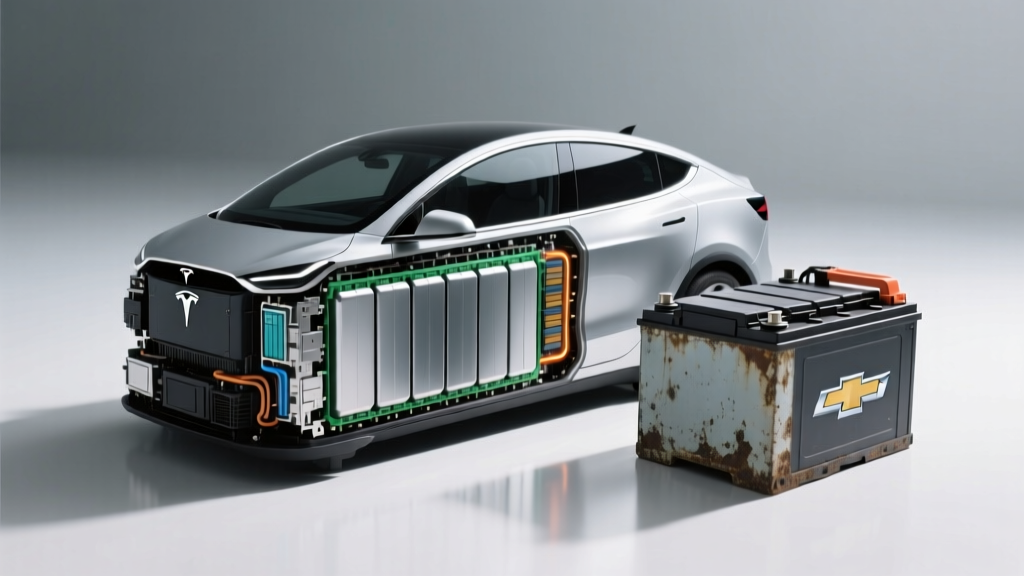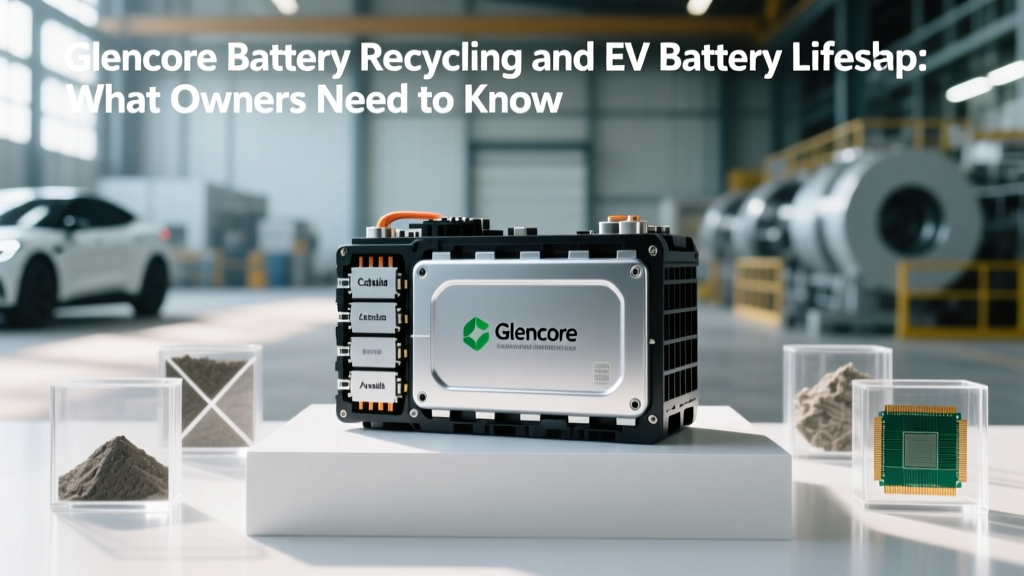
Most EV batteries will outlast the cars they power. That's the central finding from millions of miles of fleet data, manufacturer warranty claims, and independent teardowns. Yet the question of what happens when a traction battery finally reaches end-of-life — and how companies like Glencore are building the recycling infrastructure to handle it — is becoming one of the most important topics in electric mobility.
This guide covers the full battery lifecycle: chemistry choices that affect longevity, real-world degradation data, warranty protections, replacement economics, and how Glencore's battery recycling operations fit into a circular supply chain that may ultimately lower the cost of your next EV.
How Long Do EV Batteries Actually Last?
The short answer: longer than most buyers expect. Data from fleet operators, telematics providers like Geotab, and manufacturer reports consistently show that modern lithium-ion traction batteries lose roughly 1.5% to 2.5% of total capacity per year under normal use. That translates to retaining approximately 85–90% of original capacity after eight years and 100,000 miles.
Tesla's 2024 Impact Report noted that Model 3 and Model Y batteries retained roughly 85% of original range at 150,000 miles. Hyundai and Kia back their EV batteries with 10-year/100,000-mile warranties at 70% capacity retention — a conservative threshold that very few packs actually breach in practice.
Typical Degradation Curve (NMC 811 Chemistry, Liquid-Cooled Pack):
- Year 1 / 15,000 mi: ~2–3% loss (initial formation drop)
- Year 3 / 45,000 mi: ~5–7% cumulative loss
- Year 5 / 75,000 mi: ~8–10% cumulative loss
- Year 8 / 120,000 mi: ~12–15% cumulative loss
- Year 10 / 150,000 mi: ~15–18% cumulative loss
Sources: Geotab Battery Health Study, Tesla Impact Report, Recurrent Auto fleet data. Actual rates vary by climate, charging habits, and chemistry.
The key insight: degradation is non-linear. Most capacity loss occurs in the first 12–18 months as the solid electrolyte interphase (SEI) layer stabilizes. After that, the curve flattens considerably. A battery that has lost 5% in its first year is not on track to lose 25% by year five.
LFP vs NMC/NCA: Chemistry Trade-Offs That Affect Longevity
Battery chemistry is the single biggest factor in lifespan, cost, and performance. Two chemistries dominate the 2026 EV market: LFP (lithium iron phosphate) and NMC/NCA (nickel manganese cobalt / nickel cobalt aluminum).
| Attribute | LFP (LiFePO4) | NMC / NCA |
|---|---|---|
| Energy Density | Lower (~160–180 Wh/kg cell-level) | Higher (~230–280 Wh/kg cell-level) |
| Cycle Life | 3,000–5,000+ cycles to 80% SoH | 1,000–2,000 cycles to 80% SoH |
| Calendar Life | Excellent (15–20+ years projected) | Good (10–15 years typical) |
| Cold-Weather Performance | Weaker — more range loss below 32°F | Better low-temp conductivity |
| Cost per kWh | ~$80–100 (2026 cell pricing) | ~$110–140 (2026 cell pricing) |
| Cobalt/Nickel Content | None — iron and phosphate only | Contains cobalt, nickel, manganese |
| Recycling Value | Lower — no high-value metals to recover | Higher — cobalt and nickel recovery is profitable |
| Common Vehicles (2026) | Tesla Model 3 RWD, BYD models, Ford Mustang Mach-E Select (LFP option) | Hyundai Ioniq 5/6, Kia EV6/EV9, BMW iX, Rivian R1T/R1S, Porsche Taycan |
Which is better? It depends on your ownership plan. If you intend to keep a vehicle 10+ years or drive high annual mileage, LFP's superior cycle life makes it the longevity winner. If you need maximum range in a smaller, lighter pack — or regularly drive in sub-freezing climates — NMC/NCA delivers better energy density and cold-weather performance. From a recycling standpoint, NMC packs contain the cobalt and nickel that make operations like Glencore's battery recycling economically compelling.
What Does the Battery Warranty Actually Cover?
Federal law mandates that EV manufacturers warranty the high-voltage traction battery for at least 8 years or 100,000 miles (whichever comes first). In California Air Resources Board (CARB) states — which include California, New York, Massachusetts, Oregon, Washington, and several others — the requirement extends to 10 years or 150,000 miles.
| Manufacturer | Warranty Period | Capacity Retention Threshold | Notes |
|---|---|---|---|
| Tesla (Model 3/Y LFP) | 8 yr / 100,000 mi | 70% | NMC Long Range: 8 yr / 120,000 mi |
| Hyundai / Kia | 10 yr / 100,000 mi | 70% | Among the longest standard coverage |
| Ford (Mustang Mach-E, F-150 Lightning) | 8 yr / 100,000 mi | 70% | Components covered separately |
| GM (Ultium-platform EVs) | 8 yr / 100,000 mi | 70% | CARB states: 10 yr / 150,000 mi |
| BMW / Mercedes-Benz | 8 yr / 100,000 mi | 70% | Module-level replacement available |
| Rivian | 8 yr / 175,000 mi | 70% | Highest mileage threshold in market |
The critical detail: the warranty threshold (typically 70% State of Health) is a floor, not an expectation. Most packs retain well above 80% at the warranty boundary. A warranty claim means the battery has degraded abnormally — it's a safety net, not a prediction.
Warranties cover capacity loss below the threshold and manufacturing defects. They do not cover damage from accidents, flooding, improper charging equipment, or modifications. Always review the specific warranty booklet for your vehicle.
EV Battery Replacement Cost: What the Data Shows
Battery replacement is the most feared — and most misunderstood — aspect of EV ownership. The reality: the vast majority of EV batteries are never replaced. Most packs outlast the vehicle's economic life, just as most gas-car engines outlast the car without needing a full replacement.
When replacement is needed — typically from a manufacturing defect, physical damage, or extreme degradation well outside the norm — costs vary significantly by pack size and architecture:
| Vehicle / Platform | Battery Size | Chemistry | Estimated Replacement Cost (2026) | Architecture |
|---|---|---|---|---|
| Tesla Model 3 RWD | ~60 kWh | LFP | $12,000–$15,000 | Full pack swap |
| Hyundai Ioniq 5 | 77.4 kWh | NMC | $15,000–$20,000 | Module-level repair possible |
| Ford F-150 Lightning Ext. Range | ~131 kWh | NMC | $25,000–$32,000 | Full pack swap |
| GM Ultium (Blazer EV, Lyriq) | 85–102 kWh | NMC | $14,000–$22,000 | Module-level replacement supported |
| BMW iX xDrive50 | 111.5 kWh | NMC | $22,000–$28,000 | Module-level repair |
Important context on declining costs: Battery pack prices have fallen from over $1,200/kWh in 2010 to approximately $115–130/kWh at the pack level in 2026, per BloombergNEF data. Module-level repair architectures (used by GM, Hyundai, BMW, and others) mean that a single degraded or defective module can be replaced for $2,000–$5,000 rather than swapping the entire pack.
This is where Glencore battery recycling intersects with replacement economics. Glencore, one of the world's largest commodity and mining companies, has invested heavily in battery recycling partnerships — most notably through its stake in battery recycling ventures that recover cobalt, nickel, lithium, and manganese from spent NMC packs. Recovered materials re-enter the supply chain, reducing the raw-material cost of new battery cells and contributing to the long-term downward pressure on replacement pricing.
What Is Glencore Battery Recycling and Why Does It Matter?
Glencore's involvement in battery recycling is part of a broader strategy to secure critical mineral supply chains for the EV transition. The company has partnered with recycling technology firms to process end-of-life EV batteries and manufacturing scrap, recovering metals that can be fed directly back into cathode production.
Here's why this matters for EV owners:
- Supply chain security: Recycling reduces dependence on new mining for cobalt, nickel, and lithium — materials subject to geopolitical concentration (particularly DRC for cobalt, China for processing).
- Cost stabilization: Recycled materials provide a domestic, price-stable input for battery manufacturing, insulating against commodity price spikes.
- Environmental impact: Hydrometallurgical recycling recovers 90–95%+ of cathode metals with significantly lower carbon emissions than virgin mining, according to lifecycle analyses from Argonne National Laboratory.
- Regulatory compliance: The EU Battery Regulation (effective 2024–2027) mandates minimum recycled content in new batteries. Glencore's recycling operations help automakers selling in Europe meet these requirements, and similar policy momentum is building in the US through IRS §30D critical mineral sourcing rules that incentivize North American supply chains.
Glencore's recycling footprint includes facilities and partnerships in Europe and investments in North American processing capacity. The company has also secured long-term supply agreements with cell manufacturers, creating a closed-loop pipeline: spent pack → recycling → cathode precursor → new cell → new EV.
For consumers, the practical takeaway is that the battery in your next EV will increasingly contain recycled materials from companies like Glencore — and the battery in your current EV will eventually feed back into that same loop rather than ending up in a landfill.
Factors That Accelerate (or Preserve) Battery Life
Not all miles are equal when it comes to degradation. These factors have the most measurable impact on long-term State of Health:
Battery Care Best Practices (Data-Backed):
- Avoid sustained 100% SoC: Store and daily-drive between 20–80% SoC. Charge to 100% only when you need full range for a trip. (LFP exception: Tesla and BYD recommend periodic 100% charges for LFP packs to allow cell balancing.)
- Limit DC fast charging frequency: Occasional DCFC is fine; daily 150+ kW sessions accelerate degradation by ~0.5–1% annually vs. Level 2 home charging, per Geotab fleet data.
- Use preconditioning: Warm the battery before fast charging (most EVs do this automatically when you navigate to a charger). Cold batteries charged at high power suffer lithium plating.
- Avoid extreme heat storage: A pack sitting at 100% SoC in 100°F+ ambient temperatures degrades faster than any other condition. If parking long-term in heat, target ~50% SoC.
- Drive it regularly: Lithium-ion cells prefer regular cycling to prolonged storage. A car driven 30 miles daily degrades less than one sitting for weeks at high SoC.
- Use Level 2 for daily charging: A home Level 2 charger at 7–11 kW is the gentlest regular charging method and the most cost-effective.
How to Check and Monitor Your Battery's State of Health
State of Health (SoH) is the percentage of original capacity your battery can still hold. A new battery is 100% SoH; a battery that held 75 kWh when new and now holds 67.5 kWh is at 90% SoH.
How to check SoH:
- In-vehicle displays: Some manufacturers (notably Tesla via the service menu, Hyundai/Kia via the infotainment diagnostics screen, and BMW via iDrive) provide SoH estimates directly. Accuracy varies.
- OBD-II diagnostic tools: Devices like the OBDeleven, Carly, or dedicated EV tools (e.g., EV Bat Mon) can read the Battery Management System (BMS) directly for more granular SoH data.
- Third-party services: Companies like Recurrent Auto offer free battery health reports by connecting to your vehicle's telematics data.
- Dealer diagnostics: Any authorized service center can pull a full BMS report showing SoH, cell voltage variance, and thermal history.
When to be concerned: A sudden drop in SoH (more than 2–3% in a single month), significant range variance between charges, or a dashboard battery warning light all warrant immediate dealer diagnostics. Gradual, linear loss of 1–2% per year is normal and not a cause for concern.
Emerging Battery Tech: Solid-State and Beyond
Several next-generation battery technologies are in advanced development, though none are commercially available in mass-market EVs as of 2026:
- Solid-state batteries: Replace the liquid electrolyte with a solid material, promising higher energy density (potentially 400+ Wh/kg cell-level), faster charging, and improved safety. Toyota, Samsung SDI, and QuantumScape are targeting limited production in 2027–2029 vehicles. Realistic mass-market availability: 2029–2032.
- Silicon-dominant anodes: Companies like Sila Nanotechnologies and Group14 are replacing graphite anodes with silicon composites, increasing energy density by 20–40%. Early deployments are appearing in 2025–2026 model-year vehicles in limited applications. Mass adoption expected by 2027–2028.
- Sodium-ion batteries: CATL and BYD have begun production of sodium-ion cells for lower-cost, shorter-range EVs and energy storage. No cobalt, nickel, or lithium required. Currently deployed in Chinese-market vehicles; US availability is announced but not yet confirmed.
- Advanced recycling integration: As companies like Glencore scale recycling capacity, the next generation of batteries will incorporate higher percentages of recycled cathode materials — potentially 30–50% recycled content by 2030 under EU regulations — without performance compromise.
These technologies are forward-looking. Current buyers should base decisions on today's proven LFP and NMC chemistries, which offer excellent longevity and well-understood performance characteristics.
FAQ: EV Battery Longevity and Recycling
How long do EV batteries last in years and miles?
Based on fleet data from Geotab, Recurrent Auto, and manufacturer reports, most modern EV batteries retain 80–90% of original capacity at 150,000 miles and 10+ years. Many will function well beyond 200,000 miles before reaching the 70% warranty threshold. The battery is one of the most durable components in an EV.
How much does it cost to replace an EV battery in 2026?
Full pack replacement ranges from approximately $12,000 for a smaller LFP pack (Tesla Model 3 RWD) to $25,000–$32,000 for a large NMC pack (F-150 Lightning Extended Range). However, module-level repairs — available on GM Ultium, Hyundai E-GMP, and BMW platforms — can address isolated cell issues for $2,000–$5,000. The overwhelming majority of EV batteries never require replacement.
What does the EV battery warranty cover?
Federal minimum is 8 years / 100,000 miles. CARB states extend to 10 years / 150,000 miles. Coverage applies when the battery's State of Health drops below the manufacturer's threshold (typically 70% of original capacity) or in the event of a manufacturing defect. Warranties do not cover physical damage, accident-related damage, or misuse.
How do I check my EV battery's State of Health?
Options include in-vehicle diagnostic menus (Tesla, Hyundai, BMW), OBD-II diagnostic tools that read the BMS, third-party services like Recurrent Auto, or a dealer diagnostic check. For most owners, an annual dealer check or a connected service like Recurrent provides sufficient visibility.
LFP vs NMC — which battery chemistry is better for longevity?
LFP offers superior cycle life (3,000–5,000+ cycles vs 1,000–2,000 for NMC) and better calendar aging, making it the longevity winner for high-mileage or long-ownership scenarios. NMC offers higher energy density and better cold-weather performance, making it preferable when maximum range or cold-climate driving is a priority. Both chemistries comfortably exceed their warranty periods under normal use.
What is Glencore's role in EV battery recycling?
Glencore is a major commodities company that has invested in battery recycling partnerships to recover cobalt, nickel, lithium, and manganese from end-of-life EV batteries. Recovered materials re-enter the battery supply chain, reducing reliance on virgin mining and helping stabilize cell costs. This closed-loop approach supports the critical mineral sourcing requirements in US and EU battery regulations.
Does frequent DC fast charging damage my battery?
Occasional DC fast charging has minimal impact. However, daily reliance on high-power DCFC (150+ kW) can accelerate degradation by roughly 0.5–1% per year compared to primarily Level 2 charging, per Geotab's fleet analysis. Using preconditioning and avoiding fast charging at extreme temperatures mitigates most of this effect.