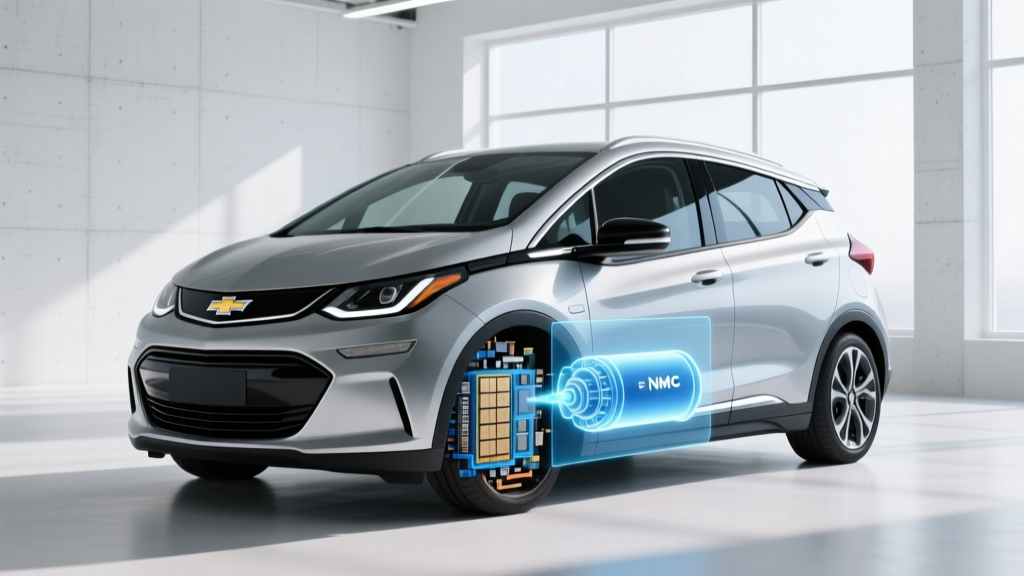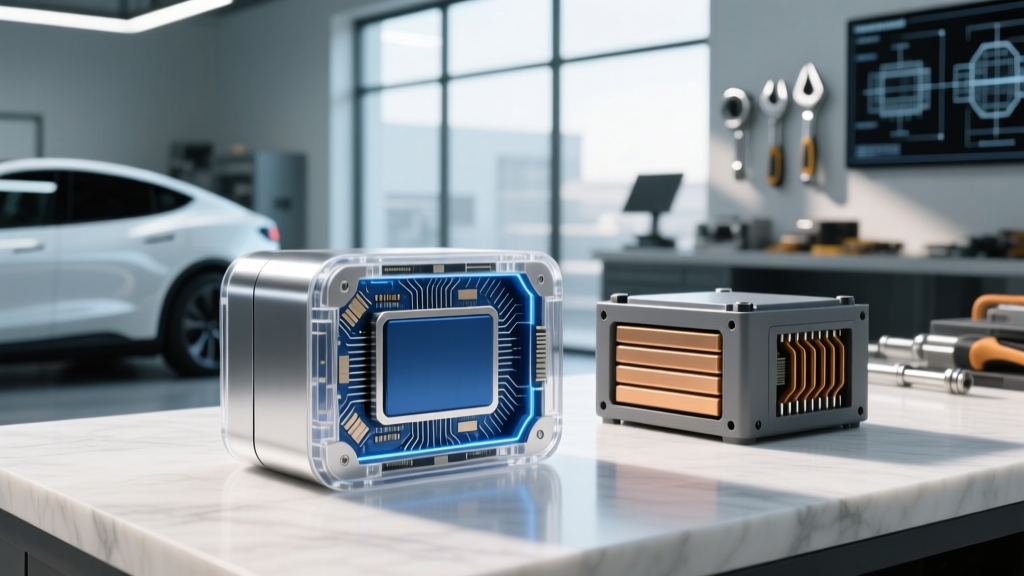
The EV battery conversation in 2026 splits into two camps: the lithium-ion cells powering every EV on the road today, and the solid-state batteries automakers promise will eventually replace them. If you're shopping for an EV now, or trying to decide whether to wait for next-generation tech, you need hard data on both — not marketing slides.
This guide breaks down exactly how today's lithium-ion chemistries (NMC, NCA, and LFP) perform in real-world ownership, what degradation looks like at 100,000 miles, what a replacement actually costs, and where solid-state technology genuinely stands. No hype, no fear — just the numbers that matter.
Lithium-Ion Chemistries Explained: NMC, NCA, and LFP
Every EV sold in the US today uses a lithium-ion traction battery, but not all lithium-ion cells are the same. The cathode chemistry determines energy density, lifespan, cost, and cold-weather behavior. The three dominant chemistries in 2026 are:
- NMC (Nickel Manganese Cobalt): Used in most long-range EVs — Tesla Model 3 Long Range, Hyundai Ioniq 5, Ford Mustang Mach-E Extended Range. High energy density enables 300+ mile EPA ranges in manageable pack sizes.
- NCA (Nickel Cobalt Aluminum): Tesla's earlier chemistry, still found in some Model S and Model X packs. Similar profile to NMC with slightly higher energy density but comparable cost.
- LFP (Lithium Iron Phosphate): Found in the Tesla Model 3 RWD, Model Y RWD, and standard-range offerings from BYD and others. Lower energy density but significantly longer cycle life, lower cost, and no cobalt.
| Attribute | LFP | NMC | NCA |
|---|---|---|---|
| Energy Density | ~160 Wh/kg (lower) | ~220-260 Wh/kg (higher) | ~250-270 Wh/kg (highest) |
| Typical Cycle Life | 3,000-5,000+ cycles | 1,000-2,000 cycles | 1,000-1,500 cycles |
| Cold-Weather Performance | Moderate (more range loss below 32°F) | Better (heat pump mitigates loss) | Better |
| Cost per kWh (pack-level) | ~$85-$100 | ~$110-$135 | ~$120-$140 |
| Thermal Stability | Excellent (very low thermal runaway risk) | Good (requires active BMS management) | Good |
| Recommended SoC for Daily Use | 100% OK daily | 80% recommended daily | |
| Found In (2026 Examples) | Tesla Model 3 RWD, Model Y RWD, BYD Seal | Hyundai Ioniq 5, Chevy Equinox EV, BMW i4 | Tesla Model S/X (legacy packs) |
LFP vs NMC — Which Is Better and Why?
Neither chemistry is universally superior — the right choice depends on your driving pattern:
Choose LFP if: You want maximum longevity, plan to keep the vehicle 10+ years, charge daily to 100% without worry, and can accept a slightly shorter EPA range (typically 250-272 miles in a Tesla Model 3 RWD). LFP's cycle life of 3,000-5,000 cycles means you could theoretically drive 500,000+ miles before hitting 80% capacity — far beyond the vehicle's mechanical lifespan.
Choose NMC if: You need maximum range per charge (310-360+ miles EPA), regularly road-trip in cold weather, or need the lightest possible pack for performance applications. NMC's higher energy density packs more kWh into the same physical space. The trade-off: you should charge to 80% for daily use and only go to 100% before long trips, which slightly reduces convenience.
How Long Do EV Batteries Actually Last?
The short answer: almost certainly longer than you'll own the car. Data from fleet operators, Tesla's impact reports, and independent studies consistently show that modern lithium-ion EV batteries degrade far more slowly than early-generation predictions suggested.
Real-World Degradation Data Points
- Tesla fleet data (2025 Impact Report): Model 3/Y packs retain approximately 85% of original capacity at 200,000 miles — well above the 70% warranty threshold.
- Geotab fleet study (10,000+ EVs): Average annual degradation of 1.8% per year across all chemistries, meaning ~82% retention at 10 years under typical use.
- Taxi/ride-share high-mileage data: Tesla Model 3 vehicles used in ride-share service (60,000-80,000 miles/year with frequent DC fast charging) show 88-91% retention at 200,000 miles.
- Nissan Leaf (passive-cooled, earlier generation): An outlier — first-generation Leafs with passive air cooling showed 20-30% degradation at 80,000 miles in hot climates, underscoring the importance of active thermal management.
Most EV batteries in liquid-cooled packs from 2022 onward will outlast the vehicle's structural and mechanical components. The typical failure mode isn't sudden death — it's gradual capacity loss that reduces range from, say, 310 miles to 265 miles over a decade. That's still a highly usable vehicle.
What Does the EV Battery Warranty Cover?
Federal law mandates a minimum battery warranty of 8 years/100,000 miles for all EVs sold in the US. Most manufacturers meet or exceed this baseline. Here's how the major warranties compare in 2026:
| Manufacturer | Warranty Period | Mileage Limit | Capacity Retention Threshold |
|---|---|---|---|
| Tesla (Model 3/Y LFP) | 8 years | 120,000 miles | 70% |
| Tesla (Model 3/Y Long Range, S/X) | 8 years | 120,000-150,000 miles | 70% |
| Hyundai / Kia | 10 years | 100,000 miles | 70% |
| Ford (Mach-E, F-150 Lightning) | 8 years | 100,000 miles | 70% |
| GM (Ultium platform) | 8 years | 100,000 miles | 70% (60% for LMR) |
| BMW | 8 years | 100,000 miles | 70% |
| Rivian | 8 years | 175,000 miles (R1T/R1S) | 70% |
Key detail: The warranty guarantees the battery will retain at least 70% of its original usable capacity (typically measured in kWh) for the stated period. If your 75 kWh pack drops below 52.5 kWh within 8 years/100,000 miles, the manufacturer must repair or replace it. In practice, warranty claims are rare — most packs retain 85%+ at the warranty boundary, according to Tesla's annual impact reports and third-party fleet data.
Warranties cover defects and abnormal degradation. They do not cover damage from accidents, improper modifications, or (in most cases) using the battery as a stationary power source beyond manufacturer-approved V2H/V2L features.
EV Battery Replacement Cost: What You'll Actually Pay
This is where fear-mongering runs rampant, so let's anchor the conversation in data. Yes, EV battery replacements are expensive. But context matters enormously:
| Vehicle | Battery Size (kWh) | Chemistry | Estimated Replacement Cost |
|---|---|---|---|
| Tesla Model 3 RWD | ~60 kWh | LFP | $12,000-$14,000 |
| Tesla Model Y Long Range | ~75 kWh | NMC | $14,000-$18,000 |
| Hyundai Ioniq 5 | ~77.4 kWh | NMC | $15,000-$20,000 |
| Ford F-150 Lightning Extended Range | ~131 kWh | NMC | $22,000-$30,000 |
| Chevrolet Equinox EV | ~85 kWh | NMC (Ultium) | $16,000-$21,000 |
| BMW i4 eDrive40 | ~83.9 kWh | NMC | $18,000-$25,000 |
When is replacement typically needed? For most owners, it isn't. Based on current degradation curves, a liquid-cooled EV battery from a 2023-2026 model year will retain 80-88% capacity at 200,000 miles. Full replacement is typically only necessary after a collision, a manufacturing defect that manifests outside warranty, or extreme abuse (repeated deep discharges in high heat without thermal management).
Pack-level battery costs have fallen from over $1,000/kWh in 2010 to approximately $100-$135/kWh in 2026 (per BloombergNEF data). They're projected to dip below $80/kWh by 2030, meaning replacement costs will continue declining for the life of any EV purchased today.
Factors That Accelerate (or Preserve) Battery Life
Not all miles are equal when it comes to battery wear. These factors have the most measurable impact on long-term State of Health (SoH):
Battery Care Best Practices
- Minimize DC fast charging when possible. Occasional road-trip fast charging (1-2x/week) has negligible impact. Daily DC fast charging at 150+ kW, however, accelerates degradation by an estimated 1-2% additional loss per year vs. Level 2 home charging, according to Geotab fleet analysis.
- Avoid prolonged storage at 100% or below 10% SoC. For NMC/NCA, the ideal storage range is 40-60%. LFP tolerates 100% storage better but still benefits from not sitting at 0% for weeks.
- Let the thermal management system do its job. Precondition the battery before fast charging (most EVs do this automatically when you navigate to a charger). In extreme cold, plug in when parked so the car can maintain battery temperature using grid power rather than pack energy.
- Don't fear 100% charges before road trips. Occasional full charges are fine. The damage comes from sitting at 100% for days in hot weather. Charge to 100% and drive away within a few hours.
- Use scheduled charging. Set your EV to finish charging to 80% (NMC) or 100% (LFP) shortly before you leave each morning. This minimizes time spent at high SoC.
- Keep firmware updated. OTA updates often refine battery management algorithms, thermal thresholds, and charging curves — sometimes improving longevity without any hardware change.
How to Monitor Your Battery's State of Health
State of Health (SoH) is the percentage of original capacity your battery can still hold. A new 75 kWh pack at 95% SoH can store approximately 71.25 kWh. Here's how to check it:
In-vehicle displays: Tesla shows estimated range at 100% charge, which you can compare to the original EPA figure. Hyundai/Kia provides a battery health percentage in the EV settings menu on newer models. BMW's iDrive includes a battery health indicator.
OBD-II diagnostic tools: Devices like the OBDLink CX paired with apps such as EV Health or Scan My Tesla can read the BMS-reported SoH percentage, individual cell voltages, and pack impedance — far more precise than dashboard estimates.
Charging log method: Track how many kWh your charger delivers during a 10%-to-90% session (your charger app logs this). If your 75 kWh pack once accepted 60 kWh for that window but now only takes 53 kWh, your SoH is roughly 88%. This is the most accurate DIY method because it measures actual energy accepted, not BMS estimates.
Third-party inspections: Services like Recurrent Auto offer battery health reports that compare your pack's degradation to a fleet of identical vehicles, giving you a percentile ranking. This is increasingly useful for used-EV buyers.
Solid-State Battery vs Lithium-Ion: The Realistic Timeline
Solid-state batteries replace the liquid electrolyte in a lithium-ion cell with a solid material (ceramic, sulfide, or polymer). This promises three major advantages:
- Higher energy density: 350-500 Wh/kg at the cell level vs. ~250 Wh/kg for today's best NMC — potentially enabling 500+ mile ranges without larger packs.
- Faster charging: Solid electrolytes can theoretically handle higher C-rates without lithium plating, potentially enabling 10-80% charges in under 10 minutes.
- Improved safety: No flammable liquid electrolyte means dramatically reduced thermal runaway risk.
Where it actually stands in 2026:
Toyota has announced solid-state battery production for a limited-run EV expected in 2027-2028, with initial volumes of a few thousand units. Samsung SDI is targeting 2027 for mass production. QuantumScape has delivered prototype cells to automotive partners but has not announced a production vehicle. Nissan plans a solid-state pilot plant by 2028.
The honest assessment: Solid-state batteries will not be in a vehicle you can walk into a dealership and buy before 2029 at the earliest, and likely not at mainstream pricing until 2032+. Manufacturing challenges — particularly achieving consistent solid-electrolyte interfaces at scale — remain unsolved for high-volume production. Cost projections place early solid-state packs at $200-$300+/kWh, roughly double today's lithium-ion pricing.
Other emerging technologies like silicon-dominant anodes (used in limited form today by companies like Sila Nanotechnologies) are closer to market and offer 10-20% energy density improvements within existing lithium-ion architectures. Expect incremental gains here before any solid-state revolution.
Bottom line: If you need an EV in the next 1-4 years, today's lithium-ion technology is mature, well-understood, and backed by extensive real-world durability data. Waiting for solid-state means waiting at least 5-7 years for meaningful availability at non-luxury price points.
Frequently Asked Questions
How long do EV batteries last in years and miles?
Modern liquid-cooled EV batteries (2022 and newer) typically retain 80-88% of original capacity at 200,000 miles and 12-15 years of age. Based on fleet data from Tesla, Geotab, and fueleconomy.gov, most packs will remain functional (above 70% capacity) for 250,000-350,000 miles. LFP chemistries may exceed 400,000 miles before reaching the 70% threshold.
How much does it cost to replace an EV battery?
Out-of-warranty replacement costs range from approximately $12,000 for a Tesla Model 3 RWD (60 kWh LFP pack) to $30,000 for a Ford F-150 Lightning Extended Range (131 kWh NMC pack). However, most EV batteries never require full replacement under normal ownership — the pack typically outlasts the vehicle's other major components. Pack-level costs continue declining ~8-10% annually.
What does the EV battery warranty actually cover?
All US-sold EVs carry a minimum 8-year/100,000-mile battery warranty (federally mandated). Some manufacturers extend to 10 years (Hyundai/Kia) or higher mileage (Rivian: 175,000 miles). The warranty guarantees the pack will retain at least 70% of its original usable kWh capacity. If degradation exceeds this threshold within the warranty period, the manufacturer repairs or replaces the battery at no cost.
How do I check and maximize my EV battery health?
Monitor SoH via your vehicle's battery health display, OBD-II diagnostic apps, or by tracking kWh accepted during a known SoC window (e.g., 10%-90%) using your home charger's app. To maximize longevity: favor Level 2 home charging over daily DC fast charging, set charge limits to 80% for NMC (100% for LFP), precondition before fast charging, avoid prolonged storage at extreme SoC levels, and keep your vehicle's firmware updated.
Is LFP or NMC better for my EV?
LFP is better if you prioritize longevity (3,000-5,000+ cycle life), want to charge to 100% daily without concern, and can accept 250-272 miles of EPA range. NMC is better if you need maximum range (310-360+ miles EPA), frequently drive in cold weather, or value peak performance. Both chemistries will comfortably outlast a typical ownership period when properly managed.
Should I wait for solid-state batteries before buying an EV?
Realistically, no. Solid-state batteries will not reach mainstream, affordable production vehicles before 2030-2032. Current lithium-ion technology is mature, well-warrantied, and supported by extensive real-world durability evidence. If you wait for solid-state, you'll delay your EV purchase by 5-7+ years while paying for gasoline in the interim. The economics of switching to a current-generation EV now almost always outweigh the speculative benefit of waiting.