Toyota's Solid-State Bet: Hype Check for 2026 EV Buyers
If you've followed EV news for the past three years, you've seen the headline: Toyota will launch a solid-state battery EV with 750+ km (466+ miles) of range and a 10-minute 10-80% DC fast charge. The promise is tantalizing — a battery that charges like a gas fill-up, lasts longer, and resists thermal runaway better than today's lithium-ion cells.
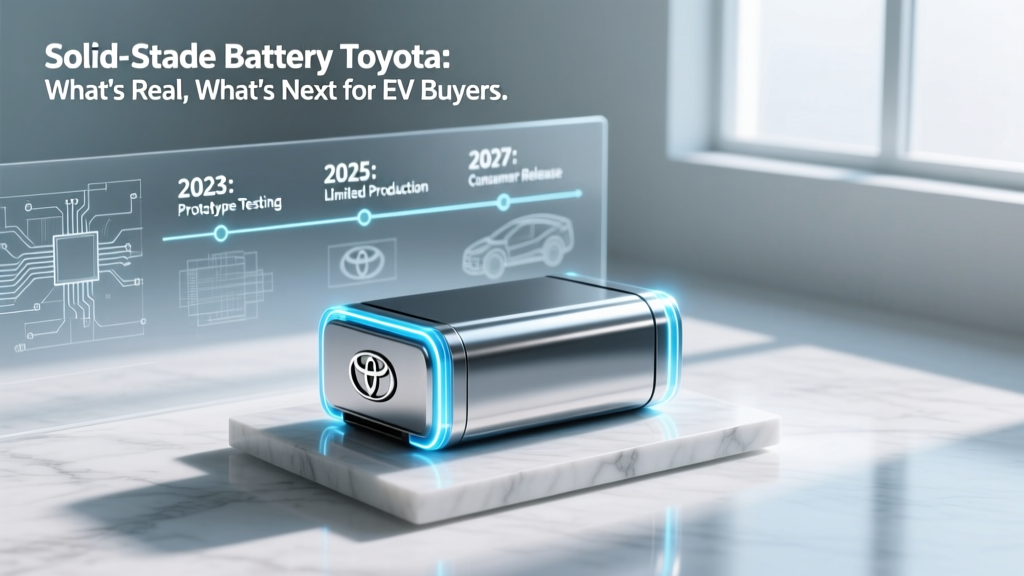
But as of early 2026, no Toyota vehicle with a solid-state traction battery is on sale anywhere in the world. What Toyota has confirmed, per its official battery strategy updates, is a phased rollout beginning with a limited-production BEV around 2027-2028, likely starting in Japan and China before reaching North America. Until then, every Toyota and Lexus EV you can actually buy — the bZ4X, the upcoming three-row bZ5X, and the Lexus RZ — runs on conventional liquid-electrolyte lithium-ion cells, primarily NMC chemistry supplied by Panasonic and CATL.
This guide breaks down what solid-state actually means, where Toyota's timeline stands, and — more practically — how today's proven battery chemistries (LFP and NMC/NCA) perform in real ownership. Because the battery in the EV you buy today will likely outlast the car itself.
What Is a Solid-State Battery, and Why Does Toyota Want It?
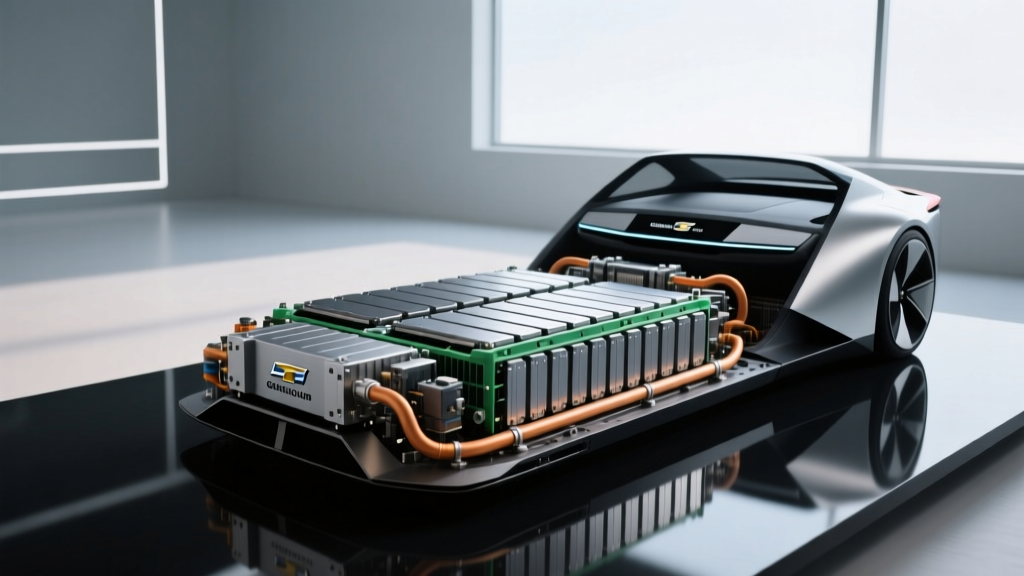
A conventional lithium-ion cell uses a liquid or gel electrolyte to shuttle lithium ions between the cathode and anode. A solid-state battery replaces that liquid with a solid electrolyte — typically a ceramic, sulfide glass, or polymer. The theoretical advantages are significant:
- Higher energy density: Solid electrolytes can enable lithium-metal anodes, potentially pushing cell-level energy density from today's ~250-300 Wh/kg to 400-500 Wh/kg.
- Faster charging: Solid electrolytes can tolerate higher C-rates without lithium plating, enabling the 10-minute 10-80% charge Toyota targets.
- Improved safety: No flammable liquid electrolyte means dramatically reduced thermal-runaway risk.
- Wider operating temperature: Solid-state cells can function in extreme cold with less capacity loss than liquid cells.
Toyota holds the most solid-state battery patents of any automaker — over 1,300 as of 2025. Its partner, Idemitsu Kosan, is scaling production of sulfide-based solid electrolyte material. But manufacturing challenges remain formidable: achieving uniform solid-to-solid contact between the electrolyte and electrodes at scale, managing the pressure requirements of sulfide-based cells, and driving down cost from an estimated 4-8x current lithium-ion cell pricing.
Today's Reality: LFP vs. NMC/NCA Chemistry Trade-Offs
While solid-state remains on the horizon, today's EV buyers choose between two dominant cathode chemistries: LFP (lithium iron phosphate, LiFePO₄) and NMC/NCA (nickel manganese cobalt / nickel cobalt aluminum). Each has distinct strengths.
| Attribute | LFP (LiFePO₄) | NMC / NCA |
|---|---|---|
| Energy Density (cell-level) | ~160-200 Wh/kg | ~220-300 Wh/kg |
| Typical EPA Range (same vehicle) | ~10-15% less than NMC equivalent | Maximum range for pack size |
| Cycle Life | 3,000-5,000+ cycles to 80% SoH | 1,000-2,000 cycles to 80% SoH |
| Cold-Weather Performance | More range loss below 32°F; slower cold charging | Better cold performance; preconditioning helps |
| Recommended Daily SoC | 100% daily charging is fine (and recommended for BMS calibration) | 80% daily; 100% only for trips |
| Cost (cell-level, 2025-2026) | ~$70-90/kWh | ~$100-130/kWh |
| Cobalt/Nickel Content | Zero cobalt, zero nickel | Contains cobalt and/or nickel (supply-chain and ethical considerations) |
| Thermal Stability | Excellent — very resistant to thermal runaway | Good with active thermal management; more sensitive at high SoC |
Which is better? It depends on your use case. If you have home charging, drive under 250 miles daily, and plan to own the car 8+ years, LFP's cycle-life advantage and 100% daily charging convenience make it the pragmatic choice — Tesla's Model 3 Standard Range and Ford's base Mustang Mach-E both use LFP. If you need maximum range for road trips or live in a cold climate where every mile of EPA range matters, NMC's higher energy density is worth the trade-off. Toyota's current bZ4X uses NMC, prioritizing its 252-mile EPA range target.
How Long Do EV Batteries Actually Last? Degradation Data
The fear of a $20,000 battery replacement at year five is the single biggest barrier to EV adoption — and it's largely unsupported by fleet data. Modern EV traction batteries are engineered for longevity far exceeding initial expectations.
- Tesla Model 3/Y (NMC & LFP): Tesla's 2024 Impact Report showed median battery degradation of ~12% at 150,000 miles, with LFP variants showing ~8% loss at the same mileage.
- Chevrolet Bolt EV/EUV (NMC, 65 kWh): Recurrent Auto fleet data shows ~90% State of Health (SoH) retention at 100,000 miles for liquid-cooled packs.
- Nissan LEAF (passive air-cooled, older packs): The cautionary tale — early 24 kWh and 30 kWh LEAF packs showed 15-25% degradation at 80,000 miles due to lack of active thermal management. The 62 kWh LEAF Plus with improved thermal design performs significantly better.
- Hyundai Ioniq 5 / Kia EV6 (NMC, 77.4 kWh): Owner-reported SoH remains above 93% at 50,000 miles based on OBD-II scanner readings, with the heat pump and liquid cooling proving effective.
- Toyota bZ4X (NMC, 71.4 kWh usable): Toyota targets 90% capacity retention at 10 years — the most conservative degradation target of any mainstream automaker, though independent long-term data is still limited given the 2023 launch.
The pattern is clear: liquid-cooled batteries with active thermal management degrade 1-2% per year under normal use, while passively cooled packs can lose 3-5% annually, especially in hot climates. At a 1.5% annual loss rate, a battery retains ~88% SoH after 8 years — well above warranty thresholds.
Most EV batteries will outlast the vehicle they're installed in. The average age of a scrapped car in the US is 12.1 years (S&P Global Mobility, 2024). A battery retaining 80-85% SoH at that age is still perfectly functional — just with proportionally reduced range.
Battery Warranty Terms: What's Actually Covered
Federal law mandates a minimum 8-year/100,000-mile warranty on EV battery packs for emissions-related compliance, and every major automaker meets or exceeds this baseline. Here's how the warranties compare:
| Manufacturer | Duration / Mileage | Capacity Retention Threshold | Notes |
|---|---|---|---|
| Toyota (bZ4X) | 8 yr / 100,000 mi | 70% | Toyota targets 90% at 10 years; warranty is conservative floor |
| Tesla (Model 3/Y) | 8 yr / 100,000-120,000 mi | 70% | Long Range/Performance get 120K mi; RWD gets 100K mi |
| Hyundai / Kia | 10 yr / 100,000 mi | 70% | Longest duration among mainstream brands |
| Ford (Mach-E, F-150 Lightning) | 8 yr / 100,000 mi | 70% | Standard across BEV lineup |
| GM (Chevrolet, Cadillac) | 8 yr / 100,000 mi | 70% (60% for Bolt) | Ultium-platform vehicles at 70%; Bolt at 60% |
| BMW / Mercedes-Benz | 8 yr / 100,000 mi | 70% | Premium brands match mainstream warranty terms |
Key warranty details buyers miss:
- The warranty covers capacity loss below the threshold, not any degradation. A battery at 72% SoH at year 7 is functioning within warranty spec.
- Warranties typically cover defects and excessive degradation — not damage from accidents, flooding, or unauthorized modifications.
- Some manufacturers (Hyundai, Kia) offer longer 10-year coverage, which matters if you plan to keep the vehicle beyond 8 years.
- Warranty replacement may use a refurbished or remanufactured pack, not necessarily a brand-new one — but it must meet the capacity threshold.
EV Battery Replacement Cost: When and How Much
Out-of-warranty battery replacement is the scenario that generates fear — but context matters. The vast majority of EV batteries never need replacement during original ownership. When they do, here's what the numbers look like in 2026:
| Vehicle / Pack Size | Battery Cost (Parts) | Labor | Total Estimated |
|---|---|---|---|
| Tesla Model 3 RWD (~60 kWh LFP) | $8,000 - $12,000 | $1,500 - $2,500 | $10,000 - $14,500 |
| Tesla Model Y LR (~82 kWh NMC) | $12,000 - $16,000 | $1,500 - $2,500 | $13,500 - $18,500 |
| Hyundai Ioniq 5 (~77.4 kWh NMC) | $11,000 - $15,000 | $2,000 - $3,000 | $13,000 - $18,000 |
| Ford F-150 Lightning Ext. (~131 kWh NMC) | $18,000 - $28,000 | $2,500 - $4,000 | $20,500 - $32,000 |
| Chevrolet Bolt EV (~65 kWh NMC) | $9,000 - $13,000 | $1,500 - $2,500 | $10,500 - $15,500 |
| Toyota bZ4X (~71.4 kWh NMC) | $10,000 - $14,000 | $2,000 - $3,000 | $12,000 - $17,000 |
Cell prices continue falling — Bloomberg NEF's 2025 survey pegged average pack-level pricing at $115/kWh, down from $141/kWh in 2023. By the time a 2026-model-year EV actually needs an out-of-warranty replacement (likely 2036+), replacement costs should be materially lower. Third-party refurbishers are also emerging, offering module-level repair for $3,000-$7,000 on packs with isolated cell failures rather than full-pack replacement.
When is replacement actually needed? Almost never before 150,000 miles on liquid-cooled packs. The cases that do arise typically involve manufacturing defects (covered under warranty), physical damage, or — in older passively-cooled vehicles like the early LEAF — gradual capacity loss that eventually makes the vehicle impractical for the owner's commute.
Maximizing Battery Life: What Actually Matters
Battery longevity isn't mysterious — it follows well-understood electrochemistry principles. Here are the factors that meaningfully affect your pack's lifespan, ranked by impact:
- Avoid sustained high SoC (NMC/NCA only): Storing an NMC battery at 100% SoC for days accelerates calendar degradation. Set your daily charge limit to 80% and charge to 100% only when you'll drive immediately. LFP batteries are exempt from this — charge to 100% regularly for BMS calibration.
- Minimize DC fast-charging frequency: Occasional road-trip fast charging is fine. But daily reliance on 150+ kW DC charging generates sustained heat that degrades cells faster. A Recurrent study found that vehicles fast-charging more than 3x per week showed ~1-2% additional degradation over 3 years vs. primarily Level 2 charging.
- Precondition before fast charging: Navigating to a DC fast charger (or using your car's preconditioning feature) warms the battery to optimal temperature, enabling faster charging and reducing lithium plating risk. This matters especially below 50°F.
- Avoid extreme SoC storage: Don't leave any EV sitting at 5% or 100% for weeks. For extended parking, set charge limit to 50-60%.
- Use Level 2 home charging as your primary method: A 7-11 kW Level 2 charger adds 25-44 miles of range per hour — more than enough for overnight replenishment — with minimal thermal stress on the pack.
- Don't obsess about cold-weather range loss: Temporary 20-30% range reduction in sub-freezing temperatures is normal and reversible. It's not degradation — it's physics. The battery recovers when temperatures rise.
Monitoring Battery Health: How to Check Your SoH
Most EVs don't display a battery health percentage on the dashboard the way a smartphone does. Here's how to actually monitor your traction battery's State of Health:
- In-car range estimation trend: Track your full-charge range estimate over time. If your EV showed 270 miles at 100% when new and now shows 245 miles at 100%, that's roughly 9% degradation. Note that range estimates fluctuate with temperature and recent driving patterns — look at the trend over months, not individual readings.
- OBD-II diagnostic apps: Devices like the OBDLink MX+ paired with apps such as Car Scanner or LeafSpy (for Nissan) can read the battery management system's reported SoH percentage directly. Many Hyundai/Kia and Tesla owners use this method.
- Manufacturer service checks: Dealerships can pull a detailed battery health report during service visits. Request this annually or before warranty expiration.
- Third-party services: Companies like Recurrent Auto offer battery health reports based on connected-car data, and some used-EV marketplaces (Carvana, CarMax) now include battery health certificates.
If your SoH drops below the warranty threshold (typically 70%) within the warranty period, contact the manufacturer for a warranty claim. Document your mileage, charging habits, and any range-reduction evidence.
Beyond Solid-State: Silicon Anodes and the 2027-2030 Battery Pipeline
Toyota's solid-state battery isn't the only next-generation technology in development. The broader battery pipeline includes several technologies that may reach production before or alongside solid-state:
- Silicon-dominant anodes: Companies like Sila Nanotechnologies and Group14 are replacing graphite anodes with silicon composites, boosting energy density 20-40% within existing cell formats. Mercedes-Benz's next-gen G-Class EV (announced for 2027) will use Sila's silicon anode cells. This technology is closer to mass production than solid-state.
- Sodium-ion batteries: CATL began shipping sodium-ion cells in Chinese-market EVs in 2024-2025. These offer lower energy density (~140-160 Wh/kg) but dramatically lower cost and no lithium, cobalt, or nickel. Expect them in budget EVs and as range-extender supplementary packs, not as primary long-range solutions.
- Lithium iron manganese phosphate (LMFP): An evolution of LFP that adds manganese for ~15-20% higher energy density while retaining LFP's cost, safety, and cycle-life advantages. CATL and BYD are scaling LMFP production for 2026-2027 vehicles.
- Toyota's "Performance" and "Popularisation" batteries: Alongside solid-state, Toyota has announced a bipolar NMC "Performance" battery targeting 800 km range by 2026-2027, and a bipolar LFP "Popularisation" battery targeting 20% cost reduction by 2027-2028. These conventional-chemistry innovations may matter more to near-term buyers than solid-state.
The honest assessment: solid-state batteries are real technology with genuine advantages, but Toyota's own timeline suggests limited production through 2028-2029, with cost-competitive mass production not arriving until 2030 or later. If you're buying an EV in 2026, you're buying today's chemistry — and that chemistry is good enough to last the life of the car.
Frequently Asked Questions
How long do EV batteries last in years and miles?
Modern liquid-cooled EV batteries typically retain 80-90% of their original capacity after 150,000-200,000 miles (10-15 years). Fleet data from Tesla, Hyundai, and GM shows degradation rates of 1-2% per year under normal use. Most batteries outlast the vehicle they're installed in.
How much does it cost to replace an EV battery?
Out-of-warranty replacement costs range from ~$10,000 for smaller packs (60 kWh, Tesla Model 3 RWD) to $20,000-$32,000 for large packs (131 kWh, F-150 Lightning Extended Range). However, the vast majority of EV batteries never require replacement during original ownership, and cell prices continue declining ~10-15% annually.
What does the EV battery warranty actually cover?
Federally mandated minimum coverage is 8 years/100,000 miles. Most warranties guarantee the battery will retain at least 70% of its original capacity. If degradation drops below this threshold within the warranty period, the manufacturer will repair or replace the pack at no cost. Hyundai and Kia extend this to 10 years/100,000 miles.
Is LFP or NMC better for my EV?
LFP wins on longevity (3,000-5,000 cycles vs. 1,000-2,000), cost ($70-90/kWh vs. $100-130/kWh), safety, and convenience (100% daily charging is fine). NMC wins on energy density (more range per pound) and cold-weather performance. Choose LFP for daily commuting with home charging; choose NMC if you need maximum range or live in cold climates.
When will Toyota's solid-state battery EV be available to buy?
Toyota has announced a limited-production solid-state BEV targeting 2027-2028, initially in Japan and China. North American availability is not confirmed and likely won't arrive before 2029-2030 at the earliest. Cost-competitive mass production is projected for 2030+. All currently available Toyota/Lexus EVs use conventional lithium-ion batteries.
Does fast charging damage my EV battery?
Occasional DC fast charging (road trips, a few times per month) causes negligible additional degradation. However, daily reliance on 150+ kW fast charging can add 1-2% extra degradation over several years compared to primarily Level 2 home charging. Always use your car's preconditioning feature before fast charging, especially in cold weather.
How do I check my EV battery's health?
Monitor the full-charge range estimate over months (not individual readings), use an OBD-II scanner with apps like Car Scanner for direct SoH readouts, or request a battery health report from your dealer during service visits. If SoH drops below 70% within the warranty period, file a warranty claim.