Toyota's Solid-State Battery: Separating Hype from Reality
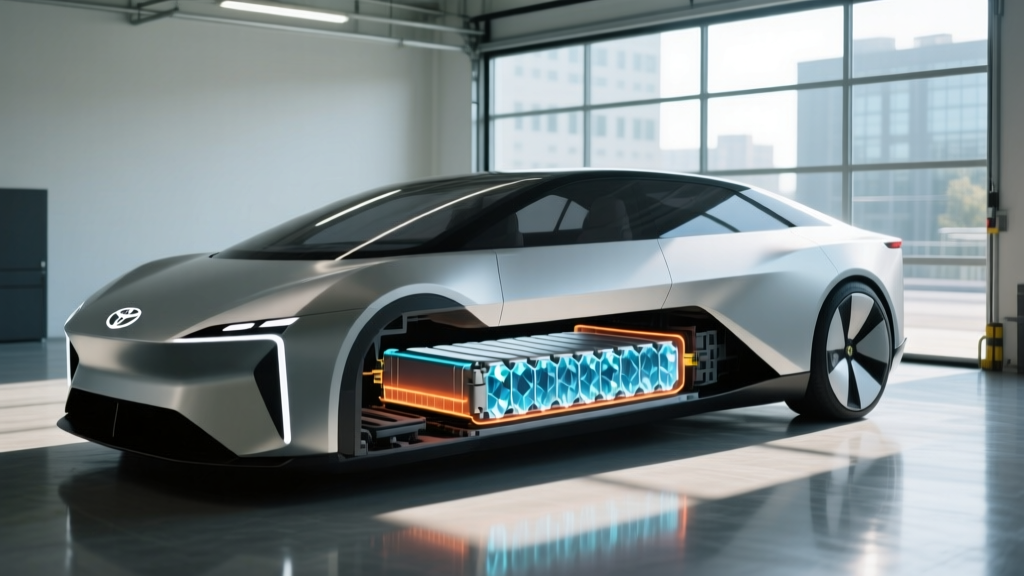
Toyota has been teasing solid-state battery breakthroughs for years, with announcements of 750+ km (466+ mile) range and 10-minute fast charging. But as of 2026, no Toyota EV with a solid-state battery is available for purchase. The technology remains in limited pilot production, with commercial rollout expected in 2027-2028 for select models.
For today's EV buyers, understanding Toyota's battery roadmap requires separating announced capabilities from shipping products. Current Toyota EVs like the bZ4X use conventional lithium-ion cells with NMC (nickel-manganese-cobalt) chemistry, delivering 252 miles of EPA range and 150 kW peak DC fast charging.
Solid-State vs. Today's Lithium-Ion: The Chemistry Gap
Solid-state batteries replace the liquid electrolyte in conventional lithium-ion cells with a solid material (ceramic, polymer, or sulfide-based). This eliminates flammability risk, enables lithium-metal anodes, and theoretically doubles energy density. Toyota's announced specs target 900 Wh/L volumetric energy density versus ~600 Wh/L for today's best NMC cells.
But the engineering challenges are substantial. Solid electrolytes suffer from poor ionic conductivity at room temperature, interface degradation during charge cycles, and manufacturing costs 3-5x higher than mature lithium-ion processes. Toyota's 2023 announcement of a "breakthrough" addressed interface stability, but scaling production remains the bottleneck.
| Attribute | NMC (Current Toyota bZ4X) | LFP (Tesla Model 3 RWD, BYD) | Solid-State (Announced) |
|---|---|---|---|
| Energy Density | ~250 Wh/kg | ~160 Wh/kg | ~500 Wh/kg (target) |
| Cycle Life | 1,000-2,000 cycles | 3,000-5,000 cycles | Unknown (lab: 1,000+) |
| Cold Performance | Moderate (20-30% range loss at 20°F) | Poor (30-40% range loss at 20°F) | Expected: better (no liquid to freeze) |
| Fast Charge Capability | 150-250 kW peak | 170-250 kW peak | 700+ kW (10 min 10-80%) |
| Cost (2026) | ~$130/kWh (pack level) | ~$100/kWh (pack level) | $300-500/kWh (estimated) |
| Availability | Now | Now | 2027-2028 (limited) |
How Long Do EV Batteries Actually Last?
Modern EV batteries are designed to outlast the vehicle itself. Real-world data from Tesla's 2022 Impact Report shows Model S/X batteries retain ~90% capacity after 200,000 miles. Nissan Leaf data (passive air cooling) shows more degradation—~80% capacity at 100,000 miles—but liquid-cooled systems in newer EVs perform significantly better.
For Toyota specifically, the bZ4X uses a 71.4 kWh NMC pack with liquid thermal management. Based on industry averages for similar chemistry and cooling, expect 10-15% degradation over 10 years or 150,000 miles under normal use.
- Year 1-2: 2-3% loss (initial formation)
- Year 3-5: 1-2% per year (linear phase)
- Year 6-10: 0.5-1% per year (plateau)
- Year 10 typical: 85-90% State of Health (SoH)
Source: Geotab fleet data (6,300+ EVs), Recurrent Auto database
What Does the Battery Warranty Cover?
Federal law mandates a minimum 8-year/100,000-mile warranty on EV battery packs, with a capacity retention threshold (typically 60-70% of original capacity). Toyota exceeds this minimum on the bZ4X with an 8-year/100,000-mile warranty covering defects and capacity loss below 70%.
| Manufacturer | Warranty Period | Capacity Threshold | Transferable? |
|---|---|---|---|
| Toyota bZ4X | 8 yr / 100,000 mi | 70% SoH | Yes |
| Tesla Model Y | 8 yr / 120,000 mi (LR) | 70% SoH | Yes |
| Hyundai Ioniq 5 | 10 yr / 100,000 mi | 70% SoH | Yes (original owner) |
| Ford Mustang Mach-E | 8 yr / 100,000 mi | 70% SoH | Yes |
Important: Warranty coverage applies to defects and excessive degradation—not damage from accidents, flooding, or improper charging. Always review the specific warranty booklet for exclusions.
How Much Does an EV Battery Cost to Replace?
Battery replacement costs vary dramatically by pack size and chemistry. As of 2026, expect $5,000-$22,000 for a full pack replacement (parts + labor), though most owners never need this service.
| Vehicle | Battery Size | Replacement Cost (Parts + Labor) | Typical Replacement Trigger |
|---|---|---|---|
| Nissan Leaf (40 kWh) | 40 kWh | $6,500-$8,500 | Severe degradation (>30% loss) or cell failure |
| Tesla Model 3 (75 kWh) | 75 kWh | $12,000-$16,000 | Rare; most packs last 300k+ miles |
| Toyota bZ4X (71.4 kWh) | 71.4 kWh | $14,000-$18,000 | Unlikely within vehicle lifespan |
| Ford F-150 Lightning (131 kWh) | 131 kWh | $18,000-$22,000 | Rare; fleet data shows <5% failure rate |
Key context: Most EV batteries outlast the vehicle. Data from Recurrent Auto (15,000+ EVs tracked) shows only 1.5% of batteries replaced outside warranty. When replacements occur, they're typically covered under the 8-year warranty.
Factors That Accelerate Battery Degradation
While modern battery management systems (BMS) protect against most abuse, certain habits accelerate wear:
- DC Fast Charging Frequency: Daily use of 150+ kW chargers increases degradation by 2-3% over 5 years vs. Level 2 charging. Occasional road-trip fast charging has negligible impact.
- Extreme State of Charge: Regularly charging to 100% or draining below 10% stresses cells. For daily driving, 20-80% SoC is optimal (many EVs let you set charge limits).
- High Temperatures: Sustained operation above 95°F (35°C) accelerates chemical degradation. Liquid-cooled packs mitigate this, but parking in shade helps in hot climates.
- Cold Charging Without Preconditioning: Charging a cold battery (below 32°F) at high power can cause lithium plating. Most EVs precondition the pack when navigation is set to a charger.
- High-Performance Driving: Frequent hard acceleration and track use increase internal resistance over time. Moderate driving extends life.
How to Check and Maximize Battery Health
Most EVs display State of Health (SoH) in the infotainment system or mobile app. Tesla shows this in the Service menu; Hyundai/Kia provide it via the dealer scan tool or third-party apps like LeafSpy (Nissan) or OBDeleven (VW group).
Monitoring SoH:
- Check the vehicle's battery health screen (if available)
- Use an OBD-II dongle with EV-specific apps (e.g., Car Scanner, ABRP)
- Request a battery health report from the dealer during service
- Track range over time—a 10% range drop suggests ~10% degradation
Maximizing Longevity:
- Set daily charge limit to 80% (90% for LFP batteries like Tesla Model 3 RWD)
- Use Level 2 home charging for daily needs; reserve DC fast charging for road trips
- Enable battery preconditioning when navigating to a charger in cold weather
- Avoid leaving the vehicle at 100% SoC for extended periods (days/weeks)
- Park in shade or a garage in hot climates; use a block heater in extreme cold
LFP vs NMC: Which Chemistry Is Better?
The "better" chemistry depends on your priorities:
Choose LFP (Lithium Iron Phosphate) if:
- You want maximum cycle life (3,000-5,000 cycles vs 1,000-2,000 for NMC)
- You can charge to 100% daily without degradation concerns
- You prioritize cost savings (~$100/kWh vs $130/kWh for NMC)
- You live in a mild climate (LFP performs poorly below 32°F)
- Examples: Tesla Model 3 RWD, BYD Dolphin, Ford Mustang Mach-E Select (2024+)
Choose NMC (Nickel-Manganese-Cobalt) if:
- You need maximum range per charge (higher energy density)
- You live in a cold climate (better low-temperature performance)
- You want faster DC charging speeds (NMC handles high C-rates better)
- You drive long distances regularly and need 300+ mile range
- Examples: Tesla Model Y Long Range, Hyundai Ioniq 5, Toyota bZ4X
Solid-State Battery Timeline: What to Expect
Toyota's solid-state battery roadmap remains ambitious but uncertain:
- 2027-2028: Limited production in select Toyota/Lexus models (likely a premium EV sedan). Expect 750 km (466 mi) WLTP range, 10-minute 10-80% charging, but high cost ($300-500/kWh).
- 2029-2030: Broader rollout if manufacturing costs decrease. Still likely limited to high-end models.
- 2030+: Potential mainstream adoption if costs approach $150/kWh.
Realistic expectations: Solid-state batteries will initially appear in $80,000+ vehicles. Mass-market adoption (sub-$40,000 EVs) is unlikely before 2032-2035. For 2026 buyers, today's NMC and LFP chemistries are mature, reliable, and cost-effective.
Other manufacturers pursuing solid-state: QuantumScape (VW partnership), Solid Power (BMW/Ford), Samsung SDI. All face similar manufacturing scale-up challenges.
Frequently Asked Questions
Can I buy a Toyota with a solid-state battery today?
No. As of 2026, no Toyota production vehicle uses solid-state batteries. The bZ4X and all current Toyota hybrids use conventional lithium-ion (NMC) or nickel-metal hydride (NiMH) batteries. Solid-state is expected in limited production in 2027-2028.
How long will my Toyota EV battery last?
Toyota's bZ4X battery is designed to retain 70% capacity after 8 years/100,000 miles (warranty threshold). Real-world data suggests 85-90% capacity retention at 10 years/150,000 miles with normal use. Most EV batteries outlast the vehicle.
Is fast charging bad for my EV battery?
Occasional DC fast charging (road trips) has minimal impact. Daily fast charging at 150+ kW can increase degradation by 2-3% over 5 years. For daily use, Level 2 home charging (7-11 kW) is gentler on the battery.
Should I charge my EV to 100% every night?
For NMC batteries (Toyota bZ4X, Tesla Model Y LR), set the daily limit to 80%. For LFP batteries (Tesla Model 3 RWD), Toyota recommends 100% at least once per week to calibrate the BMS. Check your owner's manual for chemistry-specific guidance.
What happens if my EV battery fails outside warranty?
Full replacement costs $14,000-$18,000 for a Toyota bZ4X, but this is rare. Individual cell modules can sometimes be replaced for $2,000-$5,000. Third-party rebuild services are emerging but not yet widely available.
Will solid-state batteries make current EVs obsolete?
Not immediately. Solid-state will debut in premium vehicles at high cost. Today's NMC and LFP batteries offer 250-350 mile range, 20-30 minute fast charging, and 10+ year lifespans at $100-130/kWh. Solid-state must prove reliability and scale manufacturing before displacing current tech.
For the latest Toyota EV specifications and warranty details, consult the official Toyota bZ4X page or your local dealer. Battery technology and pricing evolve rapidly—verify current figures before purchase.