The Rise of Sodium-Ion: Who Makes Sodium-Ion Batteries for Electric Vehicles?
Sodium-ion batteries have moved from lab curiosity to production reality. As of 2026, several major cell manufacturers are shipping sodium-ion (Na-ion) packs in volume — primarily in China, with growing interest from global automakers seeking lower-cost, cobalt-free alternatives to lithium-based chemistries. If you've been searching for who makes sodium-ion batteries, the answer centers on a handful of cell giants and a wave of startups racing to commercialize this technology.
But sodium-ion is just one piece of a rapidly diversifying EV battery landscape. To make an informed purchase — whether you're eyeing an LFP-equipped Tesla Model 3, an NMC-powered Hyundai Ioniq 5, or a future sodium-ion commuter car — you need to understand how these chemistries compare, how long they last, what warranties actually cover, and what replacement really costs. This guide covers all of it, with hard numbers.
Major Sodium-Ion Battery Manufacturers in 2026
Here are the key players producing or scaling sodium-ion battery cells for EV applications:
- CATL (Contemporary Amperex Technology Co. Limited): The world's largest battery maker launched its first-generation sodium-ion cells in 2023 and began integrating them into EV packs by 2024–2025. CATL's Na-ion cells offer energy density around 160 Wh/kg at the cell level — lower than LFP (~170–200 Wh/kg) but improving with each generation. CATL has also developed an AB battery pack that combines sodium-ion and lithium-ion cells in a single pack to balance cost and range.
- BYD: While best known for its Blade Battery (LFP), BYD has been actively researching sodium-ion technology. As of 2026, BYD's Na-ion efforts remain largely in the R&D and pilot-production phase, though industry analysts expect a commercial product before 2027.
- HiNA Battery Technology: A Chinese startup spun out of the Chinese Academy of Sciences, HiNA was among the first to commercialize sodium-ion cells. They supply cells for small EVs and energy storage systems, with energy densities reaching approximately 145–160 Wh/kg.
- Faradion: Now a subsidiary of India's Reliance Industries, Faradion is a UK-origin company focused on sodium-ion cells for both automotive and stationary storage. Their cells target ~160 Wh/kg with strong cycle-life claims exceeding 2,000 cycles.
- Natron Energy: A US-based company (spun out of Harvard) using Prussian Blue analog chemistry for sodium-ion cells. Natron's focus is primarily on data center UPS and fast-charge applications rather than EV traction packs, but their ultra-fast charge capability (0–100% in under 8 minutes) hints at future automotive use cases.
- Tiamat Energy: A French startup developing sodium-ion cells based on polyanionic cathode materials. Tiamat targets European production with an emphasis on sustainability and reduced reliance on critical minerals.
The common thread: sodium-ion batteries trade some energy density for lower raw-material cost, better cold-weather performance, and elimination of lithium, cobalt, and nickel from the supply chain. For budget EVs and city commuters, this trade-off makes increasing sense.
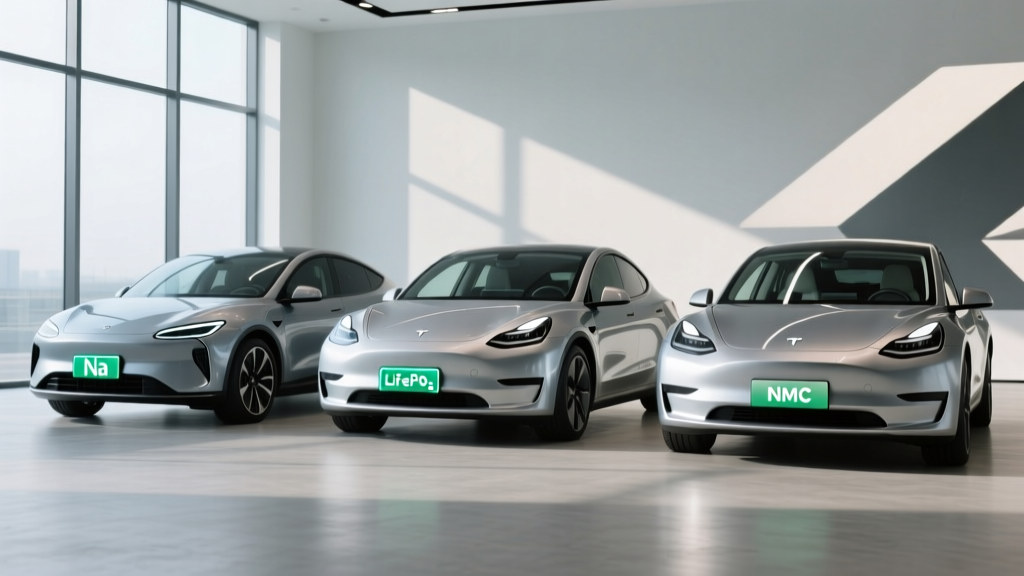
LFP vs NMC vs Sodium-Ion: Chemistry Trade-Offs Explained
Understanding battery chemistry is the single most important factor in predicting your EV's real-world range, longevity, and charging behavior. Here's how the three main chemistries compare:
| Attribute | NMC/NCA (Nickel-based) | LFP (Lithium Iron Phosphate) | Sodium-Ion (Na-ion) |
|---|---|---|---|
| Cell Energy Density | 220–300 Wh/kg | 160–200 Wh/kg | 140–170 Wh/kg |
| Cycle Life (to 80% SoH) | 1,000–2,000 cycles | 2,500–5,000+ cycles | 2,000–4,000+ cycles |
| Cold-Weather Performance | Moderate loss (~20–30% at -20°C) | Moderate loss (~25–35% at -20°C) | Better retention (~10–15% loss at -20°C) |
| Cost per kWh (cell) | $100–$130 | $70–$95 | $50–$75 (projected at scale) |
| Critical Minerals | Nickel, Cobalt, Lithium | Lithium, Iron, Phosphate | Sodium, Iron/Manganese — no lithium |
| Thermal Stability | Lower (requires robust BMS) | Higher (inherently stable) | High (similar to LFP) |
| Typical EV Applications | Long-range, performance models | Standard-range, fleet, budget models | City EVs, budget segments (emerging) |
| Example Vehicles (2026) | Hyundai Ioniq 5, BMW iX, Rivian R1T | Tesla Model 3 RWD, BYD Dolphin, Ford Mustang Mach-E Select | Chery QQ Ice Cream (China), JAC Yiwei E10X |
LFP vs NMC — Which Is Better and Why?
Neither chemistry is universally "better" — the right choice depends on your driving patterns:
Choose NMC/NCA if: You need maximum range per charge (300+ miles), frequently take long road trips, or prioritize performance. The higher energy density means more kWh in a lighter, smaller pack. Trade-offs include faster degradation at high states of charge and higher replacement cost.
Choose LFP if: You primarily commute and charge at home, want the longest possible battery lifespan, or are budget-conscious. LFP tolerates regular charging to 100% without the accelerated degradation that NMC suffers at high SoC. Tesla explicitly recommends charging LFP-equipped Model 3/Y vehicles to 100% at least once per week. The trade-off is lower energy density — meaning heavier packs for the same range, or shorter range for the same pack weight.
Sodium-ion is not yet widely available outside China but is worth watching. Its standout advantage is cold-weather performance and raw-material cost. If you live in a cold climate and mostly drive short distances, Na-ion could become an excellent fit once it reaches global markets — likely 2027 or later for US-spec vehicles.
How Long Do EV Batteries Actually Last? Degradation Data
The fear of a dead battery is the number one barrier to EV adoption — and it's largely overblown. Modern EV batteries are engineered to outlast the vehicle itself in most cases. Here's what the data shows:
Typical Degradation Curve (Industry-Wide Data):
- Year 1: ~2–3% capacity loss (initial "break-in" degradation)
- Years 2–5: ~0.5–1% per year (gradual, linear decline)
- Years 5–8: ~0.5–1.5% per year depending on usage patterns
- Year 8 average: ~88–93% State of Health (SoH) remaining for liquid-cooled packs
- Year 10 projection: ~82–90% SoH for well-maintained packs
Real-world data points from fleet studies and owner reports:
- Tesla Model 3/Y (NMC and LFP): Tesla's 2024 Impact Report showed that Model 3/Y batteries retain approximately 85% of original capacity after 200,000 miles — well beyond the 8-year/120,000-mile warranty threshold.
- Nissan Leaf (passive air-cooled, older models): Earlier Leafs (2011–2017) with air-cooled packs showed notably worse degradation — some losing 20–30% capacity within 5 years in hot climates. This is why liquid thermal management is now standard across the industry.
- Chevrolet Bolt EV/EUV: After the 2022 battery recall and replacement with updated NMC cells, Bolt owners report minimal degradation — typically under 5% loss over 3 years.
- Hyundai/Kia E-GMP platform (Ioniq 5, EV6): These 800V packs with active liquid cooling show approximately 3–5% loss over the first 60,000 miles based on European fleet data.
The takeaway: a modern, liquid-cooled EV battery should comfortably last 150,000–200,000 miles while retaining 80%+ of its original capacity. Many will last the life of the car.
EV Battery Warranty Terms: What's Actually Covered?
Federal law mandates a minimum battery warranty of 8 years/100,000 miles for EVs sold in the US (10 years/150,000 miles in CARB states like California). Most manufacturers exceed these minimums. Here's what the major warranties look like for 2026 model-year vehicles:
| Manufacturer | Warranty Period | Mileage Limit | Capacity Retention Threshold |
|---|---|---|---|
| Tesla (Model 3/Y LFP) | 8 years | 120,000 miles | 70% |
| Tesla (Model S/X) | 8 years | 150,000 miles | 70% |
| Hyundai (Ioniq 5/6) | 8 years | 100,000 miles | 70% |
| Kia (EV6/EV9) | 10 years | 100,000 miles | 70% |
| Ford (Mach-E, F-150 Lightning) | 8 years | 100,000 miles | 70% |
| GM (Ultium-based: Equinox EV, Blazer EV, Silverado EV) | 8 years | 100,000 miles | 70% |
| BMW (iX, i4) | 8 years | 100,000 miles | 70% |
| Rivian (R1T, R1S) | 8 years | 175,000 miles | 70% |
Key warranty details to understand:
- The 70% threshold is the trigger. If your battery drops below 70% of original usable capacity within the warranty period, the manufacturer must repair or replace it — at no cost to you. This is measured by the battery management system (BMS), not by range alone.
- Warranties cover defects AND excessive degradation. It's not just for catastrophic failure. If your pack degrades to 68% SoH at year 7, you're covered.
- Replacement may mean a refurbished pack. Most warranties specify that the replacement battery will have at least 70% capacity — it may not be brand-new. This is standard practice and still restores meaningful range.
- Warranties typically do NOT cover: damage from accidents, flooding, unauthorized modifications, or use of non-approved charging equipment. Read the fine print.
How Much Does an EV Battery Cost to Replace?
Out-of-warranty battery replacement is the scenario that generates the most anxiety — and the most misleading headlines. Here are the actual costs based on 2025–2026 service data and industry estimates:
| Vehicle / Battery Size | Battery Capacity | Replacement Cost Range (parts + labor) | Typical When Needed |
|---|---|---|---|
| Tesla Model 3 RWD (LFP) | ~60 kWh | $12,000–$16,000 | 15+ years / 200,000+ mi (rare) |
| Tesla Model Y Long Range (NMC) | ~75 kWh | $14,000–$20,000 | 15+ years / 200,000+ mi (rare) |
| Hyundai Ioniq 5 (NMC) | ~77.4 kWh | $15,000–$22,000 | 15+ years / 200,000+ mi (rare) |
| Ford F-150 Lightning Extended Range | ~131 kWh | $25,000–$35,000 | 15+ years / 200,000+ mi (rare) |
| Chevrolet Bolt EV | ~65 kWh | $14,000–$18,000 | 15+ years / 200,000+ mi (rare) |
| BMW iX xDrive50 | ~111.5 kWh | $22,000–$30,000 | 15+ years / 200,000+ mi (rare) |
Context that matters:
- Most EV batteries never need replacement. Data from fueleconomy.gov and fleet operators shows that the vast majority of EVs are retired, sold, or totaled before the traction battery fails. Battery replacement is the exception, not the expectation.
- Costs are declining. Battery pack prices have fallen from over $1,000/kWh in 2010 to approximately $115–$130/kWh in 2026 (BloombergNEF data). By the time your pack might actually need replacement in the 2030s, costs will likely be significantly lower.
- Module-level repair is increasingly possible. Many modern packs (especially GM Ultium, Hyundai E-GMP) are designed with individually replaceable modules. A single degraded or faulty module can be swapped for $1,500–$4,000 rather than replacing the entire pack.
Factors That Affect EV Battery Life — and How to Maximize It
Your battery's longevity is heavily influenced by how you use and charge it. Here's a practical, data-backed care guide:
Battery Care Checklist for Maximum Longevity
- Avoid sustained 100% SoC (NMC/NCA only): For nickel-based chemistries, regularly charging to 100% and leaving the car sitting accelerates degradation. Set your daily charge limit to 80% and only charge to 100% when you need the full range for a trip. Note: This does NOT apply to LFP — Tesla and BYD recommend charging LFP to 100% at least weekly for accurate BMS calibration.
- Minimize DC fast charging when possible: Frequent use of 150+ kW DC fast charging generates significant heat. Occasional road-trip fast charging is fine, but daily fast charging can add 1–2% extra annual degradation compared to Level 2 home charging. Use Level 2 (7–11 kW) as your primary charging method.
- Precondition before fast charging: Most EVs automatically precondition the battery when you navigate to a DC fast charger. This warms the pack to the optimal temperature for accepting charge, reducing stress. If your car doesn't auto-precondition, do a few minutes of moderate driving before plugging into a fast charger in cold weather.
- Avoid extreme SoC in extreme temperatures: Don't leave your EV sitting at 100% SoC in 100°F+ heat, and avoid leaving it near 0% SoC in sub-freezing conditions for extended periods. The combination of extreme temperature and extreme SoC is the worst scenario for battery health.
- Use scheduled charging: If you charge at home overnight, set your car to finish charging just before you leave in the morning rather than reaching full charge at 10 PM and sitting at high SoC for 8 hours.
- Keep the battery cool in summer: Park in shade or a garage when possible. Liquid-cooled packs manage this automatically, but reducing ambient heat load still helps.
How to Check Your EV Battery's State of Health (SoH)
State of Health (SoH) is the percentage of your battery's original usable capacity that remains. A new battery is 100% SoH; a battery that has degraded to hold only 70% of its original kWh is at 70% SoH. Here's how to monitor it:
- In-car BMS display: Many EVs display battery health or degradation information in the settings or service menu. Tesla's service mode (accessible via the software screen) shows detailed pack data. Hyundai/Kia models show SoH through the dealer diagnostic tool.
- OBD-II diagnostic tools: Devices like the OBDeleven, Carista, or dedicated EV tools such as the OBD2 dongle paired with apps like ABRP (A Better Route Planner) or LeafSpy (for Nissan Leaf) can read the BMS-reported SoH directly. This is the most reliable DIY method.
- Dealer health check: Most dealerships can perform a battery health report during a service visit. Some manufacturers (BMW, Hyundai) include this in scheduled maintenance.
- Range tracking: While less precise, tracking your real-world range over time at a consistent SoC gives a rough indicator. If your 80% charge used to give you 220 miles and now gives you 200, that suggests approximately 9% degradation. Note that temperature, tire pressure, and driving style all affect this — so track over months, not individual trips.
- Third-party testing: Companies like Geotab and Recurrent offer fleet battery health analytics. Recurrent provides individual EV battery health reports that compare your pack's degradation to a database of thousands of similar vehicles.
Emerging Battery Technologies: What's Next After Sodium-Ion?
Sodium-ion is just one of several next-generation technologies in the pipeline. Here's a realistic timeline for what's coming — with clear distinctions between what's available now and what's still in development:
Solid-State Batteries
Solid-state batteries replace the liquid electrolyte with a solid material (ceramic, sulfide, or polymer), promising higher energy density (potentially 400–500 Wh/kg at the cell level), faster charging, and improved safety. Current status: Toyota has announced a solid-state battery pilot for limited production vehicles around 2027–2028, but mass-market availability remains uncertain. Samsung SDI, QuantumScape, and Solid Power are also in advanced testing. Realistic mass-market timeline: 2029–2032 at the earliest. Do not delay an EV purchase waiting for solid-state — it is not imminent.
Silicon Anode Batteries
Replacing graphite anodes with silicon can boost energy density by 20–40%. Companies like Sila Nanotechnologies and Group14 Technologies are supplying silicon-dominant anode materials to battery makers. Current status: Mercedes-Benz's upcoming G-Class EV (announced for 2025–2026) was expected to feature Sila's silicon anode cells. Partial silicon anodes (5–10% silicon blend) are already in production cells from Panasonic and others. Realistic timeline: Partial silicon anodes are here now; full silicon-dominant anodes at scale: 2027–2029.
Lithium Iron Manganese Phosphate (LMFP)
An evolution of LFP that adds manganese to boost energy density by 15–20% while retaining LFP's safety and cycle-life advantages. CATL and BYD are both developing LMFP cells. Realistic timeline: Initial production vehicles in 2026–2027, primarily in China.
For authoritative and up-to-date information on battery technology standards and safety, the National Highway Traffic Safety Administration (NHTSA) and the US Department of Energy maintain ongoing research programs and publish findings regularly.
Frequently Asked Questions
How long do EV batteries last in years and miles?
Modern liquid-cooled EV batteries typically last 15–20 years or 150,000–200,000+ miles while retaining 80% or more of their original capacity. Fleet data from Tesla, Hyundai, and others confirms that the vast majority of EV batteries outlast the vehicle itself. The 8-year/100,000-mile federal warranty minimum provides a strong backstop, but actual lifespan is significantly longer in most cases.
How much does an EV battery cost to replace?
Out-of-warranty replacement costs range from approximately $12,000 for a smaller pack (60 kWh, like the Tesla Model 3 RWD) to $35,000 for a very large pack (131 kWh, like the F-150 Lightning Extended Range). However, most EV batteries never need replacement. Costs are also declining steadily — by the 2030s, replacement costs are projected to be 30–50% lower than today. Module-level repairs (replacing individual cell modules rather than the full pack) are increasingly available for $1,500–$4,000.
What does the EV battery warranty actually cover?
Federal law requires a minimum 8-year/100,000-mile battery warranty (10 years/150,000 miles in CARB states). The warranty covers both manufacturing defects and excessive capacity degradation — specifically, if your battery drops below 70% of its original usable capacity within the warranty period. The manufacturer must repair or replace the battery at no cost. Some manufacturers, like Kia, offer 10-year/100,000-mile coverage, and Rivian covers up to 175,000 miles.
How do I check and maximize my EV battery health?
Check your State of Health (SoH) through your car's BMS display, an OBD-II diagnostic tool, a dealer health report, or third-party services like Recurrent. To maximize longevity: charge to 80% daily for NMC/NCA (100% for LFP), minimize frequent DC fast charging, precondition the battery before fast charging, avoid leaving the car at extreme SoC in extreme temperatures, and use scheduled charging to minimize time spent at high SoC.
LFP vs NMC — which battery chemistry is better for me?
Choose NMC/NCA if you need maximum range (300+ miles) and take frequent long trips — the higher energy density gives more range in a lighter pack. Choose LFP if you commute, charge at home, and want the longest possible battery lifespan — LFP tolerates 100% charging and offers 2,500–5,000+ cycle life. Sodium-ion, when it becomes widely available outside China, will be an excellent option for budget EVs and cold-climate drivers who don't need 300+ miles of range.
Who makes sodium-ion batteries for electric vehicles?
The major sodium-ion battery manufacturers as of 2026 include CATL (the largest, shipping cells in Chinese EVs), HiNA Battery Technology, Faradion (Reliance Industries), Natron Energy (US-based, focused on fast-charge applications), and Tiamat Energy (France). BYD is also developing Na-ion technology. Sodium-ion EVs are currently available primarily in China, with global expansion expected in 2027 and beyond.