The electric vehicle industry is built on lithium-ion chemistry that has improved incrementally over the past decade. But a fundamental shift in battery materials could unlock significantly more range, faster charging, and lighter packs. One of the most closely watched developments is silicon-anode technology — and Amprius Technologies is among the companies pushing it toward commercial viability for automotive applications.
This guide explains where Amprius Technologies silicon-anode batteries stand in 2026, how they compare to today's dominant chemistries (NMC, NCA, and LFP), what degradation and warranty realities look like for current EV batteries, and when next-generation cells might actually reach your driveway.
Current EV Battery Chemistry: LFP vs. NMC vs. NCA
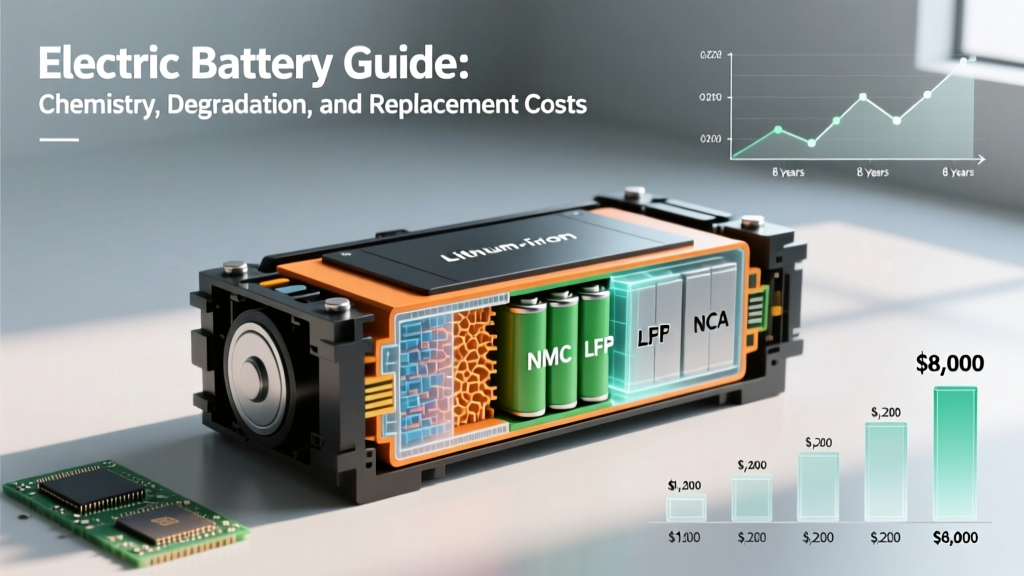
Before evaluating what silicon anodes promise, it helps to understand what's powering EVs today. Nearly every production EV in 2026 uses one of three cathode chemistries paired with a graphite-based anode:
- NMC (Nickel Manganese Cobalt): The workhorse of long-range EVs. Used in the Hyundai Ioniq 5, Ford Mustang Mach-E, and many BMW iX configurations. High energy density (~250–300 Wh/kg at the cell level), but relies on cobalt and nickel — both expensive and supply-constrained.
- NCA (Nickel Cobalt Aluminum): Tesla's long-range chemistry of choice (alongside Panasonic). Similar energy density to NMC with slightly different thermal characteristics.
- LFP (Lithium Iron Phosphate): Lower energy density (~160–200 Wh/kg) but cheaper, longer cycle life, no cobalt or nickel. Used in the base Tesla Model 3 RWD, standard-range BYD models, and the Ford F-150 Lightning standard-range pack. LFP tolerates regular 100% charging better than NMC.
| Attribute | NMC / NCA | LFP |
|---|---|---|
| Cell-level energy density | 250–300 Wh/kg | 160–200 Wh/kg |
| Typical cycle life (to 80% capacity) | 1,000–2,000 cycles | 2,500–5,000+ cycles |
| Cold-weather performance | Better low-temp discharge | More range loss below 32°F; preconditioning critical |
| Recommended daily charge limit | 80% SoC for longevity | 100% SoC acceptable (and recommended periodically for BMS calibration) |
| Raw material cost exposure | High (nickel, cobalt) | Low (iron, phosphate) |
| Common in (2026 models) | Tesla Long Range, Ioniq 5, BMW iX, Rivian R1S | Tesla Model 3 RWD, BYD Dolphin, F-150 Lightning Std Range |
The trade-off is straightforward: NMC/NCA gives you more range in a lighter, smaller pack; LFP gives you a cheaper, longer-lasting pack with slightly less range per kilogram. For most buyers in 2026, this decision is already made at the trim level.
Silicon-Anode Technology: What Amprius Brings to the Table
The anode is the negative electrode in a lithium-ion cell — the side that stores lithium ions during charging. In conventional cells, that anode is made of graphite. Silicon can theoretically store roughly 10 times more lithium per gram than graphite, which is why it has been a target material for battery researchers for over a decade.
The problem has always been mechanical: silicon expands by up to 300% in volume when it absorbs lithium, causing the anode to crack, pulverize, and lose electrical contact over charge cycles. This swelling also stresses the cell packaging and can create safety hazards.
Amprius Technologies has developed a silicon nanowire anode architecture that addresses this expansion issue. Rather than using bulk silicon particles embedded in a graphite matrix (the approach used in small-percentage silicon blends by companies like Sila Nanotechnologies and Group14), Amprius grows silicon nanowires directly on a conductive substrate. The nanowire structure accommodates expansion without pulverization because each wire can swell independently without cracking its neighbors.
Amprius has demonstrated cells with energy densities exceeding 450 Wh/kg and, in laboratory settings, approaching 500 Wh/kg — roughly 60–80% higher than the best NMC cells in production today. For context, that means a pack that currently weighs 500 kg and stores 80 kWh could theoretically shrink to roughly 300 kg for the same energy, or the same weight could store 130+ kWh.
Why Silicon Anodes Matter for EVs
If silicon-anode technology scales to automotive volumes and costs, the implications are significant:
- Range without weight penalty: A mid-size SUV could carry 400+ miles of EPA range without the 1,000+ kWh packs or 5,000+ lb curb weights that current long-range vehicles require.
- Faster charging potential: Silicon anodes can accept lithium ions more rapidly than graphite in certain configurations, potentially enabling sustained high C-rates (charge speeds relative to pack capacity).
- Reduced critical mineral dependency: Replacing graphite (often sourced from China) with domestically produced silicon could simplify supply chains.
- Smaller, lighter packs for the same range: This frees up vehicle design space, lowers tire wear, and improves handling.
However, cycle life, manufacturing cost per kWh, and high-volume yield remain the hurdles. Lab results and aerospace production at $500+/kWh do not translate directly to automotive viability at the $80–100/kWh cell price that mainstream EVs require.
How Long Do Current EV Batteries Actually Last?
One of the most persistent buyer concerns is battery longevity. The data from over a decade of real-world EV operation is reassuring: most modern EV traction batteries outlast the vehicles they're installed in.
Degradation Data Points from the Field
Based on fleet data, owner surveys, and third-party testing through 2025–2026:
- Tesla Model 3/Y (NMC/NCA, 2018–2024): Average degradation of approximately 10–12% after 100,000 miles (~5–6 years of average driving). Early 2018–2019 Model 3 Long Range vehicles show roughly 88–90% capacity retention at 100k miles per data aggregated by Teslanomics and Recurrent Auto.
- Chevrolet Bolt EV/EUV (NMC, 2017–2023): Slower degradation curve, typically 6–9% loss at 80,000 miles. The Bolt's conservative charge management and active liquid cooling contribute to strong longevity.
- Nissan LEAF (passive air-cooled, 2011–2017): A cautionary tale — early LEAFs without active thermal management showed 20–30% capacity loss in hot climates over 8 years. The 2018+ LEAF with larger packs and improved thermal management performs better, but remains an outlier in degradation compared to liquid-cooled competitors.
- LFP-equipped vehicles (Tesla Model 3 RWD, 2021–present): Early data suggests 3–5% degradation over 50,000 miles — consistent with LFP's superior cycle life. Long-term (100k+ mile) data is still accumulating.
What Does the EV Battery Warranty Actually Cover?
Federal law in the United States mandates that EV batteries on certified vehicles carry a minimum warranty of 8 years or 100,000 miles (whichever comes first). In California and states that follow CARB (California Air Resources Board) emissions standards, the requirement extends to 10 years or 150,000 miles for the battery as a emissions-related component.
However, warranty terms vary in what they consider a "defect" versus acceptable degradation:
| Manufacturer | Warranty Period | Capacity Retention Threshold | Notes |
|---|---|---|---|
| Tesla (Model 3/Y Long Range, NMC) | 8 yr / 120,000 mi | 70% | Covers defects and degradation below 70% |
| Tesla (Model 3 RWD, LFP) | 8 yr / 100,000 mi | 70% | Shorter mileage cap on base trim |
| Hyundai / Kia (Ioniq 5, EV6, EV9) | 10 yr / 100,000 mi | 70% | Among the longest time coverage in the industry |
| Ford (Mach-E, F-150 Lightning) | 8 yr / 100,000 mi | 70% | Applies to both NMC and LFP packs |
| GM (Ultium-based: Equinox EV, Blazer EV, Silverado EV) | 8 yr / 100,000 mi | 70% (some trims 60% for fleet) | Verify specific trim terms at purchase |
| Rivian (R1T, R1S) | 8 yr / 175,000 mi | 70% | Highest mileage threshold among major OEMs |
| BMW (i4, iX, i7) | 8 yr / 80,000 mi | 70% | Lower mileage cap than most competitors |
The 70% threshold is critical: the manufacturer will replace or repair the battery only if measured capacity drops below 70% of the original usable kWh within the warranty period. Given typical degradation curves, very few batteries actually fall below this threshold within 8 years/100k miles under normal use — which is why out-of-warranty battery replacements are rare for vehicles less than 10 years old.
EV Battery Replacement Costs: When and How Much
If a battery does need replacement — whether from an uncommon defect, physical damage, or degradation beyond the warranty window — the cost is substantial but often misunderstood.
| Vehicle / Pack Size | Battery Cost (Parts) | Labor | Total Estimated Range |
|---|---|---|---|
| Tesla Model 3 RWD (~60 kWh LFP) | $8,000–$11,000 | $1,500–$2,500 | $9,500–$13,500 |
| Tesla Model Y Long Range (~75 kWh NMC) | $12,000–$16,000 | $2,000–$3,000 | $14,000–$19,000 |
| Ford F-150 Lightning Extended Range (~131 kWh) | $20,000–$28,000 | $2,500–$4,000 | $22,500–$32,000 |
| Hyundai Ioniq 5 (~77 kWh) | $11,000–$15,000 | $1,500–$2,500 | $12,500–$17,500 |
| Chevrolet Bolt EV (~65 kWh) | $9,000–$13,000 | $1,500–$2,500 | $10,500–$15,500 |
| BMW iX xDrive50 (~111 kWh) | $18,000–$25,000 | $2,500–$4,000 | $20,500–$29,000 |
Several important caveats apply to these figures:
- Most batteries never need replacement. Based on Recurrent Auto's fleet data covering over 15,000 EVs, fewer than 1.5% of EVs required a battery replacement within the first 8 years, and most of those were covered under warranty.
- Module-level repair is increasingly common. Many packs can be serviced at the module level (replacing 1–2 degraded modules rather than the entire pack) for $3,000–$7,000, depending on the vehicle.
- Refurbished/remanufactured packs are becoming available through OEM and third-party channels at 30–50% lower cost than new packs.
- The battery usually outlives the car. A 2026 EV with 85% capacity at 150,000 miles still has a functional, drivable battery — just with reduced range. The vehicle's suspension, interior, and electronics are more likely to end its useful life before the battery becomes unusable.
Factors That Accelerate (or Preserve) Battery Health
Not all miles are equal when it comes to battery wear. The following factors have the most measurable impact on long-term capacity retention:
Battery Care Essentials for Maximum Longevity
- Avoid sustained high SoC on NMC/NCA: Charge to 80% for daily driving; reserve 100% charges for road trips. LFP owners should charge to 100% at least weekly to keep the BMS calibrated.
- Minimize DC fast charging when possible: Occasional Supercharging or Electrify America stops are fine — the battery management system limits peak current to protect cells. But daily DC fast charging at 150+ kW accelerates degradation compared to Level 2 home charging. Data from Idaho National Laboratory testing showed that exclusive DC fast charging resulted in roughly 2–3% additional capacity loss over 50,000 miles versus exclusive Level 2 charging.
- Precondition before fast charging: Most modern EVs do this automatically when you navigate to a charger. A warm battery (around 77–95°F / 25–35°C) accepts charge faster and with less stress. Cold batteries that are fast-charged without preconditioning experience lithium plating — a permanent form of degradation.
- Avoid extreme heat exposure: Parking in direct sun in Phoenix or Death Valley for extended periods with a full battery accelerates calendar aging. If you live in a hot climate, charge to 80% or less when the car will sit for days.
- Don't let the battery sit at 0% or near-zero: If storing the vehicle for weeks, leave it at roughly 50% SoC. Deep discharge combined with storage is one of the few scenarios that can cause irreversible cell damage.
- Use regenerative braking wisely: In cold weather, reduced regen is normal and protective — the BMS limits regen current to prevent lithium plating on a cold anode. Don't override this protection.
Monitoring Your Battery's State of Health (SoH)
State of Health (SoH) is the percentage of original capacity your battery currently retains. A new battery is 100% SoH; a battery that held 77.4 kWh when new and now holds 69.7 kWh is at roughly 90% SoH.
How to Check SoH in 2026 EVs
- In-vehicle displays: Tesla provides a battery health estimate in the service menu (software 2025.24+). Hyundai/Kia includes a battery health indicator in the EV settings on the Ioniq 5, EV6, and EV9. BMW's iDrive shows estimated range based on recent consumption, which indirectly reflects SoH.
- OBD-II dongles and apps: Tools like the OBDLink MX+ paired with apps such as EV Battery Health or Car Scanner can read the BMS-reported SoH value directly. This is often the most accurate consumer-accessible method.
- Third-party services: Companies like Recurrent Auto offer battery health reports based on connected vehicle data, often available free through participating fleets or for a small fee for individual owners.
- Dealer diagnostics: A service center can run a full capacity test (charge to 100%, discharge under controlled conditions) — but this is time-consuming and rarely needed unless you're contesting a warranty claim.
For buyers evaluating a used EV, SoH is the single most important data point. A 2021 Tesla Model 3 Long Range at 92% SoH with 45,000 miles is a far better battery proposition than one at 84% SoH — even if the exterior condition is identical. Always request the SoH reading before purchasing.
Emerging Battery Technologies: Beyond Silicon Anodes
Amprius's silicon-anode cells are one piece of a broader wave of next-generation battery R&D. Here's how the major emerging technologies stack up on realistic timelines:
- Silicon-dominant anodes (Amprius, Sila, Group14): Currently in production for niche applications (aerospace, consumer electronics). Automotive-scale cells with 20–40% silicon content (blended with graphite) may reach limited production vehicles by 2027–2028. Full silicon-anode packs at automotive cost are a 2029–2032 prospect, optimistically.
- Solid-state batteries (Toyota, QuantumScape, Samsung SDI): Toyota has announced a solid-state battery targeting 2027–2028 production in limited vehicles, claiming 450+ mile range and 10-minute fast charging. QuantumScape has demonstrated prototype cells to Volkswagen but has not reached volume production. Solid-state replaces the liquid electrolyte with a solid material, improving safety and potentially energy density, but manufacturing challenges remain enormous.
- Sodium-ion batteries (CATL, BYD): Already in limited production in Chinese-market vehicles (e.g., BYD Seagull sodium-ion variant). Lower energy density than lithium-ion but dramatically cheaper and free of lithium, cobalt, and nickel. Best suited for city cars and budget segments. Unlikely to appear in US-market vehicles before 2028 due to supply chain and regulatory differences.
- Lithium-sulfur (Li-S): Theoretical energy density 3–5x current lithium-ion, but cycle life remains far too low (typically under 200 cycles in lab conditions). Still a research-stage technology with no announced production timeline for automotive use.
The honest assessment: today's NMC and LFP batteries are mature, reliable, and improving incrementally every model year. Next-generation chemistries will arrive in stages — first in premium and niche applications, then gradually in mainstream vehicles. If you're buying an EV in 2026, current battery technology is not a compromise; it's a proven platform with strong longevity data.
Frequently Asked Questions
How long do EV batteries last in years and miles?
Based on fleet data through 2025, a typical liquid-cooled NMC battery retains 80–85% of its original capacity at 150,000 miles (roughly 10–12 years of average driving). LFP batteries are tracking toward 90%+ retention at the same mileage. Very few batteries fail catastrophically — degradation is gradual, and the battery remains functional well beyond the point where it would trigger a warranty replacement.
How much does it cost to replace an EV battery out of warranty?
Full pack replacement ranges from roughly $10,000 for a smaller pack (Chevrolet Bolt, ~65 kWh) to $25,000–$32,000 for large packs (F-150 Lightning Extended Range, ~131 kWh). However, fewer than 1.5% of EVs require replacement within 8 years, and module-level repairs can reduce costs to $3,000–$7,000 in many cases. Most batteries outlive the vehicle.
What does the EV battery warranty cover?
All major manufacturers warranty the traction battery for at least 8 years / 100,000 miles against defects and degradation below 70% of original capacity (some OEMs use 60% for fleet vehicles). In CARB states, coverage extends to 10 years / 150,000 miles. The warranty covers the cost of parts and labor if the battery falls below the threshold — but normal gradual degradation above 70% is expected and not covered.
How do I check my EV battery's State of Health?
Use the vehicle's built-in battery health display (available on Tesla, Hyundai/Kia, BMW, and others), an OBD-II scanner with an EV-compatible app like Car Scanner, or a third-party service like Recurrent Auto. For used-EV purchases, always verify SoH before committing — it's the most important indicator of remaining battery life.
LFP vs. NMC — which battery chemistry is better for me?
Choose LFP if you want lower cost, longer cycle life, the ability to charge to 100% daily without concern, and don't need maximum range (LFP packs are heavier for the same kWh). Choose NMC/NCA if you need the longest possible range in the lightest package, regularly drive in very cold climates (better low-temp performance), or want the fastest DC charging speeds. Neither is universally "better" — it depends on your driving profile and priorities.
When will Amprius silicon-anode batteries be in production EVs?
Amprius Technologies currently produces silicon-anode cells for aerospace and defense applications, where energy density justifies high per-kWh costs. The company has announced roadmaps targeting automotive-relevant cells, but no 2026 production vehicle uses a full Amprius silicon-anode pack. Realistic expectations for silicon-dominant anode technology in mainstream EVs are 2028–2032, with initial adoption likely in premium or performance segments.