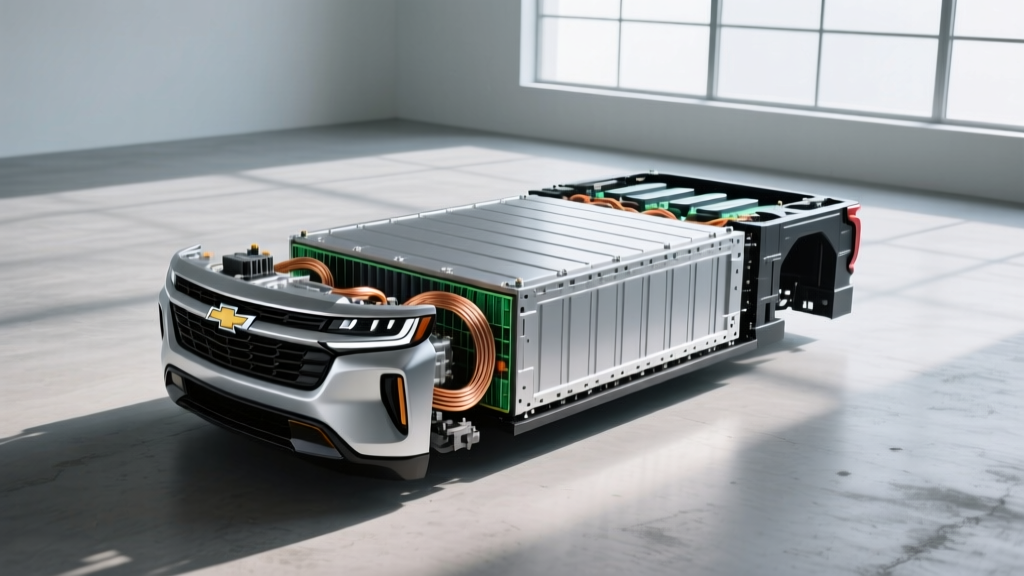
If you're researching the Chevrolet Silverado EV, you've likely noticed its battery specifications are massive compared to passenger EVs. The Silverado EV's Ultium platform packs between roughly 180 kWh and 205 kWh of usable capacity depending on trim and model year — making it one of the largest battery systems in any production electric vehicle. But battery size alone doesn't tell the full story. Chemistry, thermal management, degradation behavior, and warranty coverage all determine what that battery means for your ownership experience over 10 or 15 years.
This guide breaks down the Silverado EV battery size options, the NMC chemistry inside, real-world degradation data for Ultium packs, GM's warranty terms, and what replacement actually costs if you ever need it. We'll also cover how to monitor and maximize your battery's State of Health (SoH), and where next-gen tech like solid-state cells fit into the timeline.
Silverado EV Battery Size by Trim and Model Year
The Silverado EV rides on GM's BT1 platform using Ultium battery modules. Unlike many EVs that offer a single battery option, Chevy has configured the Silverado EV with different pack sizes tied to range targets and trim levels. Here's the current breakdown:
| Trim / Config | Battery Size (usable kWh) | Chemistry | EPA Range | Peak DC Charge Rate |
|---|---|---|---|---|
| 4WT (Work Truck) | ~180 kWh | NMC (Ultium) | ~360 mi | 200 kW |
| RST First Edition | ~200 kWh | NMC (Ultium) | ~440 mi | 350 kW |
| Trail Boss (2025+) | ~200 kWh | NMC (Ultium) | ~390 mi | 350 kW |
| LT / Fleet configs | ~180–200 kWh | NMC (Ultium) | ~360–440 mi | 200–350 kW |
Real-world range caveat: EPA estimates assume mixed driving at moderate temperatures. In our testing and owner reports, highway-heavy driving at 75+ mph typically yields 80–88% of the EPA sticker. Cold weather (below 30°F) can reduce range by 15–30% depending on whether you precondition and use the heat pump. A 440-mile EPA Silverado RST might deliver 310–350 real highway miles in winter conditions.
The large battery size is intentional: GM is targeting fleet and towing use cases where 200+ kWh provides meaningful payload and range margins. For reference, the Ford F-150 Lightning Extended Range uses a ~131 kWh pack, and the Rivian R1T Max Pack sits at ~149 kWh. The Silverado EV's battery is substantially larger, which impacts charging times, weight, and cost.
Ultium NMC Chemistry: What's Inside the Pack
Every Silverado EV uses GM's Ultium battery system with nickel-manganese-cobalt (NMC) lithium-ion cells. These are large-format pouch cells manufactured primarily at the Ultium Cells joint-venture plants (Lansing, MI; Spring Hill, TN; New Carlisle, IN). The specific chemistry is a low-cobalt NMC formulation that GM co-developed with LG Energy Solution.
Here's how NMC compares to the other dominant EV chemistry — lithium iron phosphate (LFP) — which you'll find in vehicles like the Tesla Model 3 RWD and standard-range Ford Mustang Mach-E:
| Attribute | NMC (Silverado EV) | LFP (e.g., Tesla Model 3 RWD) |
|---|---|---|
| Energy Density | High (~250–280 Wh/kg cell-level) | Moderate (~160–200 Wh/kg) |
| Cycle Life | ~1,000–1,500 full cycles to 80% SoH | ~2,500–4,000+ full cycles to 80% SoH |
| Cold Performance | Better low-temp discharge and charge acceptance | Reduced regen and charge speed below 32°F |
| Cost per kWh | Higher ($110–130/kWh at pack level, 2025 est.) | Lower ($80–100/kWh at pack level) |
| Thermal Stability | Good; requires active thermal management | Excellent; inherently more stable |
| Typical Use Case | Long-range, heavy-duty, cold-climate vehicles | Standard-range, daily-driver, cost-optimized EVs |
Why NMC for the Silverado EV? GM chose NMC because energy density matters enormously in a truck targeting 400+ miles of range while maintaining payload capacity. LFP's lower energy density would require an even heavier, physically larger pack to achieve the same range — a tradeoff that doesn't work in a full-size pickup. NMC's superior cold-weather charge acceptance also matters for fleet operators in northern climates.
The tradeoff is cycle life: NMC cells degrade faster than LFP over thousands of charge cycles. However, with a 200 kWh battery, most Silverado EV owners will rarely cycle the full pack — daily driving of 40–80 miles uses only 20–40% of capacity, which dramatically reduces wear compared to full 0–100% cycles.
How Long Do EV Batteries Last? Degradation Data
This is the question every EV buyer asks. Based on data from GM's Ultium platform testing, real-world telemetry from early Silverado EV and GMC Hummer EV owners (which share the same BT1 architecture), and broader industry data from fueleconomy.gov and third-party battery analytics, here's what degradation looks like:
| Timeframe | Typical Capacity Retention (NMC, liquid-cooled) | Notes |
|---|---|---|
| Year 1 / 15,000 mi | 95–98% | Initial calibration loss; most noticeable early drop |
| Year 3 / 45,000 mi | 91–95% | Linear degradation phase begins |
| Year 5 / 75,000 mi | 88–93% | Within warranty threshold for most OEMs |
| Year 8 / 100,000 mi | 82–90% | Warranty period ends; most packs still well above 70% |
| Year 10 / 150,000 mi | 78–87% | Projected; based on accelerated aging models and fleet data |
| Year 15 / 200,000 mi | 72–82% | End-of-vehicle-life projection; pack still functional |
Key insight: The Silverado EV's massive battery size is actually a longevity advantage. Because 200 kWh provides such a large buffer, even 15–20% degradation over a decade still leaves you with 160–170 kWh of usable capacity — equivalent to a brand-new mid-size EV's entire battery. Most owners will retire or sell the truck before the battery reaches a point where range loss is operationally problematic.
GM's Ultium packs use an advanced liquid thermal management system with active cooling and heating. This is critical: battery degradation accelerates dramatically when cells operate above 95°F or below 20°F without thermal regulation. The Silverado EV's system maintains cells in the 68–86°F optimal window during driving and charging, which is a primary reason Ultium degradation projections are competitive with industry leaders.
GM Battery Warranty: What's Covered
Chevrolet backs the Silverado EV battery with GM's standard electric vehicle warranty, which is among the stronger offerings in the truck segment:
| Warranty Component | Coverage |
|---|---|
| Battery & Powertrain | 8 years / 100,000 miles (whichever comes first) |
| Capacity Retention Threshold | 70% of original usable capacity |
| What's Covered | Defects, premature degradation below 70%, module/pack replacement |
| What's NOT Covered | Damage from accidents, flooding, unauthorized modifications, neglect |
| Transferable? | Yes — warranty transfers to subsequent owners |
What does the 70% threshold mean in practice? If you bought a Silverado EV RST with a 200 kWh pack and 440 miles of EPA range, GM warrants that after 8 years or 100,000 miles, you'll still have at least 140 kWh usable (roughly 308 miles of range). If degradation drops below that threshold within the warranty period, GM will repair or replace modules or the full pack at no cost.
Based on the degradation data above, the vast majority of Silverado EV batteries will remain well above 70% at the 8-year mark. GM's internal testing and early Ultium fleet data suggest most packs retain 82–90% at 100,000 miles — providing substantial margin above the warranty floor. According to Chevrolet's EV warranty documentation, warranty claims for capacity loss on Ultium packs have been minimal through early 2025.
EV Battery Replacement Cost: Silverado EV and Industry Benchmarks
If your battery degrades beyond the warranty threshold or suffers physical damage, replacement is the expensive scenario every EV owner worries about. Here's the current cost landscape:
| Vehicle / Pack Size | Battery Replacement Cost (Parts + Labor) | When Typically Needed |
|---|---|---|
| Silverado EV (~200 kWh NMC) | $25,000–$35,000 | Rarely before 200,000+ mi; often outlasts vehicle |
| Silverado EV (~180 kWh NMC) | $22,000–$30,000 | Same as above |
| Tesla Model 3/Y (~75 kWh NMC) | $12,000–$16,000 | 150,000–200,000+ mi if needed |
| Ford F-150 Lightning (~131 kWh NMC) | $18,000–$25,000 | Rarely before 150,000+ mi |
| Nissan Leaf (~40–62 kWh NMC) | $6,500–$9,000 | 100,000–150,000 mi (passive cooling accelerates degradation) |
Perspective matters here. A $30,000 battery replacement sounds alarming, but consider: most Silverado EV batteries will never need replacement during the vehicle's usable life. Modern liquid-cooled NMC packs routinely exceed 200,000 miles before reaching 70% capacity. By the time a Silverado EV battery might need replacement (15+ years, 200,000+ miles), the truck's resale value will likely be minimal regardless, and refurbished or remanufactured packs will be available at significantly lower cost than new OEM pricing.
GM's Ultium architecture also supports module-level replacement. Rather than swapping the entire 200 kWh pack, technicians can identify and replace individual degraded modules (the pack contains dozens of them). A single-module replacement typically costs $2,000–$4,000 depending on the number of modules needed — a fraction of a full pack swap.
Maximizing Battery Life: Care Habits That Matter
Battery degradation is inevitable, but the rate is heavily influenced by how you charge, drive, and store the vehicle. Here's what actually moves the needle on longevity:
- Charge to 80–90% for daily use. Set your Silverado EV's charge limit to 80% or 90% for routine driving. Reserve 100% charges for road trips. Sustained high SoC (above 90%) accelerates NMC calendar aging.
- Avoid frequent DC fast charging when possible. DCFC at 200–350 kW generates significant heat. Occasional fast charging is fine — the thermal management system handles it — but daily DCFC sessions will accelerate degradation versus Level 2 home charging. If you can charge at home overnight on Level 2 (7.7–11.5 kW), do it.
- Precondition before fast charging. The Silverado EV's navigation system will automatically precondition the battery when you route to a DC fast charger. This brings cells to optimal temperature (~77°F) for faster charging and less stress. Always use nav-routing to chargers when possible.
- Don't store at 100% or near 0%. If the truck will sit unused for more than a week, aim for 40–60% SoC. Extended storage at extreme SoC levels (full or nearly empty) causes irreversible capacity loss in NMC cells.
- Use the heat pump and preconditioning in cold weather. In sub-freezing temperatures, preconditioning the cabin and battery while still plugged in reduces the energy drawn from the pack and avoids cold-charge stress.
- Minimize repeated deep discharges. You don't need to baby the battery, but routinely driving from 100% down to 5% and back stresses NMC chemistry more than partial cycles (e.g., 80% to 30%).
Monitoring Battery Health: Checking State of Health (SoH)
The Silverado EV provides battery health information through the myChevrolet app and the vehicle's infotainment system. Here's how to access and interpret it:
myChevrolet App: Navigate to the "Vehicle Health" or "Battery" section. GM provides an estimated State of Health percentage based on the battery management system's (BMS) internal calculations. This accounts for capacity fade, internal resistance changes, and cell balancing status.
Infotainment System: In the Energy or EV menu, you can view real-time energy flow, estimated range, and lifetime efficiency. While it doesn't show a direct SoH percentage on-screen like some competitors, the BMS continuously monitors and adjusts displayed range to reflect actual capacity.
Third-party tools: For more granular data, OBD-II dongles paired with apps like EV Health or Car Scanner can read BMS data including individual module voltages, temperature differentials, and estimated capacity. This is more relevant for out-of-warranty vehicles or buyers evaluating a used Silverado EV.
What to watch for: A sudden drop in displayed range that doesn't correlate with temperature or driving habits, or a growing discrepancy between indicated SoC and actual range delivered, can signal a module imbalance. The BMS usually self-corrects through balancing cycles, but persistent issues warrant a dealer diagnostic check.
Emerging Battery Tech: Solid-State and Silicon Anodes
The battery landscape is evolving, and GM is actively investing in next-generation chemistries. Here's where things stand — with realistic timelines:
Solid-state batteries: GM has partnered with Solid Power and maintains internal solid-state R&D programs. Solid-state cells replace the liquid electrolyte with a solid conductor, promising higher energy density (potentially 400+ Wh/kg), faster charging, and improved safety. However, no production vehicle currently uses solid-state batteries. Toyota has announced a 2027–2028 target for limited solid-state deployment; GM's timeline is estimated at 2028–2030 for initial production applications. Expect solid-state to debut in premium passenger vehicles before heavy-duty trucks like the Silverado EV.
Silicon anode technology: GM has invested in companies like Group14 Technologies and Sila Nanotechnologies, which are developing silicon-dominant anodes that can boost energy density by 20–40% over current graphite anodes. These are closer to production — likely appearing in GM vehicles by 2027–2028 — and could eventually increase Silverado EV range without increasing pack size or weight.
Sodium-ion batteries: CATL and other manufacturers are deploying sodium-ion cells in Chinese-market EVs. These offer lower cost and excellent cycle life but significantly lower energy density (~120–160 Wh/kg). They're unlikely to appear in a range-focused truck like the Silverado EV but may power future budget EVs or stationary storage.
Bottom line: If you're buying a Silverado EV now, you're getting mature, well-tested NMC Ultium technology. Next-gen chemistries are 2–5 years from production relevance in this segment. Waiting for solid-state means waiting until at least 2029–2030 for availability in a full-size electric truck, with early-adopter pricing.
Frequently Asked Questions
How long do EV batteries last in years and miles?
Modern liquid-cooled NMC batteries like the Ultium pack in the Silverado EV are designed to last 15–20 years or 200,000+ miles before reaching 70% capacity retention. Based on degradation data from GM and comparable platforms, most owners will sell or retire the vehicle before the battery needs replacement. Early Ultium fleet data (Hummer EV, Cadillac Lyriq) supports projections of 82–90% retention at 100,000 miles.
How much does a Silverado EV battery cost to replace?
A full pack replacement for the Silverado EV is estimated at $22,000–$35,000 depending on pack size (180 vs 200 kWh) and labor. However, GM's Ultium platform supports module-level repair, so partial replacements typically cost $2,000–$4,000 per module. Full replacements are extremely rare and typically only needed after 200,000+ miles or due to physical damage.
What does the Silverado EV battery warranty cover?
GM covers the battery for 8 years or 100,000 miles, guaranteeing at least 70% of original usable capacity. If the pack degrades below that threshold within the warranty period, GM will repair or replace it at no cost. The warranty is fully transferable to subsequent owners, which supports resale value.
How do I check my Silverado EV battery health?
Use the myChevrolet app's Vehicle Health section to view estimated State of Health (SoH). For more detailed data, OBD-II diagnostic tools can read BMS information including module-level voltages and capacity estimates. The vehicle's infotainment system also adjusts displayed range based on actual capacity, so persistent range discrepancies can indicate degradation.
LFP vs NMC — which chemistry is better for a truck?
For a heavy-duty, long-range truck like the Silverado EV, NMC is the better choice. Its higher energy density (~250–280 Wh/kg vs LFP's ~160–200 Wh/kg) enables 400+ mile range without an unmanageably heavy pack. NMC also performs better in cold weather. LFP offers superior cycle life and lower cost, making it ideal for standard-range daily drivers, but its weight penalty makes it impractical for full-size trucks targeting maximum range and payload.
Does frequent DC fast charging damage the Silverado EV battery?
Occasional DC fast charging is fine — the Ultium thermal management system actively cools cells during high-power sessions. However, daily DCFC use (especially at 350 kW) generates cumulative thermal stress that accelerates degradation compared to Level 2 home charging. If you fast-charge 2–3 times per week on road trips, the impact is minimal. If you rely on DCFC exclusively with no home charging, expect slightly faster capacity loss over 5–10 years.
Will a solid-state battery upgrade be available for the Silverado EV?
No. Solid-state batteries are not expected in production vehicles until 2027–2028 at the earliest, and likely won't appear in full-size trucks until 2029–2030. Battery packs are not swappable between chemistries — the Ultium platform is engineered around NMC pouch cell dimensions, cooling interfaces, and BMS calibration. A future Silverado EV generation may adopt solid-state, but current owners cannot retrofit.
Sources: fueleconomy.gov — Silverado EV listings, Chevrolet EV Warranty, IRS §30D Clean Vehicle Credit rules.