Sodium-ion batteries — often colloquially called "salt batteries" — have generated significant buzz as a potential low-cost, cobalt-free alternative to lithium-ion cells. But with EV buyers facing real decisions today about LFP versus NMC chemistries, battery longevity, and replacement economics, it's critical to separate what's in the lab from what's in the driveway. This guide covers where salt battery technology stands in 2026, how it compares to proven lithium chemistries, and everything current and prospective EV owners need to know about battery health, degradation, warranties, and replacement costs.
What Is Salt Battery Technology (Sodium-Ion)?
When people search for "salt battery technology," they're almost always referring to sodium-ion (Na-ion) batteries. Sodium sits directly below lithium on the periodic table, shares similar electrochemical properties, and is abundantly available — sodium chloride is, after all, table salt. Instead of shuttling lithium ions between cathode and anode, sodium-ion cells shuttle sodium ions.
The appeal is straightforward: sodium is roughly 1,000x more abundant than lithium in the Earth's crust, doesn't require mining from concentrated brine or hard-rock spodumene deposits, and can be paired with aluminum current collectors on the cathode side (lithium cells require copper, which is expensive). Several Chinese manufacturers — notably CATL, HiNa Battery, and Farasis Energy — have begun limited production of sodium-ion cells for energy storage and light electric vehicles.
However, as of 2026, no mass-market EV sold in the United States uses sodium-ion traction batteries. The technology remains in early commercial deployment, primarily in two-wheeled electric scooters, micro-EVs in China (like certain Chery and JAC city cars), and grid-scale stationary storage. The energy density gap remains the fundamental barrier for full-size EVs.
LFP vs NMC vs Sodium-Ion: Chemistry Trade-Offs
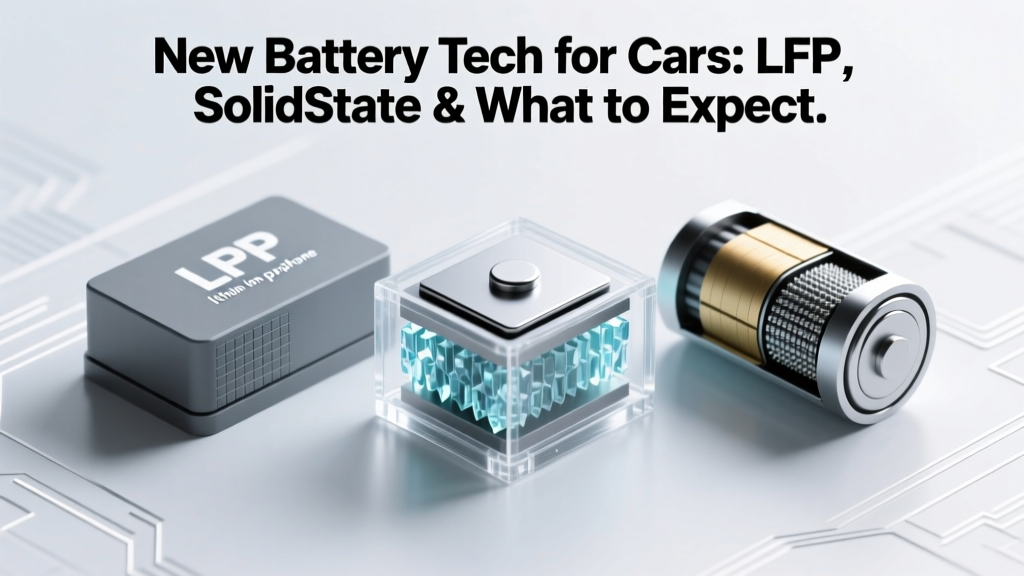
Understanding where sodium-ion fits requires comparing it against the two dominant lithium-ion chemistries powering today's EVs: LFP (lithium iron phosphate) and NMC/NCA (nickel manganese cobalt / nickel cobalt aluminum).
| Attribute | LFP (LiFePO₄) | NMC/NCA | Sodium-Ion (Na-ion) |
|---|---|---|---|
| Cell-Level Energy Density | 160–180 Wh/kg | 220–300 Wh/kg | 120–160 Wh/kg |
| Cycle Life (to 80% SoH) | 3,000–6,000 cycles | 1,000–2,500 cycles | 2,000–4,000 cycles |
| Cold Performance (-20°C capacity retention) | ~55–65% | ~65–75% | ~75–85% |
| Raw Material Cost Index | Medium (no cobalt/nickel) | High (nickel, cobalt) | Low (abundant sodium, aluminum) |
| Thermal Stability | Excellent (resists thermal runaway) | Good (requires robust BMS) | Excellent (can discharge to 0V safely) |
| Fast-Charging Tolerance | Good (up to ~3C sustained) | Very Good (up to ~4C peak) | Moderate (1.5–2C typical) |
| Current US EV Availability | Wide (Tesla Model 3/Y RWD, Ford Mustang Mach-E Select, many others) | Wide (most long-range/AWD trims) | None in US passenger EVs |
Key takeaway: LFP offers the best combination of longevity, safety, and cost for most buyers who don't need maximum range. NMC/NCA delivers the highest energy density for long-range and performance applications. Sodium-ion promises lower material costs and excellent cold-weather behavior but can't yet match lithium energy density — meaning a sodium-ion pack large enough for 300+ miles of range would be significantly heavier and bulkier than an equivalent LFP pack.
LFP vs NMC — Which Is Better and Why?
There's no universal winner; the right chemistry depends on your ownership pattern:
Choose LFP if:
- You charge at home nightly and can routinely charge to 100% (LFP tolerates full-SoC storage far better than NMC)
- You plan to keep the vehicle 8+ years and prioritize cycle life
- You live in a moderate climate where cold-weather range loss is manageable
- Your daily driving is under 200 miles and you don't need maximum single-charge range
Choose NMC/NCA if:
- You need 300+ miles of EPA range for road trips or long commutes
- You frequently drive in cold climates and need better low-temperature energy retention
- You prioritize performance (higher energy density enables lighter packs for the same range)
- You're comfortable charging to 80% daily and only going to 100% before long trips
Real-world example: The 2026 Tesla Model 3 Rear-Wheel Drive uses a ~60 kWh LFP pack (EPA 272 miles), while the Long Range AWD variant uses a ~79 kWh NMC pack (EPA 363 miles). The LFP car is roughly $6,000 cheaper at base MSRP, weighs less, and will likely show slower degradation at the 100,000-mile mark — but gives up 91 miles of rated range.
How Long Do EV Batteries Last?
The data on lithium-ion EV battery longevity has become robust enough to state with confidence: most modern EV traction batteries will outlast the vehicle they're installed in.
- Tesla Model 3/Y (NMC, 2018–2023): Fleet data aggregated by Tesla shows median degradation of approximately 12% at 150,000 miles. That means a 350-mile EPA car retains roughly 308 miles of range at that mileage (source: Tesla 2023 Impact Report).
- Nissan LEAF (LMO/NMC, 2011–2025): Early air-cooled LEAFs showed 20–30% degradation by year 8 in hot climates. The 2018+ LEAF with active thermal management shows significantly better retention — approximately 10–15% loss at 100,000 miles.
- Chevrolet Bolt EV/EUV (NMC, 2017–2025): Owner surveys indicate 5–8% degradation at 60,000 miles with the liquid-cooled 65 kWh pack. The Bolt's conservative charge management and robust thermal system contribute to strong longevity.
- LFP-equipped vehicles (Tesla Model 3 RWD, BYD models): LFP packs are showing 3–5% degradation at 50,000 miles in fleet data, consistent with the chemistry's 3,000+ cycle-life rating.
For context, the average US driver covers ~13,500 miles per year according to the Federal Highway Administration. At that rate, a 150,000-mile battery lifespan represents over 11 years of driving — and most degradation curves flatten significantly after the initial 5–10% loss in the first year or two.
What Does the Battery Warranty Cover?
Federal law mandates that EV battery warranties cover a minimum of 8 years / 100,000 miles (whichever comes first). In California Air Resources Board (CARB) states, the requirement extends to 10 years / 150,000 miles. Manufacturers uniformly guarantee that the battery will retain a minimum percentage of its original capacity — typically 70% — over the warranty period.
| Vehicle | Warranty Term | Capacity Retention Threshold | Chemistry |
|---|---|---|---|
| Tesla Model 3 RWD | 8 yr / 100,000 mi | 70% | LFP |
| Tesla Model 3 Long Range | 8 yr / 120,000 mi | 70% | NMC |
| Hyundai Ioniq 5 | 10 yr / 100,000 mi | 70% | NMC |
| Ford Mustang Mach-E | 8 yr / 100,000 mi | 70% | NMC (ext. range) / LFP (std.) |
| Chevrolet Equinox EV | 8 yr / 100,000 mi | 60% (modules) / 70% (pack) | NMC |
| Rivian R1T / R1S | 8 yr / 175,000 mi | 70% | NMC |
What triggers a warranty claim: If your battery's State of Health (SoH) drops below the threshold — say 70% of original capacity — within the warranty period, the manufacturer must repair or replace the battery at no cost. In practice, many OEMs will first attempt module-level replacement (swapping degraded modules within the pack) before replacing the entire pack.
What's typically excluded: Physical damage (collision, flooding), unauthorized modifications, and damage from using non-approved charging equipment. Normal degradation above the threshold is not covered — a battery at 72% SoH after 9 years is functioning within warranty terms even if range has noticeably decreased.
How Much Does an EV Battery Cost to Replace?
This is the question that generates the most anxiety — and the most misinformation. Let's look at actual replacement costs with critical context.
| Vehicle | Pack Size | Estimated Replacement Cost (Parts + Labor) | When Typically Needed |
|---|---|---|---|
| Nissan LEAF (40 kWh) | 40 kWh | $6,500–$9,000 | Rarely; most packs last vehicle life |
| Chevrolet Bolt EV (65 kWh) | 65 kWh | $9,000–$14,000 | Post-warranty, 150,000+ mi |
| Tesla Model 3 (LFP, ~60 kWh) | ~60 kWh | $8,000–$12,000 | Rarely within vehicle life |
| Tesla Model Y LR (NMC, ~79 kWh) | ~79 kWh | $12,000–$16,000 | Rarely within vehicle life |
| Ford F-150 Lightning (ext. range) | ~131 kWh | $18,000–$28,000 | 200,000+ mi if at all |
| Mercedes EQS (107.8 kWh) | ~108 kWh | $22,000–$32,000 | Very rare; luxury segment low volume |
The critical context most coverage omits: Out-of-pocket battery replacement is exceedingly rare. According to a Consumer Reports analysis, fewer than 5% of EVs have required traction battery replacement, and the vast majority of those replacements were covered under warranty. The battery packs in liquid-cooled modern EVs are proving far more durable than early predictions suggested.
Additionally, pack-level costs have dropped roughly 90% since 2010 (per BloombergNEF data), and module-level repairs — replacing only the degraded cells rather than the entire pack — are becoming standard practice at OEM service centers, reducing out-of-warranty costs substantially.
Factors That Affect EV Battery Life
While modern battery management systems (BMS) handle most protection automatically, owner habits still influence long-term degradation rates. The data from fleet operators and owner communities points to these primary factors:
- Avoid sustained high SoC (NMC/NCA only): For NMC packs, set your daily charge limit to 80%. LFP packs should be charged to 100% regularly — their degradation curve actually benefits from full charges, and the BMS needs 100% for accurate cell balancing.
- Minimize DC fast charging when possible: Occasional DCFC is fine, but daily use of 150+ kW chargers accelerates degradation. Research from the Idaho National Laboratory showed that vehicles charged exclusively via DC fast charging showed approximately 10% more degradation at 50,000 miles compared to Level 2-only charging. Use Level 2 (7–11 kW) at home as your primary method.
- Precondition before fast charging: Most modern EVs automatically precondition the battery when you navigate to a DC fast charger. This heats or cools the cells to the optimal ~35–40°C range, which reduces lithium plating risk and allows the pack to accept peak charge rates. A cold battery forced to accept 150 kW will degrade faster.
- Avoid extreme SoC storage: Don't leave an NMC vehicle sitting at 100% for days, and don't store any EV below 10% SoC for extended periods. If storing for weeks, target 50–60% SoC.
- Extreme heat is worse than extreme cold: Sustained ambient temperatures above 95°F (35°C) accelerate electrolyte decomposition. Garage parking in hot climates measurably extends battery life. Cold temperatures reduce range temporarily but don't cause permanent degradation unless you fast-charge a frozen pack without preconditioning.
- Don't obsess over it: The BMS manages charge rate taper, cell balancing, and thermal limits. Modern EVs are engineered to tolerate normal use patterns. The difference between "optimal" and "normal" care typically amounts to 2–5% additional capacity retention over 10 years — not a reason to sacrifice usability.
How to Check and Monitor Battery Health (SoH)
State of Health (SoH) represents the battery's current maximum capacity as a percentage of its original capacity when new. A car with 90% SoH that originally had a 75 kWh usable pack now holds approximately 67.5 kWh at full charge.
OEM apps and in-vehicle displays: Most modern EVs provide battery health information through the manufacturer's connected app or service menu. Tesla's app shows estimated range at 100% (which you can compare to the original EPA figure). Hyundai/Kia's Bluelink/UVO system includes a battery health indicator. BMW's iDrive displays SoH percentage in the service menu.
OBD-II diagnostic tools: Third-party tools like LeafSpy (for Nissan LEAF), TeslaFi (for Tesla), and ABRP's OBD dongle can read detailed battery telemetry including individual cell voltages, pack impedance, and calculated SoH. These tools read the same CAN-bus data the OEM service centers use.
Dealer diagnostics: Any authorized dealer can run a full battery health report, typically during routine service visits. If you're approaching a warranty mileage threshold and suspect excessive degradation, request a formal SoH test — this creates a documented record for any potential warranty claim.
The real-world range method: The simplest approach requires no tools. Charge to 100% (or your normal limit), note the displayed range, and compare it to the range displayed at the same SoC when the vehicle was new. Account for seasonal temperature differences — winter range will always be lower due to cabin heating demand and increased battery resistance, not degradation.
Emerging Battery Tech: Solid-State, Silicon Anode, and Sodium-Ion Timelines
Beyond sodium-ion ("salt battery technology"), several next-generation chemistries are in development. Here's where they stand with realistic, not marketing-driven, timelines:
Solid-state batteries: Replace the liquid electrolyte with a solid ceramic, polymer, or sulfide conductor, potentially doubling energy density and eliminating thermal runaway risk. Toyota has announced a 2027–2028 production target for a limited-run solid-state EV, and QuantumScape is shipping prototype cells to automotive partners. However, manufacturing yield challenges and cost remain significant barriers. Realistic mass-market timeline: 2030+ for broad availability, likely debuting in premium segments first.
Silicon anode batteries: Replacing graphite anodes with silicon can increase energy density by 20–40%. Companies like Sila Nanotechnologies and Group14 are already shipping silicon-dominant anode materials to cell manufacturers. The Mercedes G-Class electric variant (announced) references silicon anode cells. Realistic timeline: Incremental adoption underway now; mainstream EV penetration expected 2027–2029.
Sodium-ion for EVs: CATL has announced second-generation sodium-ion cells targeting 200 Wh/kg (up from ~160 Wh/kg today), which would make them competitive with current LFP for city cars and compact SUVs. BYD and other Chinese OEMs are testing sodium-ion packs in fleet vehicles. Realistic US-market timeline: Not before 2028–2029 for any passenger EV, and likely limited to budget-oriented compact models initially due to the weight penalty from lower energy density.
None of these technologies are currently available in any US-market passenger EV. Any vehicle claiming solid-state or sodium-ion batteries today is either a prototype, a non-US-market micro-vehicle, or a stationary storage product.
Frequently Asked Questions
Is salt battery technology available in EVs I can buy today?
No. Sodium-ion ("salt") batteries are not used in any passenger EV currently sold in the United States. The technology is in early commercial use in China for micro-EVs, electric two-wheelers, and grid storage. For US buyers in 2026, the choice is between LFP and NMC/NCA lithium-ion chemistries — both proven, well-warrantied, and widely available.
How long do EV batteries actually last in years and miles?
Fleet data shows modern liquid-cooled EV batteries retaining 85–90% of original capacity at 150,000 miles (roughly 11 years of average US driving). Most will outlast the vehicle. Complete pack failure before 100,000 miles is statistically rare — well under 5% of vehicles according to industry data.
How much does it cost to replace an EV battery out of warranty?
Costs range from approximately $6,500 for a small pack (40 kWh LEAF) to $28,000+ for a large pack (131 kWh F-150 Lightning Extended Range), including labor. However, the vast majority of replacements occur under warranty at no cost to the owner, and module-level repairs are reducing out-of-pocket costs for partial failures.
What does the federal battery warranty requirement cover?
Federal law requires a minimum 8-year / 100,000-mile warranty on EV traction batteries, guaranteeing they will retain at least a specified percentage of original capacity (typically 70%). CARB states extend this to 10 years / 150,000 miles. The warranty covers defects and excessive degradation but not physical damage, misuse, or unauthorized modifications.
Does frequent DC fast charging damage the battery?
Exclusively relying on DC fast charging accelerates degradation by roughly 5–10% compared to Level 2 home charging over 50,000 miles, per Idaho National Laboratory research. However, mixed use — daily Level 2 with occasional DCFC for road trips — shows negligible additional degradation. Modern BMS and thermal management systems mitigate most fast-charging stress.
Should I wait for solid-state or sodium-ion batteries before buying an EV?
Solid-state batteries are realistically 4+ years from mass-market availability. Sodium-ion for US-market EVs is likely 3–5 years away and will initially target budget compact segments. Current LFP and NMC batteries are mature, well-warrantied, and cost-competitive. If you need a vehicle now, waiting for next-generation chemistry means missing years of fuel savings and current federal tax incentives under IRS §30D.