The search for a better EV battery has produced dozens of candidates over the past decade, but few have attracted the kind of manufacturing-focused attention as the Sakuu Kavian dry battery. Sakuu (formerly Imec/Imprint Energy lineage and now operating under the Kavian platform) is pursuing a dry-electrode coating process that promises to slash factory energy use, reduce solvent waste, and unlock new chemistry combinations. For EV shoppers in 2026, the question is practical: does this technology matter for the car you're buying today, and how does it stack up against the lithium iron phosphate (LFP) and nickel-manganese-cobalt (NMC/NCA) packs already on the road?
This guide breaks down the Kavian dry battery process in the context of current chemistries, real-world degradation data, warranty terms, replacement economics, and the battery-care habits that actually move the needle on longevity.
What Is the Sakuu Kavian Dry Battery?
Traditional lithium-ion electrode manufacturing involves mixing active materials with a toxic solvent (typically NMP — N-methyl-2-pyrrolidone), coating the slurry onto metal foil, then running the coated foil through massive drying ovens that can stretch over 100 meters. Those ovens consume enormous energy and require solvent recovery systems. The entire coating-and-drying line is often the most expensive and space-intensive part of a gigafactory.
The Sakuu Kavian dry battery process eliminates the solvent entirely. Instead of a wet slurry, dry powder is deposited directly onto the current collector using a proprietary printing and calendaring technique. Sakuu claims this approach:
- Reduces factory footprint by up to 50% compared to conventional wet-coating lines
- Eliminates NMP solvent use and the associated recovery infrastructure
- Lowers energy consumption in electrode manufacturing by a significant margin
- Enables thicker electrodes, which can improve energy density at the cell level
- Supports multiple chemistries — the process is chemistry-agnostic, meaning it could be applied to NMC, LFP, silicon-anode, or even solid-state configurations
As of early 2026, Sakuu is scaling production through its pilot lines and has announced partnerships targeting both consumer electronics and EV applications. However, no mass-market EV currently shipping uses Kavian dry-electrode cells at scale. The technology is in the advanced-development and early-commercialization phase. Tesla's own dry-electrode work (acquired via Maxwell Technologies in 2019) has been slowly integrating into 4680 cell production, offering an industry reference point for how long this transition takes.
Today's Dominant Chemistries: LFP vs NMC/NCA
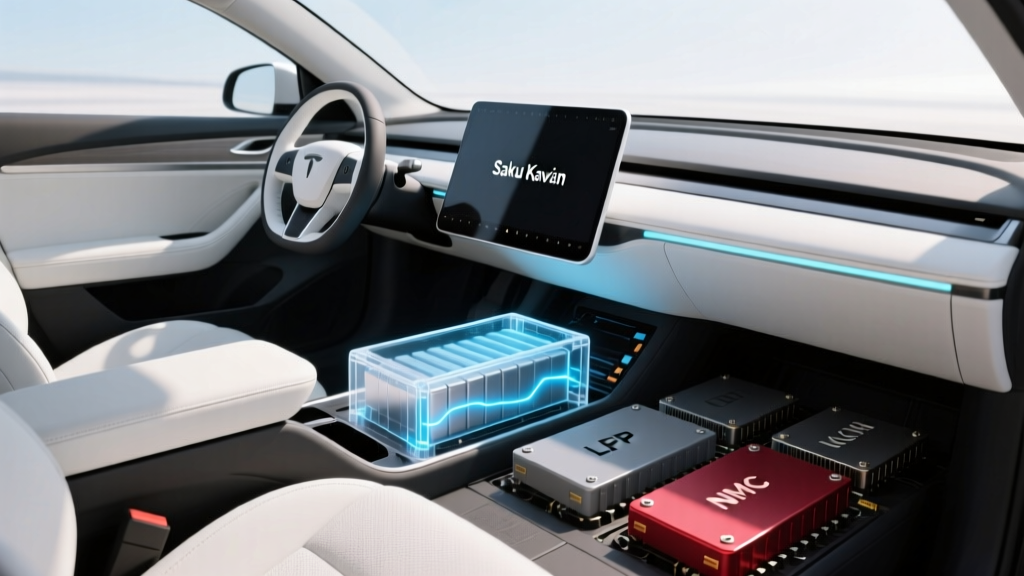
Before evaluating what dry-electrode manufacturing might enable, it's worth understanding the two chemistries that dominate the 2026 EV market. Every EV buyer should know which chemistry is under their floor — it affects range, charging habits, cold-weather behavior, and long-term degradation.
| Attribute | LFP (Lithium Iron Phosphate) | NMC / NCA (Nickel-based) |
|---|---|---|
| Energy Density (cell-level) | ~160–180 Wh/kg | ~220–300 Wh/kg |
| Cycle Life | 3,000–5,000+ cycles to 80% SoH | 1,000–2,500 cycles to 80% SoH |
| Cold-Weather Performance | Weaker — more range loss below 32°F | Better low-temp discharge capability |
| Thermal Stability | Excellent — higher runaway threshold | Good but requires more active thermal management |
| Cost per kWh (2026) | ~$80–$100/kWh at cell level | ~$110–$140/kWh at cell level |
| Cobalt Content | None | Varies; low-cobalt NMC trending, NCA minimal |
| Recommended Daily SoC | Can charge to 100% regularly | Best kept at 80% daily; 100% for trips only |
| Common 2026 Applications | Tesla Model 3/Y RWD, Ford Mustang Mach-E Select, many Chinese-market EVs | Long-range/performance trims, Hyundai Ioniq 5/6, BMW iX, Rivian |
LFP: The Longevity and Cost Play
LFP has surged in market share because it solves two of the biggest buyer anxieties simultaneously: degradation fear and upfront cost. The trade-off is lower energy density, which means either less range for the same pack weight or a heavier pack for the same range. For vehicles where maximum range isn't the priority — standard-range sedans, urban crossovers, fleet vehicles — LFP is increasingly the default choice. The ability to charge to 100% daily without accelerated degradation also simplifies ownership for drivers who don't want to manage state-of-charge limits.
NMC/NCA: The Range and Performance Play
Nickel-rich chemistries remain the choice for long-range and performance trims where packing maximum kWh into a given volume and weight envelope matters. The 2026 Hyundai Ioniq 5 Long Range (84 kWh usable, NMC) and the BMW iX xDrive50 both rely on NMC variants. The trade-off is a shorter cycle life and the need for more careful SoC management — most manufacturers recommend an 80% daily charge limit for NMC packs, reserving 100% for road trips.
Real-World Degradation: What the Data Shows
Degradation is the single most misunderstood aspect of EV ownership. Marketing materials emphasize peak range; real ownership is about how much of that range remains in year five. Here's what aggregated fleet data and manufacturer reports indicate for current-generation packs:
- Tesla Model 3/Y (NMC/NCA): ~5–8% capacity loss at 100,000 miles, based on Tesla's 2025 Impact Report fleet data. Most vehicles retain 90%+ State of Health (SoH) at this milestone.
- Tesla Model 3 RWD (LFP): Early fleet data suggests ~3–5% loss at 100,000 miles, benefiting from LFP's superior cycle life.
- Hyundai/Kia E-GMP platform (Ioniq 5, EV6, NMC): ~6–9% loss at 100,000 miles in aggregated owner reports.
- Nissan Leaf (passive air cooling, older NMC): Historically higher degradation — 15–25% loss at 100,000 miles for earlier generations without active thermal management. The 2026 Ariya uses liquid cooling and performs in line with industry norms.
- Chev Bolt EV/EUV (NMC, liquid-cooled): ~5–7% at 100,000 miles; strong track record for the segment.
Sources: Tesla Impact Report, owner-community aggregations (Teslalogger, Recurrent Auto fleet data).
The critical insight: most modern liquid-cooled EV batteries lose 5–10% capacity over the first 100,000 miles, then the degradation curve flattens significantly. The initial "break-in" drop (typically 2–4% in the first year or 20,000 miles) is normal and should not alarm owners. After that, loss tends to be roughly linear at ~0.5–1% per year under normal use.
Where the Sakuu Kavian dry battery process could influence degradation is indirect: thicker dry-coated electrodes may enable different porosity structures that affect lithium-ion diffusion uniformity over thousands of cycles. Whether this translates to measurably better or worse cycle life depends on the specific cell design and chemistry pairing — data that Sakuu has not yet published at fleet scale.
Battery Warranty Terms: What's Actually Covered
Federal law in the United States mandates a minimum battery warranty of 8 years / 100,000 miles for EVs (10 years / 150,000 miles in CARB states like California). Most manufacturers meet or exceed this floor. Here's how major warranties compare:
| Manufacturer | Warranty Period | Mileage Limit | Capacity Retention Threshold |
|---|---|---|---|
| Tesla (Model 3/Y LFP) | 8 years | 100,000 mi | 70% |
| Tesla (Model 3/Y LR/Perf NMC) | 8 years | 120,000 mi | 70% |
| Hyundai / Kia (E-GMP) | 10 years | 100,000 mi | 70% |
| Ford (Mach-E, F-150 Lightning) | 8 years | 100,000 mi | 70% |
| GM (Ultium platform) | 8 years | 100,000 mi | 70% |
| BMW (iX, i4) | 8 years | 100,000 mi | 70% |
| Rivian (R1T, R1S) | 8 years | 175,000 mi | 70% |
The 70% threshold is the industry standard trigger: if your battery's usable capacity drops below 70% of its original value within the warranty window, the manufacturer will repair or replace it. In practice, based on the degradation data above, very few liquid-cooled EVs breach this threshold within the warranty period under normal use. Warranty claims are overwhelmingly driven by manufacturing defects (bad cell groups, BMS faults, coolant leaks) rather than gradual wear.
EV Battery Replacement Costs: Numbers and Context
This is where fear-mongering thrives and context dies. Let's establish the actual numbers before discussing when replacement is needed.
| Vehicle / Platform | Battery Size (usable kWh) | Estimated Replacement Cost | Notes |
|---|---|---|---|
| Tesla Model 3 RWD (LFP) | ~57 kWh | $8,000–$12,000 | LFP cells cheaper; labor varies |
| Tesla Model Y LR (NMC) | ~75 kWh | $12,000–$16,000 | 4680 structural pack may require more labor |
| Hyundai Ioniq 5 (NMC) | ~77.4 kWh | $14,000–$18,000 | E-GMP skateboard architecture |
| Ford F-150 Lightning Ext. Range | ~131 kWh | $22,000–$30,000 | Largest consumer pack on market |
| Chevrolet Equinox EV (Ultium) | ~85 kWh | $13,000–$17,000 | Modular Ultium design may allow partial replacement |
| BMW iX xDrive50 | ~105 kWh | $20,000–$28,000 | Premium labor rates, complex integration |
When is replacement actually needed? For the vast majority of owners, it isn't — at least not within the vehicle's useful life. A battery retaining 75–80% capacity at 200,000 miles still provides substantial range (e.g., a 300-mile EPA vehicle would still deliver ~225–240 miles). Most EVs are retired or totaled for unrelated reasons before the battery reaches end-of-life. Out-of-warranty replacements are typically needed only after 15+ years or 200,000+ miles, or in cases of physical damage or manufacturing defect that falls outside warranty coverage.
The cost trajectory is also favorable: battery pack prices have fallen from over $1,000/kWh in 2010 to roughly $120–$140/kWh at the pack level in 2026, per BloombergNEF annual surveys. Dry-electrode manufacturing processes like Kavian could push costs further down by reducing factory capex and energy use — but this benefit will only reach consumers once the process scales to gigafactory volumes.
Factors That Affect Battery Life (and What You Can Control)
Not all miles are created equal when it comes to battery wear. The following factors have the most significant impact on long-term State of Health:
- Limit DC fast charging frequency: Occasional road-trip fast charging is fine. Daily reliance on 150+ kW DCFC accelerates degradation through sustained high temperatures and lithium plating risk. Aim for Level 2 home charging as your daily routine.
- Manage State of Charge (SoC): For NMC/NCA packs, set your daily charge limit to 80%. For LFP packs, periodic 100% charges are recommended (helps BMS cell-balancing). Avoid leaving any pack at 100% for extended periods (days/weeks).
- Avoid extreme SoC storage: If storing the vehicle for weeks, leave it at ~50% SoC. Storing at 100% or near 0% accelerates calendar degradation.
- Use preconditioning: In cold weather, precondition the battery before fast charging (most EVs do this automatically when you navigate to a charger). Charging a cold battery forces the BMS to limit power, and attempting to force high current into a cold cell causes lithium plating — a permanent degradation mechanism.
- Park in shade/garage when possible: Prolonged exposure to high ambient temperatures (100°F+) while at high SoC is the worst-case scenario for calendar aging. A garage or shaded spot meaningfully reduces thermal stress.
- Don't obsess over daily fluctuations: The BMS manages cell balancing, thermal limits, and buffer zones. The top and bottom ~5% of the displayed SoC are typically buffered (not truly 0% or 100% at the cell level). Drive normally and let the system do its job.
The Fast-Charging Question
DC fast charging is not inherently harmful — it's the thermal management during and after that matters. Modern liquid-cooled packs with active thermal management (Tesla, Hyundai E-GMP, GM Ultium, BMW) handle fast charging far better than older passively-cooled designs. Data from Recurrent Auto suggests that EVs that fast-charge more than 90% of the time show only marginally higher degradation (~2–3% additional loss at 100,000 miles) compared to those that primarily use Level 2. The effect is real but smaller than popularly feared — provided the vehicle has active liquid cooling.
How to Check and Monitor Battery Health
State of Health (SoH) is the percentage of original usable capacity your battery currently retains. A new battery is 100% SoH; a battery with 10% degradation is at 90% SoH. Here's how to monitor it:
Built-In Vehicle Displays
Some manufacturers provide a direct SoH readout or a battery health indicator in the vehicle settings. Tesla does not natively display SoH in the car UI (a frequent owner complaint), but the Tesla app's "Battery Health" section now provides an estimated percentage. Hyundai/Kia provide a battery health readout in the infotainment diagnostics menu on E-GMP vehicles.
Third-Party Apps and OBD-II Tools
Apps like TeslaFi, Stats (for Tesla), and ABRP (A Better Route Planner) can estimate SoH by comparing actual energy drawn from a full charge against the original pack capacity. For non-Tesla vehicles, OBD-II dongles paired with apps like Car Scanner or manufacturer-specific diagnostic tools can read BMS-reported SoH values directly. These readings are typically accurate within 1–2%.
Dealer Diagnostics
Any authorized dealer can pull a full battery health report during service visits. This is especially useful pre-purchase for used EVs — request a battery health printout as part of any inspection.
Emerging Battery Tech: Solid-State, Silicon Anode, and Dry Electrode Timelines
The Sakuu Kavian dry battery exists within a broader wave of next-generation battery manufacturing and chemistry advances. Here's a realistic assessment of where each technology stands as of 2026:
- Dry-electrode manufacturing (Sakuu Kavian, Tesla 4680): In early commercial deployment. Tesla has integrated dry-coated anodes into some 4680 production; Sakuu is scaling pilot lines. Mass-market EV availability: 2027–2029 estimated for broad adoption across multiple OEMs.
- Silicon-dominant anodes (Sila Nanotechnologies, Group14): Silicon offers 10x the theoretical capacity of graphite anodes but swells ~300% during lithiation, causing mechanical failure. Sila's silicon-carbon composite anodes are shipping in some consumer electronics and are entering automotive qualification. First EV applications: 2027–2028 estimated, initially in premium vehicles.
- Solid-state batteries (Toyota, QuantumScape, Samsung SDI): Replace the liquid electrolyte with a solid ceramic or polymer, enabling lithium-metal anodes and higher energy density. Toyota has announced a 2027–2028 production target for limited volumes. QuantumScape is in the validation phase with Volkswagen. Realistic mass-market availability: 2029–2032. These are not available in any production EV today.
- Sodium-ion batteries (CATL, BYD): Lower energy density than lithium-ion but cheaper and free of lithium, cobalt, and nickel. Already shipping in some Chinese-market micro-EVs and energy storage. US-market EV applications: 2028+ estimated, likely in budget segments.
Where the Sakuu Kavian Dry Battery Fits in Your EV Decision
For the EV buyer or owner in 2026, the Sakuu Kavian dry battery is significant as an indicator of where manufacturing costs are heading — not as a feature you can spec on a current vehicle. The dry-electrode process's primary value proposition is economic: cheaper factories, lower energy consumption, elimination of toxic solvents, and potentially higher energy density through thicker electrodes. If Sakuu and competitors succeed in scaling, the downstream effect should be lower pack costs, which translates to either cheaper EVs or more range at the same price point.
The practical decision framework remains straightforward:
- Choose LFP if: You want maximum longevity, plan to keep the vehicle 8+ years, primarily charge at home, don't need maximum range, and prefer the simplicity of 100% daily charging. Ideal for commuters, fleet operators, and second vehicles.
- Choose NMC/NCA if: You need maximum range (300+ miles EPA), frequently road-trip, tow, live in a cold climate where LFP's low-temperature weakness is more pronounced, or want a performance-oriented trim. Accept the 80% daily SoC habit as a minor tradeoff.
- Wait for dry-electrode/solid-state if: You're not buying for 3–5+ years and want potentially lower costs or step-change energy density improvements. But don't delay a needed purchase for technology that remains in pilot production.
Frequently Asked Questions
How long do EV batteries last in years and miles?
Based on current fleet data, modern liquid-cooled EV batteries routinely last 15–20 years or 200,000+ miles before reaching 70% State of Health (the point at which most consider replacement worthwhile). Many will outlast the vehicle itself. The 8-year/100,000-mile federal warranty floor is conservative relative to observed lifespans.
How much does an EV battery cost to replace?
Replacement costs range from approximately $8,000 for smaller LFP packs (e.g., Tesla Model 3 RWD) to $30,000 for the largest packs (e.g., Ford F-150 Lightning Extended Range). Most owners never need a replacement — the battery typically outlasts other major vehicle components. Costs continue to decline as cell prices fall.
What does the EV battery warranty actually cover?
Battery warranties cover capacity loss below a specified threshold (typically 70% of original capacity) and manufacturing defects. They do not cover damage from accidents, modifications, or improper use. The standard coverage is 8 years / 100,000 miles federally, with some manufacturers offering 10 years or higher mileage limits. See the fueleconomy.gov resource for EV incentive and warranty context.
How do I check my EV battery's State of Health?
Methods vary by vehicle: some offer built-in SoH displays (Hyundai/Kia), some provide it via the companion app (Tesla), and others require third-party OBD-II tools or dealer diagnostics. For used EV purchases, always request a battery health report before committing.
LFP vs NMC — which chemistry is better for me?
Neither is universally better. LFP wins on cycle life, cost, thermal safety, and daily-charging simplicity. NMC/NCA wins on energy density (more range per pound), cold-weather performance, and fast-charge acceptance. Match the chemistry to your driving pattern: LFP for daily commuting and home charging; NMC for long-range needs, cold climates, and frequent road trips.
Will the Sakuu Kavian dry battery be in EVs I can buy soon?
Not imminently. Sakuu is scaling pilot production and has announced partnerships, but no mass-market EV currently uses Kavian dry-electrode cells. Realistic integration into consumer EVs is estimated at 2027–2029 at the earliest, pending OEM qualification cycles and gigafactory-scale manufacturing agreements. The technology's primary near-term impact will be on manufacturing economics rather than consumer-visible performance differences.