Why CATL's Solid-State Battery Matters Now
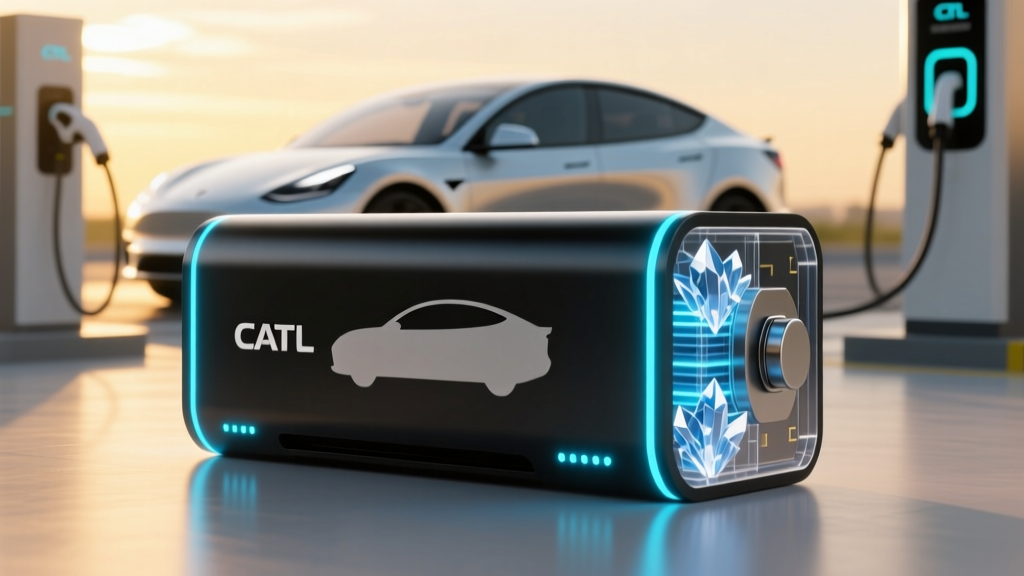
CATL—the world's largest EV battery supplier by market share—has signaled that its condensed-matter and solid-state cells could reach limited production by the late 2020s. For shoppers researching a CATL solid-state battery for their next EV, the headline promise is higher energy density (potentially 500 Wh/kg at the cell level) and improved safety versus today's liquid-electrolyte lithium-ion packs. But solid-state remains forward-looking technology; no mass-market EV sold in the U.S. today uses a true all-solid-state pack.
What does exist right now is a mature, data-rich ecosystem of LFP and NMC/NCA batteries powering millions of EVs. Understanding today's chemistry trade-offs, degradation curves, warranty coverage, and replacement economics is the fastest way to make a smart purchase—whether your next EV has a conventional pack or, eventually, a solid-state one.
Today's Battery Chemistries: LFP vs NMC vs NCA
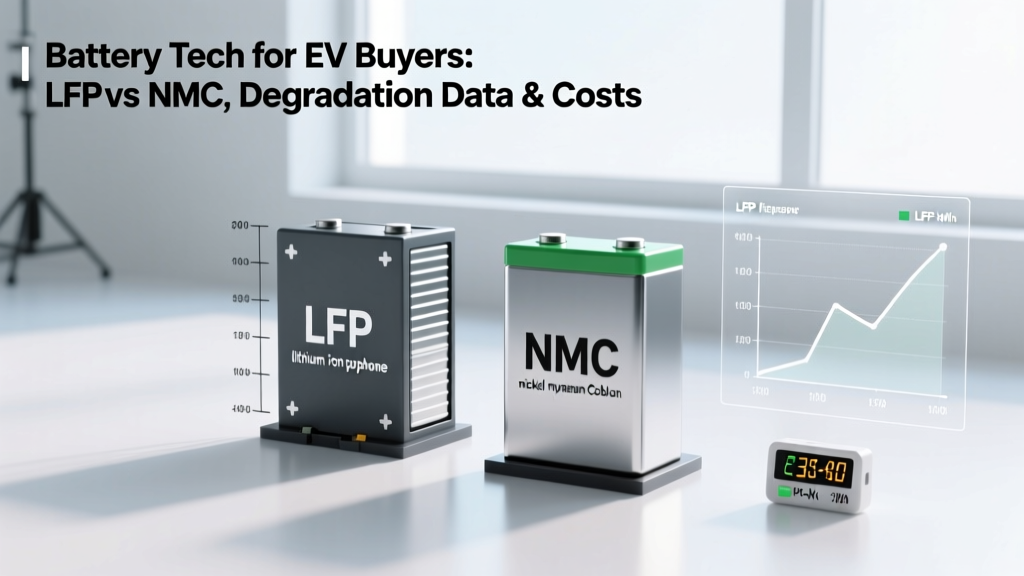
Every current EV uses one of three cathode chemistries: lithium iron phosphate (LFP), nickel manganese cobalt (NMC), or nickel cobalt aluminum (NCA). CATL manufactures both LFP and NMC at massive scale, and the choice between them shapes range, cost, longevity, and cold-weather behavior.
| Attribute | LFP (e.g., Tesla Model 3 RWD, BYD Blade) | NMC / NCA (e.g., Hyundai Ioniq 5, Ford F-150 Lightning) |
|---|---|---|
| Cell-level energy density | 160–180 Wh/kg | 230–300 Wh/kg |
| Typical pack-level range (EPA) | 240–310 mi | 280–400+ mi |
| Cycle life (to 80% SoH) | 3,000–6,000 cycles | 1,000–2,500 cycles |
| Cold-weather range loss (~20°F) | 30–40% reduction | 20–30% reduction |
| Peak DC fast-charge rate | 170–250 kW | 200–350 kW |
| Recommended daily SoC | 100% OK (per Tesla, BYD) | 80% daily, 100% for trips |
| Relative pack cost ($/kWh) | Lower (~$90–110) | Higher (~$120–150) |
| Thermal runaway risk | Very low | Low (with BMS + cooling) |
Which is better? LFP wins on cycle life, safety, and cost—ideal for daily commuters who can charge to 100% without worry. NMC/NCA wins on energy density and cold-weather efficiency—better for long-range drivers and colder climates. CATL supplies both chemistries to automakers including Tesla, BMW, and Volvo, so the badge on the car doesn't always tell you which cells are inside.
How Long Do EV Batteries Actually Last?
The short answer: most EV traction batteries outlast the vehicles they power. Real-world fleet data from sources like fueleconomy.gov and long-term owner studies show average degradation of 8–12% over the first 100,000 miles, with the steepest drop occurring in the first 20,000 miles (typically 2–4%) before the curve flattens.
Typical Degradation Curve (NMC 75–85 kWh Pack)
- Year 1 / 15,000 mi: ~2–4% capacity loss (initial settling)
- Year 3 / 45,000 mi: ~5–7% total loss
- Year 5 / 75,000 mi: ~7–9% total loss
- Year 8 / 120,000 mi: ~10–13% total loss
- Year 10 / 150,000 mi: ~12–17% total loss (varies heavily by climate and charging habits)
LFP packs generally show slower degradation—often 5–8% at 100,000 miles—thanks to more stable cathode chemistry and the ability to sit at 100% SoC without accelerating wear.
Context matters: a Tesla Model 3 fleet study published by Recurrent Auto found that vehicles in moderate climates with predominantly Level 2 home charging retained 92–95% of original capacity at 60,000 miles. Vehicles frequently DC fast-charged in hot climates (Arizona, Texas) showed 2–4 percentage points more loss over the same distance.
What Does the Battery Warranty Actually Cover?
Federal law mandates a minimum 8-year / 100,000-mile warranty on EV battery packs (10 years / 150,000 miles in CARB states like California, New York, and Massachusetts). Most manufacturers set the capacity-retention threshold at 70% of original capacity—meaning the warranty triggers only if your pack degrades below that floor within the covered period.
| Manufacturer | Coverage Period | Capacity Threshold | Notes |
|---|---|---|---|
| Tesla (Model 3/Y LFP) | 8 yr / 100,000 mi | 70% | Covers defects + degradation |
| Tesla (Model S/X, LR/AWD) | 8 yr / 120,000–150,000 mi | 70% | Varies by drivetrain |
| Hyundai / Kia (Ioniq 5, EV6) | 10 yr / 100,000 mi | 70% | Among the longest terms |
| Ford (F-150 Lightning, Mach-E) | 8 yr / 100,000 mi | 70% | Covers battery + HV components |
| GM (Ultium platform) | 8 yr / 100,000 mi | 70% | Includes Bolt EUV, Blazer EV, Silverado EV |
| BMW (i4, iX) | 8 yr / 100,000 mi | 70% | Module-level replacement when possible |
Key nuance: warranty coverage is for defects and abnormal degradation. Gradual, expected capacity loss above the 70% threshold is considered normal wear and is not covered. If your 82 kWh pack reads 60 kWh (73% SoH) at year seven, you're within spec. At 55 kWh (67%), you'd likely qualify for a warranty repair or module replacement.
EV Battery Replacement Cost: What to Budget
Out-of-warranty battery replacement is the single most cited fear among prospective EV buyers. Here's the reality: most EVs are retired or totaled before the pack needs replacement, and when replacement is needed, module-level repair is increasingly common (replacing only the degraded modules rather than the entire pack).
| Vehicle / Pack Size | Full Pack Replacement | Module-Level Repair | Typical Need Timeline |
|---|---|---|---|
| Tesla Model 3 RWD (60 kWh LFP) | $12,000–$15,000 | $3,000–$5,000 | Rarely before 200,000 mi |
| Tesla Model Y LR (82 kWh NMC) | $14,000–$18,000 | $4,000–$6,500 | Rarely before 180,000 mi |
| Hyundai Ioniq 5 (77.4 kWh NMC) | $15,000–$20,000 | $4,500–$7,000 | Rarely before 180,000 mi |
| Ford F-150 Lightning ER (131 kWh NMC) | $22,000–$30,000 | $6,000–$10,000 | Rarely before 150,000 mi |
| Chevy Silverado EV (200+ kWh Ultium) | $28,000–$38,000 | $7,000–$12,000 | Insufficient long-term data |
| BMW iX xDrive50 (111.5 kWh NMC) | $20,000–$26,000 | $5,500–$9,000 | Rarely before 150,000 mi |
Costs have declined roughly 40–50% since 2018 as pack designs shifted toward module-serviceable architectures (especially GM's Ultium and Hyundai's E-GMP). Refurbished and remanufactured packs are also increasingly available through OEM programs and third-party shops, typically at 40–60% of new-pack pricing.
Factors That Accelerate (or Preserve) Battery Life
Degradation isn't random—it's driven by measurable inputs. Here's what the data shows matters most:
Battery Longevity Checklist
- Limit DC fast charging to road trips. Daily use of 150+ kW DCFC adds ~1–3 percentage points of extra degradation over 100,000 miles versus predominantly Level 2 home charging.
- Avoid sustained 100% or 0% SoC (NMC/NCA). Store between 20–80% when possible. LFP is the exception—manufacturers recommend periodic 100% charges for BMS calibration.
- Precondition before fast charging. A cold battery charged at high power suffers lithium plating. Most EVs auto-precondition when you navigate to a charger (Tesla, Hyundai, Ford).
- Park in shade or a garage in extreme heat. Sustained pack temps above 95°F accelerate electrolyte decomposition. A heat-pump-equipped EV (standard on Ioniq 5, Tesla Model Y) manages this better.
- Use scheduled charging to time sessions. Charge to 80% just before departure rather than sitting at high SoC for hours.
- Minimize deep discharges. Regularly driving below 10% SoC stresses cells; plug in at 15–20% when practical.
How to Monitor Your Battery's State of Health
State of Health (SoH) is the percentage of your battery's current maximum capacity relative to its original rated capacity. A new 82 kWh pack at 95% SoH can store ~78 kWh when full.
In-vehicle methods:
- Tesla: Navigate to Service → Battery Health in the vehicle settings (available on 2023+ software builds). The car displays estimated SoH percentage.
- Hyundai / Kia: Use the infotainment EV diagnostic menu or the MyHyundai/MyKia app to view battery condition reports.
- Ford: The FordPass app shows battery health status; dealers can pull a detailed SoH report via the diagnostic port.
- GM (Ultium): The myChevrolet/myCadillac app provides battery health summaries; OnStar diagnostics can generate detailed reports.
Third-party tools: Apps like Tessie (Tesla-specific) and Recurrent (multi-brand) connect to your vehicle's telematics API and track SoH trends over time, flagging abnormal degradation early. OBD-II dongles paired with apps like Leaf Spy (Nissan) or Scan My Tesla provide real-time cell voltage and capacity data for more granular monitoring.
Solid-State and Silicon Anode: What's Real, What's Next
Solid-state batteries replace the liquid electrolyte in today's lithium-ion cells with a solid material (ceramic, sulfide, or polymer). The theoretical advantages are significant:
- Energy density: 400–500 Wh/kg at the cell level vs. 230–300 Wh/kg for current NMC—enabling 500+ mile ranges without larger packs.
- Safety: No flammable liquid electrolyte; dramatically lower thermal runaway risk.
- Charge speed: Potential for 10–80% charges in under 10 minutes due to higher C-rate tolerance.
- Cycle life: Early lab data suggests 1,000+ cycles with minimal degradation, though long-term fleet data does not yet exist.
CATL's condensed-matter battery, announced in 2023, is a semi-solid-state design achieving ~500 Wh/kg at the cell level. CATL has indicated initial applications in aviation and premium EVs, with broader automotive production targeted for 2027–2028 at the earliest. Toyota, Samsung SDI, and QuantumScape are pursuing parallel timelines, with Toyota announcing limited solid-state production for 2027–2028 model-year vehicles.
Silicon anode technology is closer to market. Companies like Sila Nanotechnologies and Group14 are supplying silicon-dominant anode materials to battery manufacturers, enabling 15–20% energy density gains over graphite anodes. The Mercedes G-Class EV (announced) and select 2026–2027 models are expected to incorporate silicon-anode cells. This is an incremental improvement—not a revolution—but it meaningfully extends range without changing pack size.
Realistic timeline for solid-state in mainstream EVs: 2028–2030 for premium segments; 2030+ for volume-market vehicles priced under $50,000. Manufacturing yield, cost per kWh, and supply-chain scale remain unsolved challenges at mass-market price points.
Frequently Asked Questions
How long do EV batteries last in years and miles?
Most modern EV batteries (2020+) retain 80–88% of original capacity at 150,000 miles and 10 years of use. LFP packs often exceed 90% retention at that mileage. Catastrophic failure (sudden, non-degradation-related) is rare—well under 1% of packs based on fleet data. The vast majority of EVs are sold, traded, or totaled before the battery reaches end-of-life.
How much does it cost to replace an EV battery out of warranty?
Full pack replacement ranges from roughly $12,000 for a compact EV (Tesla Model 3 LFP) to $30,000+ for a large truck (F-150 Lightning ER, Silverado EV). Module-level repairs—replacing only degraded sections—typically cost $3,000–$12,000. Refurbished packs can reduce costs by 40–60%. Most owners never pay for replacement because the pack outlasts the vehicle or is covered under the 8-year/100,000-mile federal warranty.
What does the EV battery warranty cover?
Federal law requires 8 years / 100,000 miles of coverage (10/150,000 in CARB states). Coverage includes manufacturing defects and degradation below a stated threshold—typically 70% of original capacity. Normal, gradual degradation above that threshold is not covered. The warranty follows the vehicle, not the original owner.
How do I check my EV battery's State of Health?
Most 2023+ EVs include SoH reporting in the vehicle settings or companion app (Tesla Service menu, FordPass, MyHyundai). Third-party apps like Tessie and Recurrent offer trend tracking. For detailed cell-level data, an OBD-II reader with EV-specific software provides voltage delta and capacity estimates. Dealers can generate official SoH reports during service visits.
LFP vs NMC—which chemistry should I choose?
Choose LFP if you prioritize longevity (3,000–6,000 cycle life), lower cost, and the convenience of charging to 100% daily. Choose NMC/NCA if you need maximum EPA range (300–400+ mi), better cold-weather efficiency, or faster peak DC charging. Both chemistries are proven to exceed warranty thresholds under normal use.
Is CATL's solid-state battery available in any EV I can buy today?
No. As of 2026, no production EV sold in the U.S. uses a CATL solid-state or condensed-matter pack. CATL's condensed-matter battery is in limited production for specialty applications, with automotive deployment targeted for 2027–2028. Current CATL-supplied EVs (Tesla Model 3 RWD, select Volvo and BMW models) use conventional LFP or NMC cells with liquid electrolyte.
Does fast charging damage my EV battery?
Occasional DC fast charging (road trips, 2–4 times per month) has negligible impact on long-term health. Daily DCFC use, especially at 150+ kW without preconditioning, can add 1–3 percentage points of extra degradation over 100,000 miles. Modern battery management systems actively limit charge rates when the pack is cold or near full, which mitigates damage. For daily use, Level 2 home charging (7–11 kW) remains the longevity-optimal choice.