If you own a Rivian R1T or R1S — or you're researching one — the high-voltage traction battery is the single most expensive component in the vehicle. Understanding who builds it, what chemistry it uses, how it degrades, and what it costs to replace is essential for confident ownership. This guide unpacks the Rivian EV battery supplier landscape, the engineering behind the packs, and the real-world data every current or prospective owner should know.
Who Supplies Rivian's EV Batteries?
Rivian's battery strategy has evolved significantly since the R1T launched for the 2022 model year. The company has used cells from multiple suppliers across different pack sizes:
- Samsung SDI — The primary supplier for Rivian's large battery packs. Samsung SDI provides 2170-format cylindrical NMC (nickel-manganese-cobalt) cells used in the Max and Large battery configurations. These cells are known for high energy density and are manufactured in facilities in South Korea and Hungary.
- LG Energy Solution — Has supplied cells for certain Rivian pack configurations, particularly earlier production runs. LG's NMC chemistry is widely used across the EV industry (GM, Ford, and others).
- CATL — For the Standard (LFP) battery pack introduced in the R1S and R1T lineup, Rivian turned to lithium iron phosphate cells. CATL is the world's largest battery manufacturer and the dominant LFP supplier globally.
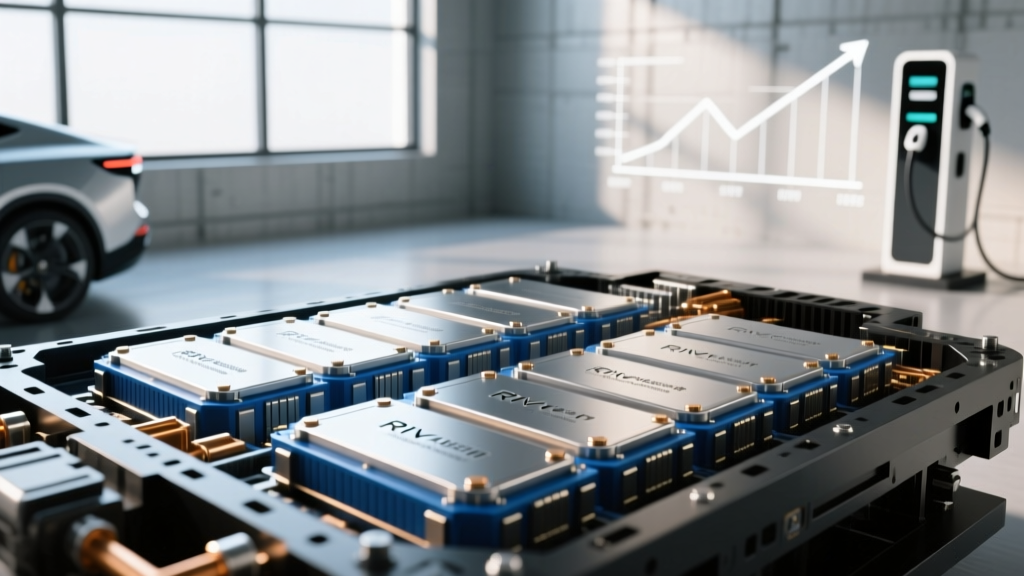
Rivian assembles these cells into its own proprietary pack architecture at its Normal, Illinois manufacturing facility. The pack design includes liquid thermal management (active heating and cooling), structural integration with the vehicle's skateboard platform, and module-level serviceability — meaning individual modules can theoretically be replaced without swapping the entire pack.
For the upcoming R2 platform (announced for 2026 production), Rivian has indicated it will use a new 46mm-diameter cylindrical cell format — similar to Tesla's 4680 — sourced from multiple suppliers to reduce cost and increase energy density. Final supplier contracts for R2 volume production have not been fully disclosed.
Battery Chemistry Explained: NMC vs. LFP in Rivian Packs
Rivian offers two distinct battery chemistries depending on the pack you choose. Understanding the trade-offs is critical because chemistry affects range, charging behavior, longevity, and even how you should charge day-to-day.
| Attribute | NMC (Large / Max Pack) | LFP (Standard Pack) |
|---|---|---|
| Chemistry | Nickel-Manganese-Cobalt | Lithium Iron Phosphate |
| Energy Density | Higher (~250 Wh/kg cell-level) | Lower (~170 Wh/kg cell-level) |
| Usable Capacity (R1T) | ~106 kWh (Large), ~141 kWh (Max) | ~92 kWh (Standard) |
| Cycle Life | ~1,000–1,500 full cycles to 80% SoH | ~3,000–5,000+ full cycles to 80% SoH |
| Daily Charging Recommendation | 80% for daily use; 100% only for trips | 100% regularly is fine (and recommended periodically for BMS calibration) |
| Cold-Weather Performance | Better low-temp energy delivery | Reduced range in freezing temps; preconditioning critical |
| Cost | Higher (cobalt and nickel are expensive) | Lower (iron and phosphate are abundant) |
| Thermal Stability | Good, with active management required | Excellent — inherently more stable |
The practical takeaway: If you prioritize maximum range and cold-weather performance (the Max pack delivers an EPA-estimated 400+ miles in the R1S), NMC is the choice. If you want a lower purchase price, longer cycle life, and simpler charging habits (charge to 100% freely), the LFP Standard pack makes sense — with the trade-off of roughly 60–80 fewer miles of EPA range.
How Long Do Rivian EV Batteries Last?
EV battery longevity is measured in both years and charge cycles. A "cycle" is one full 0–100% discharge (partial discharges accumulate proportionally). Modern EV batteries are engineered to outlast the typical ownership period, but degradation is real and measurable.
Typical NMC Degradation Curve (Industry Data)
| Timeframe | Mileage | Expected Capacity Retention |
|---|---|---|
| Year 1 | ~15,000 mi | 95–97% |
| Year 3 | ~45,000 mi | 90–93% |
| Year 5 | ~75,000 mi | 87–91% |
| Year 8 | ~120,000 mi | 82–88% |
| Year 10 | ~150,000 mi | 78–85% |
Source: Aggregated data from Recurrent Auto battery health studies and manufacturer warranty thresholds. Individual results vary based on climate, charging habits, and pack chemistry. LFP packs typically show slower degradation.
Rivian's liquid-cooled thermal management system plays a significant role here. Active cooling during DC fast charging and active heating during cold-soak scenarios keep cells in their optimal temperature window (roughly 20–35°C), which materially slows degradation compared to passively cooled packs.
A Rivian R1T with the Large pack (106 kWh usable) retaining 88% capacity at year 8 would still offer roughly 93 kWh usable — translating to approximately 280–300 miles of real-world range depending on driving conditions. That's still highly functional for most owners.
Rivian Battery Warranty: What's Covered
Rivian's high-voltage battery warranty aligns with industry norms and meets the federal minimum mandated for EVs. Here are the specifics:
| Coverage Element | Terms |
|---|---|
| Duration | 8 years or 175,000 miles (whichever comes first) |
| Capacity Retention Threshold | 70% of original usable capacity |
| What Triggers a Claim | Measured capacity falls below 70% during the warranty period |
| Coverage Includes | Battery pack repair, module replacement, or full pack replacement at Rivian's discretion |
| Exclusions | Damage from accidents, modifications, improper charging equipment, or neglect |
| Transferable | Yes — warranty transfers to subsequent owners |
The 175,000-mile threshold is notably generous compared to the federal minimum of 100,000 miles (150,000 in CARB states). Rivian's 70% retention threshold is standard across the industry — Tesla, Ford, and GM use the same benchmark. In practice, very few modern EV batteries drop below 70% within 8 years unless subjected to extreme abuse.
If you're buying a used Rivian, verify the remaining warranty by checking the in-service date and odometer. Rivian Service Centers can pull the battery's State of Health (SoH) report during a pre-purchase inspection.
EV Battery Replacement Cost: What Rivian Owners Should Budget
Full battery pack replacement is the scenario that generates the most anxiety — and the most misleading headlines. The reality: catastrophic pack failure outside of warranty is rare. Most degradation is gradual, and module-level repairs are possible.
| Pack Type | Estimated Full-Pack Replacement Cost (Out of Warranty) | Typical Replacement Scenario |
|---|---|---|
| Standard (LFP, ~92 kWh) | $12,000 – $16,000 | Rare before 200,000+ mi; module repair more likely |
| Large (NMC, ~106 kWh) | $15,000 – $20,000 | Rare before 175,000+ mi; covered under warranty in most cases |
| Max (NMC, ~141 kWh) | $20,000 – $28,000 | Very rare; largest pack, most buffer, slowest to reach threshold |
Estimates based on 2025–2026 industry replacement pricing and Rivian service bulletins. Costs are expected to decline as cell prices continue falling. Module-level repairs (replacing individual failed modules) typically cost $2,000–$5,000.
For context, a conventional vehicle's engine or transmission replacement can also cost $5,000–$10,000+ — and those failures are more common than EV battery failures within the first 150,000 miles. The vast majority of EV batteries are still functional when the vehicle is retired or totaled.
Factors That Affect Rivian Battery Life
Not all miles and charge cycles are created equal. These factors have the most measurable impact on long-term battery health:
Battery Care Checklist for Rivian Owners
- Minimize DC fast charging frequency. Occasional road-trip fast charging is fine, but daily 200+ kW sessions accelerate degradation. For daily use, Level 2 home charging (7–11 kW) is ideal. The charging curve tapers above 80% SoC to protect cells — let it taper rather than unplugging early and re-plugging.
- Avoid sustained 100% or 0% SoC. For NMC packs (Large/Max), set your daily charge limit to 80–85%. Charge to 100% only before long trips and drive away promptly. LFP packs tolerate 100% better, but still avoid leaving them at 0% for extended periods.
- Use preconditioning. Rivian's navigation-integrated preconditioning warms the battery before you arrive at a DC fast charger. This enables faster charging and reduces stress on cold cells. Enable it whenever routing to a charger.
- Park in shade or a garage in extreme heat. Sustained high ambient temperatures (above 95°F / 35°C) accelerate calendar aging. The thermal management system runs even when parked, but reducing heat soak helps.
- Don't stress about regen braking. Rivian's regenerative braking returns energy to the pack at moderate C-rates that are well within safe limits. Aggressive regen settings do not harm battery longevity.
- Keep software updated. Rivian's over-the-air updates frequently include battery management algorithm improvements that optimize charge profiles and thermal strategies.
How to Check Your Rivian's Battery Health (SoH)
State of Health (SoH) is the percentage of original capacity your battery currently holds. A new battery is 100% SoH; a battery that can only hold 90 kWh of its original 106 kWh is at roughly 85% SoH.
Rivian owners can monitor battery health through several methods:
- Rivian App & In-Vehicle Display: While Rivian doesn't currently display a raw SoH percentage on the main screen (unlike some competitors), the app and vehicle energy screens show estimated range at full charge, which indirectly reflects degradation. If your 100% charge range has dropped from 328 miles to 300 miles over two years, that's roughly an 8.5% capacity loss.
- Service Center Diagnostic: Rivian Service Centers can pull a detailed SoH report that includes individual module voltage balance, internal resistance measurements, and total energy throughput. Request this during routine service visits or a pre-purchase inspection.
- Third-Party Tools: OBD-II dongles paired with apps like EV Health or Scan My Tesla-style tools (availability for Rivian's CAN bus varies) can surface more granular data. Community forums such as Rivian Owners Forum often share techniques for extracting battery telemetry.
- Charge Tracking: Logging your kWh consumed per charge session against miles driven gives a real-world efficiency trend. A gradual decline in miles-per-kWh over time (controlling for weather) can signal degradation.
Emerging Battery Tech: What's Next for Rivian
Rivian's battery roadmap includes several forward-looking technologies, but it's important to separate what's available now from what's still in development:
- 46mm Cylindrical Cells (R2 Platform): Announced for the R2 SUV and R3 crossover, these larger-format cells promise higher energy density and lower manufacturing cost. Volume production is targeted for 2026, but supply chain ramp-up timelines remain uncertain. This is announced technology, not yet in customer vehicles.
- Silicon-Anode Cells: Companies like Sila Nanotechnologies and Group14 are developing silicon-dominant anodes that could boost energy density by 20–40%. Rivian has not confirmed adoption, but the industry broadly expects silicon-anode cells to reach volume production between 2027–2029.
- Solid-State Batteries: Often cited as the "holy grail," solid-state cells replace the liquid electrolyte with a solid conductor, promising faster charging, higher energy density, and improved safety. Toyota, QuantumScape, and Samsung SDI have all demonstrated prototypes, but commercial viability at automotive scale remains 2028–2030+ away. Rivian has not announced solid-state plans.
The practical guidance: don't delay a purchase waiting for next-generation chemistry. Today's NMC and LFP cells from suppliers like Samsung SDI and CATL are mature, well-characterized, and backed by robust warranties. Incremental improvements will continue, but the current generation is already highly capable.
Frequently Asked Questions
How long do EV batteries last in real-world use?
Based on aggregated fleet data from sources like Recurrent Auto, modern liquid-cooled EV batteries (including Rivian's) typically retain 85–90% of original capacity after 100,000 miles and 5–7 years of use. Most batteries outlast the vehicle itself — total pack failure before 200,000 miles is statistically uncommon. LFP chemistry tends to show even slower degradation.
How much does it cost to replace a Rivian battery?
A full out-of-warranty pack replacement ranges from approximately $12,000 (Standard LFP) to $28,000 (Max NMC). However, most replacements are covered under Rivian's 8-year/175,000-mile warranty. Module-level repairs — replacing individual failed sections rather than the entire pack — typically cost $2,000–$5,000 and are more common than full swaps.
What does Rivian's battery warranty cover?
Rivian warrants the high-voltage battery against capacity loss below 70% of original usable capacity for 8 years or 175,000 miles. Coverage includes repair, module replacement, or full pack replacement. The warranty is transferable to subsequent owners. Damage from accidents, unauthorized modifications, or improper equipment is excluded.
How do I maximize my Rivian's battery health?
Charge to 80% daily on NMC packs (100% is fine for LFP). Use Level 2 home charging for routine top-ups rather than daily DC fast charging. Enable navigation-based preconditioning before fast-charging sessions. Avoid leaving the vehicle at 0% or 100% SoC for days at a time. Keep up with OTA software updates. These habits, supported by data from fleet studies, measurably slow degradation.
LFP vs. NMC — which Rivian battery is better?
Neither is universally "better." NMC (Large/Max packs) offers higher energy density, more range, and better cold-weather performance — ideal for road-trippers and cold-climate owners. LFP (Standard pack) offers longer cycle life, lower cost, simpler charging habits (charge to 100% freely), and superior thermal stability — ideal for daily commuters and budget-conscious buyers. Your driving pattern determines the right choice.
Does frequent Supercharger-style DC fast charging hurt the battery?
Occasional DC fast charging (a few times per month on road trips) has minimal measurable impact on modern liquid-cooled packs. Daily DC fast charging at 150–200+ kW does accelerate degradation compared to Level 2 charging, according to data from the Idaho National Laboratory. If you rely on public fast charging daily, expect capacity retention at the lower end of the typical range — perhaps 82–85% at year 8 instead of 88–91%.
Can Rivian replace individual battery modules instead of the whole pack?
Yes. Rivian's pack architecture supports module-level serviceability. If diagnostic testing identifies a single degraded or failed module, Rivian Service Centers can replace that module rather than the entire pack, significantly reducing cost and downtime. This is one advantage of Rivian's modular pack design over some competitors' monolithic architectures.
Understanding the Rivian EV battery supplier ecosystem — Samsung SDI for NMC, CATL for LFP — and the engineering decisions behind each pack gives you the context to make informed choices about trim selection, daily charging habits, and long-term ownership expectations. The data is clear: modern EV batteries, properly cared for, are among the most durable components in the vehicle.