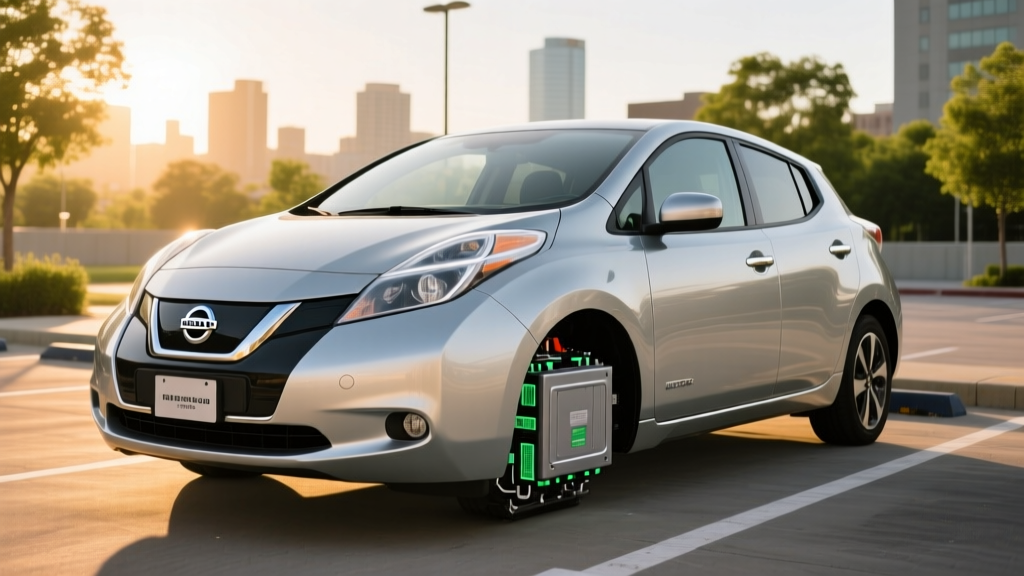
The Nissan Leaf holds a unique place in EV history. As one of the first mass-market electric vehicles, it has accumulated more real-world battery mileage data than nearly any other EV on the road. For current owners and prospective used-EV buyers, understanding Nissan Leaf battery life — how fast the pack degrades, what the warranty actually covers, and what a replacement costs — is essential before signing any paperwork.
This guide breaks down Leaf battery longevity with real degradation figures, explains the chemistry inside both the 40 kWh and 62 kWh packs, and walks through practical steps to maximize State of Health (SoH). We also cover where battery technology is heading next.
Nissan Leaf Battery Specs at a Glance
Before discussing longevity, here are the hard numbers for the two Leaf battery configurations sold in recent model years. Note that the Leaf uses a lithium-ion pack with NMC (nickel manganese cobalt) chemistry and, critically, a passively cooled thermal management system — meaning no liquid cooling loop. This design choice has significant implications for battery life, which we cover below.
| Specification | Leaf S / SV (40 kWh) | Leaf SV Plus / SL Plus (62 kWh) |
|---|---|---|
| Usable battery capacity | ~39 kWh | ~59 kWh |
| Chemistry | NMC (laminated cells) | NMC (laminated cells) |
| Thermal management | Passive (air-cooled) | Passive (air-cooled) |
| EPA range | 149 miles | 212 miles |
| Real-world range (highway, 70 mph) | ~115–130 miles | ~170–190 miles |
| Max DC fast charge rate | ~50 kW (CHAdeMO) | ~100 kW (CHAdeMO) |
| Level 2 charge rate | 6.6 kW | 6.6 kW |
| 0–60 mph | ~7.9 sec | ~6.5 sec |
| Horsepower | 147 hp | 214 hp |
| Battery warranty | 8 yr / 100,000 mi | 8 yr / 100,000 mi |
Source: fueleconomy.gov (EPA estimates). Real-world range figures based on owner reports and independent testing; highway driving at sustained speeds and cold weather will reduce range further.
How Long Do Nissan Leaf Batteries Actually Last?
The short answer: most Leaf batteries outlast the car's economic life. But the passively cooled design means degradation patterns differ from liquid-cooled EVs like the Tesla Model 3 or Hyundai Ioniq 5.
Degradation Data: What Owners Report
Nissan Leaf degradation data is among the most extensively documented in the EV community, thanks to the built-in battery health bar (displayed as a series of bars on the dash) and third-party tools like LeafSpy. Here is what the data shows:
Typical Nissan Leaf Battery Degradation Curve
- Year 1–2 (0–30,000 mi): 5–8% capacity loss. The steepest initial drop is normal for all lithium-ion cells as the solid electrolyte interphase (SEI) layer stabilizes.
- Year 3–5 (30,000–75,000 mi): Degradation slows to roughly 1.5–2.5% per year. A 5-year-old 40 kWh Leaf typically retains 82–88% of original capacity.
- Year 6–8 (75,000–120,000 mi): Cumulative loss reaches 15–25% depending on climate and charging habits. Packs in hot climates (Arizona, Texas, Southern California) degrade faster — some owners in these regions report 30%+ loss by year 7.
- Year 10+ (120,000+ mi): Many Leafs remain operational with 70–80% capacity, though range is noticeably reduced. Some early 2011–2015 Leafs (24/30 kWh packs) have exceeded 150,000 miles on original batteries.
Data synthesized from LeafSpy community databases, Recurrent Auto battery degradation reports, and owner forums. Individual results vary significantly based on climate, charging behavior, and storage habits.
The critical factor is heat. Because the Leaf lacks active liquid cooling, repeated DC fast charging in hot weather — or simply living in a high-temperature climate — accelerates degradation more than in liquid-cooled competitors. A Leaf in Phoenix will typically show more capacity loss at 60,000 miles than an identical Leaf in Seattle.
How Long Do EV Batteries Last in General?
Across the broader EV fleet, modern lithium-ion traction batteries are engineered for 200,000+ miles of service life before reaching 70–80% of original capacity. Most EV batteries will never need replacement during typical ownership. The Leaf's passive cooling makes it somewhat more susceptible to heat-related aging, but the fundamental chemistry is proven and durable.
LFP vs NMC: Understanding Leaf Battery Chemistry
The Nissan Leaf uses NMC (nickel manganese cobalt oxide) lithium-ion cells in a laminated pouch format. This is different from the LFP (lithium iron phosphate) chemistry used in vehicles like the Tesla Model 3 Standard Range and BYD models. Understanding the trade-offs helps explain why the Leaf behaves the way it does.
| Attribute | NMC (Nissan Leaf) | LFP (e.g., Tesla Model 3 RWD) |
|---|---|---|
| Energy density | Higher (~160–220 Wh/kg cell-level) | Lower (~140–170 Wh/kg cell-level) |
| Cycle life | ~1,000–2,000 full cycles | ~3,000–5,000+ full cycles |
| Cold-weather performance | Better low-temp energy delivery | Reduced range in cold; slower charging below freezing |
| Thermal stability | Good, but more heat-sensitive over time | Excellent; inherently more stable chemistry |
| Cost per kWh | Higher (cobalt/nickel commodity pricing) | Lower (iron/phosphate are abundant) |
| Recommended daily SoC | 80% for daily use (prolongs life) | 100% OK for regular use |
| Used in Nissan Leaf? | Yes (all model years) | No |
Why this matters for Leaf owners: NMC's higher energy density gives the 62 kWh Leaf its 212-mile EPA range in a compact package. But NMC cells degrade faster when exposed to sustained heat and high states of charge — and without liquid cooling, the Leaf's NMC pack is more vulnerable to thermal stress during repeated fast charging or hot-weather driving.
Nissan Leaf Battery Warranty: What's Covered
Nissan provides an 8-year/100,000-mile lithium-ion battery capacity warranty on the Leaf. Here is what that actually means in practice:
| Warranty Element | Details |
|---|---|
| Duration | 8 years or 100,000 miles (whichever comes first) |
| Capacity threshold | 9 bars out of 12 on the battery capacity gauge (approximately 70–72.5% of original capacity) |
| What triggers a claim | Battery drops below 9 capacity bars within the warranty period |
| Remedy | Nissan will repair or replace the battery to restore it above the 9-bar threshold |
| Defect coverage | 8 yr / 100,000 mi for manufacturing defects |
| Transferable? | Yes — warranty transfers to subsequent owners |
Source: Nissan Owner's Manual and Warranty Booklet. Always confirm current warranty terms with your dealer, as policy details can vary by model year.
Important nuance: The capacity gauge (the 12-bar display on the dash) is not a perfectly linear measurement. A Leaf can drop from 12 to 11 bars within the first year or two, then hold at 11 bars for years. The warranty only activates if the pack falls below 9 bars — a significant loss. Many owners find the gauge imprecise and use LeafSpy (an OBD-II dongle app) to get exact State of Health percentage readings.
How Much Does a Nissan Leaf Battery Replacement Cost?
If your Leaf's battery degrades beyond the warranty threshold — or if the car is out of warranty and you want to restore original range — replacement is possible but expensive. Costs vary by pack size and whether you use a new, refurbished, or used pack.
| Battery Pack | New (Dealer) | Refurbished / Remanufactured | Used (Salvage) |
|---|---|---|---|
| 40 kWh pack | $6,500–$8,500 | $4,000–$5,500 | $2,500–$3,500 |
| 62 kWh pack | $8,000–$9,500+ | $5,500–$7,000 | $3,500–$5,000 |
| Labor (typical) | $500–$1,200 additional depending on shop | ||
When is replacement typically needed? In practice, very few Leaf owners replace the battery. Most Leafs are retired or traded in before the pack becomes unusable. The replacement decision usually comes when:
- Range drops below your daily driving needs (e.g., a 40 kWh Leaf degrading to 80 miles of range when you need 100)
- The car is otherwise in good condition and you want to extend its life another 5+ years
- You purchased a used Leaf with a significantly degraded pack and want to restore it
Cost context: A $7,000–$9,000 battery replacement sounds steep, but consider that most Leaf owners will spend $0 on battery replacement over the car's life. Compare this to a gas car's cumulative fuel and maintenance costs over 150,000 miles — the math often still favors the EV, even with a hypothetical replacement.
Factors That Accelerate (or Slow) Leaf Battery Degradation
The Leaf's passively cooled battery makes owner behavior more impactful than in liquid-cooled EVs. Here is what the data shows about degradation drivers:
Habits That Accelerate Degradation
- Frequent DC fast charging in hot weather: The #1 degradation factor for Leaf owners. CHAdeMO fast charging generates significant heat, and without liquid cooling, that heat lingers in the cells. Rapid-charge "RAPIDGATE" — where consecutive fast charges in heat cause the car to throttle charge speed — is a known Leaf issue.
- Parking at 100% SoC for extended periods: NMC cells experience the most stress at the top and bottom of their charge range. Regularly sitting at 100% for days accelerates calendar aging.
- Hot-climate exposure: Sustained ambient temperatures above 90°F (32°C) increase chemical degradation. Garage parking in summer makes a measurable difference.
- Deep discharges to near 0%: Regularly running the battery below 10% stresses the cells.
Habits That Maximize Battery Life
- Charge to 80% for daily use: Set your Leaf's charge timer or use a smart EVSE to stop charging at ~80%. Save 100% charges for road trips.
- Use Level 2 (240V) charging as your primary method: A 6.6 kW home charger adds ~25 miles of range per hour and generates far less heat than DC fast charging.
- Limit DC fast charging: Use CHAdeMO fast charging for road trips, not daily top-ups. If you must fast-charge in summer, try to do it in the early morning when ambient temps are lower.
- Avoid prolonged storage at extreme SoC: If leaving the Leaf for a week or more, aim for ~50–60% state of charge.
- Park in shade or a garage during summer: Even a few degrees of ambient temperature reduction helps. Cabin preconditioning while plugged in also reduces battery thermal load.
- Drive moderately in extreme heat: Aggressive acceleration generates internal cell heat. In triple-digit temps, gentler driving preserves the pack.
How to Check Your Nissan Leaf's Battery Health
Monitoring State of Health (SoH) is straightforward on the Leaf, with multiple methods available:
Method 1: Dashboard Capacity Bars
The Leaf displays a battery capacity gauge (separate from the charge-level gauge) as a series of bars out of 12. A new Leaf shows 12 bars. As the pack degrades, bars disappear. This is the quickest check but is imprecise — each bar represents roughly 6–8% of capacity, and the intervals are not perfectly linear.
Method 2: LeafSpy (Recommended)
LeafSpy is a third-party app that connects to the Leaf's OBD-II port via a Bluetooth dongle (such as an OBDLink MX+ or a dedicated LeafSpy adapter, ~$30–$50). It provides:
- State of Health (SoH) percentage — the most precise degradation measurement available to owners
- Cell voltage readings — shows individual cell balance (large imbalances may indicate a failing module)
- Battery temperature — critical for deciding when to fast-charge
- Charge/discharge power (kW) — real-time energy flow data
- Hx value — an internal Nissan metric for battery health; values below ~65% typically correspond to noticeable range loss
For used-EV buyers, running LeafSpy before purchase is strongly recommended. A 5-year-old Leaf with 92% SoH is a far better buy than one at 78%, even at similar mileage.
Method 3: Nissan Dealer Diagnostic
Any Nissan dealer can run a battery health check using the CONSULT diagnostic tool. This produces a printout with SoH percentage. Some dealers offer this free; others charge a diagnostic fee ($50–$100). Request this as part of a pre-purchase inspection on a used Leaf.
The Future: Solid-State and Next-Gen Battery Tech
Nissan has been vocal about its next-generation battery plans. The automaker is developing solid-state battery technology, with a pilot production line at its Yokohama plant. Here is what is known — and what is not:
- Solid-state batteries (announced): Nissan targets commercial production around 2028–2029. Solid-state cells promise roughly double the energy density of current NMC, faster charging, improved safety, and potentially longer cycle life. However, these remain in development and are not available in any production vehicle as of 2026.
- Silicon anode technology: Companies like Sila Nanotechnologies and Group14 are supplying silicon-dominant anode materials to automakers, enabling 10–20% energy density improvements over graphite anodes. This tech is beginning to appear in limited production applications but is not yet in the Leaf.
- Cobalt-free NMC variants: Higher-nickel, lower-cobalt formulations (like NMC 811 and beyond) are already in use across the industry, reducing cost and ethical sourcing concerns while maintaining energy density.
Realistic timeline: Do not delay a Leaf purchase waiting for solid-state. The technology is promising but remains 3–5+ years from mass-market vehicles, and pricing will initially be at a premium. The current Leaf battery is proven, well-understood, and — with proper care — will serve reliably for well over 100,000 miles.
Is the Nissan Leaf Still Worth It in 2026?
The Leaf occupies a specific niche: an affordable, practical EV for daily commuting with home charging access. Its passive cooling and CHAdeMO connector are genuine limitations compared to liquid-cooled, NACS/CCS-equipped competitors. But for buyers who understand the trade-offs, the Leaf's proven battery, low purchase price, and extensive degradation data make it one of the most predictable used-EV purchases available.
If you are buying a used Leaf, run LeafSpy, check the SoH, factor in your climate and charging access, and you can buy with confidence. If you are looking at a new Leaf, know that the battery will likely outlast your ownership — and that the warranty protects you against the worst-case scenario.
How long do Nissan Leaf batteries typically last?
Most Leaf batteries retain 70–85% of original capacity at 100,000 miles and 8+ years of age. Many early Leafs have exceeded 150,000 miles on the original pack. Longevity depends heavily on climate (hot climates accelerate degradation) and charging habits (frequent DC fast charging reduces lifespan).
How much does it cost to replace a Nissan Leaf battery?
A new 40 kWh replacement pack costs approximately $6,500–$8,500 at a dealer, while a 62 kWh pack runs $8,000–$9,500+. Refurbished packs are available for $4,000–$7,000, and used salvage packs for $2,500–$5,000, plus labor. Most owners never need a replacement.
What does the Nissan Leaf battery warranty cover?
Nissan covers the Leaf battery for 8 years or 100,000 miles against capacity loss below approximately 70% (shown as fewer than 9 out of 12 bars on the capacity gauge) and against manufacturing defects. The warranty is transferable to subsequent owners.
How can I check my Leaf's battery health myself?
The fastest method is the dashboard capacity bar display (12 bars = new, fewer bars = degraded). For precise readings, use the LeafSpy app with an OBD-II Bluetooth adapter (~$30–$50) to get an exact State of Health percentage, cell voltage data, and battery temperature readings.
Is LFP or NMC battery chemistry better?
Neither is universally better — they serve different priorities. LFP offers longer cycle life (3,000–5,000+ cycles), lower cost, and better thermal stability, but lower energy density and worse cold-weather performance. NMC provides higher energy density (more range in a smaller pack) and better cold-weather behavior but has shorter cycle life and higher cost. The Leaf uses NMC for its energy density advantage.
Does fast charging damage the Nissan Leaf battery?
Occasional DC fast charging is fine. The concern is frequent fast charging in hot weather — the Leaf's passive cooling cannot dissipate heat quickly, so repeated fast charges cause sustained elevated cell temperatures that accelerate degradation. Limit fast charging to road trips, and avoid back-to-back sessions in summer heat.
Can I upgrade a 40 kWh Leaf to the 62 kWh battery?
Technically, some shops and enthusiasts have performed pack swaps between Leaf configurations, but Nissan does not offer this as a dealer service. The process involves compatibility checks, software reprogramming, and significant cost. For most owners, trading in for a Plus model is more practical than attempting an upgrade.