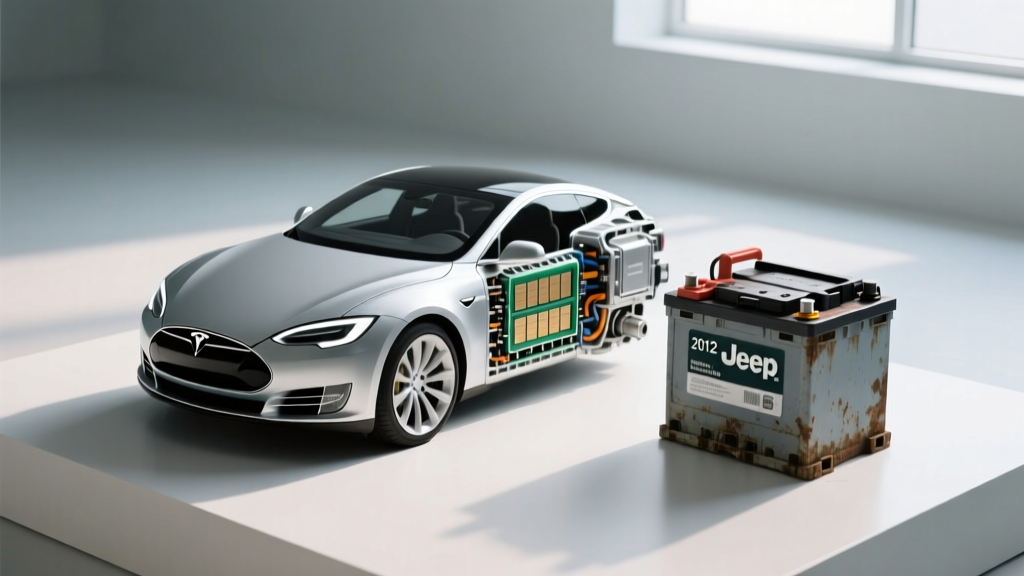
If you've ever owned or shopped for a 2012 Jeep Liberty, you know the drill: every three to five years, the 12-volt lead-acid battery dies, and you're swapping it in the driveway for $150-$220. That maintenance rhythm shapes how many buyers think about all vehicle batteries — including the high-voltage traction packs powering today's electric vehicles. The reality is fundamentally different, and understanding the gap between a conventional 12V starter battery and a modern EV battery pack is essential before you commit $40,000+ to an electric vehicle.
This guide breaks down everything you need to know about EV battery technology in 2026: chemistry trade-offs, real-world degradation data, warranty coverage, replacement costs, and how to maximize the lifespan of a pack designed to outlast the car it's bolted into.
The Fundamental Difference: 12V Starter Battery vs. High-Voltage Traction Battery
The battery in a 2012 Jeep Liberty is a 12-volt lead-acid unit (typically Group 34 or Group 75, around 0.5-0.7 kWh of energy capacity). Its sole job is cranking the starter motor and running accessories when the engine is off. It weighs roughly 35-45 lbs and delivers a short burst of high current (cold cranking amps) before the alternator takes over.
An EV traction battery is an entirely different animal. A 2026 Hyundai Ioniq 5 carries a 77.4 kWh usable lithium-ion pack operating at 400-800 volts, weighing over 1,000 lbs. A Tesla Model Y Long Range uses roughly 75 kWh at similar voltages. These packs don't just start the car — they are the car's entire energy supply, delivering sustained power over hundreds of miles. Even EVs still carry a separate 12V auxiliary battery (often lithium-ion now) for low-voltage systems, but the traction battery is the component that drives range, performance, and long-term ownership cost.
Confusing these two systems is the single most common mistake new EV shoppers make. When someone asks "what happens when the battery dies?" — the answer depends entirely on which battery they mean.
Battery Chemistry Explained: LFP vs. NMC/NCA
Not all lithium-ion batteries are the same. The two dominant chemistries in 2026 EVs are LFP (lithium iron phosphate) and NMC/NCA (nickel manganese cobalt / nickel cobalt aluminum). Each has distinct engineering trade-offs that affect your real-world ownership experience.
| Attribute | LFP (Lithium Iron Phosphate) | NMC / NCA (Nickel-Based) |
|---|---|---|
| Energy Density | Lower (~160 Wh/kg cell-level) | Higher (~250-280 Wh/kg cell-level) |
| Range per Pack Weight | Shorter range for same weight, or heavier pack for same range | More range per pound — preferred for long-range models |
| Cycle Life | 3,000-5,000+ full cycles before 80% capacity | 1,000-2,000 full cycles before 80% capacity |
| Calendar Life | Excellent — slower degradation when parked at high SoC | Good — but high SoC storage accelerates degradation |
| Cold-Weather Performance | Weaker — greater range loss below 32°F, slower cold charging | Better low-temperature discharge and charge acceptance |
| Charging to 100% | Recommended periodically for BMS calibration; tolerates full SoC well | Best kept 20-80% daily; 100% only for trips |
| Cost (Cell-Level) | Lower — no cobalt or nickel; ~$80-95/kWh in 2026 | Higher — commodity-sensitive; ~$110-140/kWh in 2026 |
| Thermal Stability | Superior — higher thermal runaway threshold (~270°C) | Good — but lower thermal runaway margin (~210°C) |
| Common 2026 Applications | Tesla Model 3/Y RWD, Ford Mustang Mach-E Select, BYD models, base-trim EVs | Tesla Long Range, Hyundai Ioniq 5/6, Rivian, Lucid, high-performance trims |
Which is better? It depends on your use case. If you drive a moderate daily commute (under 60 miles round-trip), charge at home, and want maximum longevity with minimal SoC management, LFP is the pragmatic choice — you can charge to 100% daily without accelerating degradation. If you need 300+ miles of EPA range, tow, drive in extreme cold regularly, or prioritize performance, NMC/NCA delivers the energy density required. Neither is universally superior; both will outlast 200,000 miles with proper care.
How Long Do EV Batteries Actually Last? Degradation Data
The fear that EV batteries need replacing like a 2012 Jeep Liberty battery — every few years — is not supported by fleet data. Modern lithium-ion traction packs are engineered for the life of the vehicle. Here's what the numbers actually show:
Observed Degradation Benchmarks (2026 Fleet & Owner Data):
- Tesla Model 3/Y (NMC, 2019-2022 models): Median ~5% capacity loss at 100,000 miles, ~8-10% at 200,000 miles. Source: Tesla Impact Reports, Recurrent Auto fleet data.
- Nissan Leaf (2013-2018, passive air-cooled NMC): 10-20% loss by 80,000-100,000 miles — the outlier that shaped early "battery anxiety." Lack of active thermal management was the primary cause.
- Chevrolet Bolt EV/EUV (NMC, liquid-cooled): ~5-7% loss at 100,000 miles per owner-reported data on Bolt forums and Recurrent Auto.
- Hyundai Ioniq 5 / Kia EV6 (NMC, 800V architecture): Early data (2022-2025 models) suggests 3-5% loss at 60,000 miles — among the best-performing packs in current production.
- LFP-equipped Tesla Model 3 RWD: Negligible measured degradation in first 50,000 miles for many owners, though LFP's flat voltage curve makes precise SoH measurement more difficult.
The key variable is thermal management. Every mainstream 2026 EV uses liquid-cooled battery packs, which maintain cell temperatures in the optimal 20-35°C range during charging and driving. The air-cooled Nissan Leaf was the exception that proved the rule: active cooling dramatically extends battery life. According to data aggregated by Recurrent Auto, the average modern EV battery loses roughly 5-8% of original capacity over the first 100,000 miles — meaning a 300-mile EPA-rated vehicle still delivers ~275-285 miles after a decade of typical use.
For context: the EPA's fueleconomy.gov data shows the average American drives 13,500 miles per year. At that rate, reaching 200,000 miles takes roughly 15 years — and most current EV batteries are engineered to retain 70-80% capacity at that milestone.
Battery Warranty Terms: What's Actually Covered
Federal law mandates that EV battery warranties cover a minimum of 8 years / 100,000 miles (10 years / 150,000 miles in California and states adopting CARB standards). Most manufacturers exceed these minimums in capacity-retention guarantees. Here's how major 2026 warranties compare:
| Manufacturer | Warranty Period | Capacity Threshold | Notes |
|---|---|---|---|
| Tesla (Model 3/Y LWD) | 8 yr / 100,000 mi | 70% retention | LFP pack — covers defects + capacity below threshold |
| Tesla (Model 3/Y LR & Performance) | 8 yr / 120,000 mi | 70% retention | NMC pack, higher mileage coverage |
| Hyundai / Kia | 10 yr / 100,000 mi | 70% retention | Among the longest time-period coverage in the US market |
| Ford (Mustang Mach-E, F-150 Lightning) | 8 yr / 100,000 mi | 70% retention | Components + capacity covered |
| General Motors (Ultium-based) | 8 yr / 100,000 mi | 70% retention | Covers battery energy storage system components |
| Rivian | 8 yr / 175,000 mi | 70% retention | Highest mileage threshold among major OEMs |
| Volkswagen (ID.4) | 8 yr / 100,000 mi | 70% retention | Standard coverage for MEB platform |
What the warranty covers: Manufacturing defects, cell/module failures, and capacity loss below the stated threshold (typically 70% of original usable capacity). If your 77.4 kWh Ioniq 5 pack drops below ~54 kWh usable within 10 years / 100,000 miles, Hyundai will repair or replace it at no cost.
What it doesn't cover: Damage from accidents, flooding, or unauthorized modifications. Gradual degradation above the 70% threshold is considered normal wear — not a warranty claim. Also note: using third-party DC fast charging does not void your battery warranty, despite persistent myths. The Magnuson-Moss Warranty Act protects consumers from tie-in requirements.
EV Battery Replacement Cost: The Real Numbers
This is the question that drives the most anxiety, and it deserves honest context. Yes, a full EV battery replacement is expensive. But the probability of needing one outside of warranty coverage is low — and declining.
| Vehicle / Pack Size | Out-of-Warranty Replacement Cost (2026) | Typical Need Timeline |
|---|---|---|
| Tesla Model 3 RWD (~57 kWh LFP) | $8,000 - $12,000 | Rarely before 250,000+ mi |
| Tesla Model Y LR (~75 kWh NMC) | $12,000 - $16,000 | Rarely before 200,000+ mi |
| Hyundai Ioniq 5 (~77.4 kWh NMC) | $12,000 - $18,000 | Rarely before 200,000+ mi |
| Ford F-150 Lightning Ext. Range (~131 kWh NMC) | $20,000 - $30,000 | Very large pack; rarely before 200,000+ mi |
| Chevrolet Bolt EV (~65 kWh NMC) | $9,000 - $14,000 | Post-recall replacement packs are improved |
| Nissan Leaf (40-62 kWh, older models) | $6,500 - $10,000 | Earlier degradation due to passive cooling |
For comparison, a replacement 12V battery for a 2012 Jeep Liberty costs $150-$220 and lasts 3-5 years. Over 15 years, you'd spend $600-$1,100 on lead-acid replacements. An EV traction battery is a single, far larger expense — but one that the vast majority of owners never face. According to Consumer Reports, less than 1.5% of EVs sold since 2018 have required out-of-warranty battery replacement as of 2025, and that figure is dominated by early-generation vehicles without liquid cooling.
When replacement is needed, module-level repair is increasingly an option. Rather than replacing the entire pack, specialized shops can identify and swap degraded modules for $2,000-$5,000 — a practice growing as independent EV service matures.
Factors That Accelerate Battery Degradation (and How to Avoid Them)
Lithium-ion batteries degrade through two mechanisms: calendar aging (time and temperature) and cycle aging (charge-discharge use). You can't stop either entirely, but you can significantly slow both.
EV Battery Longevity Checklist:
- Avoid sustained 100% SoC (NMC/NCA): Store between 20-80% for daily use. Charge to 100% only when departing on a trip. LFP packs are more tolerant of 100% and actually benefit from periodic full charges for BMS calibration.
- Minimize DC fast charging when Level 2 is available: Occasional DCFC is fine and won't void your warranty, but daily 150+ kW charging generates sustained heat that accelerates electrolyte decomposition. Home Level 2 (7-11 kW) is the ideal daily charging method.
- Precondition in cold weather: Use your EV's scheduled departure or preconditioning feature to warm the battery while still plugged in. Cold lithium-ion cells experience lithium plating if charged at high rates below freezing — preconditioning prevents this.
- Don't let the pack sit at 0% or near-zero for extended periods: The 12V system and BMS draw a small constant load. If an EV sits at very low SoC for weeks, cells can drop below safe voltage thresholds, causing irreversible damage.
- Park in shade or a garage during extreme heat: Sustained ambient temperatures above 95°F accelerate calendar aging. A garage or shaded spot meaningfully reduces thermal stress on the pack.
- Use regenerative braking moderately in extreme cold: In sub-freezing conditions, aggressive regen can stress cold cells. Most EVs automatically limit regen when the battery is cold, but easing off the pedal manually in the first few miles helps.
Monitoring Battery Health: How to Check State of Health (SoH)
State of Health (SoH) is the percentage of original usable capacity remaining in your battery. A new pack is 100% SoH; a pack that held 77.4 kWh when new but now holds 71 kWh is at ~91.7% SoH.
How to check it:
- In-vehicle displays: Tesla shows battery health via the service menu (accessible in recent software updates). Hyundai/Kia provides SoH data through the dealer diagnostic tool — request it during service visits.
- OBD-II dongles + apps: Tools like the OBDLink SX paired with apps such as EVnotify or LeafSpy (for Nissan) can read pack-level data including SoH, cell voltage variance, and pack temperature.
- Third-party services: Recurrent Auto offers free battery health reports by connecting to your vehicle's telematics. They compare your pack's degradation to a fleet of identical vehicles — useful for resale documentation.
- Dealer diagnostics: Any authorized service center can pull a full battery health report. Request this before purchasing a used EV — it's the single most important data point for assessing remaining pack life.
One caveat for LFP owners: because LFP cells have an extremely flat voltage curve (the voltage barely changes between 20% and 80% SoC), the Battery Management System has a harder time estimating capacity precisely. SoH readings on LFP packs may show more variance than NMC packs, even when the actual health is stable. Periodic 100% charges help the BMS recalibrate.
Emerging Battery Technology: Solid-State and Beyond
If you're researching EV batteries, you've likely seen headlines about solid-state batteries promising 600-mile range and 10-minute charging. Here's the realistic 2026 timeline:
Solid-state batteries replace the liquid electrolyte with a solid ceramic, polymer, or sulfide conductor. The theoretical benefits are substantial: higher energy density (~400-500 Wh/kg cell-level vs. ~250-280 for current NMC), faster charging without lithium plating risk, and improved thermal safety. Toyota has announced solid-state-equipped vehicles for 2027-2028, initially in limited-production models. Samsung SDI and QuantumScape are targeting 2028-2030 for broader commercialization. These are announced timelines — production scaling remains the primary challenge, and initial vehicles will carry significant price premiums.
Silicon-dominant anodes are closer to mainstream adoption. Companies like Sila Nanotechnologies and Group14 are supplying silicon-carbon anode materials that increase energy density by 15-25% without the manufacturing overhaul that solid-state requires. Expect these in premium 2027-2028 model-year vehicles as incremental range improvements rather than revolutionary leaps.
Sodium-ion batteries are emerging as a low-cost alternative for budget EVs and stationary storage. CATL has begun production, and while energy density is lower (~120-150 Wh/kg), the raw material cost advantage is significant. Don't expect sodium-ion in US-market long-range vehicles, but it may appear in entry-level models or urban EVs by 2028-2029.
None of these technologies change the buying decision today. Current lithium-ion packs — both LFP and NMC — are mature, well-warrantied, and demonstrably long-lasting. Waiting for solid-state is like waiting for a better internal combustion engine in 2010: theoretically sensible, practically a reason to delay indefinitely.
The Bottom Line: EV Battery Ownership vs. Conventional Battery Maintenance
The 2012 Jeep Liberty owner replaces a $180 lead-acid battery every 4 years as a routine cost of ownership. The EV owner has a far more capable, far more expensive battery — but one that requires zero scheduled maintenance and, based on all available fleet data, will likely retain 75-85% of its original capacity after 150,000 miles and a decade of use.
The EV battery isn't a ticking time bomb. It's the most over-engineered component in the vehicle, protected by liquid cooling, sophisticated BMS software, and warranty coverage that extends up to 10 years or 175,000 miles. The rational approach is to buy based on today's proven lithium-ion technology, follow basic SoC and thermal best practices, and let the warranty handle the unlikely edge case.
How long do EV batteries last in years and miles?
Most modern liquid-cooled EV batteries (2020 and newer) are engineered to retain 70-80% of original capacity at 200,000 miles or 15 years. Fleet data from Tesla, Hyundai, and GM shows median degradation of 5-8% at 100,000 miles. Full battery failure outside of warranty is rare — under 1.5% of vehicles per Consumer Reports data.
How much does it cost to replace an EV battery?
Out-of-warranty replacement costs range from $8,000 to $30,000 depending on pack size, with most mid-size EVs (75-80 kWh) falling in the $12,000-$18,000 range. Module-level repair can reduce this to $2,000-$5,000. However, the vast majority of EV owners never need a replacement — the pack typically outlasts the vehicle.
What does the EV battery warranty actually cover?
Federally mandated minimum coverage is 8 years / 100,000 miles (10/150,000 in CARB states). Coverage includes manufacturing defects and capacity loss below a stated threshold (typically 70% of original capacity). It does not cover accident damage, flood damage, or degradation above the threshold. Using public DC fast chargers does not void the warranty.
How do I check and maximize my EV battery health?
Check SoH through in-vehicle menus, OBD-II apps (EVnotify, LeafSpy), third-party services like Recurrent Auto, or dealer diagnostics. Maximize longevity by keeping NMC packs between 20-80% SoC for daily use, using Level 2 charging as your primary method, preconditioning in cold weather, and avoiding prolonged storage at very low or very high SoC.
LFP vs NMC — which battery chemistry is better for me?
Choose LFP if you want maximum cycle life, lower cost, can accept slightly less range, and primarily drive in moderate climates. Charge to 100% periodically for BMS calibration. Choose NMC/NCA if you need 300+ miles of range, regularly drive in extreme cold, tow, or prioritize performance. Keep daily SoC between 20-80% and charge to 100% only for trips.