Current EQS Battery Tech and the Solid-State Promise
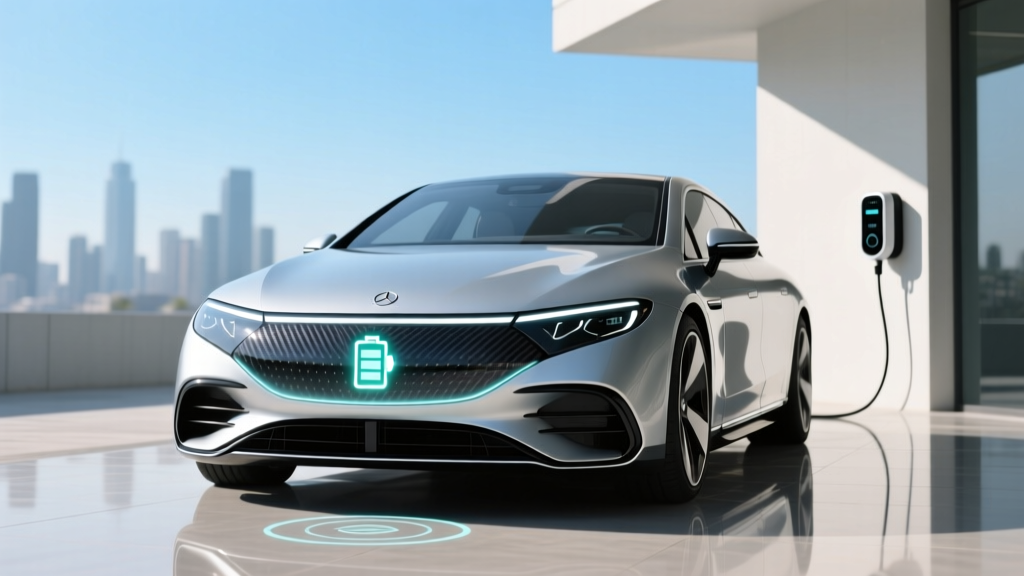
The 2026 Mercedes-Benz EQS sedan rides on a 107.8 kWh usable lithium-ion pack built around NMC (nickel-manganese-cobalt) chemistry. In EPA testing, the EQS 450+ delivers up to 390 miles of range, while the dual-motor EQS 580 4MATIC lands at roughly 345 miles. Real-world highway driving at 75 mph typically shaves 12–18% off those figures, and cold-weather operation below 30°F can push losses to 25–30% without preconditioning.
Enthusiasts and buyers frequently search for the Mercedes EQS solid-state battery range because solid-state technology promises a step-change in energy density — potentially 500+ miles in the same physical footprint. As of early 2026, Mercedes-Benz has not announced a production EQS equipped with a solid-state pack. The automaker has invested in solid-state developer Factorial Energy and has tested prototype cells, but commercialization for a luxury sedan remains in the late-2020s window at the earliest. What follows is a thorough look at the battery you can actually buy today, how it ages, what it costs to replace, and where the technology is heading.
- EPA Sticker (EQS 450+): 390 miles
- Real-World Highway (70–75 mph): ~320–345 miles
- Cold Weather (20°F, no preconditioning): ~275–300 miles
- DC Fast Charging: Peak 200 kW, 10–80% in ~31 minutes
LFP vs NMC: Understanding Your EQS Chemistry
The EQS uses NMC cells supplied primarily by CATL and Farasis Energy. NMC chemistry dominates the luxury EV segment because it delivers higher energy density than LFP (lithium iron phosphate), which translates directly into more range per kilogram of battery mass. That matters in a 5,700-pound sedan where packaging and weight distribution affect ride quality.
| Attribute | LFP (Lithium Iron Phosphate) | NMC/NCA (Nickel-Based) |
|---|---|---|
| Energy Density | ~160–180 Wh/kg (lower) | ~220–260 Wh/kg (higher) |
| Cycle Life | 3,000–5,000+ cycles | 1,500–2,500 cycles |
| Cold-Weather Performance | Weaker; slower charging below freezing | Better low-temp conductivity |
| Cost per kWh | Lower (no cobalt/nickel) | Higher (critical minerals) |
| Thermal Stability | Excellent; higher runaway threshold | Good; requires robust BMS |
| Typical Use Case | Standard-range models, fleet vehicles | Long-range luxury, performance EVs |
| SoC Recommendation | Can charge to 100% daily | 80% daily; 100% for trips only |
For the EQS, NMC is the right call. The sedan's value proposition centers on maximum range and effortless performance, both of which benefit from the energy-density advantage. The trade-off is a slightly shorter calendar life compared to LFP, and a stronger recommendation to avoid sitting at 100% state of charge for extended periods.
How Long Do EV Batteries Last? Degradation Data
Modern NMC packs in liquid-cooled luxury EVs like the EQS degrade more slowly than early-2010s batteries. Industry data from Geotab's large-scale fleet study shows average annual capacity loss of roughly 1.8–2.3% for well-managed NMC packs. Applied to the EQS, that projects to:
- Year 1 / 15,000 mi: ~98% State of Health (SoH) — 382 effective miles
- Year 3 / 45,000 mi: ~94% SoH — 367 effective miles
- Year 5 / 75,000 mi: ~90% SoH — 351 effective miles
- Year 8 / 120,000 mi: ~85% SoH — 332 effective miles
- Year 10 / 150,000 mi: ~80% SoH — 312 effective miles
These projections assume mixed driving with moderate DC fast-charging use. Heavy reliance on 200 kW DC charging (3+ times weekly) without preconditioning may accelerate loss by 1–3% over the same period.
The critical takeaway: most EQS batteries will retain well above 80% capacity at the 100,000-mile mark. Catastrophic failure requiring full replacement is rare — most owners will sell or trade the vehicle before the pack becomes a concern.
Mercedes-Benz EQS Battery Warranty: What's Covered
Mercedes-Benz backs the EQS high-voltage battery with an 8-year / 100,000-mile warranty (whichever comes first). The warranty guarantees that the battery will retain at least 70% of its original usable capacity during the coverage period. If the pack falls below that threshold under normal use, Mercedes will repair or replace it at no cost.
| Term | Detail |
|---|---|
| Duration | 8 years / 100,000 miles (whichever first) |
| Capacity Threshold | 70% of original usable capacity (75.5 kWh minimum of 107.8 kWh) |
| Coverage | Defects, excessive degradation, module failure |
| Exclusions | Physical damage, unauthorized modifications, abuse |
| Transferable | Yes — transfers to subsequent owners automatically |
| 12V Auxiliary Battery | Separate coverage under standard new-vehicle warranty (4 yr / 50,000 mi) |
One important nuance: the 12-volt auxiliary battery that powers the EQS electronics, door handles, and infotainment is a separate component with its own warranty timeline. If your EQS won't "start" (i.e., won't close the high-voltage contactors), the 12V battery is usually the culprit — not the traction pack. Mercedes dealerships can diagnose this distinction quickly.
EV Battery Replacement Cost: What EQS Owners Face
Out-of-warranty high-voltage battery replacement is the number-one fear among prospective EV buyers. For the EQS, the reality is less alarming than headlines suggest, largely because most packs outlast the vehicle's economic life.
| Vehicle / Pack Size | Battery Cost (Parts) | Labor | Total Estimated |
|---|---|---|---|
| Mercedes EQS (107.8 kWh NMC) | $22,000–$30,000 | $2,500–$4,000 | $24,500–$34,000 |
| Tesla Model S (100 kWh) | $16,000–$22,000 | $2,000–$3,000 | $18,000–$25,000 |
| Chevrolet Bolt EV (65 kWh) | $10,000–$14,000 | $1,500–$2,500 | $11,500–$16,500 |
| Ford F-150 Lightning Ext. (131 kWh) | $25,000–$35,000 | $3,000–$4,500 | $28,000–$39,500 |
When is replacement actually needed? In practice, full-pack replacement is typically triggered by:
- Physical damage from a collision or road debris impact on the underbody skid plate
- Individual module failure that cannot be isolated — Mercedes can replace individual modules rather than the full pack in many cases, reducing cost to $3,000–$8,000 per module
- Capacity below 70% after warranty expiration — rare before 200,000+ miles with proper care
For context, the average EQS owner drives roughly 12,000–14,000 miles per year. Reaching 150,000 miles takes over a decade, and at that point the vehicle's resale value will likely be below the cost of a new pack — making module-level repair or certified used-pack replacement the more probable path.
Maximizing EQS Battery Health: A Care Checklist
NMC chemistry rewards moderate habits. Here is a practical checklist for EQS owners who want to minimize degradation and preserve resale value:
- Daily charge limit: Set to 80% for routine driving. Use the MBUX charge-limit setting or Mercedes me app.
- 100% charges: Reserve for road trips. Avoid leaving the car at 100% for more than a few hours.
- DC fast charging: Use 200 kW DC charging when needed, but rely on Level 2 home charging (9.6–11 kW) for daily top-ups. Precondition the battery via navigation-to-charger routing.
- Avoid deep discharge: Don't regularly drive below 10% SoC. The EQS has a buffer, but repeated deep cycles stress NMC cells.
- Extreme heat: Park in shade or a garage when possible. The liquid cooling system handles heat well, but prolonged 100°F+ exposure while parked at high SoC accelerates calendar aging.
- Extreme cold: Always use preconditioning before DC fast charging. Plug in overnight in winter to keep the pack above 32°F using grid power rather than battery energy.
- Storage: If storing the EQS for 2+ weeks, leave it at ~50% SoC and plugged in with the charge limit set to 50%.
How to Check Your EQS Battery State of Health
Mercedes does not expose a granular SoH percentage in the MBUX interface the way some competitors do. Here are the reliable methods:
- Mercedes me App: Check available range trends over time. A consistent drop in full-charge range vs. the original EPA figure indicates degradation.
- Dealership Diagnostic: Request a battery health report during scheduled service. Mercedes technicians can pull cell-level voltage delta data and a computed SoH percentage from the BMS.
- OBD-II Scanner (advanced): Third-party tools like Carista or OBDeleven can read some BMS parameters, though Mercedes limits access compared to open-platform EVs.
- Manual tracking: Record your indicated range at 100% SoC quarterly. Compare against the original 390-mile (450+) or 345-mile (580) baseline to compute your personal degradation rate.
Solid-State Batteries: Timeline and What They Mean for the EQS
Solid-state batteries replace the liquid electrolyte in conventional lithium-ion cells with a solid conductor — typically a ceramic, sulfide, or polymer material. The theoretical advantages are substantial:
- Energy density: 350–500 Wh/kg at the cell level (vs. ~250 Wh/kg for current NMC), enabling 500+ mile range in the EQS footprint
- Charging speed: Potential for 10–80% in under 15 minutes due to reduced dendrite risk
- Safety: No flammable liquid electrolyte; higher thermal runaway threshold
- Longevity: Projected 3,000+ cycles with minimal degradation
No production passenger vehicle sold in the U.S. currently uses a solid-state traction battery. Mercedes-Benz's partnership with Factorial Energy has produced prototype cells tested in EQS development mules, but the automaker has confirmed no production timeline earlier than the late 2020s for limited deployment. Toyota, Nissan, and Samsung SDI target 2027–2029 for initial low-volume production. Current-generation EQS buyers should make their purchase decision based on today's proven NMC technology — not future solid-state promises. If solid-state arrives for the EQS successor, it will likely debut in a next-generation platform, not as a retrofit for current vehicles.
Beyond solid-state, silicon-anode technology is nearer to production. Companies like Sila Nanotechnologies and Group14 are supplying silicon-dominant anode materials that boost energy density 15–20% within existing NMC cell formats. Mercedes-Benz has invested in Sila, and early silicon-anode cells may appear in AMG or ultra-long-range variants before full solid-state packs arrive.
Frequently Asked Questions
How long do EV batteries last in years and miles?
Liquid-cooled NMC packs like the one in the EQS typically retain 80–85% of original capacity at 150,000 miles or 10 years under normal use. Catastrophic failure is uncommon. Most EV batteries outlast the economic life of the vehicle itself, with fleet data from Geotab and Recurrent showing median annual degradation of 1.8–2.3% for modern packs.
How much does an EQS battery cost to replace?
A full 107.8 kWh pack replacement for the Mercedes EQS runs an estimated $24,500–$34,000 including parts and labor as of 2026. However, module-level repair (replacing individual degraded or failed modules rather than the entire pack) can cost $3,000–$8,000 per module. Under the 8-year/100,000-mile warranty, replacement for degradation below 70% capacity is covered at no cost.
What does the Mercedes EQS battery warranty cover?
The warranty covers 8 years or 100,000 miles against defects and capacity loss below 70% of the original 107.8 kWh usable capacity. It is transferable to subsequent owners. Physical damage, unauthorized modifications, and the separate 12V auxiliary battery are excluded from high-voltage coverage.
How do I check and maximize my EQS battery health?
Track your 100% indicated range quarterly against the original EPA baseline. Request a BMS health report at your Mercedes dealer during service. To maximize longevity: charge to 80% daily, precondition before DC fast charging, avoid prolonged storage above 90% or below 10% SoC, and use Level 2 home charging as your primary method.
LFP vs NMC — which is better for my EV?
Neither is universally better; it depends on your priorities. NMC delivers higher energy density (more range in less weight), making it ideal for long-range luxury vehicles like the EQS. LFP offers longer cycle life (3,000–5,000 cycles vs. 1,500–2,500), lower cost, and the ability to charge to 100% daily without accelerated degradation — making it better for standard-range models, fleet use, and buyers who prioritize longevity over maximum range. LFP's main weakness is cold-weather charging performance, which is noticeably slower below freezing without aggressive preconditioning.
Will solid-state batteries be available for the EQS?
Not in the current-generation EQS. Mercedes-Benz is developing solid-state technology through its partnership with Factorial Energy, but production deployment is not expected before the late 2020s, likely in a next-generation vehicle platform. Current EQS owners cannot retrofit a solid-state pack. Buyers considering waiting for solid-state should weigh that timeline against the proven performance and 390-mile EPA range available today.