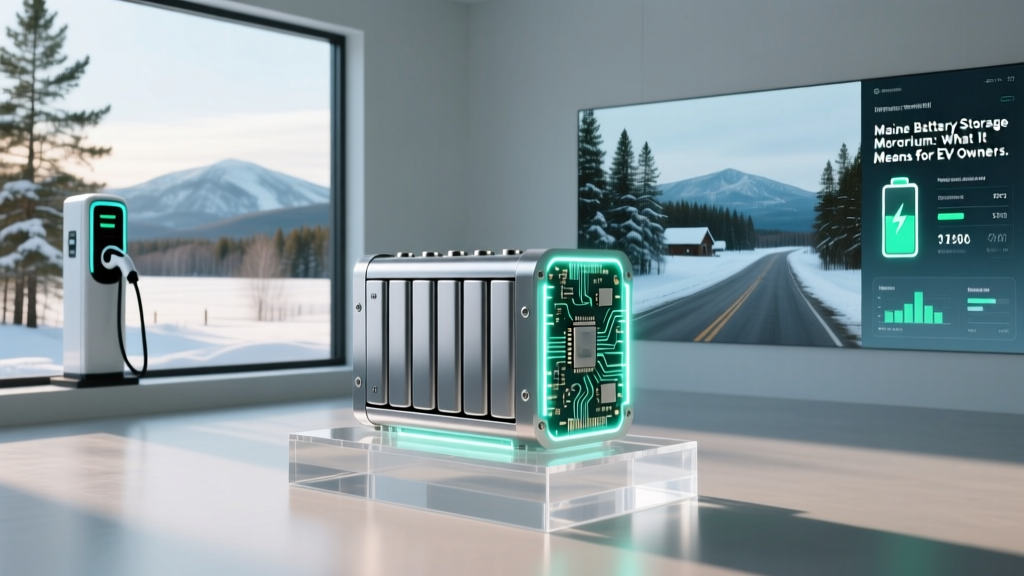
Why a Maine Battery Storage Moratorium Matters to EV Drivers
In 2024, Maine's legislature passed LD 1636, imposing a moratorium on certain large-scale battery storage facilities — specifically targeting projects using lithium-ion batteries near residential areas and sensitive environments. The moratorium was driven by constituent concerns over fire safety, chemical exposure, and environmental impact of grid-scale installations. By 2026, the policy landscape continues to evolve as Maine weighs updated siting rules.
For EV owners and prospective buyers in Maine — and anyone watching state-level battery regulation — this raises a natural question: does this affect my electric vehicle's battery? The short answer is no. The moratorium targets stationary, utility-scale energy storage systems (ESS), not the traction batteries inside your car. But the public debate has surfaced legitimate questions about lithium-ion battery chemistry, longevity, safety, and disposal that every EV owner should understand.
This guide separates grid-policy concerns from what actually matters for your EV: battery chemistry, real-world degradation, warranty coverage, replacement costs, and how to maximize your pack's lifespan.
LFP vs. NMC/NCA: Understanding Your EV's Battery Chemistry
Every EV sold in the US uses one of two dominant lithium-ion chemistries in its high-voltage traction battery. The chemistry affects range, longevity, cold-weather behavior, and cost — and it's worth knowing which one your vehicle uses.
| Attribute | LFP (Lithium Iron Phosphate) | NMC/NCA (Nickel Manganese Cobalt / Nickel Cobalt Aluminum) |
|---|---|---|
| Energy Density | Lower (~160 Wh/kg cell-level) | Higher (~250–300 Wh/kg cell-level) |
| Typical Vehicles | Tesla Model 3/Y RWD, Ford Mustang Mach-E Select (some), Rivian Standard | Tesla Long Range, Hyundai Ioniq 5/6, Ford Mach-E Extended, most luxury EVs |
| Cycle Life | 3,000–5,000+ cycles to 80% capacity | 1,000–2,000 cycles to 80% capacity |
| Cold Performance | Reduced — greater range loss below 32°F | Better low-temp discharge, but still impacted |
| Charging to 100% Daily | Recommended — Tesla and others advise periodic 100% charges for BMS calibration | Discouraged — daily 80% limit recommended for longevity |
| Cobalt Content | None | Contains cobalt (supply chain and ethical concerns) |
| Cost (cell-level) | Lower — ~$80–100/kWh in 2026 | Higher — ~$110–140/kWh in 2026 |
| Thermal Stability | Excellent — higher thermal runaway threshold (~270°C) | Good, but lower threshold (~210°C) |
The Maine connection: The moratorium debate often conflates all lithium-ion chemistries. In reality, LFP's superior thermal stability makes it fundamentally different from the NMC cells typically used in grid-scale storage. If you're buying an EV in Maine and cold-weather range is your top concern, an NMC-equipped Long Range model will lose less range in January than an LFP Standard Range variant — but LFP's cycle-life advantage means it will likely outlast the car itself.
How Long Do EV Batteries Actually Last?
Based on aggregated fleet data through 2025, the median EV battery retains approximately 88–92% of its original capacity after 100,000 miles and roughly 80–85% after 150,000 miles. These figures come from sources including Recurrent Auto's fleet analysis of over 15,000 vehicles and Tesla's own Impact Report data.
Typical Degradation Curve (NMC chemistry, average US driving conditions):
- Year 1 / 15,000 mi: ~2–3% capacity loss (initial formation loss)
- Year 3 / 45,000 mi: ~5–7% total loss
- Year 5 / 75,000 mi: ~7–10% total loss
- Year 8 / 120,000 mi: ~10–14% total loss
- Year 10 / 150,000 mi: ~15–20% total loss
LFP packs degrade more slowly in the middle years, often showing 90%+ retention at 100,000 miles. The curve flattens after the initial drop — degradation is not linear.
For context, a 2026 Hyundai Ioniq 5 Long Range with a 77.4 kWh (usable) NMC battery and an EPA range of 305 miles would realistically deliver roughly 275–285 miles at 100,000 miles of use. That's still more daily range than most drivers need. According to fueleconomy.gov, the average American drives 14,000 miles per year — meaning most EV batteries will outlast the vehicle's useful life before degrading to a point that meaningfully affects daily usability.
What the Battery Warranty Actually Covers
Federal law mandates a minimum 8-year / 100,000-mile warranty on EV battery packs (10 years / 150,000 miles for PZEV states including California and states adopting CARB standards). Most manufacturers exceed this floor. Here's how major 2026 warranties compare:
| Manufacturer | Warranty Term | Capacity Retention Threshold | Notes |
|---|---|---|---|
| Tesla (Model 3/Y LFP) | 8 yr / 100,000 mi | 70% | Covers defects + capacity below threshold |
| Tesla (Model 3/Y LR NMC) | 8 yr / 120,000 mi | 70% | Longer mileage on Long Range |
| Hyundai / Kia | 10 yr / 100,000 mi | 70% | Among the longest coverage in the US |
| Ford (Mach-E, F-150 Lightning) | 8 yr / 100,000 mi | 70% | Component + capacity coverage |
| Rivian | 8 yr / 120,000 mi | 70% | Standard on R1T and R1S |
| BMW (i4, iX) | 8 yr / 100,000 mi | 70% | Includes battery management system |
| GM (Ultium platform) | 8 yr / 100,000 mi | 70% (60% on some commercial) | Varies by model |
Key detail: The 70% threshold means the manufacturer replaces or repairs the pack only if it degrades below 70% of original capacity within the warranty period. A pack at 72% — while noticeably reduced — would not trigger a warranty claim. In practice, very few packs fall below 70% within the warranty window based on current fleet data.
The warranty covers manufacturing defects and abnormal degradation. It does not cover damage from collisions, flooding, improper charging equipment, or modifications to the battery system. Always read your specific warranty booklet — terms vary, and some exclude certain failure modes.
EV Battery Replacement Cost: The Real Numbers
Battery replacement is the concern that generates the most anxiety — and the most misinformation. Here are verified replacement cost ranges for common 2026 models, based on manufacturer service bulletins and third-party repair data:
| Vehicle | Battery Size (Usable kWh) | Chemistry | Estimated Replacement Cost |
|---|---|---|---|
| Tesla Model 3 RWD | 57.5 kWh | LFP | $12,000–$16,000 |
| Tesla Model Y Long Range | 75 kWh | NMC | $14,000–$20,000 |
| Hyundai Ioniq 5 Long Range | 77.4 kWh | NMC | $15,000–$22,000 |
| Ford Mustang Mach-E Extended | 88 kWh | NMC | $18,000–$26,000 |
| Ford F-150 Lightning Extended | 131 kWh | NMC | $25,000–$35,000 |
| Rivian R1T (Large Pack) | 128 kWh | NMC | $24,000–$32,000 |
| Chevrolet Equinox EV | 85 kWh | NMC (Ultium) | $16,000–$23,000 |
These figures include the battery module(s) and labor but can vary by region, dealer, and whether modules can be replaced individually versus the full pack. Tesla and some other manufacturers can replace individual modules within the pack for significantly less — sometimes $3,000–$7,000 for a single module failure.
When is replacement actually needed? Based on current degradation data, most EV batteries will not require full replacement due to capacity loss within the first 15 years or 200,000 miles. Premature replacements are overwhelmingly due to manufacturing defects (covered under warranty) or physical damage (covered by insurance). Out-of-pocket full-pack replacement for degradation alone remains rare.
Factors That Accelerate Battery Degradation
Not all miles are equal when it comes to battery wear. The following factors have the most measurable impact on long-term capacity retention:
Battery Care Essentials
- DC Fast Charging Frequency: Occasional DC fast charging (1–2 times per week) has minimal impact. Daily 150+ kW fast charging accelerates degradation by an estimated 1–3% over 100,000 miles compared to predominantly Level 2 home charging. The heat generated at high charge rates is the primary culprit, not the electricity itself.
- Extreme Temperatures: Sustained exposure to ambient temperatures above 95°F accelerates chemical aging. In Maine, the cold-weather concern is different — sub-freezing temps reduce usable range by 20–40% (per AAA and Recurrent data) but don't permanently damage the battery because the BMS limits charging speed until the pack warms. Garage parking helps in both extremes.
- State of Charge (SoC) Habits: For NMC batteries, regularly charging to 100% and leaving the car at full charge for days accelerates degradation. The ideal daily range is 20–80% SoC. LFP batteries are an exception — manufacturers recommend periodic 100% charges for cell balancing. Storing any EV at 0% for extended periods is damaging.
- Preconditioning: Using your vehicle's preconditioning feature (warming the battery before a fast-charge session or before departure in cold weather) reduces stress on the cells. Most 2026 EVs do this automatically when you set a departure time or navigate to a charger.
- Depth of Discharge: Frequently draining the battery below 10% before recharging causes more stress than partial, shallow cycles. Plug in when you can rather than running the pack down.
How to Monitor Your Battery's State of Health
State of Health (SoH) is the percentage of original capacity your battery currently holds. Most 2026 EVs provide some form of SoH visibility, though the depth of information varies by manufacturer:
- Tesla: The in-car service menu and Tesla app show estimated range at 100% charge. Third-party tools like TeslaFi and Stats pull detailed SoH data from the vehicle's API. A 2026 Model 3 with 50,000 miles showing 280 miles at 100% (vs. an original 315 EPA) indicates roughly 89% SoH.
- Hyundai/Kia: The E-GMP platform vehicles display battery health information in the EV-specific settings menu. The Bluelink / Kia Connect app also surfaces charging history and estimated degradation.
- Ford: FordPass provides battery status and estimated range. For deeper diagnostics, a dealer can pull the Battery Energy Control Module (BECM) report showing individual cell voltages and SoH.
- OBD-II Tools: Universal scan tools like the OBDLink MX+ paired with apps such as EVNotify or LeafSpy (for Nissan) can read SoH data from most EVs. These are particularly useful for used-EV buyers who want an independent check.
Pro tip for Maine buyers: If you're evaluating a used EV in late fall or winter, test the 100% estimated range when the battery is warm (after a drive, not cold-soaked overnight). Cold-soaked packs display artificially reduced range estimates that recover once the battery reaches operating temperature.
Emerging Battery Tech: Solid-State and Beyond
The battery technology landscape is advancing, but timelines matter. Here's where next-generation chemistries stand as of 2026:
Solid-State Batteries: Toyota, Samsung SDI, and QuantumScape have demonstrated prototype solid-state cells with energy densities exceeding 400 Wh/kg and faster charging potential. Toyota has announced limited production in select 2027–2028 models, but mass-market availability in the US remains estimated for 2029–2031. These are not yet available in any production vehicle sold today.
Silicon Anode Technology: Companies like Sila Nanotechnologies and Group14 are integrating silicon-dominant anodes into existing lithium-ion formats, boosting energy density by 15–25% without requiring entirely new manufacturing lines. Mercedes-Benz's partnership with Sila targets the upcoming G-Class EV, and broader adoption is expected in 2027–2028 model-year vehicles.
Sodium-Ion Batteries: CATL and other Chinese manufacturers have begun producing sodium-ion cells for lower-cost, shorter-range EVs. These trade energy density for lower material cost and better cold performance. US-market adoption remains uncertain due to current IRS §30D tax credit battery sourcing requirements, which favor domestically produced lithium-ion cells.
None of these technologies change the buying decision today. Current LFP and NMC packs are mature, well-understood, and demonstrably long-lasting.
The Maine Moratorium and Your EV: Bottom Line
Maine's battery storage moratorium targets utility-scale stationary installations — not your car. Your EV's traction battery operates under entirely different regulatory, safety, and engineering frameworks. The public conversation around the moratorium has, however, highlighted the importance of understanding what's in your battery, how it ages, and what protections exist.
If you own or plan to buy an EV in Maine: your battery will likely retain 85%+ of its capacity for a decade or more of typical driving, it's covered by an 8–10 year federal-mandated warranty, and replacement costs — while significant — are rarely an out-of-pocket reality for the original owner. Garage your car when possible, rely on Level 2 home charging for daily use, and save DC fast charging for road trips.
How long do EV batteries last in years and miles?
Based on fleet data, most EV batteries retain 80–85% of original capacity at 150,000 miles (roughly 10–12 years of average driving). Full failure requiring replacement within the warranty period is statistically rare — under 2% of vehicles based on Recurrent Auto and manufacturer data.
How much does an EV battery cost to replace?
Full-pack replacement costs range from roughly $12,000 for a Tesla Model 3 RWD (LFP, 57.5 kWh) to $35,000 for a Ford F-150 Lightning Extended Range (NMC, 131 kWh). However, most replacements are covered under warranty or insurance, and individual module repairs can cost $3,000–$7,000.
What does the EV battery warranty cover?
Federal law requires at least 8 years / 100,000 miles of coverage. Most warranties guarantee the battery will retain at least 70% of original capacity. They cover manufacturing defects and abnormal degradation but exclude physical damage, flooding, and unauthorized modifications.
How do I check my EV battery's health?
Most 2026 EVs display estimated range at 100% charge, which serves as a proxy for State of Health. Tesla owners can use TeslaFi or the in-car service menu. Third-party OBD-II tools like OBDLink MX+ can pull detailed SoH data from most EVs. Your dealer can also run a full diagnostic.
LFP vs. NMC — which is better for my EV?
Neither is universally better. LFP offers longer cycle life, lower cost, no cobalt, and superior thermal stability — but lower energy density and worse cold-weather range. NMC delivers more range per kWh and better cold performance — but shorter cycle life and higher cost. For Maine drivers prioritizing winter range, NMC Long Range models have an edge. For maximizing battery lifespan and minimizing cost, LFP is the stronger choice.
Does Maine's battery storage moratorium affect my electric vehicle?
No. The moratorium (LD 1636) applies to utility-scale stationary battery storage installations, not EV traction batteries. Your vehicle's battery is unaffected by this legislation in terms of ownership, charging, warranty, or legality.