What Kind of Lithium Car Battery Does Your EV Actually Have?
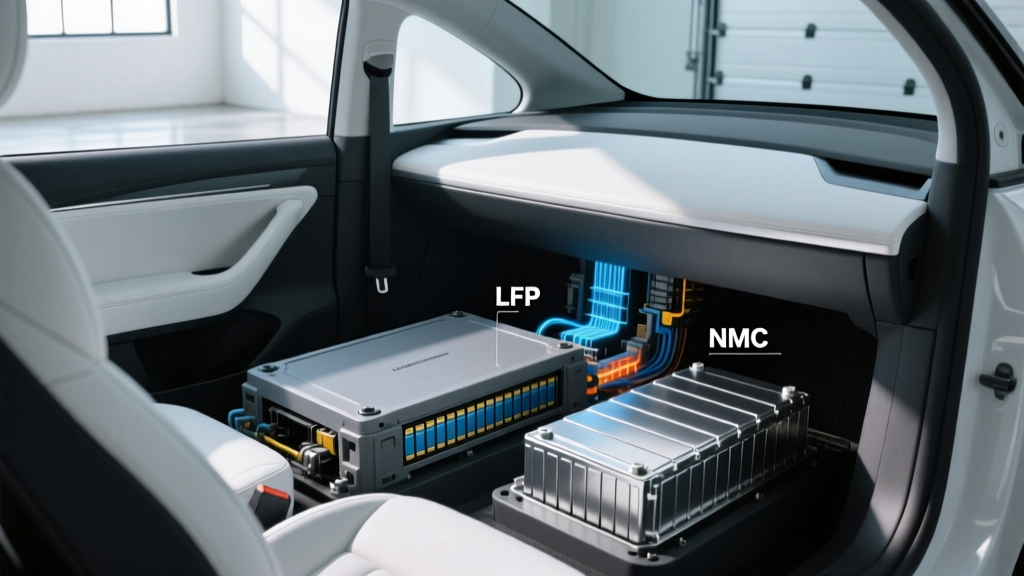
Every battery-electric and plug-in hybrid on the road relies on a lithium-ion traction pack, but the chemistry inside that pack varies enormously — and it affects your real-world range, charging speed, longevity, and resale value. As of the 2026 model year, two lithium chemistries dominate the EV market: LFP (lithium iron phosphate) and NMC/NCA (nickel manganese cobalt / nickel cobalt aluminum). Understanding which one powers your lithium car is the single most important battery decision you will make as a buyer or owner.
This guide breaks down the engineering trade-offs, the real-world degradation data, the warranty fine print, and the actual cost of replacement — with exact numbers, not marketing generalities.
LFP vs NMC vs NCA: The Chemistry Comparison That Matters
The cathode material inside a lithium-ion cell determines its energy density, thermal stability, cycle life, and manufacturing cost. Here is how the three mainstream chemistries stack up for passenger EVs in 2026:
| Attribute | LFP (LiFePO4) | NMC (Ni-Mn-Co) | NCA (Ni-Co-Al) |
|---|---|---|---|
| Energy density (cell-level) | 160–180 Wh/kg | 220–260 Wh/kg | 250–280 Wh/kg |
| Typical cycle life | 3,000–5,000+ cycles | 1,500–2,500 cycles | 1,200–2,000 cycles |
| Cold-weather performance | Moderate (slower charge > range loss below 20°F) | Better (wider operating temp window) | Good (similar to NMC) |
| Thermal runaway risk | Very low | Low–moderate | Low–moderate |
| Cobalt content | None | Yes (5–15%) | Yes (~5%) |
| Cost per kWh (cell) | ~$70–$85 | ~$95–$120 | ~$100–$125 |
| Common in (2026 models) | Tesla Model 3/Y RWD, Ford Mustang Mach-E Select, Rivian Standard, BYD | Hyundai Ioniq 5/6, VW ID.4, BMW iX, Mercedes EQE/EQS | Tesla Model S/X, Lucid Air |
| Recommended SoC for daily use | 100% (LFP benefits from full charge calibration) | 80–90% (avoid sustained 100%) | 80–90% |
The practical takeaway: If you commute daily, charge at home, and want a pack that will outlast the car with minimal degradation, LFP is the longevity champion. If you need maximum range in a single charge and regularly road-trip in cold climates, NMC or NCA packs deliver higher energy density and better cold-weather efficiency — but they age faster if routinely charged to 100%.
How Long Do Lithium Car Batteries Actually Last?
Based on aggregated fleet data from Recurrent Auto, Geotab, and manufacturer reports, here is what degradation looks like across typical ownership timelines:
Typical Capacity Retention Over Time (NMC packs, 60–80 kWh):
- Year 1 / 15,000 mi: ~95–97% State of Health (SoH) — initial formation loss
- Year 3 / 45,000 mi: ~91–94% SoH — linear slow degradation phase
- Year 5 / 75,000 mi: ~88–92% SoH
- Year 8 / 120,000 mi: ~83–88% SoH — still above most warranty thresholds
- Year 10 / 150,000 mi: ~78–85% SoH — varies heavily by usage pattern
LFP packs (Tesla Model 3 RWD, BYD Blade): Show slower degradation, typically retaining 90–95% SoH at Year 5 / 75,000 mi, with projected cycle life exceeding 3,000 full cycles — equivalent to roughly 750,000 miles of rated range throughput.
The critical insight is that lithium car batteries rarely fail catastrophically. Instead, they lose capacity gradually. A 2026 Hyundai Ioniq 5 with a 77.4 kWh NMC pack rated at 290 miles EPA might deliver ~255 miles of real-world range at 5 years old — still entirely usable for most drivers.
According to fueleconomy.gov, most EV batteries are engineered to retain at least 70% of original capacity through the federally mandated warranty period, and real-world data suggests most packs exceed that threshold significantly.
What Does the Battery Warranty Actually Cover?
Federal law (42 U.S.C. § 7541) requires automakers selling EVs in CARB-adopting states to warranty the battery for at least 10 years / 150,000 miles. In the remaining states, the federal minimum is 8 years / 100,000 miles. Most manufacturers now use the longer standard nationwide to simplify logistics. Here is a snapshot of 2026 warranty terms:
| Automaker | Warranty Term | Capacity Threshold | Notes |
|---|---|---|---|
| Tesla (Model 3/Y) | 8 yr / 120,000 mi | 70% SoH | LFP and NMC packs same terms |
| Hyundai / Kia | 10 yr / 100,000 mi | 70% SoH | Among the longest terms |
| Ford (Mach-E, F-150 Lightning) | 8 yr / 100,000 mi | 70% SoH | Includes battery components |
| GM (Ultium-based) | 8 yr / 100,000 mi | 70% SoH | Transferable to second owner |
| Rivian | 8 yr / 175,000 mi (Max pack) | 70% SoH | Standard pack: 8 yr / 120,000 mi |
| BMW / Mercedes | 8 yr / 100,000 mi | 70% SoH | Includes module-level repair |
What triggers a warranty claim: If your battery's State of Health drops below the stated threshold (usually 70%) within the term, the manufacturer must repair or replace it at no cost. This typically means replacing degraded modules rather than the entire pack. A warranty replacement does not give you a brand-new battery — it restores capacity to above the threshold.
What is NOT covered: Physical damage (collision, flood), unauthorized modifications, and capacity loss from operating the vehicle outside manufacturer guidelines (e.g., repeatedly storing at 0% SoC for months). Always read your specific warranty booklet.
How Much Does It Cost to Replace a Lithium Car Battery?
This is the question that generates the most anxiety — and the most misinformation. Here are real-world replacement cost ranges based on 2026 service data:
| Vehicle / Pack Size | Battery Cost (parts) | Labor | Total Estimate |
|---|---|---|---|
| Tesla Model 3 RWD (60 kWh LFP) | $6,000–$8,000 | $1,500–$2,500 | $7,500–$10,500 |
| Hyundai Ioniq 5 (77.4 kWh NMC) | $9,000–$12,000 | $2,000–$3,000 | $11,000–$15,000 |
| Ford F-150 Lightning (131 kWh Extended) | $14,000–$18,000 | $2,500–$4,000 | $16,500–$22,000 |
| Chevrolet Bolt EV (65 kWh NMC) | $5,500–$7,500 | $1,500–$2,000 | $7,000–$9,500 |
| BMW iX xDrive50 (111.5 kWh NMC) | $13,000–$16,000 | $2,500–$3,500 | $15,500–$19,500 |
When is replacement typically needed? Based on degradation curves, most original lithium car batteries last 150,000–250,000 miles before falling below 70% SoH. That translates to 12–18 years for the average American driver (13,500 mi/yr per FHWA data). The vast majority of EVs are retired, sold, or totaled in collisions before the battery needs replacement.
Module-level repair is also becoming more common. Rather than swapping the entire pack, dealers can replace individual degraded modules for $1,500–$4,000, restoring most of the lost capacity. This option is available on modular packs from Hyundai, GM (Ultium), BMW, and Volkswagen.
What Actually Kills a Lithium Car Battery Faster?
Not all miles are created equal. These factors accelerate degradation measurably:
Maximize Battery Health — Owner Checklist:
- Limit DC fast charging to road trips. Repeated 150+ kW sessions generate sustained heat that degrades NMC cathodes. LFP is more tolerant but still benefits from Level 2 daily charging. Data from Geotab shows fleets that DC fast-charge daily lose ~1.5–2x more capacity over 4 years vs. Level 2-only charging.
- Avoid storing at 100% or 0% SoC for extended periods. For NMC/NCA packs, the ideal storage charge is 50–60%. LFP packs are more forgiving and benefit from periodic 100% charges for cell balancing.
- Use scheduled charging and departure preconditioning. Plugging in overnight and having the car warm the battery before departure (especially in sub-30°F weather) reduces stress from cold charging.
- Enable charge limits in the vehicle app. Set daily charge to 80% for NMC/NCA. Set to 100% for LFP. Most EVs (Tesla, Hyundai, Ford, BMW) allow this via the companion app or infotainment menu.
- Minimize deep discharges. Try not to routinely drain below 10% SoC. The buffer zone below 0% displayed is real but small — repeatedly hitting it stresses cells.
- Park in shade or a garage when possible in hot climates. Sustained battery temperatures above 95°F (ambient + solar gain) accelerate calendar aging. Active thermal management helps, but it only runs when the car is on or plugged in.
How to Check Your EV's Battery Health (State of Health)
State of Health (SoH) is expressed as a percentage of the battery's original usable capacity. A new pack is 100%; a pack at 85% SoH has lost 15% of its original energy storage. Here is how to monitor it:
- In-vehicle displays: Tesla shows estimated range vs. original, which you can compare to the EPA sticker. Hyundai/Kia displays SoH percentage directly in the EV menu on 2024+ models. BMW iX shows SoH in the iDrive service menu.
- OBD-II dongles + apps: Devices like the OBDLink SX paired with apps such as EV Health or Scan My Tesla read the BMS (Battery Management System) SoH value directly. This is the most accurate consumer-accessible method and costs ~$40–$60 for the hardware.
- Dealer diagnostic reports: Any authorized service center can pull a full BMS report showing SoH, cell voltage variance, and module balance. Request this before buying a used EV — it is the single most important data point.
- Third-party services: Companies like Recurrent Auto offer free battery health reports for enrolled vehicles, using telematics data to benchmark your pack against a fleet of the same model.
What to watch for: Cell voltage variance above 0.1V between modules can indicate a weak cell group. If one module degrades faster than the rest, the entire pack is limited by that weakest link — a strong case for module-level repair rather than full replacement.
Emerging Battery Tech: Solid-State and Silicon Anodes
The lithium car battery landscape is evolving, but timelines matter more than headlines:
- Solid-state batteries: Toyota has announced limited production of solid-state cells for 2027–2028 model-year vehicles, promising ~450 Wh/kg energy density and 10-minute fast charging. However, initial availability will be restricted to low-volume, high-price models. Mass-market solid-state EVs are realistically a 2030+ proposition.
- Silicon-dominant anodes: Companies like Sila Nanotechnologies and Group14 are supplying silicon-composite anode materials to battery manufacturers now. These boost energy density by 10–20% over graphite anodes and are appearing in 2026 model-year packs from select manufacturers. The benefit is more range in the same physical pack size.
- Sodium-ion batteries: CATL and BYD are producing sodium-ion cells for low-cost, short-range EVs in China. These are not expected in US-market vehicles before 2028 at the earliest, and they offer lower energy density than even LFP — making them suitable for urban runabouts, not long-range sedans or SUVs.
- LMFP (lithium manganese iron phosphate): An evolution of LFP that adds manganese for ~15% higher energy density while retaining cobalt-free chemistry and long cycle life. Expected in several 2027 model-year vehicles from Tesla and Chinese OEMs entering global markets.
None of these technologies are currently available in vehicles you can buy today. If you are shopping now, LFP and NMC/NCA remain the proven, well-understood choices with extensive real-world track records.
Frequently Asked Questions
How long do EV batteries last in years and miles?
Most lithium car batteries retain 80–90% of original capacity at 100,000 miles and 8 years. Based on current degradation data, the average pack should remain functional (above 70% SoH) for 150,000–250,000 miles, or 12–18 years of average driving. LFP packs tend to outlast NMC packs by a significant margin due to higher cycle life.
How much does an EV battery cost to replace out of warranty?
Full pack replacement ranges from ~$7,000 for a Chevrolet Bolt to ~$22,000 for a Ford F-150 Lightning Extended Range pack, including labor. Module-level repairs are cheaper ($1,500–$4,000) and are increasingly available. However, most batteries outlast the vehicle — replacement is statistically rare.
What does the battery warranty cover and what voids it?
The warranty covers capacity loss below a stated threshold (typically 70% SoH) within the term (8–10 years, 100,000–175,000 miles depending on the automaker). It covers the battery pack, modules, and management system. Physical damage, flooding, unauthorized modifications, and extreme neglect (like storing at 0% for months) can void coverage. See the IRS and your manufacturer's warranty guide for specifics.
How do I check my EV battery's State of Health?
Check the in-vehicle BMS display (some brands show SoH directly), use an OBD-II reader with an EV-compatible app for precise BMS data, or request a diagnostic report from your dealer. Third-party services like Recurrent Auto also provide benchmarked SoH reports for enrolled vehicles.
LFP vs NMC — which lithium car battery chemistry is better for me?
Choose LFP if: you charge at home daily, want maximum longevity, drive mostly in moderate climates, and don't need the absolute longest single-charge range. Choose NMC/NCA if: you regularly road-trip 300+ miles, live in a cold climate where energy density matters, or need the highest range in a smaller physical pack. Both chemistries are proven and reliable — the right choice depends on your driving pattern, not which is objectively "better."
Does frequent DC fast charging damage my battery?
Occasional DC fast charging on road trips has minimal impact. But daily DC fast charging at 150+ kW does accelerate degradation — fleet data shows roughly 1.5–2x more capacity loss over 4 years compared to Level 2 home charging. If you rely on public DC charging, try to use 50–100 kW chargers for routine top-ups and reserve 150+ kW sessions for long trips.
Will solid-state batteries make current EVs obsolete?
Not in the near term. Solid-state batteries are still in limited production and will debut in expensive, low-volume vehicles around 2027–2028. Current LFP and NMC packs already deliver 250–400 miles of range with 15–25 minute fast charging and 12+ year lifespans. The incremental benefit of solid-state is real but will take a decade or more to reach mainstream price points.