The Liquid Salt Battery Question: Hype or Horizon?
If you've been researching EV battery technology, you've likely encountered the term liquid salt battery — sometimes called molten salt or liquid metal battery technology. It surfaces regularly in discussions about grid-scale energy storage and next-generation EV powertrains. But as of 2026, no production electric vehicle uses a liquid salt battery pack, and understanding why requires a clear-eyed look at where battery chemistry actually stands today.
Liquid salt batteries (most notably the sodium-sulfur and ZEBRA variants) operate at high temperatures — typically 300–350°C — to keep their electrolyte in a molten state. They offer abundant raw materials (sodium and sulfur are cheap and plentiful) and long cycle life in stationary applications. Companies like Ambri have pursued liquid metal battery designs for grid storage. But the thermal management requirements, weight, and power density limitations make them impractical for passenger vehicles in the near term.
What matters for EV buyers right now is mastering the chemistries that do power today's vehicles — lithium iron phosphate (LFP) and nickel manganese cobalt (NMC/NCA) — and understanding the emerging alternatives on realistic timelines. This guide covers exactly that, with hard data on degradation, warranty coverage, replacement costs, and the care habits that maximize battery longevity.
Today's EV Battery Chemistries: LFP vs NMC Explained
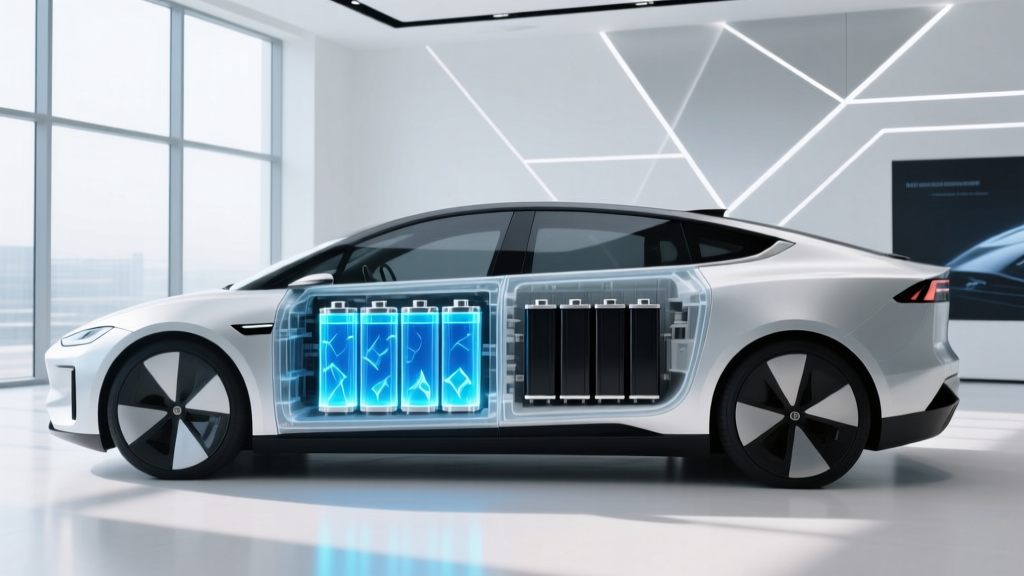
Every battery-electric and plug-in hybrid vehicle sold in the U.S. in 2026 uses some variant of lithium-ion chemistry. The two dominant cathode types are LFP (lithium iron phosphate) and NMC (nickel manganese cobalt), with NCA (nickel cobalt aluminum) appearing in some Tesla and Panasonic cells. The distinction matters because it affects range, longevity, charging behavior, and cost.
| Attribute | LFP (Lithium Iron Phosphate) | NMC/NCA (Nickel-based) |
|---|---|---|
| Energy Density | ~160–180 Wh/kg (cell level) | ~220–300 Wh/kg (cell level) |
| Cycle Life | 3,000–5,000+ cycles to 80% SoH | 1,000–2,500 cycles to 80% SoH |
| Cold-Weather Performance | Moderate — slower charging below 32°F, ~15–25% range loss | Better — ~10–20% range loss in cold, preconditioning helps |
| Cost per kWh (pack level) | ~$95–$115 | ~$125–$155 |
| Thermal Stability | Excellent — higher runaway threshold (~270°C) | Good — lower thermal runaway threshold (~210°C) |
| Recommended Daily SoC | Can charge to 100% regularly | Best kept at 80–90% daily; 100% for trips only |
| Typical Applications | Tesla Model 3/Y RWD, Ford Mustang Mach-E Select, Rivian Standard | Tesla Long Range, Hyundai Ioniq 5/6, BMW i4/iX, most premium EVs |
| Critical Mineral Concerns | None — iron and phosphate are abundant | Cobalt/nickel sourcing and supply chain ethics |
The practical takeaway: If you mostly drive under 250 miles per day and can charge at home, an LFP vehicle offers superior longevity and simpler charging habits (charge to 100% without worry). If you need maximum range in a single charge or frequently drive in cold climates, NMC packs deliver higher energy density and better cold-weather charging performance — at a modest cost to cycle life.
How Long Do EV Batteries Actually Last?
The most common fear among prospective EV buyers is premature battery failure. The data consistently shows this fear is overblown for modern packs.
Real-World Degradation Data Points
- Tesla Model 3/Y (NMC, 2019–2023): Fleet data from Tesla's 2023 Impact Report shows average battery degradation of approximately 12% after 200,000 miles. Most packs retain 88–92% capacity at 100,000 miles.
- Nissan LEAF (earlier air-cooled packs, 2013–2017): Notable outlier — 24 kWh and 30 kWh LEAF packs showed 15–25% degradation by 80,000 miles in hot climates, largely due to the lack of active thermal management. The 2018+ LEAF with 40/62 kWh packs and improved thermal design performs significantly better.
- Hyundai/Kia E-GMP platform (Ioniq 5, EV6): Owner-reported data on forums and testing by outlets like Recurrent Auto shows ~5–8% degradation at 60,000 miles for the 77.4 kWh NMC packs with active liquid cooling.
- LFP packs (Tesla Model 3 RWD, 2021+): Early fleet data suggests 3–5% degradation at 50,000 miles, consistent with LFP's superior cycle-life chemistry. Long-term data beyond 150,000 miles is still accumulating as of 2026.
- Chevrolet Bolt EV/EUV (NMC, 65 kWh): Post-recall replacement packs (LG cells manufactured under stricter quality controls) show under 5% degradation at 40,000 miles per owner reports tracked by Recurrent.
The bottom line on lifespan: Modern, liquid-cooled EV battery packs from major manufacturers are designed to last 200,000–300,000 miles before reaching 70–80% of original capacity. Most will outlast the vehicle's useful life or remain functional well beyond the typical ownership period. Catastrophic failure (a pack that simply stops working) is rare — gradual capacity loss is the norm.
EV Battery Warranty Terms: What's Actually Covered
Federal law mandates a minimum 8-year/100,000-mile warranty on EV battery packs (10 years/150,000 miles in California and states that follow CARB standards). Most manufacturers meet or slightly exceed this baseline. Here's how the major players stack up in 2026:
| Manufacturer | Warranty Period | Capacity Retention Threshold | Notes |
|---|---|---|---|
| Tesla (Model 3/Y LFP) | 8 years / 100,000 mi | 70% of original capacity | Long Range/Performance (NMC): 8 yr / 120,000 mi |
| Hyundai / Kia (E-GMP) | 10 years / 100,000 mi | 70% of original capacity | Among the longest calendar coverage in the industry |
| Ford (Mach-E, F-150 Lightning) | 8 years / 100,000 mi | 70% of original capacity | Extended-range pack uses NMC; standard uses LFP (2025+) |
| GM (Ultium platform) | 8 years / 100,000 mi | 70% of original capacity | Covers Equinox EV, Blazer EV, Silverado EV, Cadillac Lyriq |
| BMW (i4, iX, i7) | 8 years / 100,000 mi | 70% of original capacity | Some models offer optional extended battery warranty to 10 years |
| Rivian (R1T, R1S) | 8 years / 175,000 mi | 70% of original capacity | Higher mileage cap reflects truck/adventure use case |
Key details buyers miss: The warranty threshold (typically 70%) means the manufacturer only replaces or repairs the pack if capacity drops below that level within the warranty period. A pack at 72% capacity at year 7 is technically within spec. Warranty coverage applies to defects and abnormal degradation — it does not cover damage from accidents, flooding, or improper modifications. Always read the specific warranty booklet for your model year, as terms can shift.
EV Battery Replacement Cost: Numbers and Context
If a battery pack does need replacement — whether out of warranty or due to physical damage — the cost is substantial but has been declining. Here's the current landscape:
| Vehicle / Pack Size | Estimated Pack Cost (Parts) | Labor & Total Installed | Typical Replacement Trigger |
|---|---|---|---|
| Nissan LEAF (40 kWh) | $6,500–$8,500 | $8,000–$11,000 | Capacity below 60–70% in hot climates; air-cooled packs degrade faster |
| Chevrolet Bolt EV (65 kWh) | $9,000–$12,000 | $12,000–$15,000 | Post-recall packs are more reliable; replacement rarely needed |
| Tesla Model 3/Y (75–82 kWh) | $12,000–$16,000 | $14,000–$19,000 | Out-of-warranty failure; most packs last 200k+ miles |
| Hyundai Ioniq 5 / Kia EV6 (77.4 kWh) | $11,000–$14,000 | $13,000–$17,000 | Rare under current data; covered by 10-yr warranty |
| Ford F-150 Lightning (131 kWh ext.) | $18,000–$25,000 | $22,000–$30,000 | Large pack = high replacement cost; covered under 8-yr warranty |
| BMW iX xDrive50 (111.5 kWh) | $20,000–$28,000 | $25,000–$35,000 | Premium pack pricing; rarely needed within vehicle life |
Context that matters: Battery replacement cost per kWh at the pack level has fallen from roughly $350/kWh in 2015 to approximately $130–$160/kWh in 2026, according to BloombergNEF tracking. For most buyers, the battery will never need replacement during their ownership. When it does, partial pack repairs (replacing individual modules rather than the entire pack) are increasingly common and can cut costs by 40–60%. Out-of-warranty replacement is primarily a concern for high-mileage used EV buyers purchasing vehicles with 150,000+ miles and degraded packs outside the warranty window.
Factors That Accelerate (or Preserve) Battery Health
Not all miles are created equal when it comes to battery wear. The following factors have the most measurable impact on long-term State of Health (SoH):
Battery Care Checklist for Maximum Longevity
- Avoid sustained high State of Charge (NMC only): For NMC/NCA packs, daily charging to 100% accelerates degradation. Set your charge limit to 80–90% for daily use; reserve 100% for road trips. LFP packs are the exception — manufacturers like Tesla recommend periodic 100% charges for accurate BMS calibration.
- Minimize DC fast charging when possible: Frequent use of DC fast charging (150+ kW) generates significant heat. Data from Recurrent Auto shows that EVs that fast-charge more than 3 times per week show approximately 0.5–1.5% additional annual degradation compared to primarily Level 2 home charging. It's not catastrophic, but it accumulates.
- Precondition before fast charging: Most modern EVs automatically precondition the battery when you navigate to a DC fast charger. This brings the pack to optimal temperature (~25–35°C), enabling faster charging and reducing thermal stress. If your vehicle doesn't auto-precondition, do it manually via the app before arriving.
- Avoid extreme SoC in extreme temperatures: Don't let the pack sit at 100% SoC in summer heat or below 10% SoC in winter cold for extended periods. The combination of temperature extremes and high/low SoC accelerates electrolyte decomposition.
- Use Level 2 home charging as your baseline: Charging at 7–11 kW (Level 2) generates far less heat than DC fast charging and is the gentlest routine for long-term pack health. A home Level 2 charger is the single best investment for battery longevity.
- Don't baby it excessively: Modern Battery Management Systems (BMS) are sophisticated. They maintain top/bottom buffers (typically 5–10% of gross capacity is unusable by design), manage cell balancing, and control thermal limits. Drive normally and charge conveniently — the BMS handles the rest.
Monitoring Battery Health: Checking Your State of Health
State of Health (SoH) is a percentage representing your battery's current maximum capacity relative to its original capacity when new. A pack at 92% SoH holds 92% of its original kWh. Here's how to check it:
- In-vehicle displays: Some manufacturers (notably Hyundai/Kia, BMW, and Mercedes-Benz) provide a battery health or SoH readout in the vehicle settings menu. Tesla does not natively display SoH percentage in the car as of 2026.
- OBD-II diagnostic tools: Devices like the OBDLink MX+ paired with apps such as ABRP (A Better Route Planner) or Car Scanner can read the BMS-reported SoH value directly from the vehicle's CAN bus. This works for most makes and provides the most accurate reading.
- Manufacturer service centers: Any authorized dealer can run a battery health diagnostic and provide an SoH report. This is often free during routine service visits and is recommended before purchasing a used EV.
- Third-party services: Companies like Recurrent Auto offer free battery health reports for participating owners by analyzing telematics data over time. This provides a degradation curve rather than a single snapshot.
- Manual calculation: Charge to 100% (or your known maximum), note the displayed range, and compare to the original EPA-rated range. Adjust for temperature. This is imprecise (displayed range varies with recent driving style) but gives a rough estimate.
Liquid Salt, Solid-State, and Silicon Anode: What's Actually Coming
While liquid salt batteries remain a grid-storage technology — not an EV prospect — other next-generation chemistries are closer to production vehicles. Here's a realistic timeline based on announced programs and industry data:
Solid-state batteries replace the liquid electrolyte with a solid material (ceramic, sulfide, or polymer), promising higher energy density (potentially 400–500 Wh/kg at the cell level), faster charging, and improved safety. Toyota has announced a solid-state battery targeting 2027–2028 production vehicles with a claimed 750 km (~466 miles) of range and 10-minute fast charging. Samsung SDI is targeting 2027 for mass production. However, manufacturing scalability and cost remain unresolved challenges. Expect initial solid-state packs to appear in premium, low-volume models before reaching mainstream price points — likely not before 2030 for sub-$50,000 vehicles.
Silicon anode technology is already entering production. Companies like Sila Nanotechnologies and Group14 Technologies are supplying silicon-dominant anode materials that increase energy density by 20–40% over conventional graphite anodes. The Mercedes-Benz G-Class EV (2025) uses a silicon anode pack from Sila. This technology is scaling now and will appear in more 2026–2028 models. It's an incremental improvement within existing lithium-ion architecture, not a full chemistry revolution.
Sodium-ion batteries (distinct from molten salt) are the closest "alternative chemistry" to EV production. CATL began shipping sodium-ion packs in Chinese-market vehicles in 2024, and BYD is developing sodium-ion cells for entry-level models. Sodium-ion offers lower cost and better cold performance than LFP but significantly lower energy density (~140–160 Wh/kg), limiting it to short-range, budget vehicles. U.S.-market availability remains unconfirmed for 2026.
Liquid salt / molten salt batteries (sodium-sulfur, ZEBRA, liquid metal designs) continue to serve grid-scale stationary storage where weight, volume, and operating temperature are less critical. Their high-temperature operation (300°C+), thermal management complexity, and low power density make them fundamentally unsuitable for passenger vehicles. No automaker has announced a liquid salt battery EV program, and none is expected within the current decade.
Frequently Asked Questions
How long do EV batteries last in years and miles?
Modern liquid-cooled EV battery packs typically last 200,000–300,000 miles before degrading to 70–80% of original capacity. In calendar years, that translates to 15–20 years for average drivers (12,000–15,000 miles/year). Most packs will outlast the vehicle's body, suspension, and interior. Early EVs with passive cooling (pre-2018 Nissan LEAF) are the notable exception, showing faster degradation in hot climates.
How much does an EV battery cost to replace?
Full pack replacement ranges from approximately $8,000 for a smaller pack (Nissan LEAF 40 kWh) to $30,000+ for a large pack (Ford F-150 Lightning 131 kWh extended range), including labor. However, most replacements are covered under the mandatory 8-year/100,000-mile warranty, and partial module repairs can reduce out-of-pocket costs by 40–60%. Battery costs per kWh continue to decline.
What does the EV battery warranty actually cover?
Federal law requires a minimum 8-year/100,000-mile battery warranty (10 years/150,000 miles in CARB states). Coverage applies if the pack degrades below the manufacturer's threshold (typically 70% of original capacity) within the warranty period. It covers defects, abnormal degradation, and manufacturing failures. It does not cover accident damage, flooding, or aftermarket modifications. Some manufacturers (Hyundai, Kia, Rivian) exceed the federal minimum.
How do I check and maximize my EV battery health?
Check SoH via an OBD-II scanner with a compatible app, your vehicle's built-in battery health display (if equipped), or a dealer diagnostic. To maximize longevity: use Level 2 home charging as your primary method, limit DC fast charging frequency, avoid leaving NMC packs at 100% SoC for extended periods, precondition before fast charging, and avoid prolonged exposure to extreme temperatures at high or low SoC.
LFP vs NMC — which battery chemistry is better for me?
Neither is universally "better." Choose LFP if you want maximum cycle life, can charge to 100% without concern, don't need the absolute longest single-charge range, and prioritize lower cost. Choose NMC/NCA if you need the highest energy density for long-range driving, frequently operate in cold climates, or are buying a premium long-range model. Both chemistries will reliably last 150,000–250,000+ miles with proper care.
Will liquid salt batteries ever power EVs?
Not in any foreseeable timeline. Liquid salt (molten salt / liquid metal) batteries require operating temperatures above 300°C, adding significant thermal management weight and complexity. They excel in stationary grid storage where these constraints don't matter. For EVs, the industry is pursuing solid-state lithium-ion, silicon anode improvements, and sodium-ion as next-generation options — all of which operate at ambient temperatures and offer the power density vehicles require.