If you are researching electric vehicles, you have likely encountered the term ionic battery life — a shorthand for how long the lithium-ion cells inside an EV's high-voltage traction pack will hold a usable charge before degradation forces a replacement. It is arguably the single biggest financial unknown in EV ownership, and the topic is clouded by marketing claims, forum rumors, and outright misinformation.
The short answer: most modern EV battery packs are engineered to outlast the vehicle they power. But "most" is not "all," and the chemistry inside your pack — whether it is lithium iron phosphate (LFP) or nickel manganese cobalt (NMC/NCA) — has a measurable impact on how that pack ages over 100,000, 150,000, or 200,000 miles. This guide gives you the exact numbers, the chemistry trade-offs, and the ownership habits that separate a pack that degrades gracefully from one that needs a five-figure replacement.
How Long Do EV Batteries Last? The Data Behind Ionic Battery Life
Let's start with the question every prospective EV buyer asks: how many years and miles before the battery needs replacing?
The high-voltage traction battery in a modern EV (not the small 12V auxiliary battery that powers accessories) is designed for a service life of 15 to 20 years or 150,000 to 300,000 miles, depending on chemistry, thermal management, and usage patterns. That is not a marketing promise — it is reflected in the federal warranty mandate and in long-term fleet data.
According to aggregated data from fueleconomy.gov and real-world telemetry shared by fleet operators, the average EV battery retains approximately 90–94% of its original capacity after 100,000 miles. Packs that reach 200,000 miles typically show 80–88% capacity retention, still well within the usable range for daily driving.
Here is what that degradation curve looks like in practice across common mileage milestones:
| Mileage | Typical Capacity Retained | Range Impact (Example: 300-mi EPA Pack) |
|---|---|---|
| 0 miles (new) | 100% | 300 miles |
| 25,000 miles | 96–98% | 288–294 miles |
| 50,000 miles | 94–96% | 282–288 miles |
| 100,000 miles | 90–94% | 270–282 miles |
| 150,000 miles | 85–90% | 255–270 miles |
| 200,000 miles | 80–88% | 240–264 miles |
Sources: Geotab fleet study (2023–2025), manufacturer warranty thresholds, Recurrent Auto battery health data. Individual results vary by chemistry, climate, and charging habits.
The critical insight: degradation is not linear. Most capacity loss occurs in the first 20,000–30,000 miles (the "break-in" period where the solid electrolyte interphase stabilizes), after which the curve flattens considerably. A pack that holds 95% at 40,000 miles is very likely to hold 88% or more at 150,000 miles.
LFP vs NMC: Which Chemistry Delivers Better Ionic Battery Life?
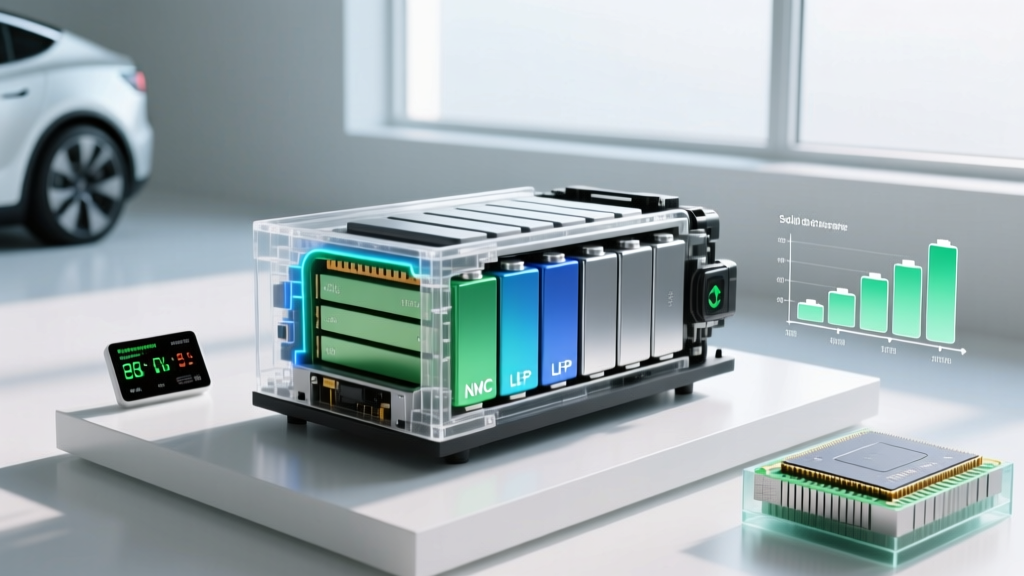
Not all lithium-ion batteries are the same. The two dominant chemistries in 2026 EVs are lithium iron phosphate (LFP) and nickel manganese cobalt / nickel cobalt aluminum (NMC/NCA). The choice between them has direct implications for longevity, range, and cost.
| Attribute | LFP (Lithium Iron Phosphate) | NMC / NCA (Nickel-based) |
|---|---|---|
| Energy Density | Lower (~160–180 Wh/kg cell-level) | Higher (~220–260 Wh/kg cell-level) |
| Cycle Life | 3,000–5,000+ cycles | 1,500–2,500 cycles |
| Calendar Life | Excellent (15–20+ years) | Good (12–18 years) |
| Cold-Weather Performance | Weaker below 32°F; slower charging | Better low-temp discharge and charge acceptance |
| Cost per kWh | Lower (~$85–100/kWh pack-level in 2026) | Higher (~$110–135/kWh pack-level in 2026) |
| Thermal Stability | Superior (less prone to thermal runaway) | Good but requires more active cooling |
| Recommended SoC Range | Can be charged to 100% regularly | Best kept 20–80% for daily use |
| Common Applications | Tesla Model 3/Y RWD, Ford Mustang Mach-E Select (LFP trims), BYD models | Long-range/performance trims, Hyundai Ioniq 5/6, Rivian, most luxury EVs |
Which is better for ionic battery life? If pure cycle count and calendar longevity are your priorities, LFP wins. An LFP pack can tolerate 3,000–5,000 full charge cycles before reaching 80% capacity — enough to drive 600,000+ miles in a vehicle with a 250-mile range. The trade-off is lower energy density (heavier pack for the same range) and weaker cold-weather charging speeds.
NMC/NCA packs deliver more range per pound and perform better in freezing climates, but they are more sensitive to high states of charge and high temperatures. Daily charging to 100% on an NMC pack accelerates degradation measurably — which is why automakers recommend an 80% daily limit for NMC-equipped vehicles.
What Does the EV Battery Warranty Actually Cover?
Federal law in the United States mandates that EV batteries carry a minimum warranty of 8 years or 100,000 miles (whichever comes first). In California Air Resources Board (CARB) states — which include California, Colorado, Maine, Massachusetts, New York, Oregon, Vermont, and Washington — the mandate extends to 10 years or 150,000 miles.
But the warranty does not cover all degradation. The industry-standard threshold is 70% capacity retention: the manufacturer will repair or replace the battery only if it drops below 70% of its original capacity within the warranty period.
| Manufacturer | Warranty Period | Mileage Limit | Capacity Threshold |
|---|---|---|---|
| Tesla (Model 3/Y LFP) | 8 years | 100,000 miles | 70% |
| Tesla (Model S/X, 3/Y LR) | 8 years | 120,000–150,000 miles | 70% |
| Hyundai / Kia | 10 years | 100,000 miles | 70% |
| Ford (Mach-E, F-150 Lightning) | 8 years | 100,000 miles | 70% |
| General Motors (Ultium) | 8 years | 100,000 miles | 70% (60% on some commercial) |
| Rivian | 8 years | 175,000 miles | 70% |
| BMW | 8 years | 100,000 miles | 70% |
Always confirm warranty terms with the manufacturer for your specific model year and trim. CARB-state residents may be entitled to extended coverage. Source: IRS and manufacturer press sites.
A practical note: very few battery replacements under warranty involve swapping the entire pack. Most manufacturers now diagnose and replace individual modules (a pack contains 10–30+ modules), which is faster, cheaper, and preserves the rest of the pack's matched cells.
How Much Does an EV Battery Replacement Cost?
This is the question that keeps prospective buyers up at night. Let's ground it in real numbers.
An out-of-warranty full battery pack replacement in 2026 typically costs between $5,000 and $22,000, depending on pack size, chemistry, and labor. However, the context matters enormously: the vast majority of EV batteries never need a full replacement during the vehicle's usable life. Data from NHTSA complaint databases and manufacturer service bulletins show that fewer than 1–2% of EV batteries require replacement due to premature failure, and most of those are covered under warranty.
| Vehicle | Pack Size (kWh Usable) | Chemistry | Estimated Replacement Cost |
|---|---|---|---|
| Tesla Model 3 RWD | 57.5 kWh | LFP | $7,000–$10,000 |
| Tesla Model Y Long Range | 75 kWh | NMC | $10,000–$14,000 |
| Hyundai Ioniq 5 (Long Range) | 77.4 kWh | NMC | $11,000–$15,000 |
| Ford F-150 Lightning (Extended) | 131 kWh | NMC | $18,000–$22,000 |
| Chevrolet Equinox EV | 85 kWh | NMC (Ultium) | $12,000–$16,000 |
| Rivian R1T (Max Pack) | 149 kWh | NMC | $18,000–$22,000+ |
Costs include parts and labor at dealer/authorized service centers. Independent EV shops may offer lower pricing. Module-level repair (replacing 1–3 failed modules) typically costs $1,500–$4,000.
When is replacement typically needed? In the rare cases where it is, premature failure (manufacturing defect) usually manifests in the first 2–4 years and is warranty-covered. Gradual degradation to the 70% threshold typically occurs at 200,000+ miles — at which point the vehicle may be retired for other reasons (body, suspension, electronics) before the battery becomes unusable.
Factors That Accelerate or Preserve Ionic Battery Life
Battery degradation is driven by electrochemical stress. The following factors have the largest measurable impact on how quickly your pack loses capacity:
Fast-Charging Frequency
DC fast charging (typically 50–350 kW) generates significant heat inside the cells. Occasional fast charging on road trips has negligible impact, but daily reliance on DC fast charging — especially at rates above 150 kW — can accelerate degradation by 1–3% over the pack's life compared to primarily Level 2 (7–19 kW) home charging. Modern thermal management systems mitigate this substantially, but the physics of high-current charging cannot be fully eliminated.
State of Charge (SoC) Habits
Lithium-ion cells experience the most stress at the extremes — below 10% and above 90% SoC. For NMC/NCA packs, keeping daily charge between 20% and 80% can extend cycle life by 30–50% compared to regular 0–100% cycling. LFP packs are more tolerant of high SoC and many manufacturers (including Tesla for LFP-equipped vehicles) recommend periodic charging to 100% to allow the battery management system (BMS) to recalibrate cell balancing.
Extreme Temperatures
Sustained exposure to ambient temperatures above 95°F accelerates calendar degradation, particularly for NMC chemistries. Vehicles with active liquid cooling (nearly all modern EVs) manage this far better than passively cooled packs, but parking in shade or a garage in hot climates measurably helps. Cold temperatures (below 20°F) do not permanently damage the battery but temporarily reduce capacity and slow charge acceptance — preconditioning the pack before charging restores normal performance.
Depth of Discharge
Shallow cycles (e.g., using 30% of the pack and recharging) are gentler on cells than deep cycles (using 80–90% before recharging). This does not mean you should avoid using your full range — modern BMS systems manage this automatically — but it does mean that a driver who charges nightly from 50% to 80% will see slightly slower degradation than one who regularly drains to 5% and charges to 100%.
Battery Care Checklist for Maximum Ionic Battery Life
- Daily charging: Set charge limit to 80% for NMC/NCA; 100% is fine for LFP (check your owner's manual).
- Home charging: Use Level 2 (240V, 32–48A / 7.7–11.5 kW) as your primary charging method.
- DC fast charging: Reserve for road trips and situations where Level 2 is unavailable.
- Hot weather: Park in shade or a garage when possible; precondition before fast charging.
- Cold weather: Precondition the battery 15–30 minutes before charging; expect 20–30% temporary range loss below 20°F.
- Long-term storage: Leave the pack at approximately 50% SoC if storing for more than 2 weeks; avoid storing at 100% or below 10%.
- Software updates: Install all manufacturer OTA updates — they often include BMS calibration improvements.
How to Monitor Your Battery's State of Health (SoH)
State of Health (SoH) is the percentage of your battery's original capacity that remains usable. Monitoring it helps you detect abnormal degradation early and plan for any warranty claim.
In-vehicle tools: Most modern EVs display SoH or a related metric in the settings menu. Tesla shows estimated range at 100% charge (comparing this to the original EPA figure gives a rough SoH). Hyundai/Kia provides a battery health percentage in the EV settings. Ford's MyFordPass app includes a battery health indicator.
OBD-II diagnostic tools: Third-party apps like LeafSpy (Nissan Leaf), Scan My Tesla, and Carista can read the BMS directly via an OBD-II dongle (~$25–50 for the hardware) and report precise SoH, cell voltage variance, and cycle count.
Dealer diagnostic reports: Request a battery health report at any scheduled service visit. This printout shows module-level voltage balance and overall capacity — useful documentation if you ever need to file a warranty claim.
What is normal vs. concerning? Losing 2–4% capacity per year in the first two years, then 1–2% per year thereafter, is typical. If you see a sudden drop of more than 5% in a short period, or if individual module voltages vary by more than 0.2V, schedule a dealer diagnostic — this can indicate a failing module that may be covered under warranty.
Emerging Battery Technology: What Comes After Lithium-Ion?
While today's lithium-ion packs are proving remarkably durable, the next generation of battery technology promises further improvements in longevity, energy density, and safety. It is important to understand which of these are real and which remain in development.
Solid-state batteries: These replace the liquid electrolyte with a solid material, potentially doubling cycle life and energy density while eliminating thermal runaway risk. Toyota has announced solid-state battery production for select 2027–2028 models (preliminary, not yet available for purchase), and Samsung SDI targets 2027 mass production. However, manufacturing scalability and cost remain significant hurdles. Expect solid-state to appear first in premium vehicles at significant price premiums, with mainstream availability no earlier than 2029–2030.
Silicon-dominant anodes: Companies like Sila Nanotechnologies and Group14 are replacing graphite anodes with silicon-based materials, boosting energy density by 20–40%. These are beginning to appear in limited production (e.g., Mercedes-Benz G-Class EV in limited trims) and will gradually scale through the late 2020s.
Sodium-ion batteries: CATL and BYD have begun limited production of sodium-ion packs for lower-cost, shorter-range EVs in China. These offer excellent cycle life (4,000+ cycles) and low cost but significantly lower energy density (~120–140 Wh/kg), limiting them to urban commuter vehicles. US availability is not expected before 2028 at the earliest.
For buyers shopping today, these technologies are forward-looking and should not influence a purchase decision. Current lithium-ion packs — particularly LFP — already offer ionic battery life that exceeds the practical service life of most vehicles.
Frequently Asked Questions About Ionic Battery Life
How long do EV batteries last in years and miles?
Most modern EV traction batteries are designed to last 15–20 years or 150,000–300,000 miles before degrading to 70–80% of original capacity. LFP chemistry packs tend toward the higher end of that range due to superior cycle life. The vehicle's body, suspension, and electronics often reach end-of-life before the battery does.
How much does it cost to replace an EV battery?
Full pack replacement costs range from approximately $5,000 to $22,000 depending on pack size and chemistry, with most mainstream EVs falling in the $8,000–$15,000 range. However, fewer than 2% of EV batteries require full replacement — most are covered under the 8-year/100,000-mile federal warranty if they fail prematurely, and most packs outlast the vehicle.
What does the EV battery warranty cover?
Federal law requires a minimum 8-year/100,000-mile warranty (10 years/150,000 miles in CARB states) that covers the battery if capacity drops below 70% of original. This covers manufacturing defects and abnormal degradation but does not cover damage from accidents, flooding, or unauthorized modifications.
Is LFP or NMC better for battery longevity?
LFP chemistry delivers significantly longer cycle life (3,000–5,000+ cycles vs. 1,500–2,500 for NMC) and is more tolerant of daily 100% charging and high temperatures. The trade-off is lower energy density (less range per pound) and weaker cold-weather performance. For maximum ionic battery life, LFP is the clear winner.
Does fast charging damage my EV battery?
Occasional DC fast charging on road trips has minimal impact on battery health. However, daily reliance on high-power DC fast charging (150+ kW) can accelerate degradation by 1–3% over the pack's life due to sustained high cell temperatures. Using Level 2 home charging as your primary method is the best practice for longevity.
How do I check my EV battery health?
Most EVs display battery health or estimated range in the settings menu. For more precise data, use an OBD-II diagnostic tool with apps like Scan My Tesla or Carista, or request a battery health report from your dealer at any service visit. Compare your current 100% range to the original EPA figure for a quick SoH estimate.
Will my EV battery need to be replaced before I sell the car?
Statistically, very unlikely. The average American keeps a vehicle for 8.4 years and drives approximately 14,000 miles per year — totaling about 118,000 miles. At that mileage, a typical EV battery retains 88–94% of its original capacity. Battery replacement before resale is the exception, not the rule.