What Powers Your Hybrid: Understanding the High-Voltage Traction Battery
When shoppers search for a "hybrid engine battery," they're almost always asking about the high-voltage traction battery — the energy-dense pack that stores electricity for the electric motor in a hybrid (HEV), plug-in hybrid (PHEV), or battery-electric vehicle (BEV). This is not the small 12V auxiliary battery that runs your infotainment and lights. The traction battery is measured in kilowatt-hours (kWh), which represents total energy capacity, and it directly determines your electric-only range in a PHEV or your total range in a BEV.
Hybrid traction batteries range from roughly 1.0 kWh in a conventional HEV like the Toyota Prius to over 20 kWh in PHEVs such as the Toyota RAV4 Prime (18.1 kWh usable) or the Jeep Wrangler 4xe (17.3 kWh usable). BEVs push far higher — the Hyundai Ioniq 5 carries an 84 kWh usable pack, while the Ford F-150 Lightning Extended Range holds 131 kWh. The chemistry inside those cells, how you treat them, and what the manufacturer warrants all determine how long the battery serves you before needing attention.
LFP vs NMC/NCA: The Chemistry Trade-Off That Matters Most
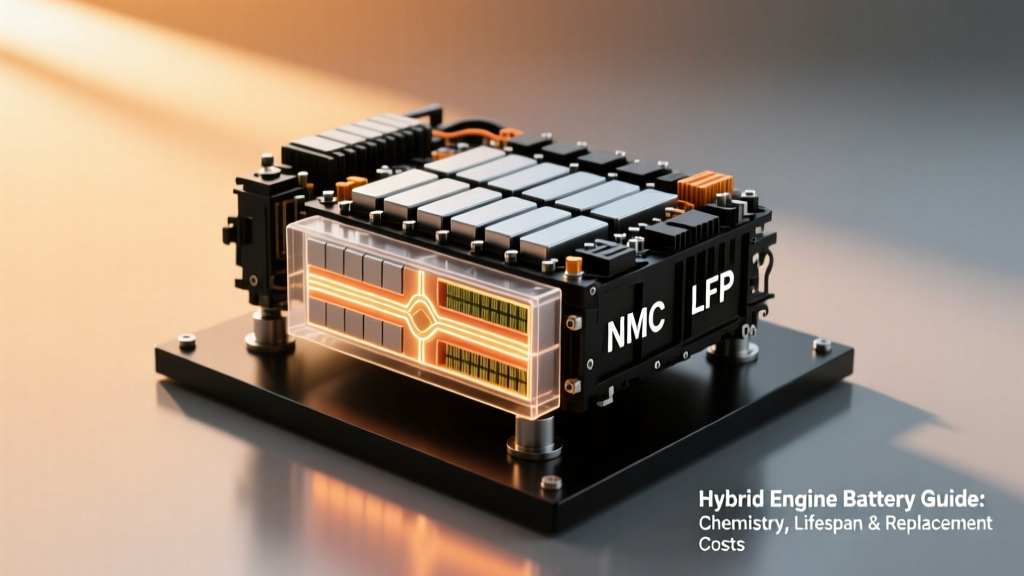
Two dominant lithium-ion chemistries power today's electrified vehicles: Lithium Iron Phosphate (LFP) and Nickel Manganese Cobalt (NMC) or Nickel Cobalt Aluminum (NCA). Each carries distinct trade-offs in energy density, cycle life, cold-weather performance, and cost.
| Attribute | LFP (LiFePO₄) | NMC / NCA |
|---|---|---|
| Energy Density | ~160–180 Wh/kg (lower) | ~220–300 Wh/kg (higher) |
| Cycle Life | 3,000–5,000+ cycles | 1,000–2,000 cycles |
| Cold Performance | Reduced; slower charge below 32°F | Better low-temp output |
| Cost per kWh | ~$90–$110 (lower) | ~$120–$150 (higher) |
| Thermal Stability | Excellent; lower runaway risk | Good; requires robust BMS |
| State of Charge Practice | Can charge to 100% daily | Best kept 20–80% for longevity |
| Common In (2026) | Tesla Model 3/Y RWD, Ford Mustang Mach-E Select, BYD models | Most long-range BEVs, PHEVs, performance trims |
Which is better? It depends on your use case. If you prioritize maximum range per charge and don't mind managing state of charge carefully, NMC/NCA delivers superior energy density. If you want a battery you can charge to 100% every day without guilt, plan to keep the car 10+ years, or live in a mild climate, LFP's cycle-life advantage and lower cost make it compelling. For most hybrid engine battery applications in PHEVs, manufacturers still favor NMC because the smaller pack size demands high energy density to deliver meaningful electric-only range.
How Long Do Hybrid and EV Batteries Actually Last?
The short answer: far longer than most buyers fear. Real-world fleet data consistently shows that modern lithium-ion traction batteries lose roughly 1–2% of total capacity per year under normal use. Here's what that looks like with actual data points:
Typical Battery Degradation Curve (BEV/PHEV, NMC chemistry, moderate climate):
- Year 1 / 15,000 mi: ~2–3% loss (initial formation drop)
- Year 3 / 45,000 mi: ~5–7% total loss
- Year 5 / 75,000 mi: ~8–10% total loss
- Year 8 / 120,000 mi: ~10–14% total loss
- Year 10+ / 150,000+ mi: ~12–18% total loss
Sources: Geotab fleet study (6,300+ vehicles) and manufacturer warranty filings. LFP packs typically show 1–2% less degradation at equivalent age due to superior cycle life.
For a PHEV like the 2026 Toyota RAV4 Prime with 42 miles of EPA-rated electric range, a 12% loss at year 8 would leave roughly 37 electric miles — still eminently usable. For a BEV like the Ioniq 5 (305 mi EPA), that same 12% drop yields about 268 real-world miles. Most batteries outlive the vehicle's useful economic life; full traction battery replacement before 150,000 miles is uncommon outside of manufacturing defects covered under warranty.
Conventional HEV batteries (the ~1 kWh packs in a standard Prius or Honda Accord Hybrid) experience even less noticeable degradation because they operate in a narrow state-of-charge window — the car's computer never lets them drop below ~40% or rise above ~80%. This shallow cycling dramatically extends life, and failures before 150,000 miles are rare.
What Does the Hybrid Engine Battery Warranty Cover?
Federal law mandates a minimum 8-year / 100,000-mile warranty on hybrid and EV traction batteries for emissions-related components, and most manufacturers exceed that baseline. Here's how major brands structure coverage in 2026:
| Manufacturer | Warranty Term | Capacity Retention Threshold |
|---|---|---|
| Toyota (HEV/PHEV) | 10 yr / 150,000 mi | ~70% (case-by-case) |
| Hyundai / Kia (BEV/PHEV) | 10 yr / 100,000 mi | 70% capacity |
| Tesla (Model 3/Y LFP) | 8 yr / 120,000 mi | 70% capacity |
| Tesla (Model S/X) | 8 yr / 150,000 mi | 70% capacity |
| Ford (BEV/PHEV) | 8 yr / 100,000 mi | 70% capacity |
| BMW (BEV/PHEV) | 8 yr / 100,000 mi | 70% capacity |
What triggers a warranty claim? The battery must fall below the stated capacity threshold (typically 70% of original) as measured by the manufacturer's diagnostic tool. Normal gradual loss of 10–15% over the warranty period will not qualify. Defects in cells, the battery management system (BMS), cooling loops, or contactors are covered regardless of capacity. Damage from collisions, flooding, or unauthorized modifications is excluded.
Always keep records of any battery-related service, and note that some manufacturers require dealer-performed diagnostics to validate a claim. Refer to your specific owner's warranty guide for exact terms, as they vary by model year and trim.
How Much Does a Hybrid Engine Battery Cost to Replace?
Out-of-warranty replacement is the fear that keeps some buyers on the sideline, but context matters: the vast majority of hybrid and EV batteries never need replacement during typical ownership. When they do, costs have fallen substantially as cell prices decline.
| Vehicle Type / Example | Battery Size | Parts + Labor Estimate |
|---|---|---|
| Conventional HEV (Toyota Prius) | ~1.0 kWh NiMH/Li-ion | $2,000 – $3,500 |
| PHEV (RAV4 Prime, Wrangler 4xe) | 17–19 kWh | $6,000 – $10,000 |
| Mid-size BEV (Tesla Model 3, Ioniq 5) | 60–84 kWh | $10,000 – $16,000 |
| Large BEV (F-150 Lightning, Hummer EV) | 131–212 kWh | $18,000 – $30,000+ |
These figures include the battery pack and dealer installation labor. Third-party EV repair shops and refurbished packs can reduce costs by 30–50%, particularly for older HEVs. Module-level repair (replacing individual cell groups rather than the entire pack) is increasingly available for NMC packs and can bring a PHEV repair under $4,000 in some cases.
The realistic timeline for needing a replacement: most BEV and PHEV batteries reach end-of-first-life (below 70% capacity) between 150,000 and 250,000 miles — at which point the pack can still serve as stationary storage or be recycled. HEV batteries, given their shallow cycling, routinely surpass 200,000 miles without issue.
Factors That Accelerate or Protect Battery Health
Battery degradation is not purely a function of time — your habits measurably influence how quickly capacity declines. Here are the five factors with the largest impact, grounded in electrochemistry:
Battery Care Best Practices for Maximum Longevity:
- Avoid sustained high State of Charge (SoC): For NMC/NCA batteries, daily charging to 100% accelerates electrolyte oxidation. Set your charge limit to 80% for daily use; reserve 100% for road trips. LFP batteries tolerate 100% daily charging and actually benefit from periodic full charges for BMS cell-balancing calibration.
- Minimize DC fast-charging frequency: Repeated 150+ kW DC fast charges generate heat that stresses cells. Data from Geotab shows vehicles fast-charging more than 3x per week degrade ~1–2% faster over 4 years than those primarily using Level 2. Use DCFC for road trips; rely on Level 2 (7–11 kW) at home for daily needs.
- Manage extreme temperatures: Sustained exposure to ambient temperatures above 95°F accelerates degradation. If possible, park in shade or a garage during summer. In sub-freezing weather, use your vehicle's battery preconditioning feature before fast charging — this warms the cells to ~70°F, enabling faster charge acceptance and reducing lithium plating risk.
- Don't store at 0% or 100%: If leaving the vehicle unused for 2+ weeks, set SoC to roughly 50% and plug in to a Level 1 or Level 2 charger so the BMS can maintain the pack.
- Drive moderately in extreme heat: Aggressive acceleration and sustained high-speed driving in hot weather push cell temperatures above 104°F, the threshold where accelerated degradation begins. Most modern packs have active liquid cooling, but thermal management has limits.
How to Check Your Battery's State of Health (SoH)
State of Health (SoH) is the percentage of original capacity your battery retains. A brand-new pack reads 100%; a degraded pack might read 88%. Here's how to monitor it:
1. In-vehicle displays: Many modern EVs and PHEVs show battery health directly. The Hyundai Ioniq 5 and Kia EV6 include an SoH percentage in the infotainment EV menu. Tesla owners can access battery health through the service menu or via third-party tools.
2. OBD-II diagnostic apps: Devices like the OBDLink CX or vLinker BM+ paired with apps such as Car Scanner, LeafSpy (Nissan), or ABRP (A Better Route Planner) can read the BMS-reported SoH value. This is the most accessible method for most owners.
3. Dealer diagnostics: Request a battery health report during routine service. Dealerships use manufacturer-specific scan tools that provide cell-level voltage variance, internal resistance, and total capacity measurements. This is the gold standard for warranty claims.
4. Manual range tracking: Charge to 100% (or your normal limit), note the displayed range, and compare it to the EPA sticker adjusted for your SoC target. If your Ioniq 5 normally shows 245 miles at 80% and now shows 220, that's roughly a 10% degradation indicator. This method is imprecise — displayed range fluctuates with driving style and temperature — but it catches major shifts.
Check SoH every 6–12 months, or before purchasing a used EV/PHEV. A reading below 85% on a vehicle with under 80,000 miles may indicate abuse or a defective module worth investigating.
What's Next: Solid-State, Silicon Anodes, and Realistic Timelines
The battery landscape is evolving, but it's critical to separate laboratory milestones from showroom availability.
Solid-state batteries replace the liquid electrolyte with a solid conductor, promising higher energy density (~400+ Wh/kg projected), faster charging, and improved safety. Toyota has announced a solid-state battery targeting 2027–2028 production in limited BEV models, initially with constrained volume. Samsung SDI and QuantumScape are pursuing similar timelines. For hybrid engine battery applications, solid-state adoption will likely trail BEV deployment by 2–3 years due to cost sensitivity in smaller packs. As of 2026, no production vehicle on sale uses a solid-state traction battery.
Silicon-dominant anodes (used by companies like Sila Nanotechnologies and Group14) increase energy density by 20–40% over conventional graphite anodes. These are beginning to appear in limited production — the Mercedes-Benz G 580 with EQ Technology uses a silicon-anode battery from 2025 onward. Expect broader adoption in BEVs by 2027–2028, with PHEV trickle-down following as costs decrease.
Sodium-ion batteries offer a lower-cost, cobalt-free alternative with good cycle life but lower energy density (~140 Wh/kg). CATL and BYD are deploying these in Chinese-market budget EVs. US-market adoption remains uncertain due to energy-density limitations for range expectations. These are unlikely to appear in PHEVs where pack space is constrained.
The practical takeaway: current NMC and LFP chemistries will dominate hybrid and EV battery packs through at least 2030. Next-generation tech will arrive incrementally, starting in premium BEVs before reaching mainstream hybrids.
Frequently Asked Questions
How long do hybrid engine batteries last in years and miles?
Most modern HEV, PHEV, and BEV traction batteries last 10–15 years or 150,000–250,000 miles before falling below 70% capacity. Conventional HEV batteries (small packs in a Prius or Accord Hybrid) often exceed 200,000 miles because the car's computer keeps them in a narrow, low-stress charge window. Complete failure before 100,000 miles is rare and typically covered under warranty.
How much does it cost to replace a hybrid engine battery?
Replacement costs range from roughly $2,000–$3,500 for a conventional HEV pack (Toyota Prius) to $6,000–$10,000 for a PHEV pack (RAV4 Prime, Wrangler 4xe) and $10,000–$16,000 for a mid-size BEV. Large-truck BEV packs can exceed $20,000. However, the vast majority of batteries never require replacement during normal ownership — most outlive the vehicle's economic lifespan. Third-party shops and refurbished modules can reduce costs 30–50%.
What does the battery warranty actually cover?
Federal law requires at least 8 years / 100,000 miles of traction battery coverage. Most manufacturers warrant the battery against capacity loss below 70% of original, plus defects in cells, the BMS, cooling system, and contactors. Normal gradual degradation of 10–15% does not trigger a claim. Collision damage, flooding, and unauthorized modifications are excluded. Check your specific owner's manual for exact terms, as they vary by brand and model year.
LFP vs NMC — which hybrid battery chemistry is better for me?
Choose NMC/NCA if you need maximum electric range from a compact pack (most PHEVs and long-range BEVs use it) or if you regularly drive in cold weather. Choose LFP if you want to charge to 100% daily without longevity concerns, plan to keep the vehicle 10+ years, prioritize lower replacement cost, or live in a moderate climate. LFP's cycle life is 2–3x longer, but its lower energy density means heavier, larger packs for the same range — which is why most PHEVs still use NMC.
How do I check and maximize my battery's health?
Monitor State of Health (SoH) through your vehicle's infotainment display, an OBD-II app like Car Scanner, or a dealer diagnostic report — check every 6–12 months. To maximize longevity: charge NMC batteries to 80% for daily use (100% is fine for LFP), minimize DC fast-charging to road trips, precondition the battery before fast charging in cold weather, avoid storing the car at 0% or 100% SoC for extended periods, and park in shade during extreme heat.
Does fast charging damage my hybrid or EV battery?
Occasional DC fast charging (1–2x per week) has minimal measurable impact on modern batteries with active thermal management. However, Geotab fleet data shows that vehicles fast-charging 3+ times per week degrade approximately 1–2% more over 4 years compared to Level 2-only charging. The risk comes from sustained heat above 104°F during rapid charge acceptance. Using battery preconditioning and avoiding back-to-back fast charges mitigates most of this effect.