Why Fully Charged Voltage Matters in Hybrid and EV Batteries
When a Prius owner checks their hybrid battery's fully charged voltage and sees 201.6V on a 168-cell NiMH pack, or a Tesla Model 3 driver watches their NMC pack approach 400V at 100% State of Charge (SoC), they're observing one of the most important health indicators in electrified vehicles. The hybrid battery fully charged voltage is the total pack voltage measured when every cell reaches its maximum safe charge — and tracking it over time reveals how much capacity your battery has lost.
For a lithium-ion cell, fully charged voltage typically sits between 4.1V and 4.2V per cell depending on chemistry. Multiply that by the number of cells in series, and you get the pack-level figure. A 96-series NMC pack, for example, reaches roughly 403V at full charge. When that same pack ages and internal resistance climbs, the voltage may rise faster during charging but deliver fewer total kilowatt-hours (kWh) of usable energy — a phenomenon that directly maps to range loss.
Understanding this relationship is critical whether you drive a plug-in hybrid (PHEV) like the 2026 Toyota RAV4 Prime with its 18.1 kWh pack, or a battery-electric vehicle (BEV) like the 2026 Hyundai Ioniq 5 with 84 kWh usable. This guide covers the chemistry, degradation data, warranty protections, replacement economics, and monitoring tools you need to maximize battery longevity.
LFP vs NMC vs NCA: Chemistry Determines Your Voltage Profile
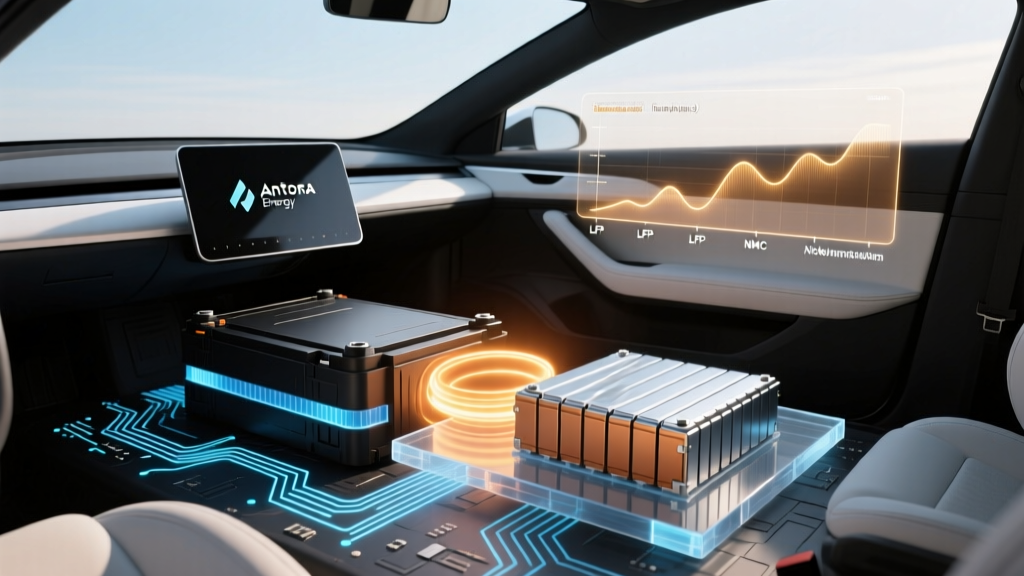
Not all lithium-ion batteries behave the same way at full charge. The cathode chemistry dictates the voltage curve, energy density, cycle life, and thermal stability. In 2026, three chemistries dominate the US market:
- NMC (Nickel Manganese Cobalt): Used in most long-range BEVs — Tesla Model Y Long Range, Ford Mustang Mach-E Extended Range, Hyundai Ioniq 5. Nominal cell voltage ~3.7V; fully charged ~4.2V.
- NCA (Nickel Cobalt Aluminum): Tesla's preferred chemistry for performance variants. Similar voltage profile to NMC with slightly higher energy density.
- LFP (Lithium Iron Phosphate): Found in Tesla Model 3 RWD, standard-range BYD models entering the US market, and some commercial vehicles. Nominal ~3.2V; fully charged ~3.65V per cell.
| Attribute | LFP | NMC | NCA |
|---|---|---|---|
| Nominal Cell Voltage | 3.2V | 3.7V | 3.6V |
| Fully Charged Cell Voltage | ~3.65V | ~4.2V | ~4.2V |
| Energy Density (Wh/kg) | 160–180 | 220–270 | 250–290 |
| Cycle Life (to 80% SoH) | 3,000–5,000+ | 1,000–2,000 | 800–1,500 |
| Cold Performance (below 32°F) | Moderate loss, slower charging | Better low-temp discharge | Better low-temp discharge |
| 100% SoC Storage Tolerance | Excellent — can sit at 100% | Poor — accelerates degradation | Poor — accelerates degradation |
| Cost per kWh (pack level) | ~$90–$110 | ~$120–$145 | ~$125–$150 |
| Thermal Stability | High — resists thermal runaway | Moderate | Moderate to low |
LFP vs NMC — Which Is Better and Why?
There is no universal winner. LFP is better for daily drivers who charge at home every night and don't need maximum range. Its flat voltage curve makes State of Charge estimation harder for the BMS, but its tolerance for 100% storage means you can charge fully without the degradation anxiety that NMC owners face. Tesla explicitly recommends charging LFP-equipped Model 3 RWD vehicles to 100% at least weekly for accurate SoC calibration.
NMC/NCA is better for road-trippers and cold-climate drivers who need 300+ miles of EPA range and faster DC charging speeds. The higher energy density packs more kWh into the same physical space. The trade-off: you should avoid routinely charging above 80% unless you're about to drive, and you should never let an NMC pack sit at 100% SoC for extended periods.
How Long Do EV and Hybrid Batteries Actually Last?
The fear that EV batteries need replacement every few years is not supported by fleet data. According to fueleconomy.gov, modern lithium-ion traction batteries are engineered for 150,000–200,000+ miles of service before reaching the 70% capacity threshold that triggers warranty coverage.
Real-world degradation data from multiple fleet studies and owner reports (2023–2025) shows a consistent pattern:
- Year 1 / 15,000 mi: ~2–4% capacity loss (initial formation loss)
- Year 3 / 45,000 mi: ~6–8% total loss
- Year 5 / 75,000 mi: ~8–12% total loss
- Year 8 / 120,000 mi: ~10–15% total loss
- Year 10 / 150,000 mi: ~12–18% total loss
LFP packs degrade more slowly — typically 5–8% loss over 100,000 miles. Early NiMH hybrid packs (like the first-gen Prius) showed 20–30% loss after 10–12 years, which is why modern lithium packs represent a major durability improvement.
The degradation curve is non-linear: most loss occurs in the first 12–18 months as the solid electrolyte interphase (SEI) layer forms on the anode. After that, degradation slows considerably. A 2026 Model Y Long Range with its 75 kWh usable NMC pack might show 305 EPA miles when new and roughly 270–280 miles at the 5-year mark — noticeable but far from catastrophic.
Factors That Accelerate Battery Degradation
- Limit DC fast charging: Occasional road-trip fast charging is fine, but daily 150+ kW sessions generate sustained heat that accelerates SEI growth. Use Level 2 (7–19 kW) for daily charging.
- Avoid extreme SoC storage: For NMC/NCA, store between 20–80% SoC. LFP can tolerate 100% storage but still benefits from occasional cycling.
- Precondition before fast charging: Cold batteries (below 50°F) charged at high rates suffer lithium plating. Use your vehicle's navigation-based preconditioning or manually warm the pack.
- Park in shade or a garage in summer: Sustained pack temperatures above 95°F accelerate calendar aging even when the car is off.
- Don't obsess over 100% charges: Set your daily charge limit to 80% (NMC/NCA) and only charge to 100% before long trips.
- Drive it regularly: Batteries that sit for months at low SoC can develop cell imbalances. A weekly drive cycle helps the BMS rebalance cells.
What Does the Battery Warranty Actually Cover?
Federal law mandates that EV and PHEV traction batteries carry a minimum warranty of 8 years / 100,000 miles. In California Air Resources Board (CARB) states, that extends to 10 years / 150,000 miles. Most manufacturers exceed the federal minimum:
| Manufacturer | Warranty Period | Capacity Threshold | Notes |
|---|---|---|---|
| Tesla (Model 3/Y NMC) | 8 yr / 120,000 mi | 70% retention | 100,000 mi for LFP variants |
| Hyundai / Kia | 10 yr / 100,000 mi | 70% retention | Among the longest in the industry |
| Ford (Mach-E, F-150 Lightning) | 8 yr / 100,000 mi | 70% retention | Covers battery and hybrid components |
| Toyota (PHEV/HEV) | 10 yr / 150,000 mi | Varies by model | CARB states; 8/100k federal |
| GM (Ultium platform) | 8 yr / 100,000 mi | 70% retention | Includes battery and propulsion |
| BMW | 8 yr / 80,000 mi | 70% retention | Lower mileage cap than competitors |
What triggers a warranty claim: If your battery's State of Health (SoH) — measured as current maximum capacity divided by original rated capacity — drops below the threshold (typically 70%), the manufacturer must repair or replace the battery at no cost. This is not cosmetic; it's a functional guarantee. For a 75 kWh pack, 70% SoH means 52.5 kWh usable — enough for roughly 200 miles in a mid-size crossover.
Warranties cover defects and abnormal degradation but not damage from accidents, flooding, or unauthorized modifications. Some manufacturers also exclude degradation from repeated 100% SoC storage in NMC packs, though this is rarely enforced in practice.
EV Battery Replacement Cost: What to Expect
Here's the reality most buyers miss: the vast majority of EV batteries outlast the vehicle itself. According to data from Recurrent Auto and other fleet-tracking services, fewer than 5% of EVs sold between 2015–2022 have required a full battery replacement outside of warranty. But if you do need one — typically on a 10+ year-old vehicle out of warranty — costs vary enormously by pack size:
| Vehicle / Pack Size | Chemistry | Battery Cost (parts) | Labor + Total |
|---|---|---|---|
| Prius Prime (13.6 kWh) | Lithium-ion | $3,000–$4,500 | $4,000–$6,000 |
| Chevrolet Bolt EV (65 kWh) | NMC | $8,000–$11,000 | $10,000–$14,000 |
| Tesla Model 3 SR (60 kWh LFP) | LFP | $7,000–$9,500 | $9,000–$12,000 |
| Tesla Model Y LR (75 kWh NMC) | NMC | $10,000–$14,000 | $13,000–$17,000 |
| Ford F-150 Lightning Ext. (131 kWh) | NMC | $18,000–$25,000 | $22,000–$30,000 |
| Hyundai Ioniq 5 (84 kWh) | NMC | $11,000–$15,000 | $14,000–$18,000 |
These prices are trending downward. Pack-level costs have fallen from ~$180/kWh in 2020 to roughly $100–$130/kWh in 2026, and third-party remanufactured battery options are emerging for popular models. Companies like certified repair networks and independent EV shops now offer refurbished packs at 30–50% below OEM pricing for out-of-warranty vehicles.
The critical context: a 2026 EV with an EPA range of 300 miles and 15% degradation after 8 years still delivers ~255 miles — more than adequate for 95% of American driving patterns per EPA data. Replacement is rarely the economic tipping point that gas-car transmission or engine overhauls represent.
How to Check and Monitor Battery State of Health (SoH)
Modern EVs and PHEVs provide several ways to assess battery health, from built-in diagnostics to third-party tools:
In-Vehicle Methods
- Tesla: Navigate to Service Mode (tap the software version 3 times) → Battery Health test. This runs a controlled discharge/charge cycle and reports SoH as a percentage.
- Hyundai/Kia: The infotainment system's EV menu shows estimated battery condition. The Bluelink/UVO app provides periodic SoH reports.
- GM Ultium vehicles: The myChevrolet/myCadillac app includes a battery health indicator tied to OnStar diagnostics.
- OBD-II scanners: Tools like the OBDLink MX+ paired with apps such as ABRP (A Better Route Planner) or LeafSpy (Nissan) can read real-time cell voltages, pack temperature, and calculated SoH from the BMS.
What Fully Charged Voltage Tells You
If you have access to cell-level voltage data via an OBD-II reader, comparing your current fully charged voltage to the factory specification reveals cell imbalance. In a healthy NMC pack, all cells in series should be within 20–30 millivolts (mV) of each other at full charge. If you see individual cells deviating by 100+ mV, the BMS is working harder to balance, and you may notice range reduction even though total pack voltage appears normal.
For PHEV owners checking hybrid battery fully charged voltage: a 2026 RAV4 Prime's 18.1 kWh pack uses 3.7V nominal NMC cells in a specific series-parallel configuration. The pack's full-charge voltage should match Toyota's published spec (available in service manuals). A drop of 5%+ from the original fully charged voltage figure, combined with reduced electric-only range, suggests it's time for a dealer diagnostic.
Emerging Battery Technology: What's Coming Next
While today's lithium-ion batteries are mature and reliable, several next-generation technologies are moving from lab to production. None are available in 2026 consumer vehicles, but timelines are becoming clearer:
- Solid-state batteries: Toyota, Samsung SDI, and QuantumScape are targeting 2027–2029 production starts. Solid-state cells replace the liquid electrolyte with a solid ceramic or polymer, enabling energy densities of 400+ Wh/kg (vs. ~270 for current NMC), faster charging (10–80% in under 10 minutes projected), and inherently better thermal safety. Timeline: limited production in luxury/commercial vehicles by 2028–2029; mainstream availability unlikely before 2030–2032.
- Silicon-dominant anodes: Companies like Sila Nanotechnologies and Group14 are replacing graphite anodes with silicon composites, boosting energy density by 20–40% without changing cathode chemistry. Timeline: appearing in select 2026–2027 model-year vehicles in limited capacity; broader rollout 2028+.
- Sodium-ion batteries: CATL and BYD are producing sodium-ion cells for low-cost, lower-range applications. Energy density is roughly 60% of LFP, but raw materials are abundant and cheap. Timeline: Chinese-market micro-EVs now; US-market entry uncertain, possibly 2028+ for fleet/commercial use.
Frequently Asked Questions
What is the fully charged voltage of a typical hybrid battery?
It depends on the chemistry and cell count. A conventional hybrid (HEV) like the 2026 Toyota Prius uses a ~185V nominal lithium-ion pack that reaches approximately 205–215V at full charge. A PHEV like the RAV4 Prime operates at higher voltages (~310–355V fully charged) because it has more cells in series to support its 42-mile electric-only range. Always consult your specific model's service documentation for exact figures.
How long do EV batteries last in years and miles?
Most modern lithium-ion EV batteries retain 80–88% of original capacity after 150,000 miles and 8–10 years of typical use. Fleet data shows that batteries rarely fail catastrophically; they gradually lose capacity. Many will outlast the vehicle's useful economic life. The 8-year/100,000-mile federal warranty minimum provides a safety net for abnormal degradation.
How much does it cost to replace an EV battery?
Out-of-warranty replacement costs range from roughly $4,000–$6,000 for a small PHEV pack to $22,000–$30,000 for a large BEV pack like the F-150 Lightning Extended Range. However, fewer than 5% of EVs have required battery replacement outside of warranty. Pack costs continue to decline, and remanufactured options are becoming available.
Does fast charging damage my battery?
Occasional DC fast charging (a few times per month on road trips) causes negligible additional degradation. The concern arises with daily fast charging, which subjects the pack to sustained high temperatures. For daily use, Level 2 home charging at 7–19 kW is gentler and more cost-effective. If you must fast-charge frequently, precondition the battery and avoid charging above 80% SoC to minimize heat exposure.
Should I charge my LFP battery to 100%?
Yes — Tesla and other manufacturers recommend charging LFP-equipped vehicles to 100% at least once per week. LFP's flat voltage curve makes SoC estimation difficult at partial charges, and the chemistry tolerates full-charge storage far better than NMC. Set your daily charge to 100% without the degradation concerns that NMC owners face.
How do I know if my battery qualifies for a warranty replacement?
If your battery's State of Health drops below the warranty threshold (typically 70% of original capacity) within the warranty period (8 years/100,000 miles minimum, 10/150k in CARB states), contact your dealer for a diagnostic test. The dealer will run a standardized capacity test — not just a voltage check — to confirm SoH. If it falls below the threshold, the manufacturer covers repair or replacement.
Is it safe to buy a used EV with high mileage?
Generally yes, provided you verify SoH before purchase. A 2020 Model 3 with 80,000 miles and 88% SoH still delivers roughly 280 miles of range. Request an OBD-II battery health report or have a dealer run a diagnostic. Check whether the original battery warranty is still in effect — it transfers to subsequent owners. High-mileage EVs with documented SoH above 80% represent strong value.